




























Introduction
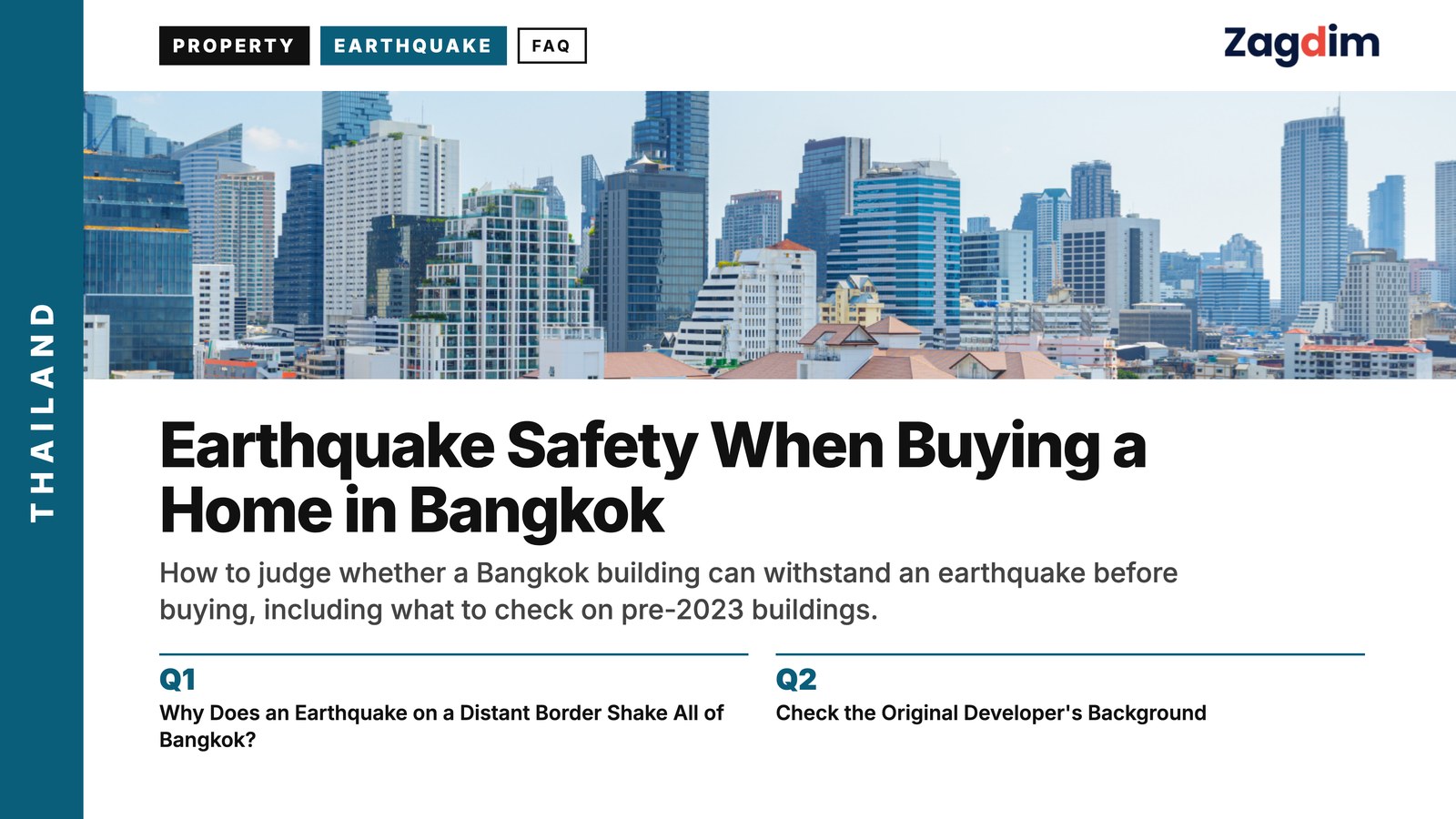
On 28 March 2025, a magnitude-7.7 earthquake centered near the Myanmar border struck hard at Bangkok: a new State Audit Office building under construction collapsed, causing serious casualties, and several high-rises showed cracks and collapsed skywalks. The earthquake was a wake-up call for a city that had been seen as being on the margins of earthquake risk. Most buyers used to weigh a Bangkok home on location, transport, price, and developer. Since 2025, there is one more question you need to add to that list: can this building withstand the next earthquake?
Earthquake Risk Isn’t Hypothetical — It’s Real
Most people picture Bangkok as a safe city, far from any fault line. In fact, Thailand and its neighboring region have experienced several earthquakes with real impact over the past two decades:
- 2011 Tarlay earthquake, Myanmar (M6.8): noticeable shaking in multiple high-rises in Chiang Rai and Bangkok.
- 2014 Chiang Rai earthquake (M6.3): damage to buildings across northern Thailand; in Bangkok, ceiling panels fell and elevators stopped working.
- 2023 northern Laos earthquake (M5.7): a relatively small magnitude, but Bangkok’s high-rises could still feel sustained shaking.
- 2025 Myanmar earthquake (M7.7): the new State Audit Office building collapsed during construction — the event that formally sounded the alarm on Bangkok’s earthquake safety.
Why Does an Earthquake on a Distant Border Shake All of Bangkok?
A common question: the epicenter was in Chiang Rai, Laos, or even Myanmar — so why does Bangkok shake too? The answer comes down to two factors:
1. The epicenter is not actually that far from Bangkok. The straight-line distance from Bangkok to the epicenters of the earthquakes that have affected the city has typically been 300 to 700 kilometers:
- 2011 Tarlay earthquake, Myanmar (M6.8) → roughly 460 km
- 2014 Chiang Rai earthquake (M6.3) → roughly 700 km
- 2023 northern Laos earthquake (M5.7) → roughly 550 km
- 2025 Myawaddy earthquake, Myanmar (M7.7) → only around 320 km
For a moderate-to-large earthquake, distances like these are close enough for seismic waves to reach Bangkok within tens of seconds, and long-period waves in particular can resonate with tall buildings, causing high floors to sway noticeably.
2. Bangkok’s ground amplifies seismic waves. Bangkok sits on a basin of thick, soft clay, a type of geology that amplifies and prolongs the shaking from an earthquake, and tall buildings are especially sensitive to this effect. Research from Chulalongkorn University found that while ground-surface acceleration may be only 0.03g, it can be amplified to more than 0.1g at the top of a tall building — up to three times the shaking amplitude.
In other words, it isn’t that the epicenter is unusually close — it’s that the ground itself is unusually good at transmitting the shaking. When choosing a home, it isn’t enough to look at how many floors a building has or whether its structure looks sound; it also matters what kind of soil it’s built on and what kind of hidden amplifier that soil represents.
According to the latest earthquake risk zoning map published by Thailand’s Ministry of Interior in 2021, the country is divided into three main earthquake risk zones:
| Zone | Earthquake Risk | Coverage | Design Base Acceleration |
|---|---|---|---|
| Zone 1 | Low risk | Parts of the northeast and southeast | Below 0.05g |
| Zone 2 | Moderate risk | Bangkok, Lopburi, Kanchanaburi, Chonburi, and 17 provinces in total | 0.10–0.25g |
| Zone 3 | High risk | Chiang Rai, Lampang, Chiang Mai, areas near the Myanmar border, and other northern areas | Above 0.30g |
Under this risk map, Bangkok is formally classified in Zone 2 — moderate risk. It is not an epicenter hotspot, but because of its distinctive geology, ground acceleration there can be amplified two to three times, which is why the newer building code actually sets a higher design standard for Bangkok. New high-rises (over 23 meters) in Bangkok must currently be designed to the มยผ.1301/1302-61 standard, with a design base acceleration cap of 0.25g — close to the standard used in the high-risk northern zone.
Worth knowing: Bangkok is not sitting directly on a fault line, but it is squarely in the path of an earthquake’s effects — seismic waves traveling hundreds of kilometers and then amplified by soft soil are a hidden risk that no tall-building design can afford to ignore.
Since 2023, the Thai government has made the newer generation of seismic design regulations (มยผ.1301/1302-61) mandatory, but most existing buildings in central Bangkok were built before that date, and it is up to the buyer to check whether a given building complies.
Meeting Code Is Not the Same as Actually Being Safe — Don’t Stop at a Certificate
Many developments advertise that they “comply with earthquake regulations,” but that is not the same as a guarantee the building will come through an earthquake unscathed. A seismic design is only a standard on paper — real safety also depends on construction quality, the materials actually used, and whether anything was cut short on site.
Especially after the 2025 earthquake, several “legally compliant” buildings still showed facade panels coming loose and skywalks collapsing — a reminder that being compliant on paper is not the same as being earthquake-resistant in practice; whether a standard on paper is actually followed on site is the real test.
Beyond the structural design itself, a few specific elements are worth your attention in a Bangkok high-rise:
- Foundation: does it use a piled raft foundation, and are the piles at least 18 meters long?
- Non-structural elements: have the facade, glass curtain wall, and any skybridges been verified against horizontal acceleration?
- Damping and monitoring systems: does the building have dampers or a Structural Health Monitoring (SHM) system installed?
Before buying, it’s worth asking one more question: “specifically which earthquake-resistant details did this building actually implement?” — a more useful question than a single stamped certificate.
Five Key Things to Check for an Earthquake-Resistant Home
In Bangkok, buyers used to care mainly about the view and the price. Now, asking “what magnitude of earthquake can this building actually withstand?” may matter more than the view. Here are five practical indicators to help you buy with more confidence:
1. Year of Design and Construction: Give Priority to Projects Designed and Started After 2023
Why this matters: since 2023, Thailand has fully implemented the newer seismic code (มยผ.1301/1302-61), which requires every new building design to meet a higher seismic standard — for example:
- accounting for the whole building’s sway and torsion during an earthquake;
- using higher-strength concrete and reinforcing steel;
- submitting a 3D digital model (BIM) to a government platform for review.
In other words, a project designed after 2023 has a much better chance of actually meeting seismic standards, from the paper design through to the finished building.
That doesn’t mean a pre-2023 building is automatically off the table — see “Buying an Older, Pre-2023 Building” below for how to evaluate one.
2. Structural Design: The More Symmetrical, the More Stable — Watch for L-Shapes and Cantilevered Balconies
During an earthquake, a building experiences horizontal shaking and torsion. If the building’s shape is not symmetrical — an L-shape, a U-shape, or a design with many cantilevered balconies — the force is distributed unevenly, making certain points especially vulnerable.
If you’re not a structural specialist, one simple rule of thumb: a square, symmetrical building with an elevator core or a structural core in the middle gives the most stable earthquake performance.
3. Foundation Type: A Piled Raft Foundation Is the Standard Solution for Bangkok’s Soft Soil
Much of Bangkok sits on an extremely thick layer of soft clay that behaves like jelly and amplifies seismic waves. This kind of ground can liquefy in an earthquake (the soil effectively turns soft), causing a building to tilt or sink.
Because of this, a properly earthquake-engineered building will use long piles — at least 18 meters — combined with a raft foundation, effectively anchoring the building on deep steel piles and then capping them with a stable platform.
Before buying, it’s worth asking: “is this a piled raft foundation?” — a simple question that signals you know what you’re looking for.
4. Non-Structural Elements: Sky Pools, Skybridges, and Glass Curtain Walls Are Weak Points in an Earthquake
Many upscale condominiums feature striking design elements such as:
- rooftop infinity pools;
- sky gardens and glass walkways;
- connecting bridges or decorative walls between towers.
These are not part of the main structure, but they are often the first things to fail and fall during an earthquake, and can pose a real risk of injury. Because of this:
- check whether these elements have been seismically reinforced (for example, with flexible connections);
- check whether a structural engineer has produced a horizontal-force verification report for them.
If the developer is willing to share this kind of documentation, that is a strong sign of credibility.
More reading: Thailand Natural Disaster Insurance (Earthquake, Flood, Fire): An In-Depth Comparison of Three Major Policies and Zagdim’s guide on whether an earthquake insurance policy is needed when buying property in Thailand.
For Those Who Want to Go Further: Five More Points to Check
5. Documentation: Ask the Developer for DARI Review Records and SHM System Information
DARI is a digital building-safety platform launched by the Thai government in 2024. Any project over 15 meters tall must upload the whole building’s 3D design model to the platform, where it is checked automatically by AI for beam and column reinforcement, material specifications, and more.
SHM (Structural Health Monitoring) is essentially a “health monitor” built into the structure, able to sense vibration, deformation, and even tilt. Having both systems in place is a safeguard not only at the design stage, but also lets the building be monitored continuously for safety after residents move in — much like a car having both airbags and lane-departure warning as standard equipment on a modern high-rise.
6. Whether Performance-Based Design (PBD) Has Been Used
Traditional design relies mainly on drawings and standard specifications, which is no longer precise enough for a tall building. In recent years, Thailand has started promoting Performance-Based Design for new high-rises, using computer simulation, vibration analysis, and non-linear dynamic calculation to actually predict how a building will respond in an earthquake.
If a project publishes simulation results, structural response diagrams, or a research summary, that is a strongly positive sign — it means the building isn’t just claiming to meet code, but has data showing it can actually withstand shaking.
7. Whether the Design Team Has Genuine Structural and Seismic Experience
Not every architect specializes in seismic design. A strong project will bring in a structural consultant or team with seismic experience — for example, research groups from AIT, Chulalongkorn University, or KMUTT — and will name that team in its brochure or on its website.
Worth checking specifically:
- is a “Structural Consultant” mentioned at all;
- are specific team leads named, with their credentials;
- have they worked on infrastructure, bridges, or other seismic high-rise projects before.
This tells you how strong the “engineering brainpower” behind the building really is.
8. Whether Materials and Construction Methods Are Disclosed (Rebar Grade, Concrete Strength, etc.)
Under the newer code, a high-rise must use:
- SD50-grade, high-ductility reinforcing steel;
- beam and column stirrup spacing reduced to 75mm;
- concrete strength of at least 30 MPa.
If a project proactively provides a materials specification sheet, concrete strength test reports, or a site construction SOP, that’s a sign this isn’t just a slogan but a genuine quality commitment.
A quick note: a project that is transparent about materials also tends to have better traceability throughout construction, which usually makes future repairs easier and safer too.
9. The Contractor’s Background and Track Record
Even a good design falls short if construction quality is poor. It’s worth checking who the main contractor is. Large infrastructure contractors such as Italian-Thai, Sino-Thai, or Powerline have more experience handling seismic structural work, bridges, and high-rises to a high standard. If the contractor working with the developer has no publicly documented experience or track record, that’s worth looking into further.
10. Whether Ongoing Maintenance and the SHM System Are Actually Being Used
SHM (Structural Health Monitoring) has become standard equipment in high-rises, but not every project actually keeps using it and sharing the data. Worth asking:
- is the building connected to the DARI platform;
- can the management committee view day-to-day vibration and displacement data;
- is there real-time notification if something unusual is detected.
If a project can tell you exactly how much your home shook today, that’s a sign it isn’t just compliant on paper — it’s actually putting your safety first.
Conclusion: From Looking at the View to Looking at the Structure
In the past, choosing a home mostly meant looking at location, view, and interior finish. Now, in a city that can no longer pretend to be far from earthquakes, we need to look deeper — at the foundation, the rebar, and whether the building can actually stand firm.
Learning to read a building’s earthquake resistance isn’t only about disaster preparedness — it’s also an attitude toward how you live: caring not just about the view outside the window, but about the stability under your feet, and buying a measure of security for the future.
Buying an Older, Pre-2023 Building: How to Choose
When people start paying attention to seismic design, the first reaction is often: “does that mean I can only consider buildings designed after 2023?” In fact, most existing buildings in central Bangkok were designed, built, or even completed before 2023. These buildings may not meet the full requirements of the newer code, but that doesn’t make them all unsafe. What matters is not the year, but the building’s design concept, construction quality, and any retrofitting carried out since. What you need isn’t to give up on older buildings — it’s to know how to evaluate and choose one. Here is a practical checklist for anyone looking at an existing mid-market or older building in central Bangkok.
1. Check the Original Developer’s Background: A Large or Well-Known Developer, or a Small One?
In an era before the newer code was mandatory, a developer who chose to invest in proper seismic design anyway is, in itself, a useful filter. Some projects by mid-to-large Thai developers such as Supalai, SC Asset, and SENA — even ones built before 2023 — used a shear-wall core design, SD50-grade rebar, or worked with well-known structural consultants (such as teams from Chulalongkorn University or AIT). That reflects a real awareness of, and investment in, structural safety.
By contrast, a smaller developer or a resale unit isn’t necessarily dangerous, but it’s worth spending more time checking documentation, comparing it against the drawings, or even asking directly whether a structural design report or engineering report from the time of construction still exists.
What matters is not the brand name, but whether the developer has a habit of retaining structural documentation — this directly determines whether you can actually verify the building’s safety.
2. Confirm the Number of Floors and the Structural Form
The more symmetrical and simple the structure, the more stable its earthquake performance tends to be. For an older building, the number of floors and the structural form are the first quick, intuitive filters:
- A building under 15 floors, especially one with a square, symmetrical layout, many walls, and closely spaced columns, generally distributes seismic force more effectively.
- Be especially cautious if you see any of the following features:
- a double-height lobby (for example, a ground floor higher than 4.5 meters);
- an L-shaped, T-shaped, or Z-shaped structure;
- large expanses of floor-to-ceiling glass combined with cantilevered balconies;
- an open ground floor used as retail space or parking (a “soft-story” structure).
These design choices may have traded off structural continuity for visual appeal or functional space at the time, which can lead to stress concentration and amplified inter-story shear during an earthquake.
If you are not a structural professional, you can look at the building’s exterior for obvious asymmetry, and then ask to see the floor plans or structural drawings.
3. Ask Whether There Is a Retrofit or Assessment Report
What makes an older building dangerous is not its age, but a structural risk that has never been checked. A building from before 2023 is not automatically lacking in seismic capacity — it simply wasn’t subject to a mandatory standard at the time, so its current safety needs to be established through retrofitting, testing, or a follow-up assessment. Worth asking or checking directly:
- Has the building’s management ever commissioned a structural engineer to carry out a seismic assessment? Such a report usually lists predicted damage at various earthquake intensities, structural weak points, and recommended reinforcement measures.
- Has any structural retrofitting or repair work been carried out? For example:
- carbon fiber wrapping, to strengthen the shear capacity and ductility of columns and beams;
- steel bracing or added shear walls;
- dampers or seismic isolation pads, to reduce the energy transmitted into the building.
- Has a Structural Health Monitoring (SHM) system been installed? This is not mandatory, but an increasing number of upmarket projects are installing one voluntarily to monitor the building’s movement and structural condition.
If the developer or the management office can provide this documentation, it not only shows they take preventive management seriously, but also gives you a clearer basis for confidence when choosing a unit.
4. Pay Attention to the Design of Shared Spaces
Earthquake resistance isn’t only about the main structure — a lot of the harm in an earthquake comes from non-structural elements, particularly in shared spaces. In many earthquakes, the real injuries come not from a building collapsing outright, but from falling objects, broken glass, and connecting elements breaking loose. When looking at an older building, pay particular attention to:
- Skybridges, rooftop pools, and other suspended features — these can be damaged or even break apart under horizontal shaking; confirm whether they use reinforced connections, steel bracing, or flexible expansion joints.
- Glass curtain walls and exterior decorative elements — if the glass isn’t properly secured, lacks seismic sealant, or wasn’t calculated for wind load, it can shatter and fall in a strong earthquake, posing a risk to pedestrians below.
- Refuge facilities and escape routes — the building should have clearly marked stairwell locations, emergency lighting, and fire doors, along with posted earthquake evacuation guidance (such as refuge floors and assembly points).
- Structural reinforcement at the junctions between floors — especially where the elevator shaft meets the floor slab; a poorly designed junction is prone to inter-story shear failure during an earthquake.
A genuinely safe older building should make you feel secure in the hallways and shared spaces too, rather than leaving you guessing at what risk might be hiding behind each finish.
5. Avoid These Three Types of High-Risk Buildings
Not every building is equal. Even one that looks modern and sits in a good location should be treated with particular caution — or avoided — if it has any of the following structural features:
| Risk Type | Typical Features | Potential Problem |
|---|---|---|
| Soft-story building | Usually a double-height ground floor with sparse columns, common in older office buildings, shopping centers, or parking structures | Most prone to amplified inter-story displacement and collapse in an earthquake |
| Irregular structure | L-shape, T-shape, staggered balconies, or extensive unreinforced cantilevers | Uneven stress distribution, unable to dissipate energy effectively in an earthquake |
| Old, with no retrofit history | Designed before 1997 (before Thailand’s first seismic design standard) and never retrofitted or repaired | Structural standard is far behind current code and cannot withstand a moderate-to-large earthquake |
Buildings like these are typically among the first to show serious damage in an earthquake. You don’t need to rule them out on sight, but you should only consider one with a professional assessment and a clear retrofit record in hand.
Takeaway: Knowing How to Choose an Older Building Is a Skill of Its Own
Pre-2023 buildings are, admittedly, somewhat behind on seismic code, but that doesn’t make them all unsafe. What really matters is whether you understand the building’s structure, construction method, and history.
As long as you avoid the high-risk types and choose a structurally stable building with a responsible developer and a documented retrofit history, it’s entirely possible to have both living quality and earthquake safety on a reasonable budget.
Choosing a home this way is a test of both judgment and risk literacy. While others are still looking only at location and interior finish, you’ll already be asking the question that matters more: can this building hold steady through the next tremor?
Disclaimer
This article draws on regulations, research, and news reporting published between 2021 and 2025, cross-checked against original Thai-language sources. Historical earthquake records go back as far as 2000; all information has been cross-verified, but any specific building still needs to be assessed on site and judged on the developer’s transparency. This content is for general information only and is not investment or home-buying advice; readers are advised to commission a professional structural engineer for an on-site review of any specific project.
Have a question about this guide? Leave a comment below, or ask Zagdim directly.
Your first stop for international property and global living.
Research and insights. Know what’s changing. Understand what matters.
Sources
- Thailand’s Ministry of Public Works and Town & Country Planning — Notification on Seismic Design and Structural Calculation Technique มยผ.1301/1302-61
- Thai Meteorological Department, Earthquake Monitoring Center — National earthquake data and risk zoning (2022–2025)
- Chulalongkorn University, Faculty of Engineering — Research report on seismic wave amplification in the Bangkok basin
- Asian Institute of Technology (AIT) — Case studies on SHM structural health monitoring and performance-based design
- Thailand’s Ministry of Interior, DARI system — BIM digital review and structural simulation requirements guide (2024 edition)
- Thailand’s Department of Disaster Prevention and Mitigation — Historical earthquake event investigation and emergency response records (2000–2024)
- Thailand’s Department of Public Works and Town & Country Planning — Building Seismic Design and Structural Standard Amendment (มยผ.1301/1302-61)
- Chulalongkorn University, Faculty of Engineering — Study on increasing seismic shaking on Bangkok’s soft soil basin
- Council of Engineers Thailand — Guidelines on inspecting and retrofitting older buildings
- DARI BIM Central Platform — Building information modeling and structural health monitoring standards
- Thai PBS — Reporting on earthquake preparedness in Bangkok’s at-risk areas