1. Introduction
Malaysia, as a popular relocation destination in Southeast Asia, has attracted a large number of foreign spouses and their family members to settle there. As international marriage and family migration have grown more common, an increasing number of foreign nationals are choosing Malaysia as their new home. Against this backdrop, the Malaysian spouse visa has become one of the preferred routes for many foreign families — particularly for foreign spouses married to a Malaysian citizen, for whom it is an ideal path to relocation.
In recent years, the Malaysian government has gradually relaxed its immigration policy toward foreign spouses, and this has led many people in international marriages to choose to settle there. However, during the application process, many families still have plenty of questions about the different visa conditions, work permits and children’s school enrollment. These questions affect not only the spouse-visa application process itself, but also the family’s long-term settlement planning. Understanding the detailed requirements and process for applying for a Malaysian spouse and family visa has therefore become a top priority for many foreign families considering this route to relocation.
2. Who Is Suited to Applying for a Malaysian Spouse and Family Visa
Malaysia’s spouse and family visa is aimed primarily at foreign nationals who wish to live long-term in Malaysia with their spouse and family members. The following groups specifically apply:
Foreign Spouse
A foreign spouse married to a Malaysian citizen or permanent resident is eligible to apply for a Malaysian spouse visa. This visa is designed to help couples reunite and allows the foreign spouse to legally reside in Malaysia. It provides not only the right to long-term residence, but also a path to further apply for a work permit and other related benefits.
Children
Minor children who are dependents under the spouse visa can also apply for a family visa together. This means the foreign spouse’s children can come to live in Malaysia together with their parents and access services such as education. For families with children in particular, this type of visa offers the convenience of family reunification and simplifies the school-enrollment process for children.
Special Circumstances
For family members with special needs — for example, a child with special educational needs, or a parent requiring medical care — Malaysia’s immigration policy also allows additional applications to be made depending on the specific circumstances. This kind of situation may require more supporting documents and materials to ensure the family member can receive appropriate assistance in Malaysia.
Regional and Purpose Distinctions
This visa is aimed primarily at foreign families who wish to settle in Malaysia long-term, particularly international-marriage families from Southeast Asia, the Middle East or Europe. Families from these regions often choose Malaysia as their place to settle for reasons of work, education or living conditions. As a result, Malaysia’s spouse and family visa holds strong appeal for these families, offering a stable, convenient residence option.
Overall, Malaysia’s spouse and family visa offers flexible options for foreign nationals of different backgrounds — whether a married spouse, a child, or a family member with special needs, each can apply for the appropriate visa based on their specific circumstances.
3. Step-by-Step Process
Applying for a Malaysian spouse and family visa needs to follow a set sequence of steps, and preparation at each step has a significant bearing on the final outcome. Below is the specific process for a successful application:
Step 1: Confirm Spouse Visa Eligibility
Before starting the application, first confirm whether you meet the basic eligibility to apply for a Malaysian spouse visa. The applicant must be married to a Malaysian citizen or permanent resident, and the marriage must have existed for at least six months. At this stage, you should prepare the following basic materials:
- Marriage certificate: ensure you provide a valid marriage certificate with a translation attached (if the marriage took place overseas).
- Proof of the spouse’s nationality: a copy of the spouse’s identity card or passport is required.
Step 2: Submit Application Materials
Once you have confirmed eligibility, the next step is to prepare and submit all application materials, which typically include:
- Basic information for the spouse and family members
- A health certificate: proof of no major illness is required
- A police clearance certificate: issued by the local police authority, certifying no criminal record
All documents need to be translated into English or Malay and must be certified or notarized. This is very important — otherwise the application may be returned for not meeting the language requirements.
Step 3: Spouse Visa Review and Waiting Period
Once all application materials have been submitted, the Malaysian Immigration Department will carry out its review. The review process typically takes several weeks, and in some cases, the Immigration Department may request additional materials or an interview.
- The waiting period: during this time, the applicant needs to wait patiently and stay in contact with the Immigration Department.
Additional supporting materials or an interview may sometimes be requested — keep your contact details reachable and check your application status regularly so you can respond quickly to any request from the Immigration Department.
Step 4: Approval and Residence
Once the application is approved, the spouse and family members will receive an initial residence permit. Depending on the application and materials provided, the spouse visa’s initial validity is typically 1 to 2 years, at which point the foreign spouse may legally reside in Malaysia.
- Residence period: the length of the initial approved residence period depends on individual circumstances.
After approval, the residence period is typically 1 to 2 years, during which the marriage to the Malaysian spouse must be maintained as stable, or the renewal may be affected.
Step 5: Children’s Education and Work Permits
Once the spouse visa is approved, the foreign spouse can arrange school enrollment for minor children, and can look into work-permit requirements under Malaysian Immigration Department rules. If the foreign spouse wishes to work, an additional work permit may need to be applied for.
- Children’s education: minor children may enroll in school according to the visa’s terms, but it is important to understand the educational resources and policies in different areas, as some regions apply special requirements to foreign students.
Some regions have their own special education resources and policies — it is advisable to find out about these in advance, to ensure children’s school enrollment does not run into later difficulties.
These are the core steps for applying for a Malaysian spouse and family visa. Each step requires careful preparation and adherence to the relevant requirements to complete the application successfully and achieve long-term residence.
4. Required Documents
When applying for a Malaysian spouse and family visa, the documents you prepare will directly affect the progress and success of your application. To avoid delays or rejection, you must ensure every document is complete and meets the requirements. Below are the main documents you will need to prepare during the application process:
Basic Documents
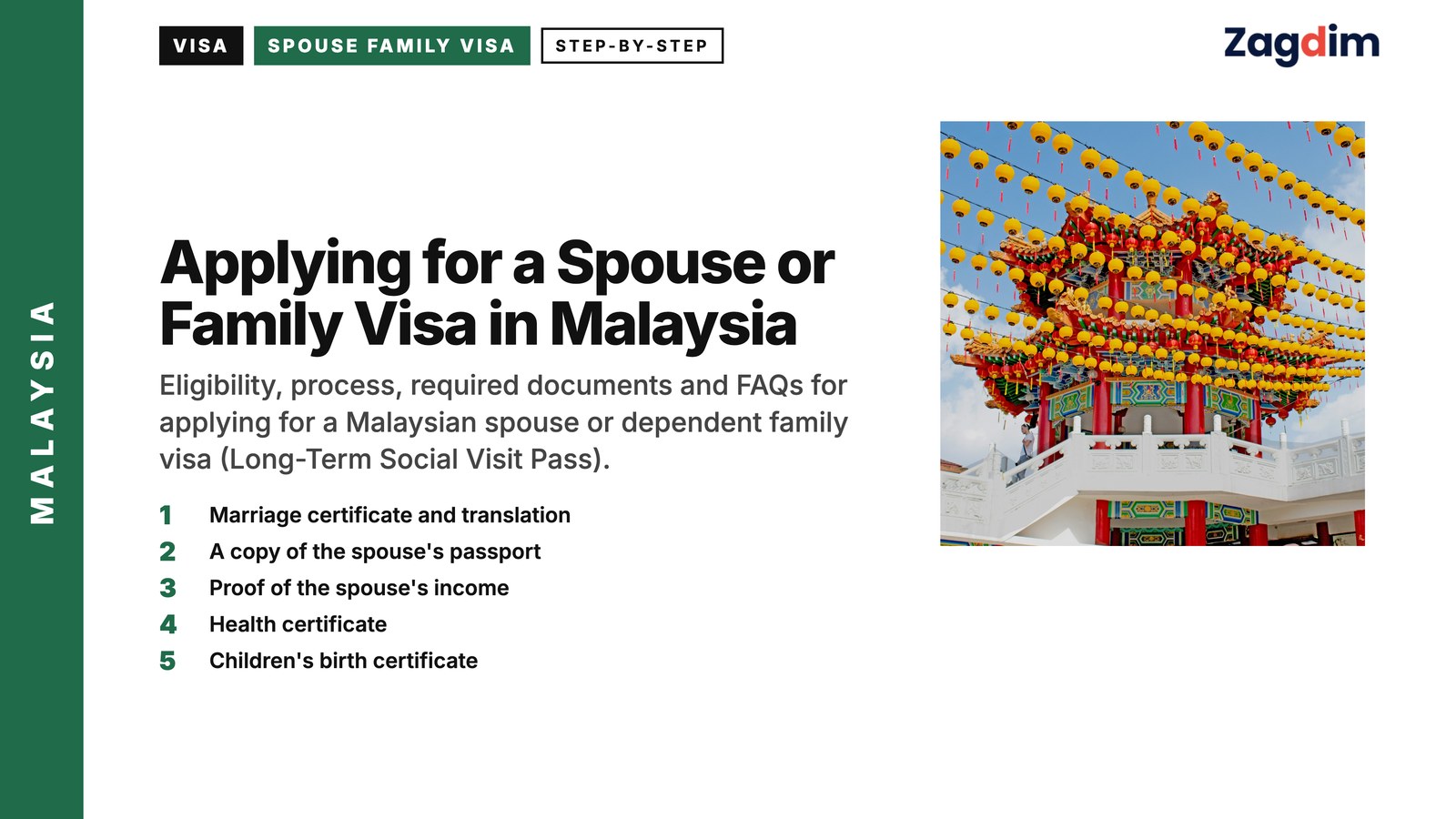
- Marriage certificate and translation
- Provide a marriage certificate recognized by the Malaysian government, together with a certified English or Malay translation. If the marriage certificate is in a language other than English or Malay, it needs to be translated and certified as a “true copy.”
- A copy of the spouse’s passport
- You need to provide a copy of the Malaysian spouse’s passport, including all pages bearing a stamp or handwritten entry. This helps prove the spouse’s identity and nationality.
- Proof of the spouse’s income
- Proof of the spouse’s income is required, including a payslip, bank deposit statement or other financial documents, to prove stable income. This helps demonstrate that the applicant will receive sufficient financial support.
- The applicant’s police clearance certificate
- Provide a police clearance certificate from the applicant’s home country, an important document confirming the applicant’s past legal record is clean and meeting entry requirements.
- Health certificate
- Provide a health certificate showing that the applicant and their family members have no major illness, a necessary step to ensure there is no impact on public health.
- Children’s birth certificate (if applicable)
- If the applicant has minor children, their birth certificate is required, together with a translated and certified version. This helps confirm that the children can be included in the application as dependents on the spouse visa.
Document Requirements
All documents need to be translated into English or Malay and certified. To ensure documents are accepted by the Malaysian Immigration Department, any documents not in English or Malay (such as the marriage certificate or birth certificate) must be translated and certified by the relevant authority. Additional supporting documents may be required depending on individual circumstances. Depending on the applicant’s specific situation, the Immigration Department may request other supporting documents — for example, if the applicant has special requirements (such as a health condition or educational needs), additional supporting documents may be needed.
Making sure your documents are properly prepared is critical to a successful application. Ask Zagdim if you need help understanding which documents are required or how to prepare them correctly.
5. FAQ
Q: How long does it take to apply for a Malaysian spouse visa?
A: It generally takes 1 to 2 months, depending on the specifics of the application. Submitting complete and correct materials can help speed up the review process and avoid unnecessary delays.
Q: Can I work on a spouse visa?
A: A spouse visa itself generally does not include a work permit. If the spouse wishes to work in Malaysia, they need to apply for a work visa or another type of work permit. Some spouse-visa holders may be able to work after obtaining additional permission.
Q: How is the children’s education arranged?
A: The foreign spouse and family members can apply for school enrollment for minor children, choosing a school according to Malaysia’s education policy. Some international schools accept foreign students, and there are also private schools offering education options. Choose a suitable school based on the child’s age and educational needs.
Q: Does a spouse visa restrict where I can live?
A: A spouse visa generally does not restrict where you can live, though some areas may apply different rules depending on local government regulations. It is advisable to understand the local residence policy before applying, especially any rules specific to particular areas or cities.
Q: How do I extend the validity of a spouse visa?
A: A spouse visa’s validity is typically 1 to 2 years, after which an extension can be applied for. The extension application requires updated documents and proof, and must be submitted at least 1 month before the visa expires. Maintaining a stable marriage relationship is an important condition for extending the visa.
Once your spouse visa is close to expiring, the renewal process needs to be handled in good time. Ask Zagdim if you have questions about preparing your renewal materials.
6. Summary
Applying for a Malaysian spouse and family visa is not difficult, but making sure all relevant documents are prepared and understanding local education and work policy are key. If you are planning to relocate to Malaysia with your family, be sure to plan in detail and confirm that all required documents are complete and meet the requirements, so your application goes as smoothly as possible.
Have a question about this guide? Leave a comment below, or ask Zagdim directly.
Your first stop for international property and global living.
Research and insights. Know what’s changing. Understand what matters.
Sources
- Great Pyramid – Spouse Visa Malaysia or Malaysia Long Term Social Visit Pass (LTSVP)
- EasyUni – International Students Bring Family Members to Malaysia
- Mishu – Malaysian Spouse Visa Guide
- Girl Dream Weekends – Malaysia LTSVP
- Zhivisa World – Malaysia Family Visa
- GenX Immigration – Dependent Visa Malaysia
- 52hrtt – Dependent Visa Malaysia
- Suhakam – RTD on Education for Refugee and Stateless Children
- TrueWords – Applying for a Malaysian Spouse Visa
This article’s sources were updated in 2023–2024, based on the latest immigration policy and visa requirements at the time. All material comes from official or authoritative bodies and has been cross-checked.