






























When you start planning a new life in the UAE, the first question that usually comes to mind is: should I live in Dubai, or Abu Dhabi? Both cities are star performers in the Middle East — modern infrastructure, an international community, a zero-income-tax system, and among the highest safety rankings in the world. But their pace, character and cost of living tell very different stories.
Dubai shines with the glow of an international metropolis — fast-paced, full of choice, like a show that never turns off the lights. Abu Dhabi, by contrast, feels more like a mature, understated capital, one that values family life, stability and quality of life.
This guide compares the two cities across five key dimensions, to help you work out your own priorities and find the city whose rhythm fits you best.
City Character and Pace of Life: Which Rhythm Fits You?
If life were a song, Dubai and Abu Dhabi would be two very different rhythms — one upbeat and full of peaks, the other understated and steady. Which one feels closer to how you live now?
Dubai is something like an Asian version of New York, with a population of more than 3.6 million and constant energy and activity. It’s a paradise for founders, digital nomads and young professionals. Amid the forest of skyscrapers you’ll find gyms that run 24 hours a day, vibrant nightlife, and a mix of cultures from more than 200 countries. If you love speed and an international network, Dubai will make every day feel like you’re riding a wave.
Abu Dhabi is more like a glass of aged red wine — one to be savored slowly. As the UAE’s political and cultural capital, it puts more emphasis on stability and a sense of security. Life here moves noticeably slower, suiting people who prioritize family, education and long-term planning. According to a 2023 InterNations survey, 94% of expats said they feel “extremely safe” in Abu Dhabi, and the city itself has been ranked the world’s safest city for nine years running.
Whether you’re a lone founder sprinting toward a career goal, or a parent wanting a stable environment to raise your kids, a city’s character quietly shapes your mood and your choices. So which rhythm pulls you in?
Cost Differences: Living Expenses and Housing — How Far Will Your Budget Go?
Whether you’re a freelancer, a company-posted executive, or someone relocating with a family, “living well for what you spend” is always an important factor in choosing a city. So with the same budget, what kind of lifestyle can you actually get in Dubai versus Abu Dhabi?
The difference in cost of living between Dubai and Abu Dhabi isn’t just about rent — it extends to utilities, transport and communications too. Here’s a comparison of the key line items:
| Item | Dubai | Abu Dhabi | Difference |
|---|---|---|---|
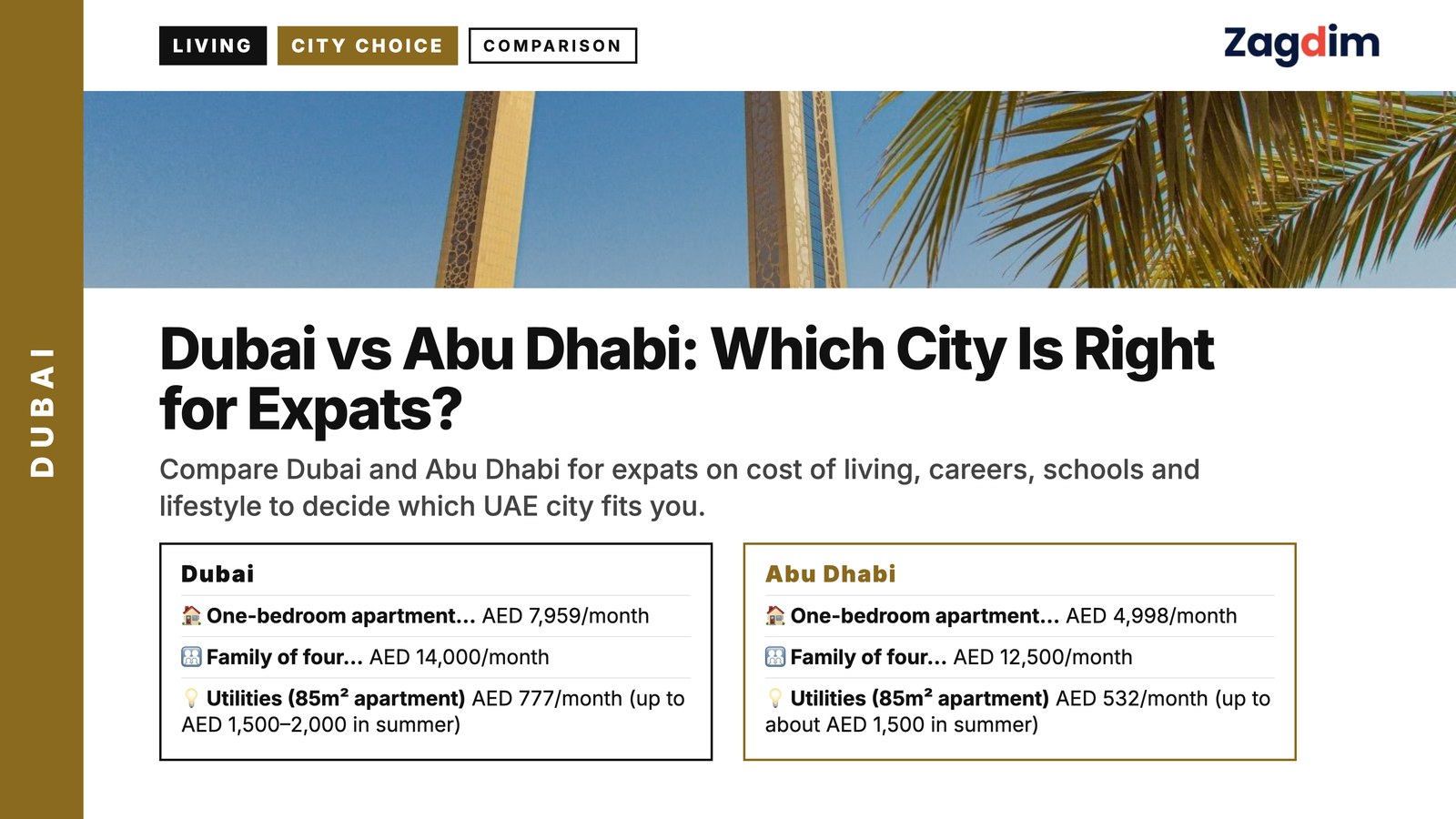
| 🏠 One-bedroom apartment, city center | AED 7,959/month | AED 4,998/month | Dubai is about 42% higher, especially downtown |
| 👨👩👧👦 Family of four, monthly living costs | AED 14,000/month | AED 12,500/month | Abu Dhabi is more budget-controllable |
| 💡 Utilities (85m² apartment) | AED 777/month (up to AED 1,500–2,000 in summer) | AED 532/month (up to about AED 1,500 in summer) | Higher overall in Dubai due to air conditioning and separate chiller billing |
| ❄️ Chiller (AC) fees | AED 200–500/month (charged separately in some communities) | No extra charge | Common in Dubai areas such as Marina and Business Bay |
| 🚍 Public transport monthly pass | AED 300/month | AED 92.5/month | Commuting is cheaper in Abu Dhabi |
| 🌐 500Mbps internet | AED 349–449/month (Etisalat/Du) | AED 329/month (Du) | Abu Dhabi pricing is slightly lower and more competitive |
First, on housing costs: according to 2024 data, Dubai rents are generally 30.6% higher than Abu Dhabi’s, and in central areas such as Downtown Dubai or Marina, a one-bedroom apartment can run AED 7,959 a month, versus about AED 4,998 in the equivalent Abu Dhabi area. If you prefer more space, a family of four in Dubai needs to budget around AED 14,000 a month for living costs, versus around AED 12,500 in Abu Dhabi.
Beyond rent, utilities and internet shouldn’t be overlooked. Dubai’s hot summers push air-conditioning costs up, with average monthly utility bills reaching AED 777, plus many communities separately bill a “chiller fee” (such as Empower Chiller) of an additional AED 200–500 a month. Abu Dhabi, by contrast, has no mandatory separate chiller billing, and most homes benefit from government subsidies, with average monthly bills of only AED 532 — a noticeable saving.
On transport and communications, Abu Dhabi is also the “understated and practical” city. A single bus fare is only AED 2.50 (versus AED 6.00 in Dubai), and a monthly pass is nearly a third cheaper. Both cities offer broadband through Etisalat and Du, but Du’s Abu Dhabi pricing is more competitive — a 500Mbps fiber plan costs just AED 329 a month, versus AED 349–449 for the same tier in Dubai.
Quick takeaway: if you want more predictable monthly spending and less family financial pressure, Abu Dhabi is the easier choice; but if you have a higher income and prioritize convenience and city energy, Dubai’s higher prices may match the lifestyle you’re looking for.
- If you prioritize budget control and balanced household spending, Abu Dhabi‘s cost of living is more accessible.
- If you have higher expectations around city amenities, entertainment options and an upscale lifestyle, consider Dubai — but budget extra room for rent and utilities.
Career and Startup Opportunities: From Desk Job to Founder Dream, Which City Should You Choose?
Whether you want to climb the corporate ladder quickly or build your own brand, both Dubai and Abu Dhabi offer distinct stages to do it on. The key differences lie in industry structure, startup support systems and workplace culture:
| Item | Dubai | Abu Dhabi | Notes |
|---|---|---|---|
| 🌐 Main industries | Media, technology, real estate, tourism, finance, startups | Energy, education, healthcare, government, family businesses | Dubai concentrates tech and creative industries; Abu Dhabi leans toward industrial and steady sectors |
| 📈 Average salary level | Higher, but cost of living is also higher | Somewhat lower but more cost-efficient | Disposable income share is more favorable in Abu Dhabi |
| 🏢 Startup ecosystem | Mature free zone system, attracts foreign founders | Growing steadily, more focused on local and family-business partnerships | Dubai suits international-style startups; Abu Dhabi favors long-term, deep-rooted growth |
| 🧑💼 Work culture | Fast-paced, flat structure, innovation-driven | Formal and stable, values relationships and long-term cooperation | Suits different personalities and career stages |
| 🛠️ Policy support and grants | Active youth entrepreneurship policy, generous tax incentives | Stronger local workforce integration (e.g. Nafis), steady startup grant programs | Abu Dhabi’s government pushes harder on industry localization and workforce nationalization |
| 📊 GDP growth (2022–2023) | About 4.2%, driven mainly by tourism and technology | About 5.5%, driven by energy and industrial transformation | Both are dynamic, but in different directions |
Recommendation:
- If you’re a young professional, freelancer or an international founder, Dubai offers more international resources and flexibility.
- If you’re a professional manager, someone with a healthcare or education background, or looking for stable growth and a family-friendly workplace, Abu Dhabi is worth considering as your starting point.
International Education and Family-Friendliness: Where Is Your Child’s Future Better Secured?
For many families planning to settle long-term, education resources and everyday convenience are key factors in choosing a city. Whether you value a British curriculum, the IB Diploma, or controlling childcare costs, both Dubai and Abu Dhabi have their strengths — the differences lie in tuition ranges, school-rating stability, and whether the pace of life fits your family’s needs.
| Item | Dubai | Abu Dhabi | Notes |
|---|---|---|---|
| 🏫 Number of international schools | About 220+ | About 200 | Dubai has more schools, wider choice |
| 🧮 Tuition range (annual) | AED 12,723 – 120,000+ | AED 2,200 – 96,000 | Abu Dhabi offers more budget-friendly options |
| 🌟 Schools rated “Outstanding” | 23 schools | 11 schools | Dubai performs more consistently in KHDA ratings |
| 🎓 Main curricula | British (IGCSE/A-level), IB, American | British, IB, American + Arabic bilingual integration | Both emphasize British-style systems; Abu Dhabi is increasingly building out bilingual and STEAM programs |
| 🧒 Early-years education and childcare | Varied and convenient, but pricier | Slightly better value, more community-integrated facilities | Abu Dhabi offers more extended care options for younger children |
| 🚌 School bus / living support | Mainly AED 5,000 – 7,500/year | AED 2,000 – 6,000, varies | Abu Dhabi is more cost-effective outside high-density areas |
A quick note:
- If you want your child to grow up in an international environment with a view toward applying to top Western universities later, Dubai’s combined IB and British-curriculum options give it an edge.
- If you want your child to grow up in a bilingual culture with longer-term stable education resources, Abu Dhabi offers more options for staying and planning long-term.
- According to surveys, parents in Abu Dhabi report notably higher satisfaction than Dubai parents with “consistent education quality” and “high teacher retention.”
Lifestyle and City Character: Which Rhythm Suits You?
Some choices aren’t just about cost, education or visas — they’re about the kind of life you want to live. In this “no income tax, endless choice” country, Dubai and Abu Dhabi offer two very different city rhythms and personal styles. One is a modern star on the international stage; the other, a calm, cultured elder statesman.
| Aspect | Dubai | Abu Dhabi |
|---|---|---|
| 🏙️ City atmosphere | International, fast-paced, diverse entertainment | Composed, culturally rich, slower pace |
| 🧑💼 Best suited to | Founders, freelancers, young professionals | Families settling down, long-term postings, those valuing a stable work environment |
| 🍽️ Lifestyle and entertainment | World-class restaurants, nightlife, frequent pop-up events | Strong sense of community, suited to outdoor family activities and art exhibitions |
| 🧘♂️ Work-life balance | Leans toward “hustle plus indulgence,” fast pace | More focused on work-life balance, relatively steady working hours |
| 🌇 After-work scenery | The Dubai Marina skyline, JBR’s seaside nights | Saadiyat Island sunsets, the quiet of Al Bateen |
| 🌍 Share of foreign residents | About 89%, diverse communities coexisting, English-dominant | About 85%, but with more local cultural presence, suited to those interested in local culture |
In short:
- If you’re drawn to speed, excitement and opportunity, Dubai will win you over.
- If you lean toward cultural depth, a sense of stability and a balanced pace of life, Abu Dhabi will feel like the safer choice.
Choose the City That Matches the Life You Want
Relocating to the UAE is never just a matter of moving house — it’s a redefinition of your lifestyle.
- Want to push your career, network internationally and experience a cutting-edge city rhythm? Dubai will give you one adventure after another.
- Hoping for a stable, family-friendly base that blends culture with modernity? Abu Dhabi is like a strong, mellow Middle Eastern tea — one you’ll grow to love slowly, and find harder to leave the longer you stay.
Whichever city you choose, the UAE’s fundamentals are strong either way:
- No income tax
- Top-tier healthcare and education resources
- An international professional stage
- A diverse and inclusive culture
The real difference comes down to this: what kind of life do you want to live? Let your choice of city become an extension of your own life’s main stage.
Have a question about this guide? Leave a comment below, or ask Zagdim directly.
Your first stop for international property and global living.
Research and insights. Know what’s changing. Understand what matters.
Sources
- *Numbeo* – 2024 Cost of Living Comparison between Dubai and Abu Dhabi
- *InterNations* – Expat Insider 2023 & 2024: Abu Dhabi and Dubai City Rankings
- *KHDA (Knowledge and Human Development Authority)* – Dubai Private Schools Inspection Report 2023–2024
- *ADEK (Abu Dhabi Department of Education and Knowledge)* – Irtiqaa School Inspection Reports 2024–2025
- *Property Finder* – Dubai vs Abu Dhabi Property Market Analysis 2024
- *Cigna Global* – Health Insurance Plans for Expats in UAE 2024–2025
- *Mercer* – 2023 Cost of Living Survey: Global Cities Ranking
- *The National* – Abu Dhabi and Dubai Residential Rental Index & Inflation Trends Report 2024
- *Bayut* – UAE Residential Market Insights 2023–2024
- *Etisalat / Du* – Home Internet & Mobile Plans Pricing Guides 2024–2025