






























**New standard effective October 16, 2025 (important update)**
>
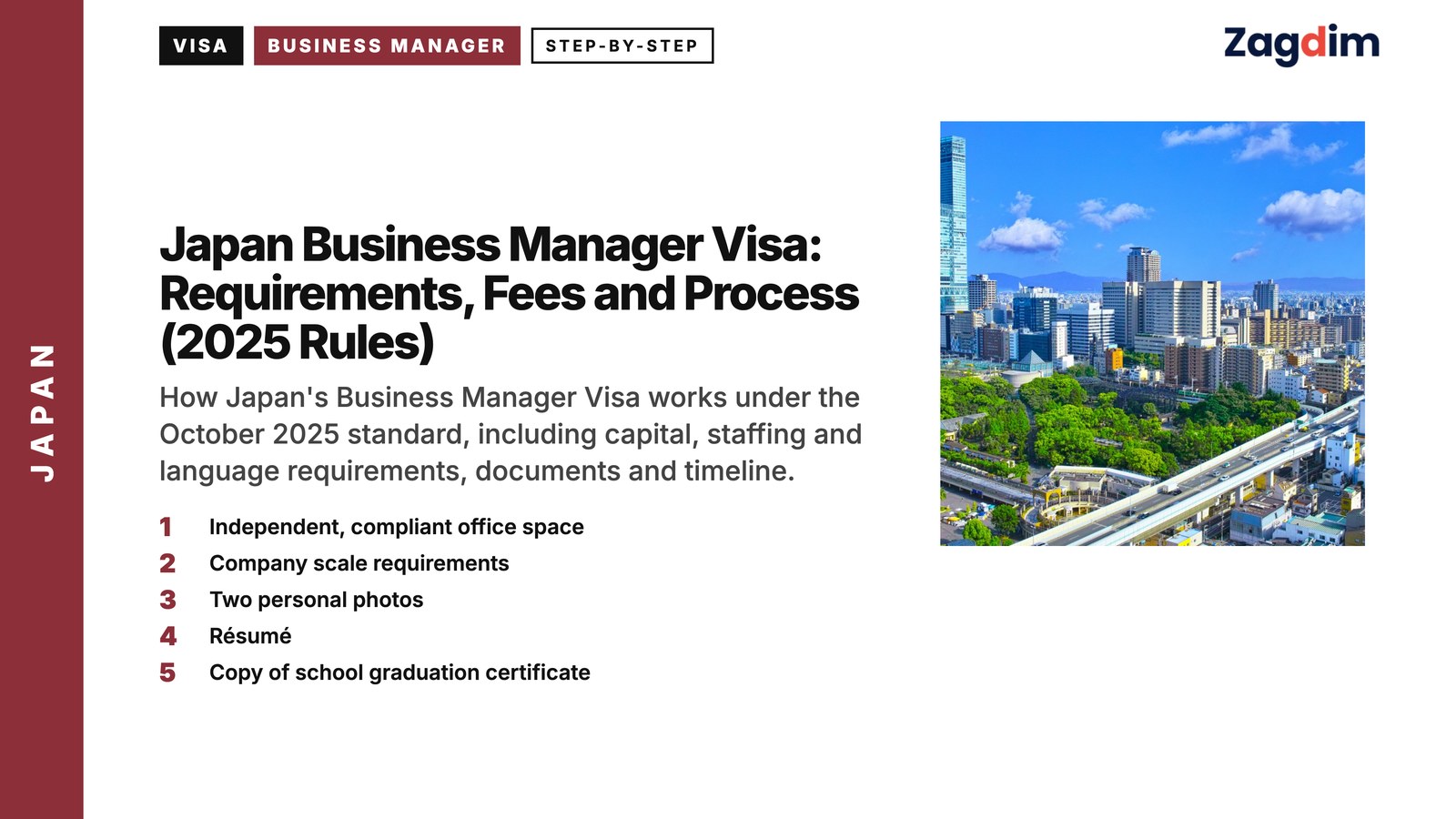
Japan’s Business Manager Visa has applied a new set of review criteria since October 16, 2025: capital or capital contribution of at least JPY 30 million, employment of at least 1 full-time staff member, and either the applicant or the company’s full-time employee holding Japanese language ability at a level comparable to CEFR B2 (the applicant may separately qualify via a related degree or 3 or more years of management experience), plus confirmation from a designated expert; a combined home-and-office premises is no longer accepted. The content further below describing “capital of JPY 5 million” reflects the previous standard and is kept here for historical reference only. Existing visa holders have a transitional arrangement running until October 16, 2028. Actual application requirements should be confirmed against the current announcements of Japan’s Immigration Services Agency.
Many people considering a move to Japan first come across the “Business Manager Visa” category, largely because of its relatively low bar to entry. This article explains the requirements and process for the Business Manager Visa in detail, to help more foreign nationals interested in starting a business in Japan.
1. What Is Japan’s Business Manager Visa?
The “Business Manager Visa” (経営管理ビザ) covers a foreign national who starts and incorporates a company in Japan, invests in and manages a Japan-based business, manages or operates a Japan-based business on behalf of a foreign corporation, or manages or operates a business in Japan on behalf of another foreign resident’s investment. Meeting any one of these conditions means you need a Business Manager Visa.
The 2015 Highly Skilled Professional visa framework also created a business-management sub-category, the Highly Skilled Professional (i)(c) visa. Its requirements for Japanese ability, educational background and management experience are higher, but if you meet them, applying directly for this Highly Skilled Professional business-management visa is worth considering, since it also makes a later permanent residency application easier.
2. What Conditions and Qualifications Does the Business Manager Visa Require?
It’s worth being clear from the start that successfully incorporating a company does not mean a Business Manager Visa application will necessarily be approved. The minimum bar for each is different, so anyone planning to apply for the visa needs to understand the visa’s own minimum requirements. Japan’s Immigration Services Agency, in its 2015 revision of the “Clarification of Residence Status Criteria for Foreign Business Owners,” set out five key points:
- The legality and continuity of the Japan-based company’s business activities
- Sufficient annual income to sustain living in Japan
- Independent, compliant office space
- Company scale requirements
- Fulfillment of the manager’s legal obligations
Reference document: “Clarification of Residence Status Criteria for Foreign Business Owners” (外国人経営者の在留資格基準の明確化について), published by Japan’s Immigration Services Agency. A list of business-type licenses and permits by industry is also available from the Mie Chamber of Commerce and Industry: Business license and permit checklist (Japan).
The Legality and Continuity of the Japan-Based Company’s Business
The visa places no major restriction on the type of industry, as long as the business is legal. Most foreign applicants choose industries such as food service, import/export trade, real estate, or IT. It is worth noting that specialized or licensed industries — food service and real estate among them — may require a business license or local government permit before you can even apply for the visa. In the food service industry specifically, the person applying for the Business Manager Visa may not personally perform hands-on labor such as cooking or front-of-house service, so a food service business will need to employ staff to meet this condition.
The company’s stability and business continuity are also key factors in both the initial application and later renewals. When first applying, you must explain the company’s business content and growth prospects in detail in a business plan, in a way that satisfies the government that the business will generate future profit. When renewing later, one or two years of losses will not by themselves cause a refusal, but a company that runs at a sustained loss without a credible improvement plan may still be refused renewal.
Sufficient Annual Income to Sustain Living
As a company director (代表取締役), income is typically drawn either as salary (legally termed “remuneration” — the regular pay a director is entitled to for company work) or as a bonus (legally termed “compensation,” paid only when the company has a surplus). For visa purposes, applicants are generally advised to take a salary, and to set monthly pay above JPY 200,000. This is not a strict legal requirement, but if the company’s profit cannot support a reasonable standard of living, it will be difficult to make the case for renewal; the visa is also intended to encourage the applicant to pay taxes consistently and contribute to Japanese society. Based on past cases, setting an annual salary at JPY 3 million or above is the safest approach.
Independent Office Space
An independent office means, quite literally, that you cannot simply “rent a company address.” You need genuine independent office space, backed by a compliant lease agreement, with a mailbox and signage identifying the company. A combined shop-front-and-residence setup is acceptable, as long as the business space is fully independent.
Company Scale
Registered capital should be JPY 5 million or more; if capital is below that, the company instead needs to employ 2 or more full-time staff, and most applicants choose the capital route. More capital is not automatically better — for example, keeping registered capital at or below JPY 10 million lets the company skip consumption tax in its first fiscal year, even if turnover in that year exceeds JPY 10 million.
Fulfillment of the Manager’s Obligations
In short, this means abiding by the law and properly paying national taxes (income tax, corporate tax, etc.) and local taxes (resident tax, etc.). Failing to meet tax obligations — for example, being convicted over unpaid taxes, or being found to have failed to pay a significant amount, or having gone unpaid for a long period, even without a conviction — will directly affect visa renewal. Where the company has employees, it also needs to comply with labor laws and enroll in the relevant social insurance, such as health insurance and welfare pension insurance.
3. Documents Required for the Business Manager Visa
- Application for Change of Status of Residence
- Two personal photos (3 x 4 cm)
- Résumé (履歴書)
- Copy of school graduation certificate
- Copy of Japanese-language certification
- Certificate of employment
- Proof of income
- Copy of bankbook
- Proof of assets
- Contracts with business partners
- Copy of passport
- Copy of ID card
- Registered seal (inkan)
- Seal registration certificate
- Office lease agreement and a copy
- Photos of the office (exterior of the building, entrance with the company nameplate displayed, mailbox with the company nameplate, and interior photos showing the office space, computers, phones, copiers, filing cabinets, etc.)
- Proof of capital contribution (JPY 30 million or more under the standard effective October 16, 2025; JPY 5 million was the pre-reform figure, still relevant only for holders under the transitional arrangement to October 16, 2028)
- Copies of any business licenses, permits or approvals required for the relevant industry
*Not every document is required in every case — it depends on individual circumstances.
4. Processing Time for the Business Manager Visa
In general, visa review takes around 1 to 3 months. If documents are missing, or the company has not yet been incorporated at the time of application, review typically takes around 4 to 6 months.
For help with a Japan Business Manager Visa case, or to learn more, ask Zagdim.
Related reading: guidance on how foreigners can set up a company in Japan, the documents needed to register a company in Japan, and frequently asked questions on Japan’s Highly Skilled Professional visa.
Have a question about this guide? Leave a comment below, or ask Zagdim directly.
Your first stop for international property and global living.
Research and insights. Know what’s changing. Understand what matters.