





























Zagdim Overseas
Subscribe
  • Home
  • Real Estate & Economic News
    • All
    • Japan Market News
    • Other Market News
    • Thailand Market News
    • UK Market News
    • Vietnam Market News
    Prime London Rental Values Jump 67% as Supply Contracts

    Prime London Rental Values Rise 67% as Supply Contracts

    Portugal's One-Bed Rent Now Tops the Minimum Wage

    One-Bedroom Flat Rent in Portugal Now Costs More Than Minimum Wage

    Dubai Rents Fall Up to 15% as Tenants Switch to New Leases

    Dubai Tenants Switch Homes as New-Lease Rents Fall Up to 15%

    Ras Al Khaimah waterfront apartments and palm promenade aerial view

    Ras Al Khaimah Apartment Prices Rise 18% in H1 2026 as Record Hotel Guest Numbers Land

    Halifax Harbour sunset skyline

    Canada Sets 90-Day Deadline for Atlantic Immigration Applicants Facing Employment Changes

    Sydney CBD night skyline

    Australia’s Capital Gains Tax Reform Takes Effect July 2027 — Why a Valuation Now Could Matter

    Trending Tags

  • Zagdim Insights
    • All
    • Market Trends Overview
    • Policy Interpretation
    • Zagdim Insights
    Automated immigration gates at Suvarnabhumi Airport

    Thailand’s Suvarnabhumi Auto Gates Expand to 33 Nationalities: Full List, Eligibility and TDAC Guide

    1960 archive photo of Queen Sirikit at a gala concert in The Hague, with Bank of Thailand specimens of the THB100 and THB500 commemorative notes

    Thailand’s commemorative banknotes return in October: where to exchange the THB100 and THB500 notes

    A document-style cover showing the Thai Revenue Department’s 15 September 2026 GloBE MCAA announcement with the subject line highlighted.

    Thailand joins the global minimum tax information exchange: which businesses need to pay attention, and are individuals affected?

    A 2025 file photo of Australian Home Affairs Minister Tony Burke at a meeting, alongside Zagdim’s analysis title on Australia’s migration reforms.

    Australia announces migration reforms targeting student families, visa switching and longer stays

    China’s Entry-Exit Agency Rules: What Your Business Needs to Prepare. Paper folders labelled Deadlines, Documents and Partners, with a calendar, Chinese gateway and flight route. AI-generated illustration.

    China’s New Entry-Exit Agency Rules: What Your Business Needs to Prepare

    Three UK New-Build Thresholds for 2026: The Building Safety Levy, Second Staircases and the New EPC

    Zagdim Research cover: investigator setting up cameras in an empty Japanese apartment - Japan Prices Death Into Its Housing Market, and Buyers Have Begun to Bite

    Japan Prices Death Into Its Housing Market — and Buyers Have Begun to Bite

    Thailand to Cancel 60-Day Visa Exemption: What Long-Stay Options Are Available for Foreigners?

    Thailand to Cancel 60-Day Visa Exemption: What Long-Stay Options Are Available for Foreigners?

    Thailand Cabinet Approves Cancellation of 60-Day Visa Exemption for 93 Countries; Official Effective Date Still Pending Royal Gazette Publication

    Thailand Cabinet Approves Cancellation of 60-Day Visa Exemption for 93 Countries; Official Effective Date Still Pending Royal Gazette Publication

    • Zagdim Insights
    • Market Trends Overview
    • Policy Interpretation
  • Global Reports
    Zagdim Featured CBRE Thailand Mid-Year Outlook 2026

    CBRE Thailand Mid-Year Outlook: What Is Changing Across Six Real Estate Sectors?

    More Firms, a Busier First Half, a Softer Q2: What Vietnam’s Property Data Show, and Where ‘Repositioning’ Is a Reading

    More Firms, a Busier First Half, a Softer Q2: What Vietnam’s Property Data Show, and Where ‘Repositioning’ Is a Reading

    The Headline Number and the Real One: Reading UK Home Values After Inflation

    The Headline Number and the Real One: Reading UK Home Values After Inflation

    Tokyo’s Property Boom: How to Read AMRO’s ‘Warning, Not a Crisis’

    Tokyo’s Property Boom: How to Read AMRO’s ‘Warning, Not a Crisis’

    A Soft Summer for US Housing: What the Data Show, and Where ‘Hurting’ Is CNBC’s Word

    A Soft Summer for US Housing: What the Data Show, and Where ‘Hurting’ Is CNBC’s Word

    Malaysia’s Property Market Is Getting Choosier — What \”Selective\” Does and Doesn’t Say

    Malaysia’s Property Market Is Getting Choosier — What \”Selective\” Does and Doesn’t Say

    72% at the Top: What Mainland Buyer-Share Data Say About Hong Kong Property — and What They Don’t

    72% at the Top: What Mainland Buyer-Share Data Say About Hong Kong Property — and What They Don’t

    Hong Kong Home Prices Are Up ~10% This Year — but Can the Rebound Last Without Local Owners?

    Hong Kong Home Prices Are Up ~10% This Year — but Can the Rebound Last Without Local Owners?

    193 Deals in Dubai, 94 in Hong Kong: Reading a Super-Prime Quarter Without Calling It a Cycle

    193 Deals in Dubai, 94 in Hong Kong: Reading a Super-Prime Quarter Without Calling It a Cycle

  • Buying & Immigration Guide
    • All
    • Expat Lifestyle Guide
    • International Property Buying Guide
    • Overseas Leasing & Long-Term Stay
    • Real Estate Law & Taxation
    • Relocation, Immigration & Visa
    Five things a first-time overseas buyer must settle before buying in London: entry (SDLT and the two surcharges), financing (interest relief capped at 20%), holding (NRLS and letting compliance), title (leasehold and building safety), exit (NRCGT and your treaty position)

    Is London property worth buying? Five things a first-time overseas buyer must settle first

    Japan’s Revised Condominium Ownership Act (2026): What Overseas Owners Need to Know About Voting Rights, Resolutions, and the New Domestic Manager Requirement

    Japan’s Revised Condominium Ownership Act (2026): What Overseas Owners Need to Know About Voting Rights, Resolutions, and the New Domestic Manager Requirement

    Before You Buy Property in Vietnam: Eligible Assets, Prohibited Categories, and How Land Rights Actually Work for Overseas Buyers

    Before You Buy Property in Vietnam: Eligible Assets, Prohibited Categories, and How Land Rights Actually Work for Overseas Buyers

    Buying Property in London: Key Risks to Check Before You Exchange — Leasehold, Service Charges, Off-Plan Deposits, and Contracts

    Buying Property in London: Key Risks to Check Before You Exchange — Leasehold, Service Charges, Off-Plan Deposits, and Contracts

    Opening a UK Bank Account as an Overseas Resident: Identity, Address, and What to Check Before You Apply

    Opening a UK Bank Account as an Overseas Resident: Identity, Address, and What to Check Before You Apply

    UK Residential Mortgage Readiness for Overseas Buyers: What Lenders Check on Income, Status, and Deposit

    UK Residential Mortgage Readiness for Overseas Buyers: What Lenders Check on Income, Status, and Deposit

    How should overseas owners manage and rent out property in Japan after purchase?

    How should overseas owners manage and rent out property in Japan after purchase?

    The retirees who no longer want to renew their Thai visa every year

    The retirees who no longer want to renew their Thai visa every year

    Same retirement age, different Thailand residence choices: Retirement O, LTR, and Thailand Privilege

    Same retirement age, different Thailand residence choices: Retirement O, LTR, and Thailand Privilege

    Trending Tags

  • About
    • Ask Questions
    • Zagdim Research
    • Contact Us — LINE / WhatsApp
  • 中文 EN
No Result
View All Result
Zagdim
  • Home
  • Real Estate & Economic News
    • All
    • Japan Market News
    • Other Market News
    • Thailand Market News
    • UK Market News
    • Vietnam Market News
    Prime London Rental Values Jump 67% as Supply Contracts

    Prime London Rental Values Rise 67% as Supply Contracts

    Portugal's One-Bed Rent Now Tops the Minimum Wage

    One-Bedroom Flat Rent in Portugal Now Costs More Than Minimum Wage

    Dubai Rents Fall Up to 15% as Tenants Switch to New Leases

    Dubai Tenants Switch Homes as New-Lease Rents Fall Up to 15%

    Ras Al Khaimah waterfront apartments and palm promenade aerial view

    Ras Al Khaimah Apartment Prices Rise 18% in H1 2026 as Record Hotel Guest Numbers Land

    Halifax Harbour sunset skyline

    Canada Sets 90-Day Deadline for Atlantic Immigration Applicants Facing Employment Changes

    Sydney CBD night skyline

    Australia’s Capital Gains Tax Reform Takes Effect July 2027 — Why a Valuation Now Could Matter

    Trending Tags

  • Zagdim Insights
    • All
    • Market Trends Overview
    • Policy Interpretation
    • Zagdim Insights
    Automated immigration gates at Suvarnabhumi Airport

    Thailand’s Suvarnabhumi Auto Gates Expand to 33 Nationalities: Full List, Eligibility and TDAC Guide

    1960 archive photo of Queen Sirikit at a gala concert in The Hague, with Bank of Thailand specimens of the THB100 and THB500 commemorative notes

    Thailand’s commemorative banknotes return in October: where to exchange the THB100 and THB500 notes

    A document-style cover showing the Thai Revenue Department’s 15 September 2026 GloBE MCAA announcement with the subject line highlighted.

    Thailand joins the global minimum tax information exchange: which businesses need to pay attention, and are individuals affected?

    A 2025 file photo of Australian Home Affairs Minister Tony Burke at a meeting, alongside Zagdim’s analysis title on Australia’s migration reforms.

    Australia announces migration reforms targeting student families, visa switching and longer stays

    China’s Entry-Exit Agency Rules: What Your Business Needs to Prepare. Paper folders labelled Deadlines, Documents and Partners, with a calendar, Chinese gateway and flight route. AI-generated illustration.

    China’s New Entry-Exit Agency Rules: What Your Business Needs to Prepare

    Three UK New-Build Thresholds for 2026: The Building Safety Levy, Second Staircases and the New EPC

    Zagdim Research cover: investigator setting up cameras in an empty Japanese apartment - Japan Prices Death Into Its Housing Market, and Buyers Have Begun to Bite

    Japan Prices Death Into Its Housing Market — and Buyers Have Begun to Bite

    Thailand to Cancel 60-Day Visa Exemption: What Long-Stay Options Are Available for Foreigners?

    Thailand to Cancel 60-Day Visa Exemption: What Long-Stay Options Are Available for Foreigners?

    Thailand Cabinet Approves Cancellation of 60-Day Visa Exemption for 93 Countries; Official Effective Date Still Pending Royal Gazette Publication

    Thailand Cabinet Approves Cancellation of 60-Day Visa Exemption for 93 Countries; Official Effective Date Still Pending Royal Gazette Publication

    • Zagdim Insights
    • Market Trends Overview
    • Policy Interpretation
  • Global Reports
    Zagdim Featured CBRE Thailand Mid-Year Outlook 2026

    CBRE Thailand Mid-Year Outlook: What Is Changing Across Six Real Estate Sectors?

    More Firms, a Busier First Half, a Softer Q2: What Vietnam’s Property Data Show, and Where ‘Repositioning’ Is a Reading

    More Firms, a Busier First Half, a Softer Q2: What Vietnam’s Property Data Show, and Where ‘Repositioning’ Is a Reading

    The Headline Number and the Real One: Reading UK Home Values After Inflation

    The Headline Number and the Real One: Reading UK Home Values After Inflation

    Tokyo’s Property Boom: How to Read AMRO’s ‘Warning, Not a Crisis’

    Tokyo’s Property Boom: How to Read AMRO’s ‘Warning, Not a Crisis’

    A Soft Summer for US Housing: What the Data Show, and Where ‘Hurting’ Is CNBC’s Word

    A Soft Summer for US Housing: What the Data Show, and Where ‘Hurting’ Is CNBC’s Word

    Malaysia’s Property Market Is Getting Choosier — What \”Selective\” Does and Doesn’t Say

    Malaysia’s Property Market Is Getting Choosier — What \”Selective\” Does and Doesn’t Say

    72% at the Top: What Mainland Buyer-Share Data Say About Hong Kong Property — and What They Don’t

    72% at the Top: What Mainland Buyer-Share Data Say About Hong Kong Property — and What They Don’t

    Hong Kong Home Prices Are Up ~10% This Year — but Can the Rebound Last Without Local Owners?

    Hong Kong Home Prices Are Up ~10% This Year — but Can the Rebound Last Without Local Owners?

    193 Deals in Dubai, 94 in Hong Kong: Reading a Super-Prime Quarter Without Calling It a Cycle

    193 Deals in Dubai, 94 in Hong Kong: Reading a Super-Prime Quarter Without Calling It a Cycle

  • Buying & Immigration Guide
    • All
    • Expat Lifestyle Guide
    • International Property Buying Guide
    • Overseas Leasing & Long-Term Stay
    • Real Estate Law & Taxation
    • Relocation, Immigration & Visa
    Five things a first-time overseas buyer must settle before buying in London: entry (SDLT and the two surcharges), financing (interest relief capped at 20%), holding (NRLS and letting compliance), title (leasehold and building safety), exit (NRCGT and your treaty position)

    Is London property worth buying? Five things a first-time overseas buyer must settle first

    Japan’s Revised Condominium Ownership Act (2026): What Overseas Owners Need to Know About Voting Rights, Resolutions, and the New Domestic Manager Requirement

    Japan’s Revised Condominium Ownership Act (2026): What Overseas Owners Need to Know About Voting Rights, Resolutions, and the New Domestic Manager Requirement

    Before You Buy Property in Vietnam: Eligible Assets, Prohibited Categories, and How Land Rights Actually Work for Overseas Buyers

    Before You Buy Property in Vietnam: Eligible Assets, Prohibited Categories, and How Land Rights Actually Work for Overseas Buyers

    Buying Property in London: Key Risks to Check Before You Exchange — Leasehold, Service Charges, Off-Plan Deposits, and Contracts

    Buying Property in London: Key Risks to Check Before You Exchange — Leasehold, Service Charges, Off-Plan Deposits, and Contracts

    Opening a UK Bank Account as an Overseas Resident: Identity, Address, and What to Check Before You Apply

    Opening a UK Bank Account as an Overseas Resident: Identity, Address, and What to Check Before You Apply

    UK Residential Mortgage Readiness for Overseas Buyers: What Lenders Check on Income, Status, and Deposit

    UK Residential Mortgage Readiness for Overseas Buyers: What Lenders Check on Income, Status, and Deposit

    How should overseas owners manage and rent out property in Japan after purchase?

    How should overseas owners manage and rent out property in Japan after purchase?

    The retirees who no longer want to renew their Thai visa every year

    The retirees who no longer want to renew their Thai visa every year

    Same retirement age, different Thailand residence choices: Retirement O, LTR, and Thailand Privilege

    Same retirement age, different Thailand residence choices: Retirement O, LTR, and Thailand Privilege

    Trending Tags

  • About
    • Ask Questions
    • Zagdim Research
    • Contact Us — LINE / WhatsApp
  • 中文 EN
No Result
View All Result
Zagdim
No Result
View All Result

How to Find a Job in Japan: 7 Methods for Foreigners

Home Japan
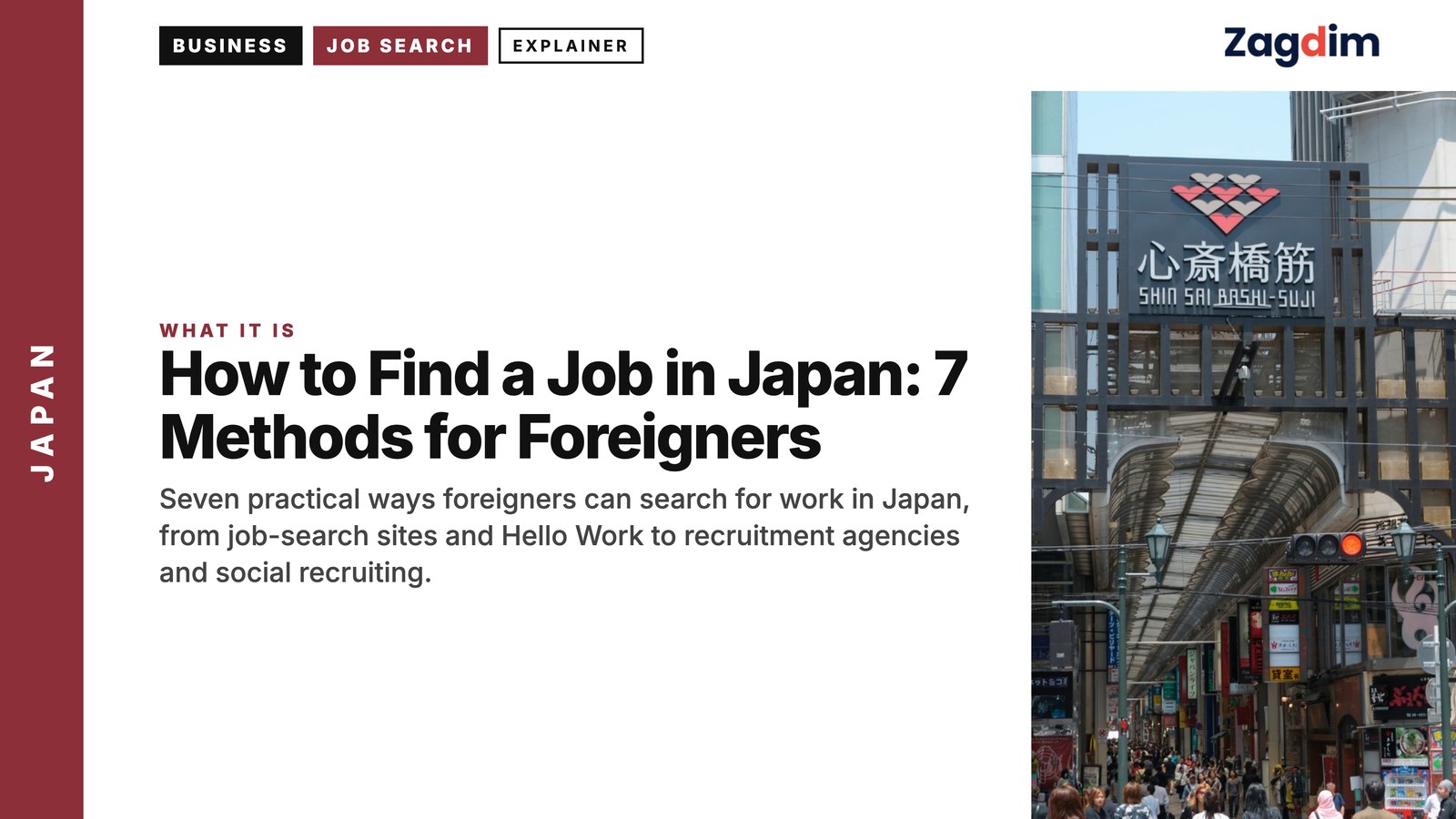
Street — shopping street exterior with billboards in Osaka, illustrating How to Find a Job in Japan: 7 Methods for Foreigners

Image: Zagdim

September 24, 2026
in Japan, Living Abroad, Visa & Immigration
Reading Time: 10 mins read

Finding a job is a major turning point in life, and whether you are working in Japan for the first time or looking to change jobs, it deserves careful thought. Japan has no single platform that aggregates every job listing, so without knowing the ropes, it’s easy to miss a good opportunity. This article introduces seven methods foreigners can use to find work in Japan, with the aim of helping you find an approach that fits your own situation and make your job search more efficient and meaningful.

Things to Keep in Mind When Job Hunting in Japan

Finding a job that matches your expectations really can be difficult. If that sounds familiar, it may be worth trying a different search method. Different methods bring different amounts of information at different speeds. If you understand each method’s strengths and weaknesses and pick the one that suits you, you’ll have taken the first step toward a successful job search. Even if you already have a company or industry in mind, casting a wider net when gathering information can help you discover strong companies you didn’t know about, or even realize that industries you’d never considered actually have plenty to offer.

The most important thing in a job search is finding a company or role you genuinely want, which matters far more than simply getting an offer. Here are seven methods for finding a job in Japan.

Use Job-Search Websites

If you want to check large volumes of job listings quickly and easily, job-search websites are a good place to start. Sites aimed specifically at foreign job seekers, in particular, list many openings that welcome foreign applicants. Using a site’s search filters — entering details like industry, position, location, expected salary and required Japanese level — lets the system automatically surface listings that match what you’re looking for, with no time or location constraints, so you can search efficiently for the right job.

Exactly what a site offers varies, but most let you register as a member and then use your own account page to save companies you’re interested in, apply through the site, and even arrange interviews through the site’s built-in messaging. In other words, the whole process — from finding a company, to applying, to communicating with the company — can happen entirely online.

Some sites also run a job-hunting guide section, covering Japan-specific basics such as how to write a résumé or interview etiquette. It’s well worth browsing if it’s available, and shouldn’t be skipped. These sites are generally free to use, so if you come across a good one, it’s worth registering right away.

That said, these sites don’t offer personal guidance, so if you run into something you don’t understand, you won’t necessarily get a clear answer right away. You can check a site’s Q&A section for answers to common questions, but more personal questions are something you’ll need to work out on your own. These sites are also limited to text and images (some offer video), so they can’t fully convey what a company is really like — things like staff dynamics and workplace atmosphere only really come across through an interview or similar direct contact. When gathering information this way, don’t take everything on a site at face value; be sure to observe the company’s actual situation for yourself when you visit or interview.

Use Recruitment Agency (Headhunting) Services

If you want your job search to draw on your own skills and work experience in a specialized field, a recruitment agency (headhunting) service is worth considering. Japan also has agencies that specialize in foreign job seekers; most of these provide an integrated package of support, including introducing openings, recommending candidates to companies, arranging interview schedules, and negotiating terms.

Recruitment agencies bring deep market knowledge, are skilled at supporting job seekers, and maintain strong channels with employers, aiming to match what both employers and job seekers need as closely as possible and reduce the risk of a mismatch after hiring. Job seekers can also comfortably ask about company culture and other things that wouldn’t appear in a job posting. Agencies also handle communication with the employer on your behalf, saving considerable hassle — useful for anyone with a busy schedule. These services are generally free for job seekers, and agencies specializing in foreign candidates typically offer support in other languages too. Depending on the agency, you may also be introduced to openings that are never posted publicly online, which can be a real advantage.

One drawback of recruitment agencies is that the number of openings they handle tends to be smaller. Companies that specifically want to prioritize hiring foreign nationals will naturally work with agencies focused on foreign candidates, while many companies that also want to hire Japanese nationals will instead work with large, mainstream agencies. In other words, even a mainstream agency focused primarily on Japanese candidates will still place a foreign candidate who meets the requirements.

tsunagu Local Jobs — a placement and career-change agency dedicated to foreign job seekers, with many listings open to foreign nationals that are not publicly posted elsewhere. Advisors of different nationalities support you in your own language, so there’s no need to worry even if you’re not confident in Japanese. (Languages supported: Japanese, English, Traditional Chinese, Simplified Chinese, Thai, Vietnamese, Korean.) Registration and use are completely free, and a simple consultation carries no obligation. If you’re considering a job change or new job in Japan, this site is worth exploring.

▼ tsunagu Local Jobs: https://jobs.tsunagulocal.com/

Use Hello Work

Hello Work is a public employment service operated by the Japanese government, with locations in every prefecture, offering free job-search seminars and access to company internships. Hello Work runs a range of programs, including introductory job-search seminars covering how to look for work in Japan and gather information, résumé and cover-letter writing workshops, and mock-interview sessions. Hello Work also organizes internships aimed at international students, letting them experience a Japanese workplace during summer or spring break. If you’d like to join any of these programs, remember to register with Hello Work in advance.

The drawback of Hello Work is that it’s constrained by location and hours. Hello Work has set up employment consultation centers for foreigners in Tokyo, Nagoya, Osaka and Fukuoka, supporting international students seeking work after graduation as well as foreign nationals in professional and technical fields. Outside these locations, many Hello Work offices don’t have a dedicated foreigner-support unit and so may not be able to offer employment consultations for foreign nationals. Hello Work also generally only operates on weekdays, from 9:00 a.m. to 5:00 p.m. (or 10:00 a.m. to 6:00 p.m.), which isn’t especially convenient for anyone who works or studies during those hours. If the location and hours work for you, Hello Work is worth considering.

▼ Hello Work online services (Japanese only): https://www.hellowork.mhlw.go.jp/

Foreigner Employment Service Centers

▼ Tokyo Employment Service Center for Foreigners
11:00 a.m.–5:00 p.m. (closed Saturdays, Sundays, public holidays, and year-end/New Year)
21F, Odakyu Daiichi Seimei Building, 2-7-1 Shinjuku, Shinjuku-ku, Tokyo
Tel: 03-5339-8625
https://jsite.mhlw.go.jp/tokyo-foreigner/home.html (also available in English and Chinese)

▼ Nagoya Employment Service Center for Foreigners
11:00 a.m.–5:00 p.m. (closed Saturdays, Sundays, public holidays, and year-end/New Year)
12F, Chunichi Building, 4-1-1 Sakae, Naka-ku, Nagoya
Tel: 052-264-1901
https://jsite.mhlw.go.jp/aichi-foreigner/ (also available in English, Chinese, Portuguese and Spanish)

▼ Osaka Employment Service Center for Foreigners
10:00 a.m.–6:00 p.m. (closed Saturdays, Sundays, public holidays, and year-end/New Year)
16F, Hankyu Grand Building, 8-47 Kakudacho, Kita-ku, Osaka
Tel: 06-7709-9465
https://jsite.mhlw.go.jp/osaka-foreigner/home.html (also available in English, Chinese, Portuguese and Spanish)

▼ Fukuoka Student Employment Center (Hello Work Student Support, Fukuoka)
10:00 a.m.–6:00 p.m. (closed Saturdays, Sundays, public holidays, and year-end/New Year)
12F, ELGALA Office Building, 1-4-2 Tenjin, Chuo-ku, Fukuoka
Tel: 092-714-1556
https://jsite.mhlw.go.jp/fukuoka-roudoukyoku/hw/fuzoku_kikan/gaikokujin.html (also available in English and Chinese)
English and Chinese interpretation is available at the following times:
English: Mondays, Wednesdays, Fridays, 10:00 a.m.–12:00 p.m. and 1:00–3:30 p.m.
Chinese: Mondays, Thursdays, 10:00 a.m.–12:00 p.m. and 1:00–4:30 p.m.

*Due to the impact of COVID-19, the resumption schedule for in-person job-search seminars was undecided at the time of writing. Check the relevant Hello Work website for the latest details. (Information above is current as of July 31, 2020.)

Apply Directly Through Company Websites

If you already have a specific company in mind, you can apply directly through that company’s own website. Compared with applying through a recruitment agency, applying directly may face a lower bar. That’s because when a company hires through a recruitment agency, it typically pays the agency a commission once a candidate is hired — so the company also has to weigh whether a candidate is worth that fee. Applying directly to a company involves no such commission, so, all else equal, the bar to being hired may be somewhat lower for the same candidate. In addition, if a company only recruits directly, no one else will be applying through job-search sites or agencies, meaning less competition.

The drawback of applying directly through a company website is that you won’t know when the company is hiring. With no one to notify you that a target company has opened a position, you need to check the company’s careers page or official social media regularly to find out. Compared with using a recruitment agency, it’s also harder to gather third-party information about a company’s culture and requirements in advance — you’ll largely need to research this yourself.

Through School Referrals

If you are an international student, it’s worth using the career consultation services offered by your university’s or vocational school’s career center. Through these services, you can access job openings aimed specifically at graduates of your school. Companies that recruit this way may have hired graduates of your school before, or already understand what your school offers, which can be reassuring for both the company and the graduate. Most schools also offer internships and other short-term workplace experiences, which are very useful for a job search. Some schools have staff dedicated to helping students find work, offering career advice and, often, one-on-one consultations covering résumé writing and interview etiquette — worth reaching out to your school for help if you have questions in this area.

That said, a referral through your school usually limits you to applying to a single company (and you generally cannot decline after being hired). Once hired through a school referral, you are generally expected to join that company — you typically cannot apply to multiple companies at the same time, or decide after being hired whether you actually want to join. Backing out after being hired can damage your school’s reputation, and may even lead the company to stop recruiting from your school in the future, so this route calls for careful consideration before you apply. That said, if you apply independently to a company that happens to be introduced through your school — for example, via a job-search website — the same restriction doesn’t necessarily apply; it’s worth asking your school’s career staff before applying, just to be sure.

Attend Joint Recruitment Fairs

A joint recruitment fair brings multiple companies together at a single venue, each setting up a booth to introduce itself to job seekers. Attending one lets you learn about many companies in a single day, which is very efficient for a job seeker. Compared with searching online, attending in person lets you meet a company’s actual staff, giving you a general sense of the workplace atmosphere and letting you observe things a website wouldn’t show. HR staff are usually present at each booth, so job seekers can ask application-related questions directly.

Some events also run job-search seminars alongside the fair, so with good time management you can go from an interview workshop to actually meeting companies within a single day. At events aimed at foreign job seekers, since the participating companies are actively looking to hire foreign nationals, most can communicate in English or another language — useful if your Japanese isn’t yet strong, since you can still take in each company’s presentation. Attendees at the same event can also exchange information and make friends, supporting each other through the job search — an advantage other job-search methods don’t offer.

The drawback is that you may not have time for an in-depth conversation with any individual company. With many attendees at a joint fair, there may not be time for company representatives to speak with everyone at length, and a popular company’s booth may get so crowded that you can’t even hear its introduction. If that happens, it’s worth taking the company’s brochure or materials home and following up later by email, or attending that company’s own individual information session.

*Due to the impact of COVID-19, many joint recruitment fairs have been suspended or moved online.

Use Social Media

In recent years, more companies have turned to “social recruiting” — recruiting through social media. Social recruiting takes many forms: posting openings on a company’s official Facebook, Twitter or Instagram page, promoting openings through social ads, or directly messaging individual accounts in a headhunting-style approach. If you already have a company in mind, it’s worth checking that company’s official social media accounts — it will likely be useful. There are also many Facebook groups that bring together foreign nationals living in Japan; joining a group for people from your own country can surface less common job postings, or opportunities that let you use your native language. The advantage of this approach is that it lets you gather information easily and quickly through social platforms you’re probably already comfortable using.

That said, information on social media tends to be less detailed, so if something seems uncertain, be sure to check the company’s official website as well. Recruiting through social media is simple, but both the company and the job seeker have access to less information, so care is needed to avoid a mismatch in expectations. Even so, since social platforms have a large, active user base skewed toward younger people, demand for this approach is likely to keep growing.

This article has covered several methods for finding a job in Japan, but there’s no need to stick to just one. It’s worth reviewing your own progress and situation, and combining several methods as you go. Starting with job-search websites and recruitment agencies — both unconstrained by time or location — to get a general picture of the Japanese job market, then building a step-by-step plan from there, is the most reliable path to finding the job you’re looking for.

Commonly Used Job-Search Websites

Indeed Japan: https://jp.indeed.com/m/

Kyujin Box: www.neo-career.co.jp/

Mynavi Tenshoku: https://tenshoku.mynavi.jp

Townwork: https://townwork.net

Related in this series:

  • Japan's Highly Skilled Professional Visa: Benefits, Points and FAQ
  • Japan's Specified Skilled Worker Visa: Eligibility, Covered Industries, and How to Apply
  • Japan Business Manager Visa: Requirements, Fees and Process (2025 Rules)
  • How to Set Up a Company in Japan as a Foreigner: Requirements and Process
  • Japan Residence Essentials: How to Apply for the Residence Card, Juminhyo, and My Number Card

Have a question about this guide? Leave a comment below, or ask Zagdim directly.

Life abroad? Ask Zagdim.

Your first stop for international property and global living.

Research and insights. Know what’s changing. Understand what matters.
Zagdim AI
All content is researched, written, or authorized for publication by the @Zagdim Overseas team. Sharing and reposting are welcome, but please make sure to credit the source and include the original article link from this website. Any plagiarism or unauthorized use may result in legal action. For article submissions, please contact us via Facebook. Thank you for your support!

For article submissions, press release publication, or interview notices, please contact [email protected]. 

Zagdim Ask

Have a specific question about overseas living, property, visa, or practical arrangements?

Fill in your situation and key concerns through Zagdim Ask. Our team will review your message and get back to you by email where appropriate.

Submit your enquiry →

Similar Topics

Skyline — Osaka skyline with tower at sunset, illustrating Japan Residence Essentials: How to Apply for the Residence Card, Juminhyo, and My Number Card
Japan

Japan Residence Essentials: How to Apply for the Residence Card, Juminhyo, and My Number Card

September 24, 2026
Architecture — curved modern building with garden terraces, illustrating How to Set Up a Company in Japan as a Foreigner: Requirements and Process
Japan

How to Set Up a Company in Japan as a Foreigner: Requirements and Process

September 24, 2026
Street — shopping street exterior with billboards in Osaka, illustrating How to Find a Job in Japan: 7 Methods for Foreigners
Japan

How to Find a Job in Japan: 7 Methods for Foreigners

September 24, 2026
Next Post
Architecture — curved modern building with garden terraces, illustrating How to Set Up a Company in Japan as a Foreigner: Requirements and Process

How to Set Up a Company in Japan as a Foreigner: Requirements and Process

Skyline — Osaka skyline with tower at sunset, illustrating Japan Residence Essentials: How to Apply for the Residence Card, Juminhyo, and My Number Card

Japan Residence Essentials: How to Apply for the Residence Card, Juminhyo, and My Number Card

Facebook Twitter Youtube

About Us

Zagdim is a global knowledge platform focused on cross-border property, relocation, lifestyle, and location-based decision-making.

We provide insights on overseas real estate, market trends, regional analysis, economic developments, and practical relocation information. Through continuous market observation and on-the-ground research, Zagdim helps readers better understand a place before deciding where to live, invest, buy property, or establish a base abroad.

We currently follow markets including the UK, Japan, Thailand, Malaysia, Germany, Australia, the UAE, Greece, Portugal, and Spain, while continuing to track emerging lifestyle, relocation, and property trends worldwide.

Category

  • Australia
  • Buying & Immigration Guide
  • Canada
  • Costa Rica
  • Dubai
  • Encyclopedia
  • Europe
  • Expat Lifestyle Guide
  • Global Reports Analysis
  • Hong Kong
  • Human-Picked
  • International Property Buying Guide
  • Japan
  • Japan Market News
  • Kenya
  • Living Abroad
  • Malaysia
  • Mallorca
  • Market Trends Overview
  • News
  • Other Market News
  • Overseas Leasing & Long-Term Stay
  • Philippines
  • Policy Interpretation
  • Portugal
  • Property
  • Property Law & Tax
  • Real Estate & Economic News
  • Real Estate Law & Taxation
  • Relocation, Immigration & Visa
  • Singapore
  • South Korea
  • Spain
  • Switzerland
  • Thailand
  • Thailand Market News
  • UK Market News
  • United Kingdom
  • United States
  • Vietnam Market News
  • Visa & Immigration
  • Zagdim Insights
  • Zagdim Property Insights

Email:[email protected]


Add Friends


WhatsApp
Contact Us


Wechat:Zagdim

Work with Zagdim

Put your brand inside the overseas property research process — in English and in Chinese. Reaching buyers, expats and investors across 19 markets.

View partnership packages →

©2026 Zagdim Overseas All Right Reserved

No Result
View All Result
  • Home
  • Zagdim Property Insights
    • Market Trends Overview
    • Policy Interpretation
    • Forest
    • PLACEHOLDER sub-cate for Zagdim Property Insights
  • Global Reports Analysis
    • In-Depth Project Analysis
  • Real Estate & Economic News
    • Thailand Market News
    • UK Market News
    • Germany Market News
    • Japan Market News
  • Buying & Immigration Guide
    • Expat Lifestyle Guide
    • Real Estate Law & Taxation
    • Overseas Leasing & Long-Term Stay
    • Starting a Business & Company Setup
  • Zagdim Ask
  • 中文 EN

©2026 Zagdim Overseas All Right Reserved