































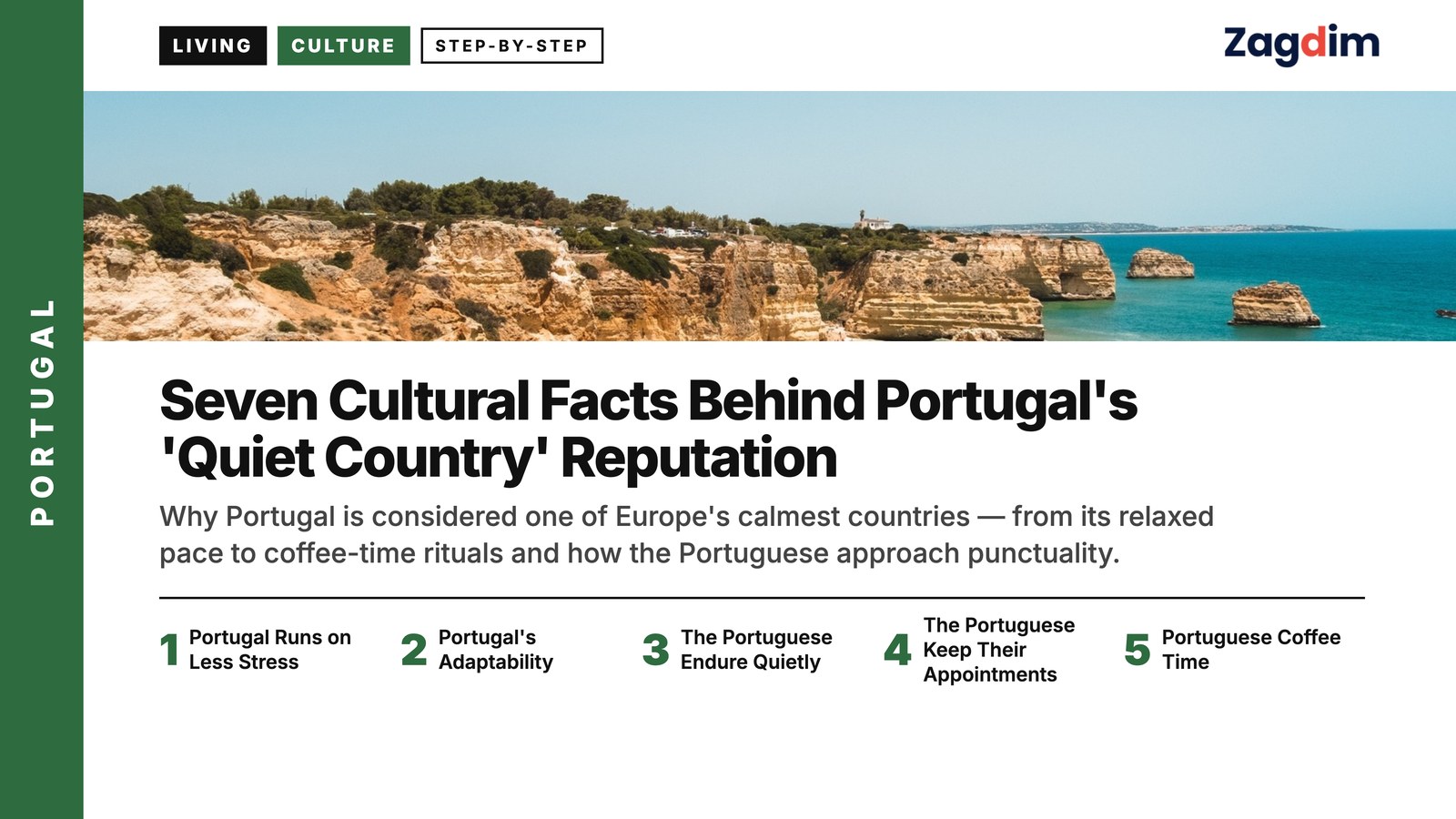
Portugal is, historically, a nation of great explorers, and also one of Europe’s calmest countries. Even amid today’s rapid globalization, the Portuguese have held on to their own particular habits.
Portugal Runs on Less Stress
In the land of Camões, people go about things calmly and methodically, and are happy to take the time to enjoy life, rarely getting worked up over time pressure. This trait shows up in almost every corner of Portuguese daily life. Lower-stress people tend to handle everything at their own steady pace — perhaps the defining trait of Portuguese life in Portugal itself. And yes, Portuguese people living abroad are different — read on and you’ll see why.
Portugal’s Adaptability
Humanity conquered the earth by adapting to the environments around it. In this respect, the Portuguese are deeply human. Rather than trying to change their circumstances, they tend to adapt to whatever adversity comes their way. This is part of why Portuguese emigrants are so often well received in their host countries — like locals, they actively adapt to and blend into their surroundings. At the same time, even far from home, they continue to hold on to their own identity and traditions. It works like a keystone, letting them adapt to their environment without losing themselves. If someone ever tries to force something onto the Portuguese that they simply cannot adapt to, they would rather leave than fight it. This also explains why the Portuguese are so often drawn toward new horizons.
The Portuguese Endure Quietly
People who tend to accept their surroundings as they are also tend to endure quietly. The Portuguese will grumble and complain when they run into trouble. But apart from adapting themselves to fit the circumstances, they generally won’t take any other concrete action.
A well-known saying sums up the Portuguese mindset: *Quem está mal que se mude*, which can be translated as “whoever is unhappy should move, or change their own mindset.”
The Portuguese Keep Their Appointments — Sort Of
If a Portuguese person tells you they’ll be there in 15 minutes, you’d better prepare yourself for them showing up an hour later. If they’re 15 minutes late to a meeting, that actually counts as being on time. Nobody will hold it against you for being 15 minutes late either — because the other person is going to be running a quarter of an hour late anyway!
Portuguese Coffee Time
We’re not talking about the kind of five-minute “coffee break” you grab standing next to the machine. We mean a proper, satisfying breakfast at the pastelaria (pastry shop) downstairs from the office, to kick off a day full of energy. How about a pastel de nata (Portuguese egg tart) with a galão (a milky coffee)? Then, during the mid-morning work break, another proper coffee. Tired of coffee already? Try a “carioca de limão” instead — a tea steeped from lemon peel. Portuguese office workers generally get a two-hour lunch break, so of course you can take your time over lunch, and gossip with colleagues while you’re at it. Eating a sandwich at your desk while working is simply unimaginable there. At 4:30 in the afternoon comes lanche (afternoon tea time) — usually a small cake or a ham-and-cheese sandwich is enough, though if you’re truly hungry, you might order a Portuguese pork sandwich (bifana). After work, you might well eat something else again. And that naturally brings us to the next point.
Portuguese Pre-Dinner Snacks (Petiscos)
In Portugal, after a busy day’s work and before dinner, people often enjoy petiscos, pre-dinner snacks. Many foreigners might confuse these with Spanish tapas, but Portuguese petiscos are more like one large starter. The menu for these “snacks” typically includes dishes such as:
- Snails (Caracóis)
- Smoked sausage (Linguiça)
- Stuffed olives
- Peanuts
- Fried cod fritters
- Portuguese fried dumplings
- Lupini beans (tremoços)
- And plenty of other choices…
Don’t forget to pair it all with a good beer — Portuguese beers like Super Bock or Sagres both work well here.
Friends Meet at Restaurants
As is often the case elsewhere, in Portugal, people rarely invite friends over for dinner at home, since it simply isn’t part of the local custom — special festive occasions aside. Why is that? Because inviting guests over means the host of the house has to spend a great deal of time and effort putting together a proper, presentable dinner. That’s a lot of work, so unless it’s a genuinely special occasion, people generally won’t extend that kind of invitation easily. Casual meet-ups between friends therefore tend to happen at restaurants instead, where everyone can chat without any pressure and then split the bill. One side doesn’t have to worry about which bottle of wine to bring the host, and the other doesn’t need to spend hours preparing food to please their guests.
That way, everyone stays relaxed and pressure-free!
Have a question about this guide? Leave a comment below, or ask Zagdim directly.
Your first stop for international property and global living.
Research and insights. Know what’s changing. Understand what matters.
Sources
- Portugal Days — original Portuguese-language article on Portuguese cultural habits, cited as the source for this piece.