In Japan, UNIQLO planned to raise the price of a pair of socks by ¥100, then pulled the plan 11 days after announcing it. On the same price list, a pair of trousers is going up by ¥1,000, and that change is going ahead as planned. Why did the item with the smaller increase stay at its old price?
The reason may not lie in the ¥100 alone. On 16 October 2026, UNIQLO’s Japan website announced that its 50-colour socks would go from ¥290 to ¥390, and that the “4 pairs for ¥990” multi-buy price would end. Buying the same 4 pairs would then cost ¥1,560 instead of ¥990, a rise of 57.6%. That figure is Zagdim’s calculation from the planned unit price, not an official price.
On 27 October the sock part was halted. UNIQLO told media that socks are a symbolic product among daily necessities and that, after further review, the price would stay as it is. The Kando trousers and the rest of the other 10 items are still scheduled to change on 10 November. For a brand known for affordable basics, could the price of one item matter more than the revenue it brings in?
If you often visit Japan, live there, or compare the cost of living overseas, this price change is also a useful way to read Japanese prices.
Key Points
The UNIQLO sock price increase was halted 11 days after it was announced. On 27 October 2026, UNIQLO told media that socks are a symbolic product among daily necessities and that, after further review, the price would stay as it is.
- Who should pay attention: people travelling to Japan or visiting family there, people living in Japan, and readers comparing the cost of living overseas.
- What was withdrawn: only the 50-colour sock price change and the sock multi-buy price. On 31 October 2026, UNIQLO’s Japan website still listed the 50-colour socks at ¥290, or 4 pairs for ¥990.
- What was not withdrawn: the Kando range and the rest of the other 10 items are still scheduled to change on 10 November.
- What UNIQLO has not said: the website notice says only that the change is halted, with an apology, and gives no reason. UNIQLO has not said that it pulled back because of consumer backlash.
- Zagdim’s calculation: 4 pairs would have cost 57.6% more. On the public listed prices of the three products checked here, Japan converts to the lowest of six markets.
The Real Sting Is 57.6%, Not ¥100
¥100 does not sound like much, but among the items below, socks have the smallest amount and the largest percentage. ¥1,000 more on the trousers is +25.1%, while ¥100 more on a single pair of socks is +34.5%. Old and new prices come from UNIQLO’s notice on its Japan website (tax included). Percentages are Zagdim calculations:
| Item | Old price | Planned new price | Extra cost | Rise | Status |
|---|---|---|---|---|---|
| Kando jacket | ¥6,990 | ¥7,990 | ¥1,000 | +14.3% | Scheduled for 10 November |
| Kando trousers | ¥3,990 | ¥4,990 | ¥1,000 | +25.1% | Scheduled for 10 November |
| PRINCESSE tam tam trousers | ¥2,990 | ¥3,990 | ¥1,000 | +33.4% | Scheduled for 10 November |
| 50-colour socks, one pair | ¥290 | ¥390 | ¥100 | +34.5% | Halted |
| 50-colour socks, 4 pairs | ¥990 | ¥1,560 (calculated) | ¥570 | +57.6% | Halted |
| Other socks, 3 pairs | ¥990 | ¥1,170 (calculated) | ¥180 | +18.2% | Halted |
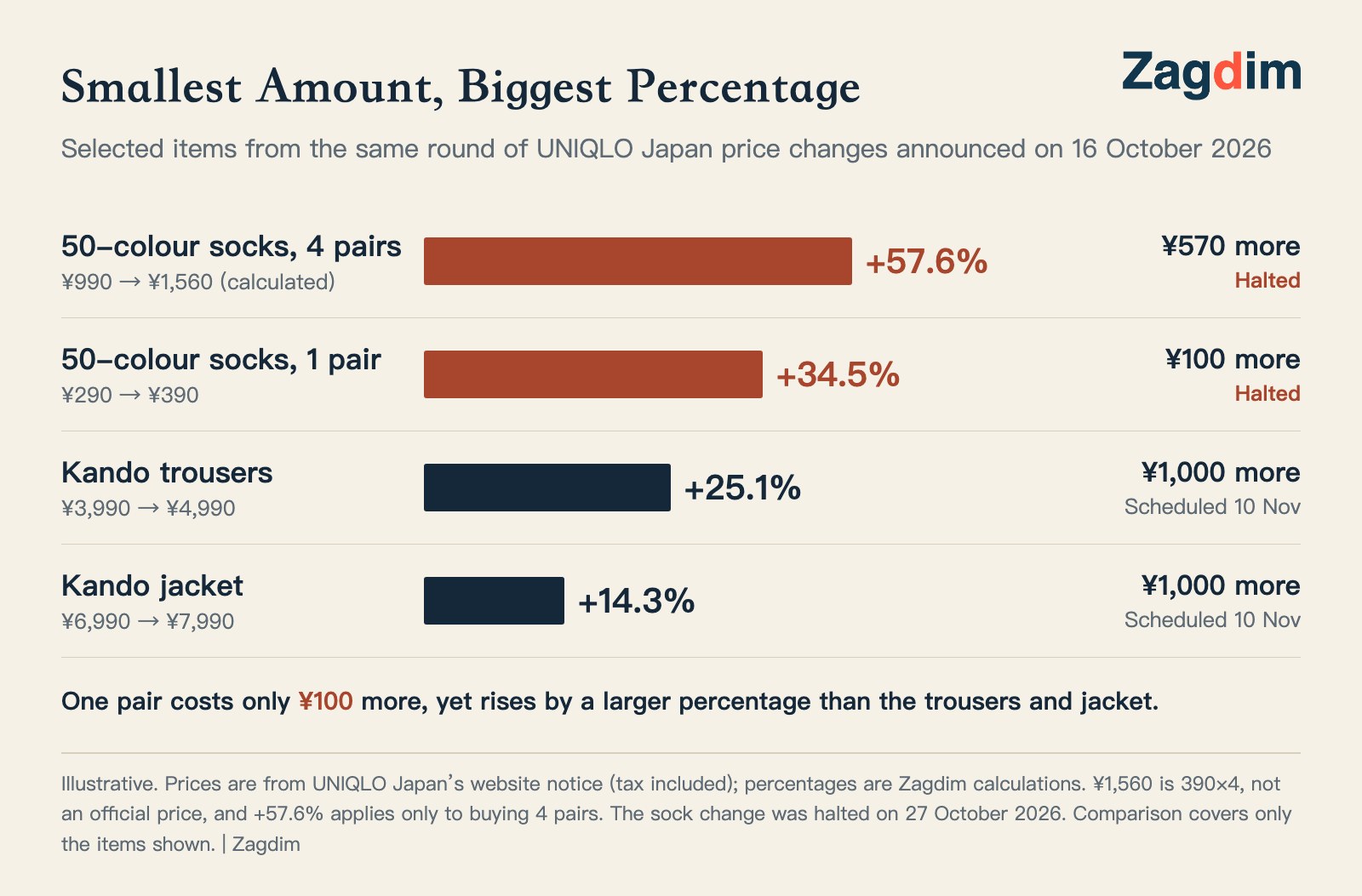
The multi-buy price hurts more. Today 4 pairs cost ¥990, or ¥247.5 a pair. If the multi-buy ended and each pair cost ¥390, the same 4 pairs would cost ¥570 more.
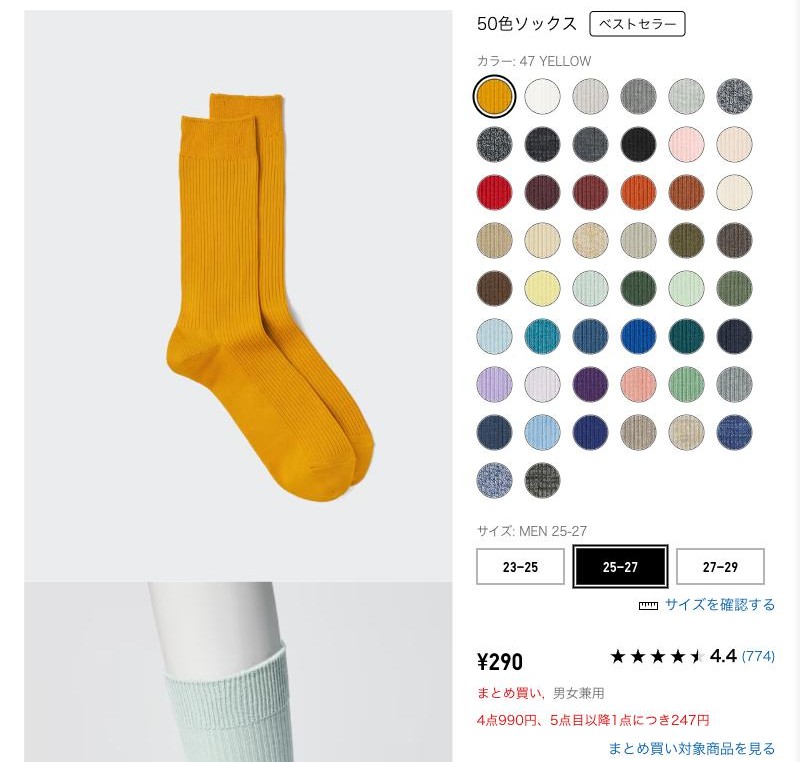
The roughly 4% UNIQLO cites is also correct, as an average across all products. The two numbers have different denominators: one is the whole store, the other is the 4 pairs of socks in your hand.
The ¥990 price also happens to sit just under ¥1,000. On a TV programme, the actor Takashi Naito said that 4 pairs costing more than ¥1,000 would not feel like UNIQLO. That is a guest’s comment, and no reliable data backs it up. Still, what customers remember may be more than a unit price; it may also be a number they can read at a glance.
Why Was the UNIQLO Sock Price Increase Withdrawn? The Company Says Only That Socks Are a Daily Necessity
UNIQLO’s explanation stops at “symbolic product” and “further review”. The notice on its website says only that the change is halted, with an apology.
The media put it more bluntly. Bloomberg reported that the withdrawal came after a wave of backlash, and its Japanese headline also said customer backlash had turned the decision around. But sequence is not causation.
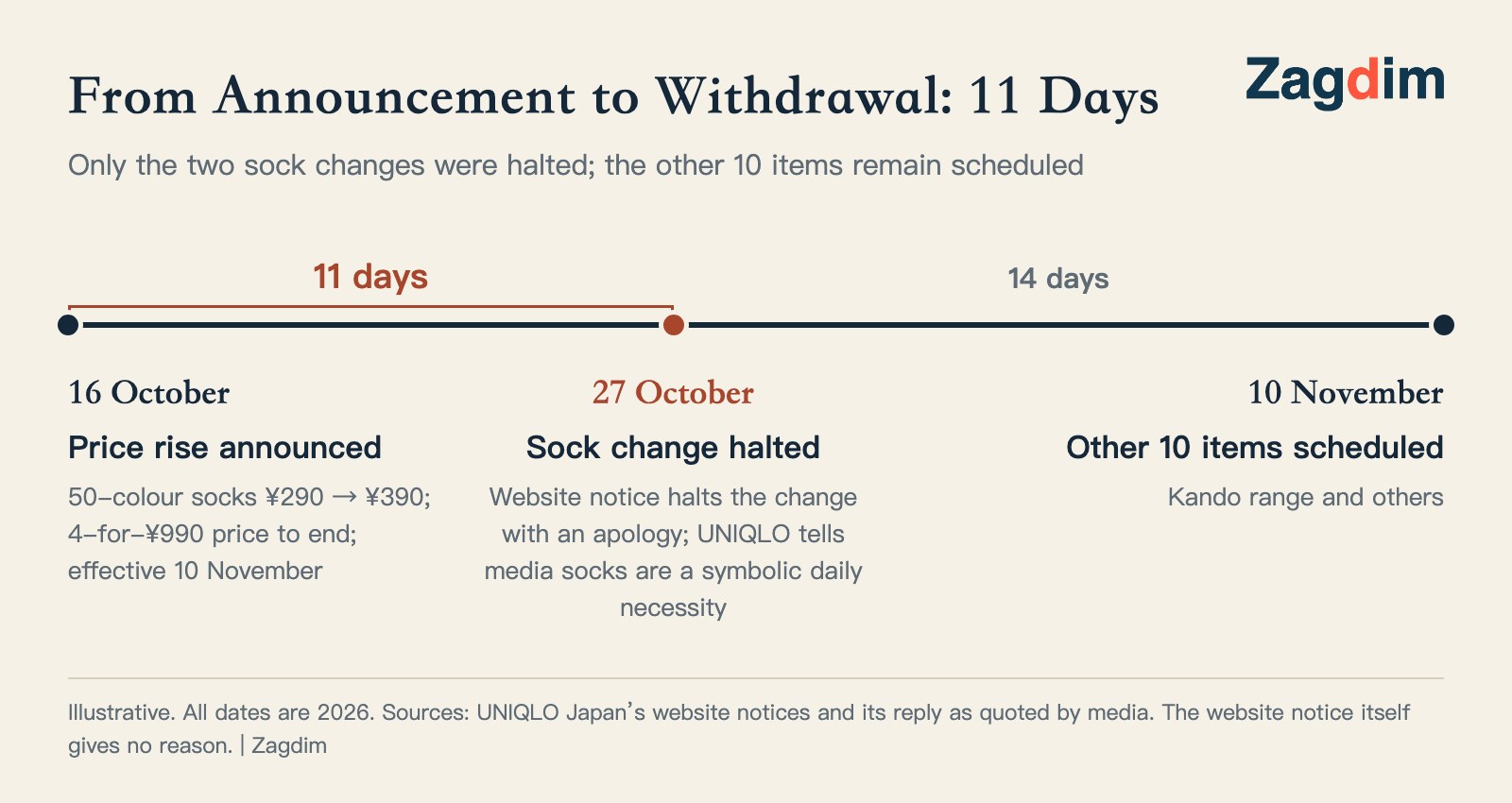
Why Pull Back Only the Socks and Keep the Other 10 Rises?
UNIQLO has not explained why only the socks were withdrawn, but cost pressure has not gone away. The reasons given in the 16 October notice were higher raw material and logistics costs and a weaker yen. Parent company Fast Retailing forecasts that next fiscal year, UNIQLO Japan’s business profit (profit from its core business) will be about level with the prior year, with gross margin slightly lower, mainly because the exchange rates it locked in for purchasing have worsened.
This is not a company struggling to survive. In the year to August 2026, UNIQLO Japan made ¥196.0 billion in business profit, up 8.1%. But spending per customer at existing stores plus online rose 4.8% while customer numbers rose only 0.2%: each customer spends more, but hardly any more people are coming in.
UNIQLO has also spoken about how far to take price rises. On 9 July 2026, CFO Okazaki said the basic policy is to avoid raising prices where possible, but that the cost increases brought by the weak yen are hard to absorb through company effort alone. For autumn/winter 2026 the average rise was under 4%, on a limited range of items. He also said that forcing through price rises to improve gross margin would backfire. He was talking about overall pricing and gross margin for the coming period, not about socks.
Taken together, withdrawing the sock change while keeping the other adjustments shows that UNIQLO has not given up on price rises altogether. Zagdim believes that a pair of socks seen as a daily necessity may carry more symbolic weight than its price: how consumers feel about its price may also shape whether they think the whole brand is still affordable. AFP also reported that the increase led local media to say UNIQLO’s name as a “symbol of affordability” was at risk.
This is Zagdim’s analysis based on the pricing results and official statements, not a reason UNIQLO has confirmed. The financial effect of the withdrawal cannot be estimated either, because sock revenue and margins are not disclosed.
UNIQLO Has Paid for Price Rises Before
UNIQLO has paid for consecutive price rises in Japan before, and has said so publicly. Prices rose about 5% from autumn/winter 2014, and in autumn/winter 2015 about 20% of products rose by an average of 10%. From September 2015 to February 2016, customer numbers at existing domestic stores beat the prior year in only one month. In April 2016, Fast Retailing’s Tadashi Yanai said the products that had gone up in price had not won market acceptance, and gave that period’s results 30 points. The policy became a return to easy-to-read price bands such as ¥1,990 and ¥2,990. Not all of this can be blamed on price rises: the company’s own text for that period pointed to its handling of a warm winter and weak marketing.
The result in 2022 was different. Fleece went from ¥1,990 to ¥2,990, while basic HEATTECH and jeans stayed at their original prices. In the year to August 2023, revenue at existing stores plus online rose 7.6% and customer numbers fell 3.1%. Raising prices has not gone badly every time.
These two episodes are only a comparison. They suggest that when this company changes prices, basics and memorable numbers may get special consideration. Basics do not stay still forever, though: HEATTECH has since been repriced and is now ¥1,290 on the Japan website. In the coverage reviewed for this article, neither UNIQLO nor the media connected this withdrawal to 2015. That comparison is Zagdim’s.
Wages Are Rising, So Why Is Japan So Sensitive to ¥100?
Because the wage figures have recovered while household spending and daily life have not kept up. According to the Ministry of Health, Labour and Welfare’s preliminary figures for August 2026, real wages rose 1.5%, positive for 8 straight months. In the Ministry of Internal Affairs and Communications’ household survey for the same month, real spending by households of two or more fell 3.1%, down for 9 straight months (the consecutive-month counts come from media reports). In the Bank of Japan’s survey from 3 August to 4 September, 54.4% of people said their life had become less comfortable, and among the things people had cut back on, clothing and shoes came second (32.7%), behind only eating out.
Official CPI (excluding fresh food) was +2.1% in September, while in the same Bank of Japan survey the median price rise people said they felt, compared with a year earlier, was +10%. The two are not measured the same way and cannot be compared directly, but side by side they show that the statistics and everyday feeling are two different things. Teikoku Databank also counts price rises on 20,327 food items known as of the end of October for January to December 2026, above 20,000 for the second year running.
Itochu Research Institute chief economist Atsushi Takeda said the withdrawal shows the company cares a great deal about consumer resistance to price rises, and that wariness is spreading beyond people on low incomes to those on higher incomes.
The same month offered a ready comparison. On 14 October the budget restaurant chain Saizeriya announced an average 6% rise from 29 October, apologised for “not trying hard enough”, and went ahead. UNIQLO apologised for changing its mind soon after announcing, and did not raise the price. One company said sorry for raising prices, the other for not raising them, which may be the most telling scene in Japanese consumer life in autumn 2026.
Cheapest of Six Markets After Conversion, So Why Does It Still Feel Expensive in Japan?
The prices below are UNIQLO’s public listed prices on each official website, compiled and converted by Zagdim:
| Market | 50-colour socks (one pair) | AIRism Cotton Crew Neck T-Shirt (short sleeve) | HEATTECH Crew Neck T-Shirt |
|---|---|---|---|
| Japan | ¥290 (approx. HK$14.4/NT$60) | ¥1,290 (approx. HK$64.3/NT$267) | ¥1,290 (approx. HK$64.3/NT$267) |
| Hong Kong | HK$25 (approx. NT$104) | HK$79 (approx. NT$329) | HK$99 (approx. NT$412) |
| Taiwan | NT$89 (approx. HK$21.4) | NT$390 (approx. HK$93.8) | NT$490 (approx. HK$117.8) |
| Singapore | S$3.90 (approx. HK$23.9/NT$100) | S$14.90 (approx. HK$91.4/NT$380) | S$19.90 (approx. HK$122.1/NT$508) |
| Malaysia | RM 12.90 (approx. HK$24.9/NT$104) | RM 49.90 (approx. HK$96.5/NT$401) | RM 49.90 (approx. HK$96.5/NT$401) |
| Mainland China | RMB 20 (approx. HK$23.6/NT$98) | RMB 79 (approx. HK$93.1/NT$387) | Launch price RMB 99 (approx. HK$116.7/NT$485) |
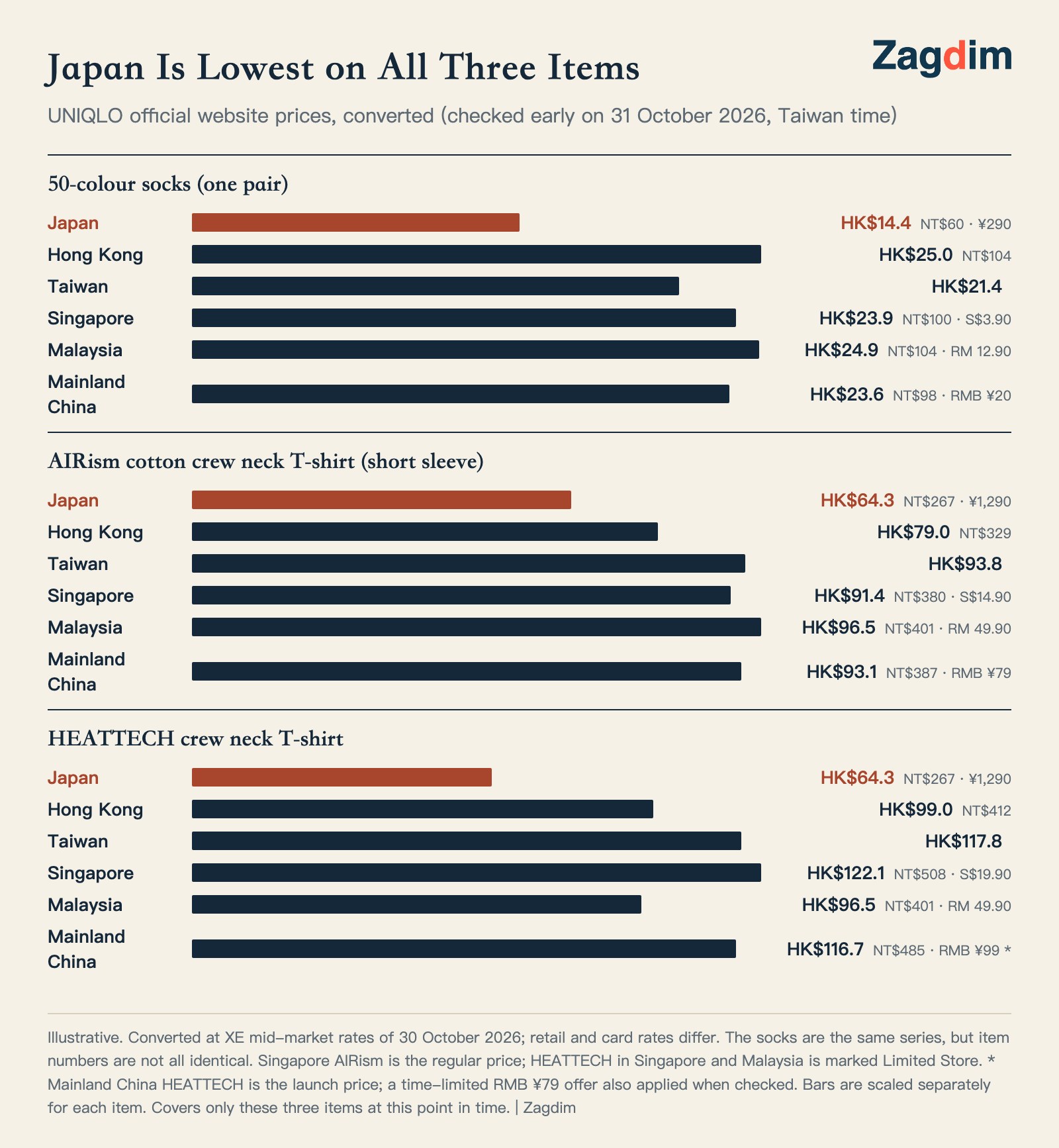
The basis for comparison is each market’s official website listed price, checked in the early hours of 31 October 2026 Taiwan time and converted at XE mid-market rates from 30 October 2026. Retail or card exchange rates will differ. Only Japan’s listed price was confirmed as tax-inclusive; the other markets were not individually checked.
- Socks: all six are from the same range, but item numbers are not all the same, and the sizes checked in Singapore, Malaysia and mainland China were 25-27cm. On the Taiwan site these socks are called “solid-colour socks”, so searching for “50 colours” may not find them.
- 4-pair multi-buy: Japan ¥990 (approx. HK$49.3/NT$205), Hong Kong HK$79 (approx. NT$329), Malaysia RM 39.90 (approx. HK$77.1/NT$321) and mainland China RMB 79 (approx. HK$93.1/NT$387). Taiwan and Singapore are not listed, which does not mean there is no multi-buy there.
- AIRism and HEATTECH: the same item in all six markets. When checked, Singapore’s AIRism also had a members-only price of S$9.90 (approx. HK$60.8/NT$253) until 5 November, lower than Japan but not a public price, so it is not compared. The Singapore and Malaysia HEATTECH pages are marked Limited Store, meaning not every store carries it. Mainland China’s HEATTECH also had a limited-time price of RMB 79 when checked, until 05:59 on 6 November.
Even at the planned ¥390, the price would convert to about HK$19.4 or NT$81, still below the current price in the other five markets. But that covers only these three products at this moment on official sites, and does not mean everything in Japan is cheap. How each market sets prices is not public; a weak yen may be one reason.
The same international brand carries different prices in different markets, and shoppers use different reference points. However cheap it looks after conversion, Japanese consumers do not pay in Hong Kong dollars; what they compare against may be the everyday prices they know. Every place may have its own pair of socks: milk tea at a Hong Kong cha chaan teng, a Taiwanese lunchbox, kopi in Singapore, nasi lemak in Malaysia. The amount is small, but when it moves, people feel that life has changed.
What Should People Visiting or Living in Japan Watch For?
Only the socks were paused. The other price changes are still under way.
- Travelling or visiting family in Japan: the Kando range and the rest of the other 10 items are scheduled to change on 10 November, and the Kando trousers differ by ¥1,000 before and after, so check the listed price on the website before you go.
- Living in Japan: prices already changed in September 2026. Children’s warm trousers went from ¥1,990 to ¥2,490 and women’s leggings from ¥2,990 to ¥3,990, and delivery and alteration fees changed from 1 September. Dai-ichi Life Research Institute forecasts that CPI excluding fresh food may exceed 3% between the end of 2026 and early 2027. That is a forecast, not a settled outcome.
- Comparing the cost of living overseas: it is best to have two rulers. One converts the price into your own currency; the other looks at how it feels to a local person earning a local salary.
Exchange rates can tell us how cheap something is after conversion, but not necessarily why local people find it expensive.
UNIQLO Sock Price Increase: Frequently Asked Questions
Is the UNIQLO Sock Price Increase Still Happening?
No. A notice on UNIQLO’s Japan website on 27 October 2026 halted the price change on the 50-colour socks and the sock multi-buy. On 31 October 2026 the site still showed the socks at ¥290, or 4 pairs for ¥990.
Will Other UNIQLO Products Still Go Up After the Sock Withdrawal?
Yes. The Kando jacket from ¥6,990 to ¥7,990, the Kando trousers from ¥3,990 to ¥4,990 and the rest of the other 10 items are still scheduled to change on 10 November 2026.
Why Can I Still See ¥390 on UNIQLO’s Website?
The old table remains on the official notice page, below the halt notice, so reading only the table can mislead. The “updated 27 October” halt notice on that page is what counts: the 50-colour socks will not go to ¥390 on 10 November.
Weren’t Socks Going Up 34.5%? Where Does 58% Come From?
34.5% is one pair going from ¥290 to ¥390. About 58% is the four-pair case: ¥990 becoming a calculated ¥1,560, a rise of 57.6%. The ¥1,560 is not an official price, and the change has been halted.
How Much Are the 50-Colour Socks in Hong Kong, Taiwan and Singapore?
On official sites on 31 October 2026: HK$25 in Hong Kong, NT$89 in Taiwan and S$3.90 in Singapore. Japan’s ¥290 is about HK$14.4, NT$60 or S$2.4, converted at XE mid-market rates from 30 October 2026. Actual card rates will differ.
Want to Compare Living Costs in Japan? Ask Zagdim
Whether you are living in Japan or comparing living costs across different places, if you have a specific situation to work through, bring it to Ask Zagdim.
Life abroad? Ask Zagdim.
Your first stop for international property and global living.
Research and insights. Know what’s changing. Understand what matters.
Newsletter for overseas updatesSubscribe →
Data Notes and Important Disclaimer
The data in this article is current as of 31 October 2026. Prices and notices change, so check UNIQLO’s latest listing in each market.
UNIQLO’s reason for the withdrawal comes from replies quoted in media reports. The website notice gives no reason, and no original UNIQLO press release was seen for this article. “4 pairs for ¥1,560” and “3 pairs for ¥1,170” are calculated from the planned unit price, and all percentages and conversions are Zagdim calculations. “Smallest amount, largest percentage” applies only to the items listed in this article.
The interpretive passage in the withdrawal section is inference and does not represent UNIQLO’s position. No reliable figures have been seen for sales changes before the withdrawal, or sock revenue and margins. Some media reports could only be read in their public sections.
This article is general information and is not consumer, investment, financial or tax advice.
References
UNIQLO Japan – Notice of Product Price and Service Fee Revisions (updated 27 October) / UNIQLO Japan – 50-Colour Socks Product Page / UNIQLO Japan – Multi-Buy Offers / UNIQLO Japan – AIRism Cotton Crew Neck T-Shirt / UNIQLO Japan – HEATTECH Crew Neck T-Shirt / UNIQLO Hong Kong – Unisex 50-Colour Socks / UNIQLO Hong Kong – Men’s AIRism Cotton Crew Neck T-Shirt / UNIQLO Hong Kong – Men’s HEATTECH Crew Neck T-Shirt / UNIQLO Taiwan – Men’s Solid-Colour Socks / UNIQLO Taiwan – Men’s AIRism Cotton Crew Neck T-Shirt / UNIQLO Taiwan – Men’s HEATTECH Crew Neck T-Shirt / UNIQLO Singapore – Colourful 50 Socks / UNIQLO Singapore – AIRism Cotton Crew Neck T-Shirt / UNIQLO Singapore – HEATTECH Crew Neck T-Shirt / UNIQLO Malaysia – Colourful 50 Socks / UNIQLO Malaysia – AIRism Cotton Crew Neck T-Shirt / UNIQLO Malaysia – HEATTECH Crew Neck T-shirt / UNIQLO Mainland China – Solid-Colour Socks / UNIQLO Mainland China – AIRism Cotton Blend Crew Neck T-Shirt / UNIQLO Mainland China – HEATTECH Crew Neck T-Shirt / XE – Currency Converter (mid-market rates, 30 October 2026, 17:26-17:27 UTC) / Fast Retailing – Results Summary for the Year to August 2026 / Fast Retailing – Q&A, 9 July 2026 / Fast Retailing – Monthly Data 2026 / Fast Retailing – Monthly Data 2023 / Fast Retailing – Monthly Data 2016 / Fast Retailing – First-Half Results Summary for the Year to August 2016 / Fast Retailing – Results Summary for the Year to August 2016 / Nikkei – UNIQLO Halts Sock Price Rise, Keeps ¥290 and ¥990 Multi-Buy (27 October 2026) / Nikkei – Yanai Says the Market Is Severe as UNIQLO Admits Price Rises Failed (13 April 2016) / Nikkei Business – UNIQLO Drops Its Price-Rise Path and Returns to Basics (8 April 2016) / Toyo Keizai – Warm Weather Alone Does Not Explain UNIQLO’s Slowdown (10 January 2016) / FASHIONSNAP – UNIQLO Reverses End of Sock Multi-Buy, Calling Socks a Daily Necessity (27 October 2026) / TBS NEWS DIG via Yahoo! News Japan – UNIQLO Halts Sock Price Change, Calling Socks a Symbolic Daily Necessity (28 October 2026) / WWDJAPAN – The Shock of UNIQLO’s 1.5-Times Fleece Price (8 June 2022) / Sendenkaigi AdverTimes – UNIQLO’s Unusual Price-Rise Withdrawal After 11 Days (28 October 2026) / ITmedia – Fast Retailing and Yanai’s Biggest Management Challenge (28 October 2026) / The Star via Bloomberg – Uniqlo Scraps Price Rise on US$2 Socks After Japan Shopper Outcry / Bloomberg Japan – UNIQLO Withdraws ¥100 Sock Rise in 11 Days After Customer Backlash (29 October 2026) / Arab News via AFP – Uniqlo Cancels Socks Price Hikes in Japan as Inflation Bites / J-CAST – UNIQLO Withdraws 50-Colour Sock Rise, With Comment From Takashi Naito (30 October 2026) / Statistics Bureau of Japan – Consumer Price Index, September 2026 / Ministry of Health, Labour and Welfare – Monthly Labour Survey, August 2026 / Shoninsha – August Household Survey: Real Spending Down 3.1% Year on Year (13 October 2026) / Statistics Bureau of Japan – Family Income and Expenditure Survey, August 2026 Preliminary / Bank of Japan – Opinion Survey on the General Public’s Views and Behavior, 107th Round / Teikoku Databank – Price Revision Survey of 195 Major Food Companies, November 2026 / Dai-ichi Life Research Institute – Consumer Price Index, Japan, September 2026 (23 October 2026) / Livedoor News – Saizeriya Announces Price Rise and Apologises, Average 6% Across Its Menu (14 October 2026)