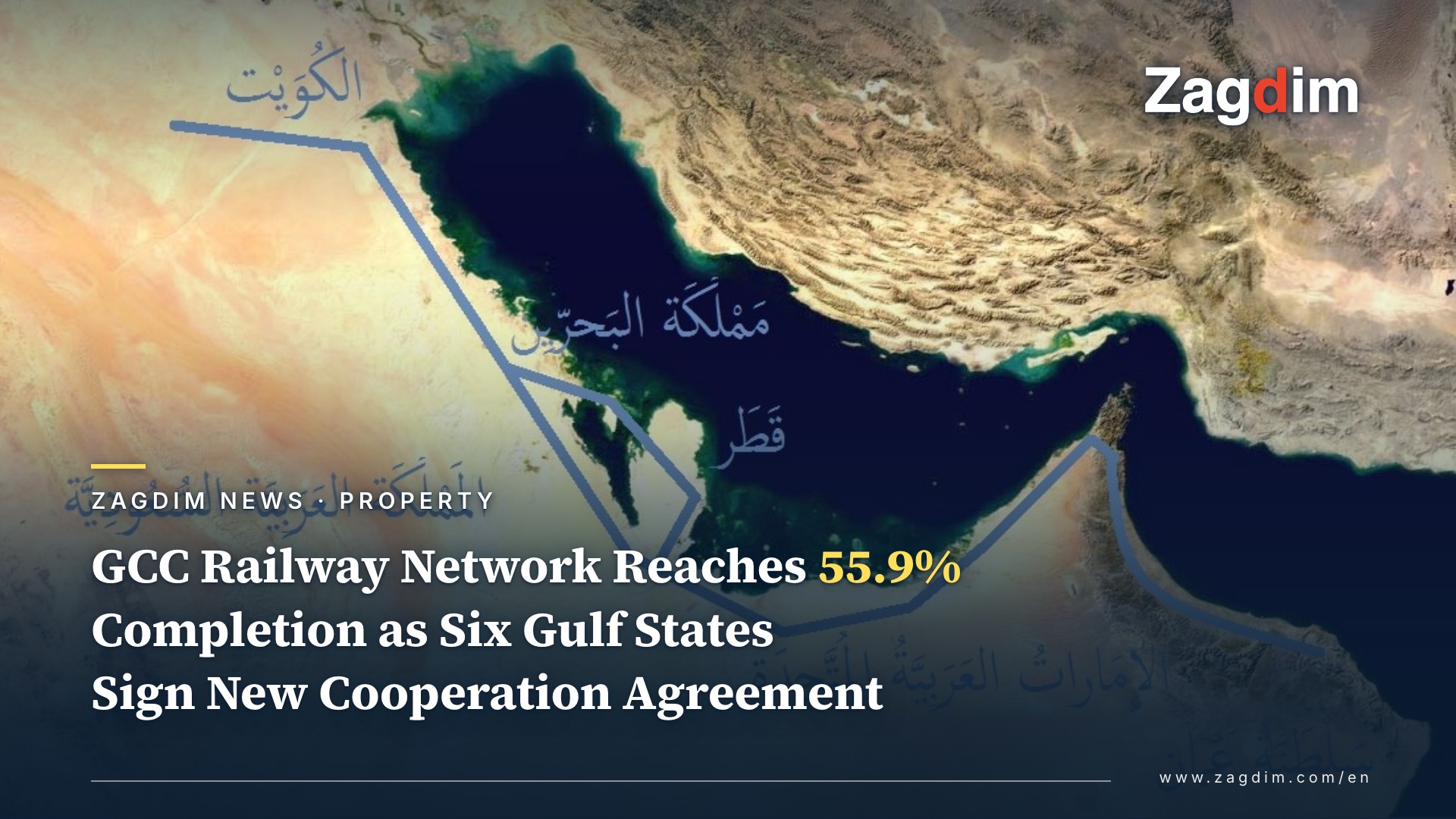
Gulf Cooperation Council (GCC) member states have signed a new agreement to coordinate the long-planned railway network linking all six countries, as the project reached 55.92% completion. The deal was signed in Bahrain on Sunday, according to the Gulf Railway Authority.
What Happened
Transport ministers from the United Arab Emirates, Saudi Arabia, Bahrain, Kuwait, Oman and Qatar signed the agreement at Al Riffa Palace in Bahrain, in the presence of Bahrain’s Crown Prince and Prime Minister, Prince Salman bin Hamad Al Khalifa, and GCC Secretary-General Jasem Mohamed Albudaiwi. The signing took place on the sidelines of the 30th meeting of the GCC Ministerial Committee on Transport and Communications, chaired by Bahrain’s Minister of Transportation and Telecommunications, Dr Shaikh Abdulla bin Ahmed Al Khalifa. The agreement sets a common framework for project implementation, technical integration and cross-border coordination on the 1,768km railway.
Who Is Affected
The network targets passengers and freight operators moving between the six Gulf states, and by extension anyone evaluating property or business connectivity across the region — a recurring theme for buyers looking at Gulf real estate near planned rail corridors. Two related bilateral deals were also signed on Sunday: Bahrain and Saudi Arabia agreed to railway cooperation covering technical knowledge-sharing and infrastructure planning, while Bahrain and Qatar agreed to cooperate on metro, land transport and smart-transport technology integration with the GCC railway project.
Background
The Gulf Railway Authority is coordinating alignment of signalling, communications and safety systems across the six national networks. The UAE has already built its own national railway, and the 238km Hafeet Rail project connecting Abu Dhabi to the Omani port city of Sohar — via Al Ain and Al Buraimi — is under construction, with trial operations expected to begin in 2027. Separately, Bahrain is working toward a rail and road link to Saudi Arabia via the proposed King Hamad Causeway.
What Comes Next
According to the Gulf Railway Authority, the full network is scheduled for completion and operation by the end of 2030. The authority projects the railway will carry six million passengers in 2030, rising to more than eight million by 2045, with freight volumes growing from 200 million tonnes in 2030 to 271 million tonnes by 2045. GCC Secretary-General Albudaiwi said the region’s transport and storage sector posted 5.7% real growth in 2025, one of the fastest-growing non-oil sectors in the Gulf.