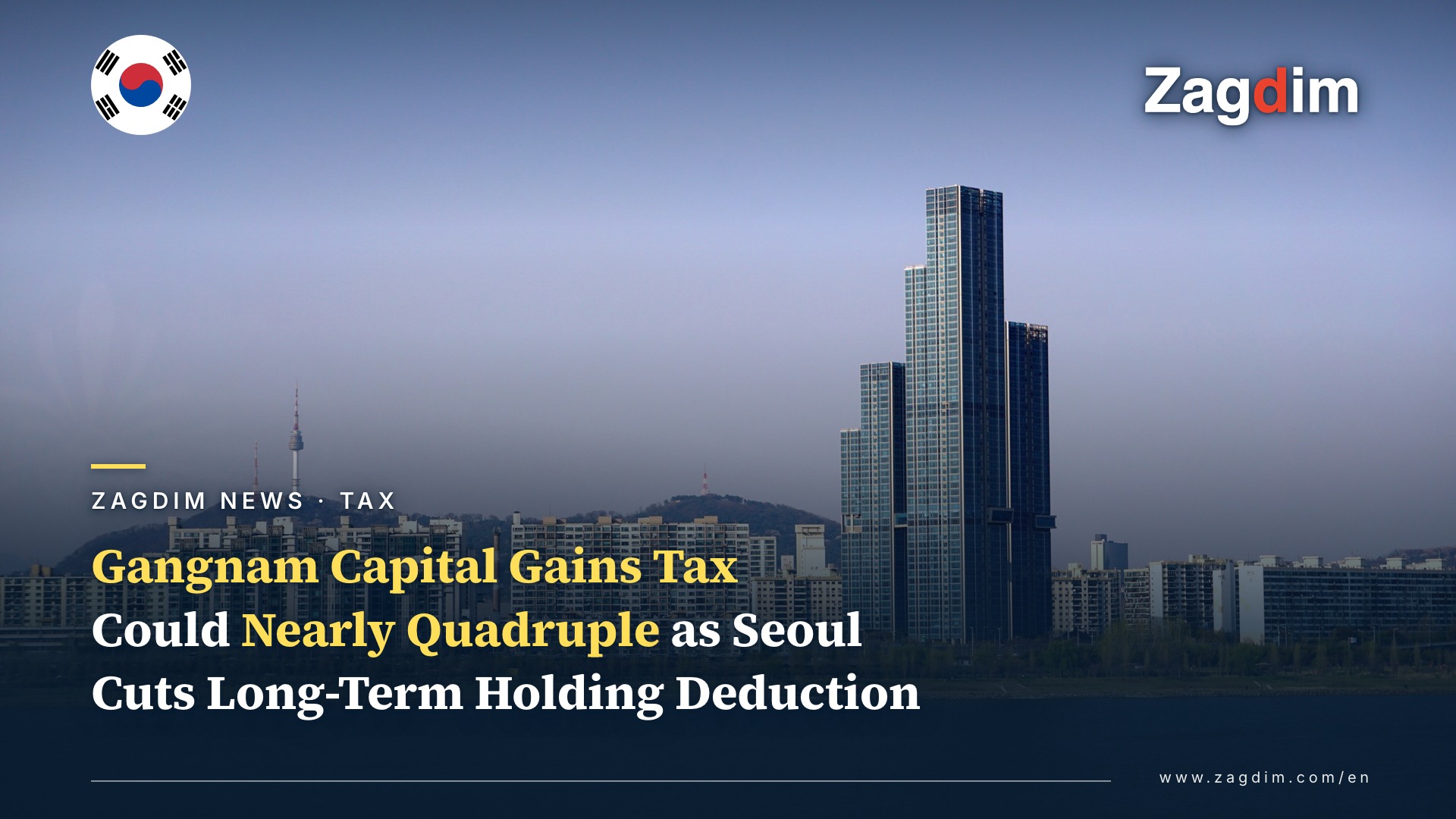
South Korean homeowners in Seoul’s high-priced Gangnam-area districts could face capital gains tax bills nearly four times current levels under a government plan to scale back the Long-Term Holding Special Deduction, intensifying a tax debate that has already reshaped how Gangnam sales are financed.
Under the current rules, a one-home owner who meets holding and residency requirements can deduct up to 80% of capital gains through the Long-Term Holding Special Deduction. The government’s plan would phase that out, cutting the deduction cap to KRW 2 billion (roughly $1.5 million) in 2028 and KRW 1 billion (roughly $750,000) from 2029. Woo Byung-tak, a senior tax advisor at Shinhan Premier Pathfinder, modelled the effect for a one-home owner who buys an 84-square-metre unit at Banpo Xi in Seocho district, holds it for 10 years and sells: the capital gains tax bill would rise from KRW 198.1 million (about $150,000) today to as much as KRW 710.48 million (about $530,000) after 2029. A second simulation, for a similarly sized unit at Raemian Prestige in the same district bought for KRW 1.6 billion and sold for KRW 5.6 billion, showed the tax bill climbing from KRW 241.85 million (about $180,000) today to KRW 944.85 million (about $700,000) after 2029.
Opposition to the scale of the cut is building inside the ruling Democratic Party of Korea itself, with Seoul-district lawmakers pushing to retain part of the holding-period deduction or apply differentiated caps by holding period, alongside separate calls to raise the Comprehensive Real Estate Tax’s basic deduction from KRW 1.2 billion to KRW 1.4 billion. A National Assembly public petition calling for the income-tax amendment to be reconsidered, filed April 8, has passed 24,000 signatures, with petitioners arguing that long-term owner-occupiers who have genuinely lived in their homes should be treated differently from speculative buyers. Experts cited by BigGo Finance say any softening of the cut is likely to have only a limited effect on Gangnam’s sale and jeonse (long-term deposit lease) markets, since holding-tax burdens and other regulations on the area remain in place regardless.
This is a new development on an issue Zagdim has covered before: a November 8 report examined Gangnam landlords lending buyers money directly, in some cases up to $1.8 million, to work around capital-gains-tax timing rules. The deduction fight now underway is a separate, longer-horizon threat to the same group of long-term Gangnam owners.