





























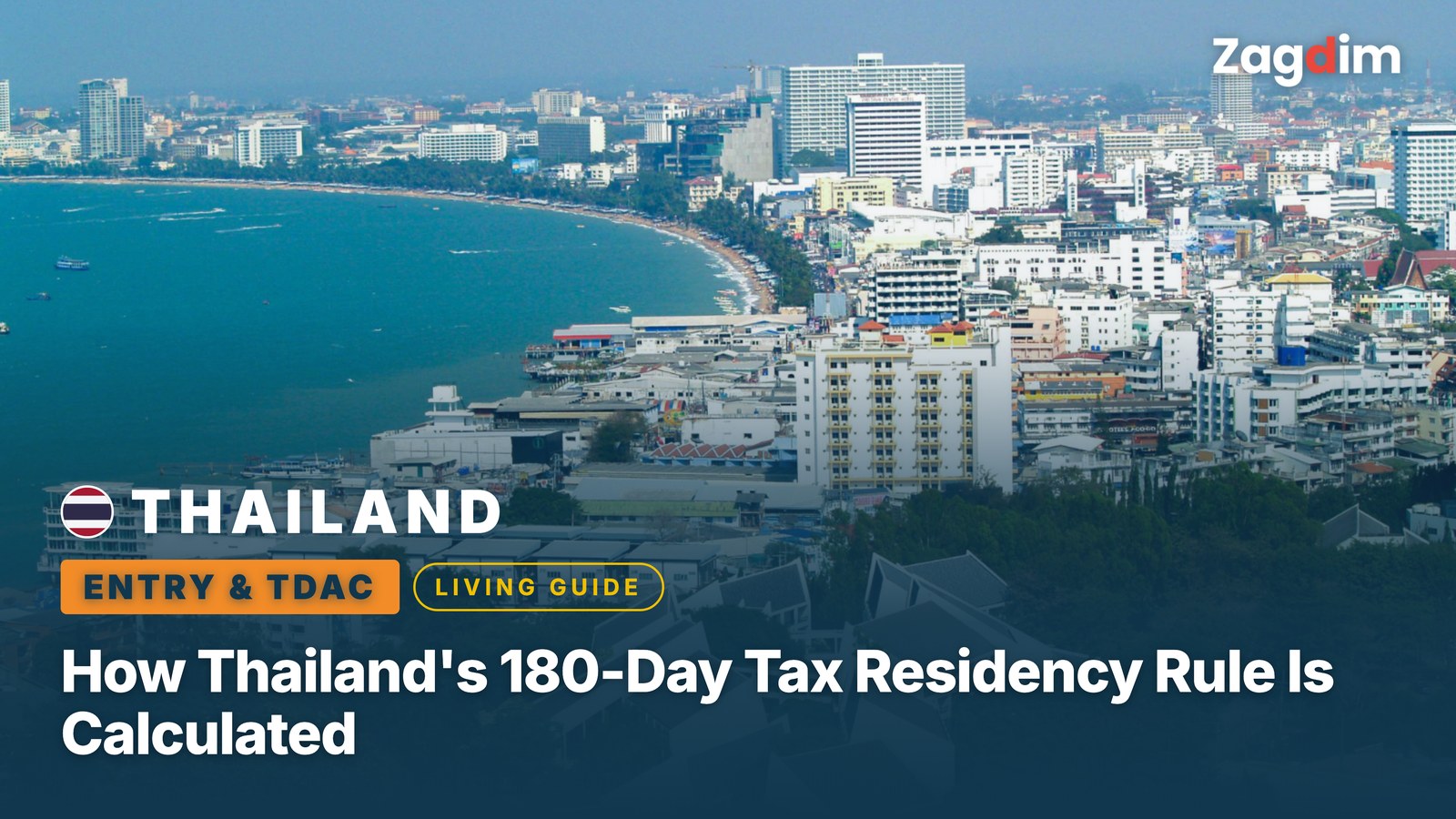
If you enter and leave Thailand multiple times in a year, what determines whether you may become a Thai tax resident is not how long any single stay lasted, but the total of all your days in Thailand added together within the same calendar year.
In short:
- Thailand’s tax year generally follows the calendar year — January 1 to December 31.
- If you enter multiple times in a year, the days you stayed need to be added up.
- Trips spanning a year-end must be split: December days count toward the earlier year, and days from January onward count toward the following year.
- If your total for the year reaches 180 days or more, you may generally be considered a Thai tax resident for that year.
Reference: guidance from the Thai Revenue Department and PwC Tax Summaries on Thai tax residency.
It’s Not Reset by Leaving — It’s a Cumulative Total for the Same Year
Many people mistakenly believe that leaving Thailand even once partway through resets the 180-day count. This understanding is not accurate.
Thai tax residency is generally determined by whether your total days in Thailand within the same tax year reach 180 days or more. In other words, even if you enter three times in a year and stay only one or two months each time, once the total reaches the threshold, you may still need to address the question of tax residency status.
For example:
| Stay | Days |
|---|---|
| First trip to Thailand | 45 days |
| Second trip to Thailand | 60 days |
| Third trip to Thailand | 80 days |
| **Total for the year** | **185 days** |
In this case, even though no single trip reached 180 days on its own, the full-year total already exceeds 180 days — so you can no longer judge the matter simply by saying “none of my individual stays were very long.”
How to Calculate It Yourself: 4 Simple Steps
First, pick the year you want to check.
For example, if you want to check 2025, you only count the days you were physically in Thailand between January 1 and December 31, 2025.
Second, list every entry and departure date.
You can compile this from passport stamps, flight records, immigration records, or a travel itinerary. The key is not to rely on impressions like “roughly half a year.”
Third, calculate each stay separately.
Each period from entry to departure counts as one stay. If you were already in Thailand the previous year and stayed on into the following year, the days before and after the year-end need to be counted separately into their respective years.
Fourth, add up all the periods.
If your annual total is clearly well below 180 days, the 180-day threshold usually is not a major concern. If it is close to 180 days, it’s worth re-checking your official entry and exit records. If it has already reached or exceeded 180 days, you should go a step further and confirm whether tax filing, a tax identification number, or the remittance of foreign-sourced income is involved.
Three of the Most Common Misunderstandings
Misunderstanding 1: Leaving the country partway through resets the day count.
In practice, tax residency is generally determined by the cumulative days within the same calendar year, not by counting each entry independently.
Misunderstanding 2: A tourist visa, DTV, or other visa type automatically rules out tax residency.
Tax residency is determined mainly by actual days of stay, not by the name of the visa. Visa type affects your right to stay in the country; it does not automatically exclude the question of tax residency.
Misunderstanding 3: Staying under 179 days guarantees there is absolutely no issue.
180 days is an important threshold, but actual tax exposure can also involve other countries’ tax residency rules, the source of your income, the timing of remittances, and whether you have Thai-sourced income. When you’re close to the threshold, you should not rely solely on what you read online.
When Should You Look Into This More Carefully?
If you only stay in Thailand for a few dozen days a year in total, generally you just need to keep records.
But if any of the following applies to you, it’s worth carefully organizing your dates:
- You travel to and from Thailand multiple times a year, staying anywhere from several weeks to several months each time;
- You live in Thailand long-term but take short trips to other countries in between;
- Your trip spans a year-end — for example, entering in December and not leaving until February the following year;
- Your own estimate falls somewhere between 160 and 190 days;
- You may already be over 180 days, and you have overseas income, investment income, rental income, or large fund transfers into Thailand.
Once you’re close to or over 180 days, the next step is no longer just “counting days” — it’s going back to the full set of tax residency and foreign-sourced income rules to confirm whether you need to file, whether remittance taxation applies, and whether you should consult a Thai tax advisor.
FAQ
Q1: How do you calculate a trip that spans a year-end?
You split it across two years. Days in December of the earlier year count toward that earlier year, and days from January 1 onward count toward the following year — you cannot put the whole trip into a single year.
Q2: Do multiple short stays in Thailand within one year still count?
Yes. Even if each stay is only a few weeks, as long as the cumulative total within the same calendar year approaches 180 days, you should list out and add up every stay.
Q3: Does exceeding 180 days automatically mean you have to pay tax?
Not necessarily. Exceeding 180 days generally means you may be considered a Thai tax resident, but whether tax is actually owed still depends on whether you have Thai-sourced income, whether foreign-sourced income was remitted to Thailand, and the tax year and rules that income falls under. This should be handled as part of full tax planning.
Have questions about a Thai visa, long-term stay, or entry status? Submit your basic situation to Zagdim first. Zagdim will do an initial review of your purpose of stay, entry records, income sources, and possible visa directions; if needed, it can also connect you with suitable Thailand visa and relocation service resources through ZDelp. Ask Zagdim.
*Disclaimer*
*This article only explains the basic method for calculating Thailand’s 180-day tax residency threshold. It is provided for general information and self-checking purposes only and does not constitute tax, legal, or financial advice. If you are already close to or over 180 days and this involves overseas income, investment returns, rental income, or large fund transfers into Thailand, you should rely on the Thai Revenue Department’s latest rules and the advice of a qualified tax advisor.*
Have a question about this guide? Leave a comment below, or ask Zagdim directly.
Your first stop for international property and global living.
Research and insights. Know what’s changing. Understand what matters.