






























Three Things You Need to Know Before Working Legally in Thailand
- To be legally employed in Thailand, most people need to hold both a Non-Immigrant Visa “B” (Non-B Working) and a Work Permit at the same time. Having only one of the two does not make you compliant.
- The employer must be a Thai entity that meets legal requirements, and in most cases must reach a certain registered capital and Thai-to-foreign staff ratio before it is eligible to apply for a work permit for a foreign employee.
- Starting in 2025, Thailand has been rolling out the e-Work Permit online platform in stages. Some procedures are moving from paper to online, with temporary transitional measures during the changeover, and both application timing and how the system is used have been changing.
Who Most Needs to Understand the Non-B and Work Permit System?
The most typical case is someone who has been offered a job in Thailand but isn’t sure which visa to apply for or whether the company can legally hire them. This group is usually white-collar professionals, teachers, hotel managers, and tech workers who are about to sign, or are already negotiating, an offer with a Thai company.
A second common situation involves people already in Thailand on a visa exemption, tourist visa, or student visa who start getting full-time or part-time work opportunities but aren’t sure whether they can switch to legal working status while still in the country. Most paths to legal work still come back to the Non-B plus Work Permit combination, and filling that gap is not as simple as it sounds.
A third group is entrepreneurs and HR staff preparing to set up a Thai company or expand a team. Before hiring foreign talent, they need to confirm whether the company itself meets the threshold for employing foreigners — each foreign employee corresponds to a certain amount of registered capital and a certain number of Thai employees, a cost that many people fail to factor in ahead of time.
From Visa to Work Permit: The Basic Path to Legal Employment
What Is the Non-B Visa?
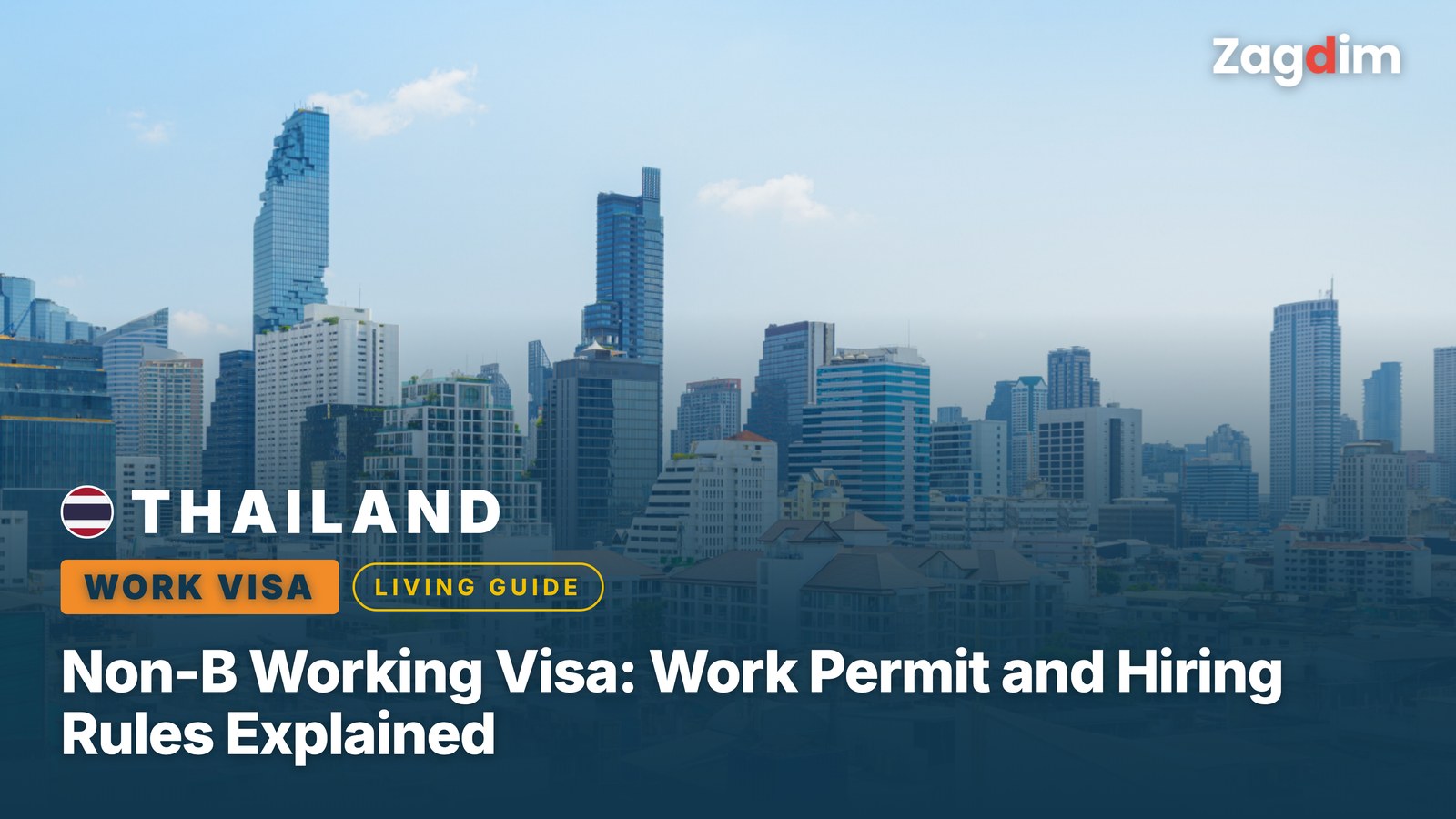
The Non-Immigrant Visa “B” is Thailand’s visa category for entry for “business and work” purposes, covering paid employment, teaching, some internships, and business activities.
If the purpose of the application is paid employment, in most cases applicants applying for a Non-B at an overseas Thai embassy or consulate need to provide an approval letter from the Ministry of Labour (usually the result of a Form WP.3 pre-approval), along with the employer’s company documents and an employment letter. Requirements vary slightly between missions (Taipei, Los Angeles, Austria, and others), but for applicants applying for work purposes, most will ask for employer-related documents and Ministry of Labour approval.
One point that is easy to confuse: the Non-B is an entry visa, not the work authorization itself. To actually work in Thailand, you must separately obtain a Work Permit issued by the Ministry of Labour after entry.
What Is the Work Permit, and Who Administers It?
The Work Permit is issued by the Department of Employment under the Ministry of Labour. It allows a specific foreign national to work, for a limited period, for a specific employer, at a specific location, in a specific role. The application records the employer’s details, job title, work location, and salary in detail, and all of this becomes the legal content printed on the Work Permit.
For most people planning to be employed in Thailand, the path generally looks like this:
1. Find a Thai employer willing to hire you.
2. The employer first applies to the Ministry of Labour for WP.3 or the relevant pre-approval.
3. You take the approval letter and company documents to an overseas Thai embassy or consulate to apply for the Non-B.
4. After entering on the Non-B, the employer helps you apply to the Ministry of Labour for the Work Permit.
Having “a Non-B but no Work Permit,” or “a Work Permit but the wrong visa type,” both create compliance problems. The two documents must be treated as a set.
The Employer Must Qualify First: Basic Eligibility for Hiring Foreigners
Before you consider whether “you” can work in Thailand, your employer must first clear the hurdle of whether it “can hire a foreigner” at all. Common requirements for a general Thai company include:
- A certain amount of registered capital corresponding to each foreign employee.
- A certain number of Thai employees corresponding to each foreign employee (a commonly cited ratio is 4 Thai employees to 1 foreign employee).
- The company must have completed tax and social security registration and be able to show records of normal operations.
The exact figures and applicable exceptions (such as a foreign employee married to a Thai national, branch offices or representative offices, or BOI companies) may follow different rules, and should be confirmed against Ministry of Labour regulations and up-to-date professional guidance.
If the company is a BOI (Board of Investment)-promoted enterprise, the quota and capital limits for hiring foreign experts and technical staff are generally more relaxed, depending on the terms of the BOI approval, though it is still assessed case by case.
For job seekers, while negotiating an offer you should proactively confirm whether “the company has processed work permits for foreigners before” and “whether it currently meets the employment quota,” rather than waiting until the application stalls to discover the company doesn’t qualify.
2025-2026: What Is Changing With the e-Work Permit?
Thailand’s Ministry of Labour is rolling out the e-Work Permit online platform, aiming to consolidate foreign worker registration and work permit applications into a single online system. From October 2025, most new applications are expected to move to online processing; however, technical issues arose soon after the system launched, and between late 2025 and early 2026 the Ministry of Labour allowed some employers to continue submitting on paper, provided they attached screenshots of the system error.
In practice, this means applications now depend more heavily on online accounts and document uploads, and both employers and employees need to set up accounts within the system. If the platform is unstable, applications may be delayed, or applicants may need to switch to the paper-based transitional option, so it is worth building extra flexibility into your timeline.
Application methods and document formats may keep changing over the next few years. Before applying, it is advisable to check the latest official announcements or confirm the currently applicable process with your employer’s HR department.
Application Steps
Step 1: Confirm the Employer and Position Are Eligible
Applying for the Non-B and Work Permit is generally an employer-led process, not something you handle alone. Confirm the following with your Thai employer first:
- The company is a legally registered entity with an actual operating record.
- Whether it has processed a Non-B and Work Permit for other foreign employees before (if so, the process usually goes more smoothly).
- Whether it currently meets the quota and capital requirements for hiring foreigners, or has already obtained special approval such as BOI status.
- Whether your position reasonably matches your education and experience — reviewers may assess whether hiring a foreigner is genuinely necessary for the role.
If the employer has no idea about these questions, the subsequent application process will require much more communication and time.
Step 2: The Employer Applies to the Ministry of Labour for Pre-Approval (WP.3)
In most cases where the Non-B is applied for from outside Thailand, the Ministry of Foreign Affairs requires the applicant to provide an approval letter from the Ministry of Labour — the Form WP.3 pre-approval document.
This document is submitted by the employer to the Office of Foreign Workers Administration or the relevant local employment office, along with company registration documents, tax and social security certificates, an employee roster, and a job description, explaining the reason for hiring a foreigner. Once the pre-approval is granted, the employer sends you the approval document, which becomes a key attachment for the Non-B application.
Step 3: Apply for the Non-B Working Visa
Once you have the pre-approval document, apply at the Thai embassy, consulate-general, or trade and economic office in your place of residence. Requirements vary slightly by mission, but generally include:
- A passport with sufficient remaining validity.
- A completed visa application form.
- A recent photo.
- An invitation or employment letter from the employer.
- The employer’s company registration documents and corporate information.
- The Ministry of Labour approval letter (WP.3).
- Proof of your education and work experience (depending on the position).
- If you have worked in Thailand before, a copy of your previous Work Permit and personal income tax filings may also be required.
Agencies such as VFS Global handle document collection in some regions, but the latest requirements from the local embassy or office still take precedence.
Step 4: Apply for the Work Permit After Entry
After entering on the Non-B, the employer will generally help you apply to the Ministry of Labour for the Work Permit within a set period. This application generally requires:
- Your passport and Non-B visa.
- The employer’s company documents (registration certificate, shareholder list, financial statements, etc.).
- A job description and employment contract.
- Proof of education and experience (sometimes requiring translation or notarization).
- A recent photo and completed Work Permit application forms (such as W.P.6, W.P.25, etc.).
After 2025, most of this material is uploaded through the e-Work Permit platform; if the platform has technical issues, a paper-based transitional route may be allowed.
Once approved, the Work Permit will clearly state the employer’s name, position, work location, and validity period. You may only work for the approved employer and role; if you change employer or role, you will need to go through the relevant procedures again.
Common Sticking Points
- The employer does not meet the capital or Thai-staff-ratio requirements, causing the pre-approval or Work Permit to be rejected.
- The employer’s documents or tax records are incomplete and cannot prove normal business operations.
- The applicant’s education does not match the position, raising questions about whether hiring a foreigner is genuinely necessary.
- The application is submitted after the e-Work Permit rules became mandatory, but still follows the old process, causing the system or the office to reject the submission.
Confirming the employer’s readiness early, and building in enough time to handle supplementary document requests and system changes, is key to reducing hold-ups.
Common Misconceptions
Misconception 1: Having a Non-B Alone Means You Can Start Working
The Non-B is an entry visa, not a work authorization. Legal employment still requires a Work Permit issued by the Ministry of Labour. Working without a Work Permit — even with a Non-B visa — can still be treated as illegal employment.
Misconception 2: You Can Enter on a Tourist Visa and Sort the Paperwork Out Later
Actually working while holding a tourist visa or on visa exemption is a high-risk situation. Most Work Permit applications require holding a Non-B as a precondition, and a tourist visa generally cannot be used to apply for a Work Permit directly. Even if there is a later opportunity to change visa type, that does not automatically make earlier work activity legal.
Misconception 3: Any Thai Company Can Sponsor a Work Permit
Only companies that meet specific capital and Thai-staff-ratio requirements are eligible to apply. Before discussing salary and role, confirm whether the employer has the corresponding quota and prior experience handling this process.
Misconception 4: Once You Have a Work Permit, You Can Do Any Job
The Work Permit clearly states the employer, position, and work location. Working for a different employer, or work whose actual content differs significantly from what was authorized, may be treated as exceeding the scope of the permit. Changing role, location, or employer generally requires updating the Work Permit and related visa at the same time.
Misconception 5: The e-Work Permit Is Just the Paper Version Turned Digital
The e-Work Permit introduces new elements such as online accounts, document upload specifications, and system-error handling — it is not simply a format conversion. During the unstable transition period, the authorities even issued temporary measures allowing paper applications to continue for a while. Before applying, confirm whether the current process is the “full online process” or the “paper-based transitional option,” to avoid delays from choosing the wrong path.
Three Typical Scenarios
Scenario 1: An Engineer With an Offer From a Bangkok Tech Startup
Background: You are a software engineer who has received a formal offer from a Bangkok startup and hope to start within three months. You are currently in your home country and have not yet applied for any Thai visa.
How to handle it: First have the employer confirm the company meets the capital and Thai-staff-ratio requirements for hiring foreigners, then have the employer apply to the Ministry of Labour for pre-approval (WP.3). With the approval letter and company documents, apply for the Non-B at your local Thai embassy. After entering, the employer helps you complete the Work Permit application on the e-Work Permit platform.
Key risk: If the employer itself does not yet meet the quota, or its documents are not ready, the overall timeline will be significantly delayed. Factor in the “company’s eligibility” before signing, not just the salary terms.
Scenario 2: A Freelancer Long-Staying in Chiang Mai on Visa Exemption
Background: You have been going in and out of Chiang Mai on visa exemption, providing remote services to overseas clients. A local company recently wants you to join as a full-time employee.
How to handle it: To become legally employed in Thailand, you still need a Non-B plus Work Permit. The specific route (converting status within Thailand or exiting and reapplying) depends on the policy at the time and the individual case; confirm first whether the company has processed this before for other foreign employees, then have the company seek professional advice to design the route.
Key risk: Past work in Thailand on a tourist visa may be considered non-compliant, and no application should assume it can “fix” all past history. Be truthful when filling out forms and in interviews, and follow the latest official rules.
Scenario 3: Setting Up a Company in Bangkok and Hiring Foreign Partners
Background: You plan to set up a company in Bangkok with several foreign partners, intend to hire multiple foreign professionals in the future, and are considering applying for BOI investment promotion status.
How to handle it: When designing the shareholding structure and registered capital, estimate the quota needed based on the expected number of foreign employees; if BOI status is obtained, the restrictions will differ. Arrange the Non-B and Work Permit for each employee individually afterward.
Key risk: If the initial capital and Thai-staff arrangements are insufficient, every additional foreign employee may require restructuring or hiring more local staff, directly affecting cost and time.
FAQ
Q1: Do foreigners working in Thailand always need both a Non-B and a Work Permit?
In most employment situations, yes. Without a Work Permit, even the correct visa type may still be treated as non-compliant, and the reverse is also true.
Q2: Can I enter Thailand on a tourist visa first and have the company arrange the Work Permit afterward?
Most Work Permit applications require holding a Non-B as a precondition; entering on a tourist visa or visa exemption generally cannot lead directly to a Work Permit. Some people enter first and consider converting status later, but feasibility and requirements vary by period and status — confirm the current policy and discuss the route with your employer or a professional before acting.
Q3: What does a Thai company need to legally hire a foreign employee?
A general limited company generally needs to reach a certain registered capital and Thai-to-foreign staff ratio, and complete tax and social security registration. A common pattern is that each foreign employee corresponds to a certain amount of capital and four Thai employees, but actual requirements vary by company type or special programs (such as BOI).
Q4: What is different for BOI companies on the Non-B and Work Permit?
Companies that have obtained BOI investment promotion status generally have more relaxed quota and capital limits when hiring foreign experts and technical staff, mainly based on the terms of the BOI approval and the program’s content. The specific process and conditions still depend on the latest official rules and individual case outcomes.
Q5: Once the e-Work Permit is live, will paper Work Permits be completely phased out?
The direction is a full move to online, but transitional measures allowing continued paper applications remain in place while the system is newly launched. Whether it will be completely phased out still depends on further official announcements.
Q6: I’m already working in Thailand without a Work Permit — can I still fix it later?
Applying retroactively does not necessarily remove the risk from past conduct. Whether it can be fixed, and whether you need to adjust your visa or leave and reapply first, depends on the policy at the time and your individual circumstances. It is best to first clarify your current visa, the nature of your work, and your employer’s status, then seek specific advice from a qualified professional.
To get help mapping out a Thailand visa, long-stay, or entry-status question, ask Zagdim.
*Disclaimer*
*This article is compiled from publicly available information from the Thai Ministry of Foreign Affairs, the Ministry of Labour, and various professional law firms and consultancies between 2019 and 2026. It is provided for general information only and does not constitute legal, tax, immigration, or other professional advice.*
*Rules concerning Thailand’s Non-Immigrant Visa “B,” the Work Permit, and company hiring of foreigners continue to be adjusted, and details of measures such as the e-Work Permit may still be updated. Before applying, you should confirm the latest announcements from Thai embassies and consulates, the Ministry of Foreign Affairs, and the Ministry of Labour, and consult a qualified lawyer, accountant, or immigration consultant where necessary.*
Have a question about this guide? Leave a comment below, or ask Zagdim directly.
Your first stop for international property and global living.
Research and insights. Know what’s changing. Understand what matters.
Sources
Ministry of Foreign Affairs of Thailand – Non-Immigrant Visa “B” / Department of Employment, Ministry of Labour – Work Permit Forms and Guidance / Royal Thai Embassies & Consulates – Non-Immigrant B (Business and Working) Visa Instructions / BIPO – Updates on Thailand’s Labour Law / Fragomen – Thailand: Mandatory Online Work Permit and Foreign Worker Registration System / Evershine CPA – Thailand Work Permit and Non-BOI/BOI Procedures / Kudun & Partners – Work Permits and Thailand Labour Law: A Foreign Worker’s Compliance Guide