




























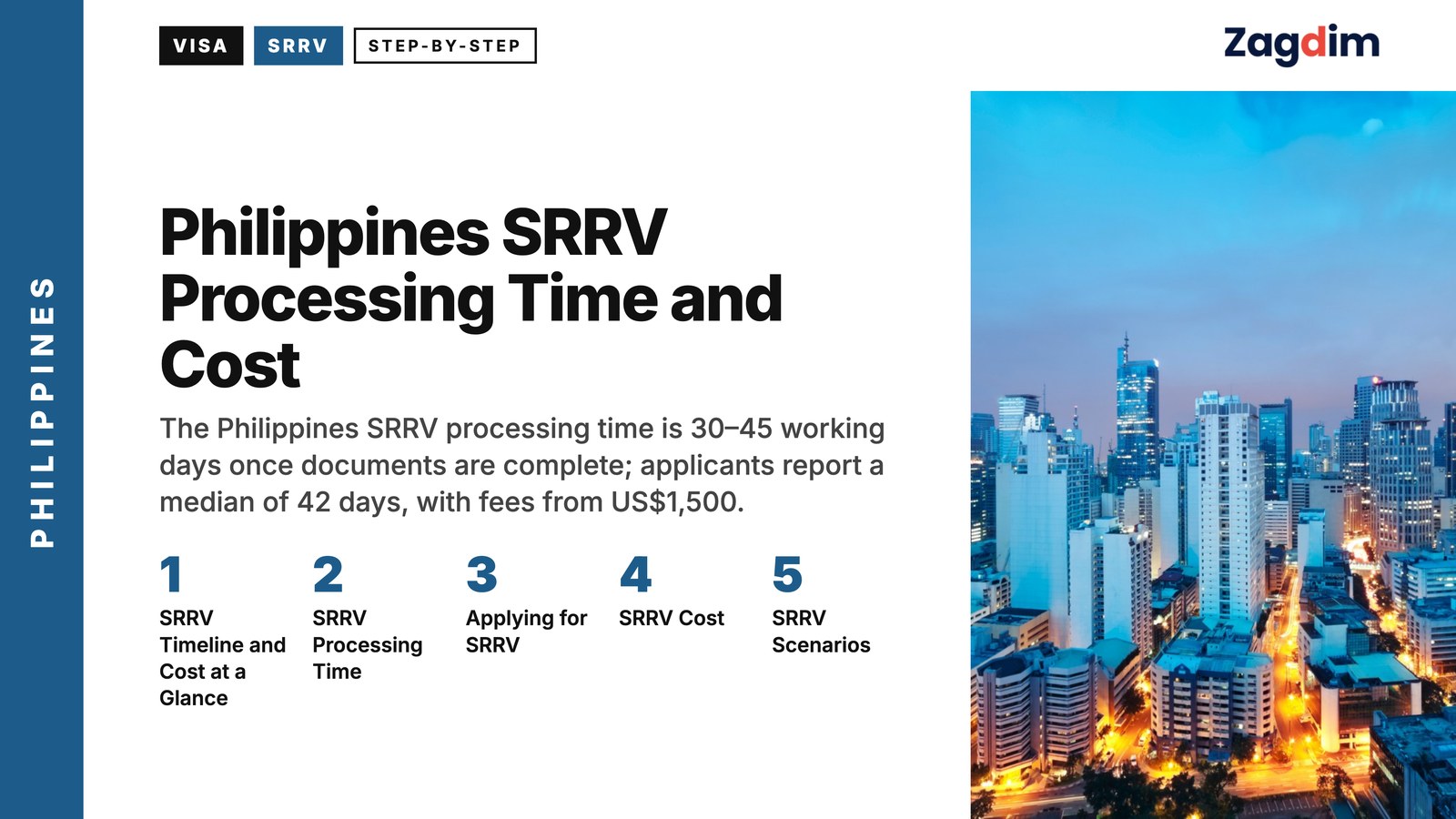
The Special Resident Retiree’s Visa (SRRV) is a long-term residency visa issued by the Philippine Bureau of Immigration under the retirement program of the Philippine Retirement Authority (PRA). It is open to foreign nationals and former Filipino citizens. Since the 2025 reform, applicants as young as 40 can apply, and SRRV holders can live in the Philippines long-term with multiple entry and exit. For anyone considering the Philippines as a retirement base or a second home abroad, the two most practical questions are: how long does SRRV processing actually take, and how much does it cost to prepare?
On timing, PRA’s official documents give two different figures: an August 2025 document states 30–45 working days once all documents are complete, while a revised September 2025 citizen’s charter states 10 working days (not including Bureau of Immigration processing). According to Zagdim research, applicants report a median of about 42 days from when they begin processing in the Philippines to when they receive their SRRV, with the middle half falling between 30 and 60 days. On cost, the SRRV application fee is a non-refundable US$1,500 for the principal applicant, and the deposit ranges from US$1,500 to US$50,000 depending on age and category, refundable on withdrawal.
This article labels information sources as Zagdim verified, Zagdim research, and Zagdim practice. Zagdim research comes from Zagdim Field Research: the Zagdim research team has compiled the first-hand experiences of nearly 1,500 SRRV applicants, holders and people considering the visa, from 2007 to 2026, recording processing times, costs, documents and problems case by case and cross-checking them against the official PRA rules (see How Zagdim researches). It closes with three sample household scenarios to help you estimate your own timeline and cash needs. Data current as of September 2026.
SRRV Timeline and Cost at a Glance
| Item | Official Rule (Zagdim Verified) | Applicant Experience (Zagdim Research) |
|---|---|---|
| Processing time | 30–45 working days once documents are complete; also a 10-working-day standard (not including immigration processing) | Median about 42 days, middle half between 30 and 60 days |
| Where you must be during processing | Applicant must remain in the Philippines for the entire application period | — |
| Application fee | US$1,500 for the principal applicant, US$300 per dependent; non-refundable if withdrawn | — |
| Deposit | US$1,500–50,000 depending on category and age; refundable | — |
SRRV Processing Time: Two Official Standards, Applicants Report 30–60 Days
Under PRA’s August 2025 official document (Zagdim verified), SRRV processing takes 30–45 working days once documents are complete (PRA, “Expanded SRRV Program”). A revised service standard from September 2025 instead states 10 working days, but this does not include Bureau of Immigration processing time (PRA, “Citizen’s Charter 2025”). Both standards exist side by side, and applicants must remain physically present in the Philippines for the entire application period.
Zagdim research compiled applicants’ self-reported SRRV processing times: from when they began processing while in the Philippines to when they received their SRRV, the median was about 42 days, with the middle half falling between 30 and 60 days. Looking only at accounts from 2025–2026, the median is also about 42 days — processing has not visibly slowed since the reform. These figures are self-reported by applicants, generally counted in calendar days, and the starting point varies by person (some count from filing, others include time spent preparing documents while already in the Philippines). They are useful for planning purposes, not an official commitment.
Zagdim reality check: SRRV Processing Time
| What the Rules Say (Zagdim Verified) | What Applicants Ran Into (Zagdim Research) | Zagdim’s Take |
|---|---|---|
| 30–45 working days; or 10 working days (not including immigration processing) | Middle half fall between 30 and 60 days; some cases move faster | Official figures are counted in working days, while applicants tend to report in calendar days, so actual experience runs closer to 30–45 working days. The clock only starts once documents are complete, so planning for a six- to nine-week stay in the Philippines is a safer bet. Claims of getting an SRRV “in two weeks” usually assume an expedited process — always ask exactly what that expediting covers and costs. |
Applying for SRRV: Timeline From Preparation to Card
| Stage | When | What Happens |
|---|---|---|
| 1. Confirm category and deposit | When deciding to apply | Confirm category and deposit amount based on age, whether you have a lifetime pension, whether you are a former Filipino citizen, and number of dependents |
| 2. Prepare home-country documents | About 2–3 months before arrival (Zagdim practice) | Police clearance must be issued within 6 months and authenticated with an apostille or through the nearest Philippine embassy or consulate; birth, marriage and other relationship documents need the same authentication; non-English documents need translation |
| 3. Wire the deposit | Before departure | Wire funds from an overseas bank to a PRA-accredited bank; if using a private accredited bank, apply to PRA for an introduction letter first |
| 4. Enter the Philippines | Once documents and deposit are ready | Enter on a valid tourist visa and keep that visa valid throughout the application |
| 5. Complete pre-filing steps in the Philippines | A few days after arrival | Medical exam; Bureau of Immigration Clearance Certificate (BICC); applicants staying 90+ days also need an NBI police clearance |
| 6. File and pay | After pre-filing steps are complete | File with PRA, attend the interview, and pay the application fee |
| 7. Approval | After filing | PRA reviews the application, then forwards it to the Bureau of Immigration for visa issuance |
| 8. Oath and card | After approval | Take the oath, get the visa stamped in your passport, and receive the PRA ID card |
Receiving the PRA ID card is not the final step. While holding an SRRV, holders must pay an annual fee, renew the PRA ID card as required, and keep the deposit in an accredited bank or convert it into a compliant investment; withdrawing the deposit later requires a separate application. Zagdim research found that many applicants continue to run into issues after receiving their SRRV — card renewal, entry and exit, annual fees, deposit refunds and bank accounts among them. Planning for these ongoing items in advance tends to reduce surprises.
SRRV Cost: Money You Get Back vs Money You Don’t
Money You Don’t Get Back
- Application fee: US$1,500 for the principal applicant, US$300 per dependent (US$1,400 before the 2025 reform). Per official documents, the application fee is non-refundable if you withdraw partway through (PRA, “Expanded SRRV Program”). For full details of the 2025 reform, see Philippines SRRV 2025 Update: Classic Age Requirement Lowered to 40.
- Annual fee: Under the 2025 reform, the official annual fee is US$360 for Classic, US$100 for Courtesy (foreign nationals), and US$50 for former Filipino citizens, each covering the principal applicant plus 2 dependents; Courtesy adds US$10 per additional dependent (PRA, “SRRVisa”).
- Documents and medical exam: Home-country police clearance, authentication, translation and the in-country medical exam — costs depend on your nationality and how you arrange them.
Money You Get Back: The Deposit
The deposit is the largest single sum in an SRRV application, but it is savings, not a fee. Under the 2025 reform, the official amounts are as follows (Zagdim verified):
| Category | Age | With Pension | Without Pension |
|---|---|---|---|
| Classic | 50 and above | US$15,000 | US$30,000 |
| Classic | 40–49 | US$25,000 | US$50,000 |
| Courtesy (specific categories only) | 50 and above | US$1,500 | |
| Courtesy (specific categories only) | 40–49 | US$3,000 | US$6,000 |
“With pension” means a lifetime pension of at least US$800 a month (single) or US$1,000 a month (with dependents). The deposit already covers the principal applicant plus 2 dependents; for Classic, each dependent from the third onward adds US$15,000; this surcharge does not apply to former Filipino citizens (PRA, “SRRVisa”).
Two rules govern the deposit: it must be wired in from an overseas bank into a PRA-accredited bank — domestic transfers within the Philippines are not accepted — and if you choose a private accredited bank, you need to apply to PRA for an introduction letter first (PRA, “SRRVisa”; PRA, “Accredited Banks”). The list of accredited banks is not fully consistent across different pages of the PRA website, so confirm the specific bank named in the introduction letter PRA issues at the time before wiring funds.
SRRV Scenarios: What Three Sample Households Need to Prepare
Start Here: Six Questions That Decide Your Deposit and Timeline
- Is the principal applicant 40–49, or 50 and above?
- Do you have a lifetime pension of at least US$800 a month (single) or US$1,000 a month (with dependents)?
- How many dependents will you bring? For Classic, each dependent from the third onward adds US$15,000 to the deposit.
- Is the principal applicant a former Filipino citizen?
- Where are your police clearance and relationship documents issued — will they go through an apostille, or a multi-step notarization and authentication process?
- Can you stay in the Philippines continuously for about six to nine weeks?
Once you can answer all six, you can find the closest match in the table below. Whichever question you can’t answer is usually the thing most worth clarifying before you apply.
The figures below cover official costs only (Zagdim verified, September 2026); medical exams, immigration clearance certificates, document authentication, translation, travel, accommodation and any service fees are separate.
| Scenario | Category | Deposit (Refundable) | Application Fee (Non-refundable) | Annual Fee |
|---|---|---|---|---|
| A. 45-year-old couple with one 12-year-old child, no lifetime pension | Classic, 40–49, no pension | US$50,000 (covers 2 dependents) | US$2,100 | US$360 |
| B. 55-year-old single applicant with a lifetime pension of US$800+/month | Classic, 50+, with pension | US$15,000 | US$1,500 | US$360 |
| C. 43-year-old former Filipino citizen (now holding another nationality) with a foreign spouse and 2 children | Courtesy, former Filipino, 40–49 | US$3,000 (covers 2 dependents); 3rd-dependent amount not yet confirmed (see below) | US$2,400 | US$60 |
What to watch for in each scenario
- Scenario A: Documents issued in some countries cannot go through a single-step apostille and instead require multi-stage notarization and authentication before Philippine authorities will accept them — typically notarization, then authentication by your home country’s foreign ministry, then by the nearest Philippine embassy or consulate. This adds both cost and processing time compared with an apostille, so check the exact steps, fees and turnaround with your nearest Philippine embassy or consulate well before you plan to travel. Police clearances and official relationship records (such as civil registry extracts) typically need the same multi-step authentication.
- Scenario B: Some countries’ police authorities do not release the clearance certificate directly to the applicant, and instead mail it directly to the requesting agency, and some do not offer apostille at all. This affects how the document can be submitted, and it’s worth confirming the exact submission method with your local police authority before applying. Zagdim is still confirming the practical submission approach for cases like this.
- Scenario C: A former Filipino citizen needs to provide either an old Philippine passport or a birth certificate from the Philippine Statistics Authority (PSA) — providing both is preferable. Based on Zagdim practice, a child’s birth certificate should be authenticated in the country where the child was born, and a marriage certificate in the country where the marriage was registered.
Zagdim practice: batch your documents and work backward from your police clearance date. Documents that need multi-step authentication, such as police clearances and civil registry extracts, move faster when submitted together rather than separately. When scheduling, work backward from your planned filing date to confirm that no more than 6 months will have passed between when the police clearance is issued and when you file. Getting the order wrong can mean discovering after you arrive that your police clearance has already expired and needs to be reissued.
What Slows Down an SRRV Application?
Based on applicants’ accounts, Zagdim research groups the common bottlenecks in SRRV applications into three categories:
- Home-country documents: Police clearance must be issued within 6 months and authenticated with an apostille or through the Philippine embassy or consulate; non-English documents need translation. Some income or status documents can’t be authenticated directly and require an alternative form of proof.
- Banking: Proof-of-deposit documentation can be slow to issue, or banks may request additional paperwork.
- Pre-filing preparation: Applicants staying 90+ days need an NBI police clearance in addition to the standard requirements; every applicant also needs a Bureau of Immigration Clearance Certificate (BICC).
How you arrange the process also makes a difference. According to Zagdim research, applicants who worked with an experienced professional on their SRRV application reported a more positive overall experience and fewer problems; applicants who handled it themselves reported relatively more problems. Handling it yourself is entirely workable, but you should set aside time to handle any requests for additional documents.
These three bottlenecks share one thing in common: most of them can be handled before you travel. If you sequence when the police clearance is issued, which authentication steps it needs, and which bank will issue your proof-of-deposit documentation before arriving in the Philippines, you avoid waiting on paperwork while your tourist visa runs down.
What Zagdim Is Still Checking
The following points are not clearly addressed in official documents. Zagdim is confirming them with the relevant authorities and will update this article once a response is received:
- Annual fee for holders who received SRRV before the reform: whether people who received their SRRV before September 2025 continue under the old annual fee. Zagdim wrote to PRA about this on 24 September 2026.
- Deposit refund timing and related costs after withdrawal: the official standard is 18–29 working days for cancellation and 5 working days for release, but the starting point for those timelines and bank processing time are not specified. Zagdim has asked PRA.
- Deposit amount for a third dependent in former-Filipino-citizen households: the official rules explicitly exclude these households from the US$15,000 surcharge but don’t state a replacement amount. Zagdim has asked PRA.
- Submission method for police clearances issued directly to a requesting agency rather than the applicant: in some countries the certificate cannot be released to the applicant directly. Zagdim is checking the practical workaround with PRA.
- Fees and turnaround for expedited immigration processing: Zagdim is confirming this with local professionals who assist with applications.
Zagdim’s Observation
Zagdim research finds that the hard part of an SRRV application is usually not the paperwork itself but figuring out what’s required: in Zagdim Field Research, applicants who are still evaluating their options report more confusion, while applicants who already hold an SRRV report more satisfaction. Working out your timeline and cash needs in advance is the single most effective way to reduce that uncertainty — plan for two months, separate the refundable money from the non-refundable, and only then decide how to handle the process.
Philippines SRRV Processing Time and Cost: Frequently Asked Questions
How Fast Can I Get an SRRV?
Short answer: Applicants report a processing time with the middle half falling between one and two months, so it’s safer to plan for two months. Official documents give two figures: 30–45 working days once documents are complete, or 10 working days (not including Bureau of Immigration processing). According to Zagdim research, the middle half of applicants’ self-reported processing times fall between 30 and 60 days, with some cases moving faster.
Can I Leave the Philippines While My SRRV Application Is Being Processed?
Short answer: No — you must remain in the Philippines for the entire application period. Under PRA’s official rules, applicants must stay in the Philippines throughout the application process and keep a valid tourist visa the whole time.
Can I Get My Deposit Back?
Short answer: The deposit can be refunded; the application fee cannot. The deposit is savings, and you can apply to have it refunded when you withdraw from SRRV; if you’re outside the Philippines, you’ll need authenticated documents such as a power of attorney. Zagdim is still confirming with PRA how long the refund takes.
What Do I Need to Do After I Receive My SRRV?
Short answer: Pay the annual fee, renew your PRA ID card as required, and keep your deposit in an accredited bank or compliant investment. Under the 2025 reform, the Classic annual fee is US$360 (covering the principal applicant and 2 dependents); when you eventually withdraw from SRRV, the deposit needs a separate refund application. Zagdim research found that many applicants continue to run into issues after receiving their SRRV — card renewal, entry and exit, annual fees, deposit refunds and bank accounts among them.
What Changed With the Fees After the 2025 Reform?
Short answer: The application fee rose to US$1,500, the deposit is now tiered by age and pension status, and the annual fee also changed. The application fee moved from US$1,400 to US$1,500; the deposit is now tiered by age and whether you have a pension, and the minimum age for the principal applicant dropped to 40; the annual fee is now US$360 for Classic, US$100 for Courtesy (foreign nationals) and US$50 for former Filipino citizens.
For the complete SRRV eligibility requirements and application process, see https://zagdim.com/en/buying-immigration-guide/philippines-srrv-retirement-visa-new-policy-and-application-guide-2026-update/.
Key Facts on This Page
| Claim in This Article | Status | Source | Checked On |
|---|---|---|---|
| Processing time: 30–45 working days once documents are complete; also a 10-working-day standard (not including immigration processing) | Zagdim verified (two official documents differ) | PRA, “Expanded SRRV Program” (August 2025); PRA, “Citizen’s Charter 2025” | 24 September 2026 |
| Application fee: US$1,500 for the principal applicant, US$300 per dependent; non-refundable if withdrawn | Zagdim verified | PRA, “SRRVisa”; PRA, “Expanded SRRV Program” | 24 September 2026 |
| Deposit tiered by category, age and lifetime pension status (US$1,500–50,000) | Zagdim verified | PRA, “SRRVisa” | 24 September 2026 |
| Annual fee: US$360 Classic, US$100 Courtesy (foreign nationals), US$50 former Filipino citizens (covers 2 dependents) | Zagdim verified; whether pre-reform holders qualify is pending PRA’s response | PRA, “SRRVisa” | 24 September 2026 |
| Deposit must be wired from an overseas bank to a PRA-accredited bank; private accredited banks require an introduction letter first | Zagdim verified | PRA, “SRRVisa”; PRA, “Accredited Banks” | 24 September 2026 |
| Applicants’ self-reported processing time: median about 42 days, middle half between 30 and 60 days | Zagdim research | Zagdim Field Research | September 2026 |
Applied for or Hold an SRRV? Share Your Experience
Whether it’s your experience applying for an SRRV, holding one, or a professional correction or addition, we welcome your input. Zagdim checks every account before using it anonymously in updates; no personal data or advertising is published. Leave a comment below.
Update Log
- 24 September 2026: First version. Official figures follow PRA’s August and September 2025 documents and the PRA website; Zagdim has written to PRA and local professionals about the items listed in What Zagdim Is Still Checking; added the Key Facts table, inline links to key official sources, and the share-your-experience section; revised statistical language.
Important Notes
This article is general information and does not constitute legal, immigration or financial advice. Whether you qualify, and which category and deposit amount apply to you, are determined by the Philippine Retirement Authority (PRA) during its review. Official information is drawn from the PRA website and official documents, current as of September 2026; rules may change, and PRA’s latest announcements take precedence. The Zagdim research and Zagdim practice in this article reflect the experience of applicants and real cases, do not represent all applicants, individual situations may vary, and are for planning reference only.
Sources
- Philippine Retirement Authority — “SRRVisa”
- Philippine Retirement Authority — “Accredited Banks”
- Philippine Retirement Authority — “Expanded SRRV Program” (August 2025)
- Philippine Retirement Authority — “Citizen’s Charter 2025”
Have a question about this guide? Leave a comment below, or ask Zagdim directly.
Your first stop for international property and global living.
Research and insights. Know what’s changing. Understand what matters.