






























Introduction
For families, international students and even budget-conscious retirees planning to settle in Malaysia long-term, “can I trust the healthcare system?” is often a key question when weighing the move. Malaysia’s healthcare system has two main pillars: public healthcare run by the government, and private healthcare run by companies. The two differ in services offered, language support, wait times and fees, and many foreigners only realize after arriving that choosing the wrong one can create inconvenience, or even risk.
In recent years, Malaysia has consistently ranked near the top in Asia on the healthcare component of the Global Retirement Index, which looks, on the surface, like an ideal choice for anyone relocating. In practice, though, there’s often a noticeable gap between that ranking and the actual experience — waiting hours to register, or limited English-language service at public hospitals — which can be a real adjustment for newcomers.
So does quality of care really vary with price? Is language support enough to handle a sudden medical issue? And as a non-Malaysian, how should you map out the right path to care for yourself? This article works through system structure × real-world experience × fee structure to give you a full picture of how Malaysia’s public and private healthcare systems differ, so healthcare doesn’t have to be a lingering worry in your life abroad.
Who Should Choose Which System
In Malaysia, which healthcare system to use isn’t just a budget question — it’s closely tied to your status, length of stay, and language needs. Understanding your own situation and the resources available to you is the first step toward stable healthcare.
Public Healthcare: The First Choice for Budget-Conscious, Long-Term Residents
Malaysia’s government healthcare system consists of public hospitals and clinics nationwide, with broad coverage and low fees, and is especially popular with local residents and foreigners on long-term visas. If you fall into one of the following groups, public healthcare may be a cost-effective option:
- You already hold a Long-Term Social Visit Pass or MM2H long-stay status
- Your spouse is a Malaysian citizen, letting you apply jointly for a dependent medical card
- You are settling long-term and have enough time to handle waiting and administrative procedures
Note, though, that even though non-citizens can use government hospitals, they do not get the subsidies reserved for locals — treatment is still billed at the “foreigner standard rate,” several times what a local pays.
Private Healthcare: Efficient, Language-Friendly, and Generally a Better Fit for Foreigners
If you place more value on medical efficiency, doctors’ English communication skills, or you’re only staying in Malaysia short-term, private healthcare is the more reliable choice. Consider a private hospital if you are:
- An international student, especially one on a language or degree program
- A short-term posted worker or a remote-working long-stay visitor
- Someone who prefers fully English-language service and has certain expectations for the care experience
- An older retiree seeking uninterrupted chronic-condition management and fast access to care
Private hospitals are mostly located in major cities such as Kuala Lumpur, Penang and Johor Bahru, and generally have an international patient department, with a simple process and short wait times, plus a choice of doctor and treatment plan — though fees typically run 3 to 5 times higher than public healthcare.
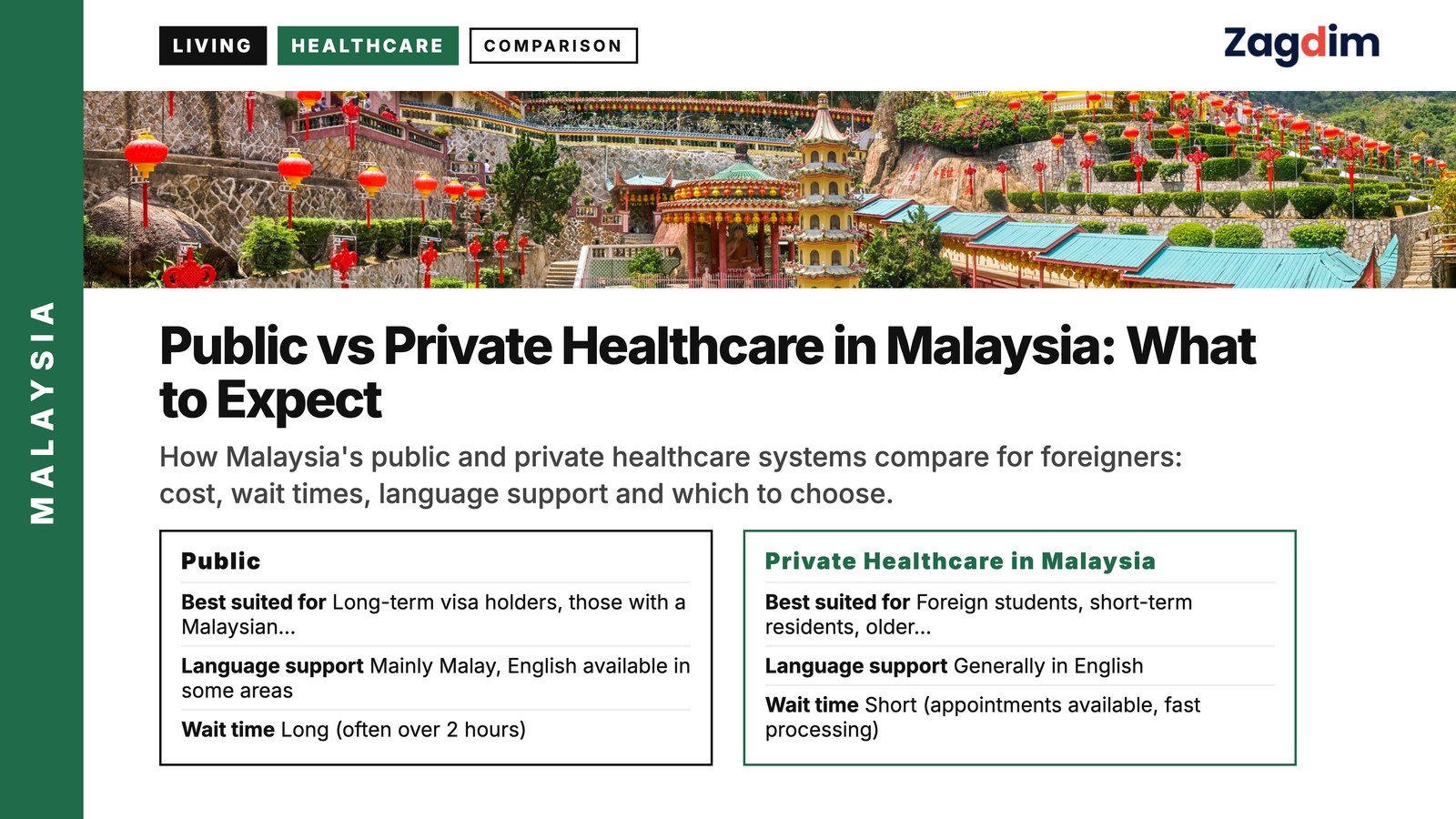
Public vs private healthcare: applicable groups × fees × wait times
| Item | Public Healthcare | Private Healthcare |
|---|---|---|
| Best suited for | Long-term visa holders, those with a Malaysian spouse, local residents | Foreign students, short-term residents, older retirees |
| Language support | Mainly Malay, English available in some areas | Generally in English |
| Wait time | Long (often over 2 hours) | Short (appointments available, fast processing) |
| Fees (foreigners) | Per-visit billing, from about RM50–200 | From about RM150–500, varying by service |
| Facilities and environment | Mostly basic care | Newer equipment, more modern facilities |
Key takeaway: even at a government hospital’s comparatively low prices, foreigners still pay the full cost out of pocket — if you value efficiency or language support, it is advisable to consider private healthcare first.
Choosing between public and private healthcare may look like a simple either-or, but which one actually fits you often depends closely on your status, visa or study situation — ask Zagdim about the specific challenge you’re facing and we’ll help you look into it.
Step-By-Step: Using Malaysia’s Healthcare System
Whichever system you choose, being familiar with the basic process for seeing a doctor can greatly reduce first-visit nerves and language mix-ups. Below is the standard process most foreigners follow when seeing a doctor in Malaysia, useful as a reference for your first visit:
Step 1: Choose the type of care (public or private)
First, decide whether to go to a government hospital or a private facility, based on your needs and budget. If you need to be seen the same day and prefer English communication, it is advisable to choose a private hospital; for chronic-condition follow-up or on a tight budget, a government clinic is worth considering.
Step 2: Confirm the nearest hospital/clinic and its scope of service
You can use Google Maps or the websites of major healthcare providers to find the nearest facility offering the relevant department. Note that some public clinics only support specific departments (such as general outpatient care or maternal and child health), while large hospitals have a full range of departments.
Step 3: Register at the front desk with your passport and visa documents
Whether it’s a first visit or a follow-up, you need your passport and a valid visa to register. Some private hospitals allow online booking in advance and provide a dedicated registration area for foreigners, cutting down on-site wait time.
Step 4: Wait, consultation, and tests (if needed)
Government hospitals usually assign numbers based on arrival time, with wait times commonly exceeding 1–2 hours; private healthcare generally runs on time, with a smoother process. In some situations (such as a fever or an injury), you may go straight into initial treatment or testing.
Step 5: Payment and picking up medication (or referral)
After treatment, go to the payment counter to pay and collect any medication. Government healthcare fees are low, but the range of medicines available may be limited; private hospitals provide full medication and an itemized quote, and often work directly with insurance reimbursement. If further tests or hospitalization are needed, the doctor will arrange a referral and explain the fee structure.
Tip: Private hospitals generally offer an English-language booking system and online registration, which is very friendly to foreigners, especially those seeing a doctor locally for the first time. Fee schedules vary, though, so it is advisable to ask for a quote in advance or use a hospital group with transparent pricing.
If you’re about to see a doctor in Malaysia but aren’t sure where to start, don’t worry — we can offer suggestions based on your location and needs. Ask Zagdim.
FAQ
Q1: Can foreigners use government hospitals directly?
A: Yes. Foreigners can go directly to a Malaysian government hospital for treatment, but must pay the full fee and cannot access the subsidies available to local citizens. The actual fee varies by treatment type and hospital tier.
Q2: Does private healthcare automatically mean higher quality?
A: Not necessarily always, but in most cases, private hospitals have newer equipment, cleaner facilities and internationally trained doctors, and the overall experience is generally better than at public hospitals, with significantly shorter wait times.
Q3: How good is doctors’ English in Malaysia?
A: In major cities such as Kuala Lumpur and Penang, doctors and medical staff generally have good English, and consultations and communication are usually not a problem. In rural areas or small clinics, though, it is advisable to confirm language support in advance.
Q4: What should I do in an emergency?
A: Government hospitals have a 24-hour emergency department at a comparatively low cost, but you may need to wait several hours if it’s busy. In a serious situation, it is advisable to go directly to a private hospital’s emergency department — fees are higher, but treatment and equipment are generally faster and better.
Q5: Will my insurance cover public hospital costs?
A: Most international health insurance mainly covers private hospital costs. If you want to claim government healthcare expenses, you need to check your policy’s specific terms or choose a plan that includes public facilities. It is advisable to proactively contact your insurer to confirm coverage before you need care.
Q6: Which highly rated international healthcare facilities does Malaysia have?
A: Well-known local private hospitals include KPJ Healthcare, Pantai Hospital, Sunway Medical Centre and Gleneagles Hospital, all commonly chosen by international patients, most with English-language websites and international patient services.
Things to Watch For
Although Malaysia’s healthcare system is generally friendly to foreigners, there are a few commonly overlooked details in practice that can affect your efficiency and budget when seeking care.
Misconception 1: Assuming government healthcare is always cheap, and ending up spending more
Many foreigners assume when they first arrive that government hospitals are uniformly cheap, without realizing that the discount for locals depends on having a medical card and citizenship. Without proof of Malaysian status or a valid medical card, you will be billed the full foreigner rate, which can sometimes end up more expensive than a mid-tier private clinic — and without the option to choose your doctor or adjust your appointment time.
Misconception 2: Registering too late, and having to queue again or being turned away
Registration at government healthcare facilities usually opens before the clinic actually starts seeing patients (for example, registration at 8am, clinic starting at 9am), and follows an on-site numbered ticket system. If you miss your window or leave partway through, you may need to draw a new number or may not be seen that day at all. This is especially common at small government clinics, where the day’s quota can fill up early in the morning — a big adjustment for foreigners used to more flexible scheduling.
Recommendation: if you’re a short-term resident, an international student, or new to retirement life in Malaysia, it is advisable to arrange coverage early and buy international health insurance that includes private healthcare, to handle a sudden illness, a language barrier, or the need for efficiency. Some health insurance plans also support online booking with no on-site payment required, greatly simplifying the process and reducing stress.
Summary
Malaysia’s healthcare system combines a cost advantage with a solid overall standard, but the key to truly settling in with peace of mind is choosing the path that fits you. Whether it’s the broad access of public healthcare, or the efficiency and language support of private hospitals, each has its own place and its own limits. For international students, budget-conscious relocators, or anyone just starting to explore life in Malaysia, understanding how the system differs, how fees are structured, and how the process works in practice isn’t just about protecting your health — it’s the starting point for a successful move.
Have a question about this guide? Leave a comment below, or ask Zagdim directly.
Your first stop for international property and global living.
Research and insights. Know what’s changing. Understand what matters.
Sources
- Ministry of Health Malaysia – Official Fee Schedule for Foreigners at Public Hospitals (2023)
- WHO – Malaysia Health System Review (2023)
- The Edge Malaysia – Private Healthcare: Cost vs Quality, What Expats Should Know
- The Star – Medical Tourism and Healthcare Access in Malaysia (2024)
- Gleneagles & KPJ Hospitals – International Patient Services Overview (2023–2024)
Disclaimer
The information in this article is drawn from public reports and official Malaysian healthcare documents from 2023 to 2024, restructured and cross-checked for consistency. This information may change as policies and healthcare institutions are updated, so readers should confirm current local rules and fee schedules before actually seeking treatment.