






























1. Introduction to the Johor Bahru–Singapore Rapid Transit System
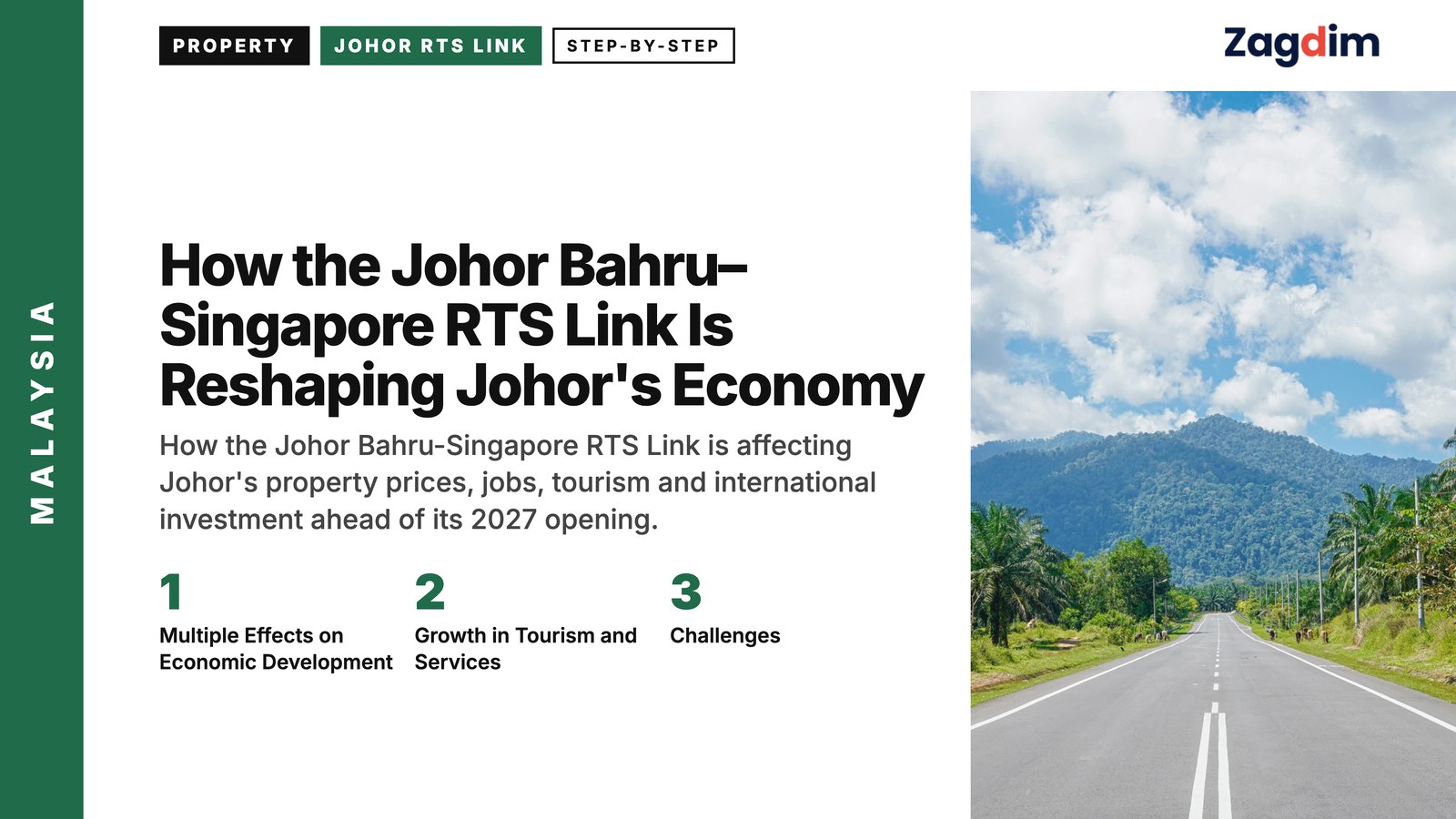
The Johor Bahru–Singapore Rapid Transit System (RTS Link) is a major international infrastructure project connecting Johor Bahru, in Malaysia’s Johor state, with Singapore, designed to fundamentally improve transport between the two, and is expected to open in 2027. The system runs about 4 kilometers, connecting Bukit Chagar Station in Johor Bahru directly with Woodlands North MRT Station in Singapore, and is expected to cut commuting time from the current 1–2 hours to just 5 minutes. As a key part of Malaysia–Singapore economic cooperation, the RTS Link will not only ease congestion at the border but also offer significant potential for Johor’s economic development.
Johor’s Importance as Singapore’s Economic Hinterland
Johor has long been an important economic partner for Singapore because of its geographic proximity and comparatively low costs. Around 300,000 international movements happen daily, including commuting, tourism and business activity, reflecting Johor’s central role in Malaysia–Singapore economic interaction. However, the Johor-Singapore Causeway and the Second Link, which currently carry this traffic by road, have long been operating over capacity, with severe congestion especially at peak hours, delaying travel and holding back economic development. The RTS Link is not just a transport upgrade, but a strategic project that strengthens economic, social and cultural ties between the two places. The system will improve commuting efficiency and deepen the two economies’ ties. Its bilateral joint Customs, Immigration and Quarantine (CIQ) clearance model lets travelers complete both sides’ border checks in one stop at the departure station, further cutting the time needed to cross the border, and is expected to significantly ease pressure on travelers during holidays and peak periods.
2. The Direct Economic Impact of Improved Transport Connectivity
Shorter Commutes and Greater International Efficiency
The RTS Link’s biggest feature is how dramatically it shortens commuting time. The roughly 1–2 hour journey from Johor Bahru to Singapore today will shrink to just 5 minutes, a change that will transform how the two places commute. In the past, congestion meant Johor Bahru residents working in Singapore spent a large amount of time commuting, while the RTS’s efficient connection will make daily international commuting far more feasible. This efficiency gain is expected to encourage more Singapore employers to hire Johor residents, and make it easier for more Singaporeans to choose to live in Johor Bahru.
Conditions Attracting Singapore Businesses to Expand into Johor
Johor has long attracted some Singapore businesses to set up manufacturing or service divisions because its land and labor costs are lower than Singapore’s. As the RTS Link opens, this trend is expected to accelerate further. Convenient transport not only lowers management costs but also lets Singapore businesses manage their Johor operations more efficiently. For example, a company can move part of its production base to Johor while keeping its headquarters or core business in Singapore, and the efficient connection between the two places makes this kind of international operating model more achievable.
Lower Freight Costs Benefit Businesses and Consumers
Beyond making it easier for people to move, the RTS Link is also expected to have a significant indirect effect on freight. According to The Star (Malaysia), the RTS Link will significantly lower the cost of moving goods across the border, with costs expected to fall by 20% to 30%. This reduction matters greatly for supply chain management, particularly in logistics and manufacturing, and can further improve the market competitiveness of products from both places. The cost savings are also expected to pass through to consumers, narrowing price gaps between goods and increasing bilateral trade volume.
Easing Congestion at the Johor-Singapore Causeway
The Johor-Singapore Causeway is currently one of the busiest border crossings in the world, with huge daily volumes of vehicles and pedestrians, and this bottleneck has long troubled international commuters and logistics operators. Once the RTS Link opens, it is expected to carry 150,000 passenger trips a day, substantially reducing the pressure of vehicle and pedestrian traffic at the Causeway and improving clearance efficiency. At the same time, convenient public transport will encourage more people to choose the rail link over private cars, which also has a positive effect on the environment.
3. Multiple Effects on Economic Development
The Special Economic Zone and Its Transport Foundation
The establishment of the Johor–Singapore Special Economic Zone (JS-SEZ) is a key strategy for deepening economic cooperation between Malaysia and Singapore. The zone covers Johor Bahru’s city center, Iskandar Puteri, and parts of northern Singapore, and focuses on high-end manufacturing, the digital economy, high technology and education. The opening of the RTS Link will become the core transport backbone of this special economic zone, promoting the efficient international flow of capital, technology and labor, and injecting new vitality into the regional economy.
Regional Ties on a Hong Kong–Shenzhen-Style Model
The connectivity the RTS Link brings deepens Johor and Singapore’s economic ties, and could form a partnership similar to the Hong Kong–Shenzhen relationship. Singapore excels in high-end finance and logistics, while Johor draws businesses with lower land and labor costs. The two places’ complementary strengths raise the whole region’s competitiveness and create opportunities for international cooperation, achieving synergy across the region. Convenient transport will not only draw more Singapore businesses to set up divisions in Johor, particularly industries that need large amounts of land and labor such as manufacturing and logistics, but will also help Johor upgrade its economy from traditional industries toward high technology.
Foreign Direct Investment and Economic Growth
As the RTS Link is built and comes into operation, Johor’s economic landscape is changing profoundly. The RTS Link offers an important opportunity for Johor to attract foreign direct investment (FDI), further stimulating a wave of investment in property, manufacturing and high-tech industries. In 2023, Johor attracted RM43 billion in investment, above the national average. This investment will not only drive local economic growth but also further raise Johor’s competitiveness.
Regional Opportunities for Johor Businesses
The RTS Link gives Johor businesses more convenient international logistics and capital-flow opportunities. For example, Johor’s small and medium-sized enterprises (SMEs) can more easily export products to Singapore and global markets, further raising Johor’s standing in Southeast Asia’s economy. At the same time, Singapore businesses can also use Johor’s low-cost advantage to expand their regional influence.
Summary: The Future Outlook for the Regional Economy
Overall, the opening of the RTS Link and the establishment of the special economic zone reinforce each other, giving Johor strong momentum for economic transformation and regional development. Johor is well placed to gradually become a regional economic center, drawing on the transport convenience and economic-cooperation advantages the RTS Link brings. This process will not only push Johor’s transformation from a border town into an internationalized city, but also set an example for Malaysia–Singapore economic cooperation, opening a new chapter for regional development in Southeast Asia.
4. Property Market Development and Potential
The Price Gap Between Singapore and Johor Bahru
There is a significant gap between property prices in Singapore and Johor Bahru — Singapore’s property prices run at roughly 3.5 times Johor Bahru’s. In Singapore, prices range roughly HK$5,000–20,000 per square foot, while in Johor Bahru’s city center, prices are typically under HK$2,000 per square foot. The gap is even more pronounced in specific areas, for example:
- Around Bukit Chagar Station (the RTS’s Malaysian terminus): RM1,000–1,300 per square foot.
- The Iskandar special zone: an average of about RM436 per square foot.
- Johor Bahru’s average property price: about RM415 per square foot, higher than Johor state’s overall average of RM306 per square foot.
Price and Rent Trends Around Bukit Chagar Station
The RTS Link’s impact on Johor’s property market is especially pronounced. According to the Malaysia Property Weekly, residential and commercial property prices near Bukit Chagar Station have risen about 18% since RTS construction began. Demand for smaller units (501–750 square feet) has grown especially strongly, with prices up 27%, making them a popular choice for investors. As transport connectivity along the rail line improves, property values in the area are expected to keep rising over the next few years, becoming one of the important drivers of Johor’s economic growth.
Comparative Analysis of Property Prices (2024)
| Property Type | Singapore (SGD/psf) | Johor Bahru (MYR/psf) |
|---|---|---|
| Suburban | 900–1,400 | 353 |
| City Business District (CBD) | 1,800–2,500 | 353 |
*Source: Zagdim analysis*
The Impact of Singapore Investors on Johor’s Property Market
Singapore buyers play an increasingly important role in Johor’s property market. From 2019 to 2023, demand from Singapore investors for Johor property grew nearly threefold, with serviced apartments offering high rental yields especially popular. Johor’s average rental yield reaches 6.25%, notably higher than Malaysia’s national average, which is highly attractive to investors seeking higher returns. As the RTS opens, Singaporeans will be able to more easily choose to live in Johor while working in Singapore, which will further drive demand in the rental market.
Value Growth Potential for Commercial and Residential Property
The RTS Link doesn’t only boost the residential market — it also brings appreciation potential for commercial property. Demand for retail and office space near Bukit Chagar Station is expected to grow significantly, particularly as Singapore businesses may choose to set up divisions in Johor to lower operating costs. In the Klang Valley, for example, similar transport infrastructure projects drove local property prices up 50% over six years, and Johor could replicate this success, drawing further attention from developers and investors.
5. The Two-Way Impact on Employment and Population Movement
The RTS Link’s Contribution to Job Creation, in Construction and Operation
The RTS Link is not just an infrastructure project — it is also a jobs engine. During construction, it created about 20,000 direct and indirect jobs, including professional roles such as engineers, technicians and logistics staff. During operation, it will continue to provide about 2,000 to 3,000 long-term positions, including train drivers, station operations and maintenance technicians. In addition, growing commercial activity along the rail line is expected to create more jobs in retail, food and beverage, and services, giving local residents stable employment opportunities and driving economic growth.
The Challenge of Talent Flowing to Singapore
While the RTS Link brings economic and transport benefits, it also raises the risk of Johor’s high-skilled talent flowing to Singapore. Because wages in Singapore run 3 to 4 times higher than in Johor, convenient transport means more Johor talent will choose to work across the border. Research shows Johor’s wage growth ranks near the bottom nationally, which could further drive talent outflow and put pressure on the local economy’s long-term development.
The Possibility of Attracting Singapore Talent and Drawing Population Back to Johor
On the other hand, the RTS Link’s opening also creates conditions for attracting Singapore talent and encouraging population inflow. Johor’s relatively low cost of living and steadily improving urban infrastructure appeal to some Singaporeans who want to reduce their living costs — according to The Independent (Singapore), in a poll of 1,548 people, when asked whether they would move to Johor Bahru to avoid Singapore’s high cost of living, 55% of Singaporeans said yes. The cost of living is leading a growing number of Singaporeans to buy homes in Johor, and even consider settling there. This two-way flow of talent and population helps balance the RTS’s short-term challenges for Johor, and supports stable population and economic development in the region over the long term.
6. Growth in Tourism and Services
The Impact of Convenient Transport on International Tourism
The RTS Link’s convenience will make Johor Bahru an appealing short-trip destination for Singapore residents. Shorter commuting times will make it easier for more Singaporean visitors to travel to and from Johor, enjoying its lower prices and diverse tourism resources. From theme parks to shopping malls, Johor Bahru’s tourism facilities are expected to see a surge in visitor numbers, further driving growth in local tourism and injecting new vitality into related industries.
Johor Bahru’s Advantages as a Short-Trip Destination
Johor Bahru’s distinctive location and comparatively low cost of living give it a natural appeal for Singapore visitors. With the RTS Link’s opening, international visitor numbers are expected to grow by 20% to 25%. Johor Bahru also offers abundant shopping, dining and entertainment facilities, giving families and younger visitors a range of options. The major improvement in transport convenience will lead more Singapore residents to choose Johor for weekend trips or short breaks.
Upgrading Tourism Infrastructure and Related Industries
To meet growing tourism demand, Johor Bahru’s hotels, dining and transport services will also be upgraded in step. Local government and businesses may accelerate improvements to tourism infrastructure, such as adding boutique hotels, upgrading public transport, and offering more cultural and leisure activities. These improvements will further raise Johor’s appeal as an international tourism destination, injecting new momentum into the regional economy.
7. Urban Development and Infrastructure Upgrades
The RTS Driving Johor Bahru’s Urbanization
Building the RTS Link is an important catalyst driving Johor Bahru’s urbanization. As the RTS’s terminus, Bukit Chagar Station will become Johor Bahru’s new economic hub, drawing residents and businesses from surrounding areas to concentrate there. As population and economic activity grow, Johor Bahru will gradually transform from a border town into a regional economic center with international characteristics, accelerating its urbanization.
Coordinated Development of Public Transport and Infrastructure
The RTS’s successful progress provides an important reference for Johor’s transport planning. The Johor state government plans to develop more local light rail lines, connecting Johor Bahru’s city center with surrounding areas such as Skudai, Iskandar Puteri and Senai International Airport, forming a complete regional transport network. This will not only improve Johor Bahru’s internal transport efficiency but also further extend the RTS’s reach, strengthening the overall economic benefit.
Johor Bahru’s Future Blueprint as a Regional International City
As the RTS Link and supporting infrastructure gradually come together, Johor Bahru’s internationalization will accelerate further. The local government is pushing forward several integrated projects, such as the Ibrahim International Business District (IIBD) and Forest City, which aim to attract international businesses and high-income residents. In the future, Johor Bahru will become a modern, diverse international city, occupying a more important position in Southeast Asia.
8. Challenges
The Potential Risk of Rising Living Costs
The RTS Link’s opening brings property and economic growth, but it could also push up the cost of living. As Singapore residents and investors move in, prices and property values in Johor could rise further, putting pressure on local low- and middle-income groups. Balancing economic growth with social equity is a key focus for local government.
Policy Recommendations for Balancing Talent Flow and Economic Development
The RTS Link may worsen the outflow of Johor’s high-skilled talent to Singapore, but it also creates opportunities to attract Singapore talent and encourage returnees. The government can retain talent by offering tax incentives, expanding vocational training and strengthening local businesses’ competitiveness. At the same time, promoting international cooperation projects between the two places, and creating more opportunities for two-way talent flow, can help balance Johor’s talent supply and demand over the long term.
9. Conclusion: The Future Outlook for Johor as an Economic Center
The RTS Link’s Combined Impact on Johor’s Economy
The construction and imminent opening of the RTS Link marks Johor’s entry into a new era of development. It not only resolves the international transport bottleneck but also drives comprehensive improvement across Johor’s economy, including rapid growth in investment, employment, tourism and urbanization.
Johor–Singapore Economic Cooperation and Johor’s Potential Standing
As the RTS is completed, economic ties between Johor and Singapore will deepen further, and Johor could become Southeast Asia’s model for a Hong Kong–Shenzhen-style economic partnership. This process will draw in more capital, technology and talent, raising Johor’s regional competitiveness.
Have a question about this guide? Leave a comment below, or ask Zagdim directly.
Your first stop for international property and global living.
Research and insights. Know what’s changing. Understand what matters.
Sources
- Straits Times – On the right track: How the JB-Singapore RTS Link is taking shape
- Straits Times – JB-Singapore RTS Link: Construction passes 65% mark on both sides, connecting span completed
- MRT Corp – Rapid Transit System Link (RTS Link) Project Between Johor Bahru and Singapore
- The Star – PMs Anwar, Lee witness completion of RTS Link connection between Malaysia and Singapore
Further Reading
- What Is the Johor Bahru–Singapore Special Economic Zone (JS-SEZ)?
- The Johor Bahru–Singapore Rapid Transit System (RTS) Is Set to Open in 2027