






























1. Introduction: Why Abu Dhabi Is Becoming a Focus for Property Investors
In recent years, the UAE property market has drawn the attention of investors worldwide. Compared with Dubai — better known, faster-moving, but more volatile — Abu Dhabi real estate investment is quietly rising as a steadier, more institutionalized alternative. For buyers seeking stable long-term returns and valuing legal protection and predictable economic policy, Abu Dhabi is showing an appeal of its own.
First, Abu Dhabi has taken a major step in liberalizing property policy. Since 2019, the government has formally allowed foreigners to hold freehold ownership in designated investment zones, paired with a property-based long-term residency visa (Golden Visa), so foreign buyers can not only invest but genuinely build a life there.
Second, on rental returns, Abu Dhabi’s relatively low vacancy rates and reasonable supply-demand balance deliver an average rental yield of 6%–8%, among the highest of major global cities. This outperforms many Asian and European markets and, in some districts, even exceeds Dubai — an attractive proposition for investors whose core strategy is rental income.
More importantly, as the UAE’s political and energy hub, Abu Dhabi has been actively pursuing “de-oil” transformation in recent years. Through Abu Dhabi Vision 2030, sustainable urban development and smart-infrastructure programs, the government is steadily steering capital toward tourism, culture, education and technology, driving a long-term shift in both the property market and the population.
Against this backdrop of policy momentum and economic restructuring, buying property in Abu Dhabi is no longer simply buying a home — it means taking part in the planning and growth of a city’s future. This is why more and more rational investors are turning their attention from Dubai to this understated but remarkably promising capital.
2. Who Should Buy Property in Abu Dhabi?
After “why Abu Dhabi,” the next question is whether it suits you. In practice, buying property in Abu Dhabi is not just an asset-allocation choice — it is often tied closely to residency planning, children’s education, or a family’s future. Below are the most common buyer profiles and their investment goals, to help you quickly place your own situation and understand the conditions for entering the market.
1. Overseas Buyers: Rational Diversifiers Seeking Middle East Exposure
For buyers from Asia, Europe and elsewhere, Abu Dhabi real estate investment is an elegant diversification strategy. Amid rising geopolitical risk and inflation, many see the Middle East as the next capital safe haven. Abu Dhabi’s policy stability, rental yields and currency stability (the dirham is pegged to the US dollar) form a natural hedge, making it a new choice for many high-net-worth individuals.
Recommended areas: Al Reem Island (stable), Yas Island (higher yield), Al Raha Beach (waterfront asset).
Note: limited to freehold investment zones — some areas still restrict foreign ownership, so always confirm a project is in an open zone before buying.
2. Prospective Immigrants and Long-Term Residents: Combining Life and Residency Planning
If you plan to live in the UAE long term, or want to work step by step toward permanent residency, buying property in Abu Dhabi is a way to strengthen your foothold locally. Beyond the right to use and rent out the property, buyers can also apply for a long-term residency visa (such as a 2-year residency or a 10-year Golden Visa), paired with schooling, healthcare and daily-life arrangements — making “moving there” far less distant a prospect.
Recommended areas: Saadiyat Island (school district and cultural amenities), Khalifa City (family-oriented communities), Masdar City (sustainability and technology focused).
3. High-Net-Worth Individuals: Combining Assets and Residency
For high-net-worth investors, Abu Dhabi real estate investment is not just about rental returns — it is a core tool for residency, tax and future planning. A property investment of AED 2,000,000 (about USD 540,000) or more qualifies for a 10-year Golden Visa, which can also be extended to a spouse and children — a compelling piece of a UAE residency strategy.
Common combinations: residential plus commercial land, multiple properties combined in a single application, using a residential asset to secure family residency.
Note: Golden Visa conditions were adjusted starting in 2024 — mortgaged properties and joint ownership are now also accepted in the approval process; a professional advisor is recommended.
4. International Student Families: Prioritizing Schooling and Living Environment
More and more families, especially from China, Singapore and the wider Middle East, are choosing to send children to school in Abu Dhabi. In this case, a property near schools, with convenient transport and in a safe community, can serve as a home while also being let short- or long-term during holidays — combining practicality with returns.
Recommended areas: Saadiyat Island (NYU Abu Dhabi, British and American international schools), Al Reem Island (mid-priced school-district homes), Al Ghadeer (near a cluster of international schools).
Buyer Type vs. Common Goals
| Buyer Type | Main Goal | Recommended Areas | Key Considerations |
|---|---|---|---|
| Overseas asset allocators | Diversification, USD hedge | Al Reem, Yas, Al Raha | Freehold zones only |
| Prospective immigrants / long-term residents | Long-term residency, education, retirement | Saadiyat, Khalifa, Masdar | Pair with a residency visa application |
| High-net-worth individuals | Asset allocation + Golden Visa | Multi-area purchases | Can be used for Golden Visa and dependant applications |
| International student families | Home + school-district property + short-let income | Saadiyat, Al Reem | Assess school access and transport |
3. How to Buy Property in Abu Dhabi
Once you are clear on your purpose and budget, the next step is to actually start the buying process. Abu Dhabi real estate investment may look complicated, but following the standard steps and choosing a reliable developer or licensed agent keeps risk low and the transaction smooth. Below is the standard process most foreign buyers follow when buying property in Abu Dhabi:
Step 1: Confirm Eligible Zones and Your Own Eligibility (Freehold vs. Leasehold)
The first step is to establish whether your nationality and status qualify you to buy. Currently, foreigners may only buy in government-designated freehold zones, such as Yas Island, Al Reem Island and Saadiyat Island.
- Freehold: ownership of the property itself plus a 99-year title (designated zones only)
- Leasehold / Usufruct / Musataha: long-term use rights without land ownership, subject to contract terms
Recommendation: choosing a government-approved developer project simplifies the process and reduces legal risk.
Step 2: Choose Your Area and Property Type (Off-Plan vs. Resale)
Next, choose the area and property type that fit your purpose (own use, rental, or residency planning):
- Off-plan: lower price, flexible payment, but delivery can take 1–3 years
- Resale (completed properties): immediate delivery, can be rented or occupied right away, but priced slightly higher with a shorter payment period
First-time investors are advised to choose a completed property, or work with a major developer (such as Aldar, Bloom or Reportage) to reduce delivery risk.
Step 3: Sign the MOU and Pay the Deposit (About 10%)
Once you have chosen a property and agreed on price with the seller, both sides sign an MOU (Memorandum of Understanding) or sale agreement confirming the terms. This stage typically requires a deposit of about 10%, with the handover date and payment terms specified.
Note: if the buyer cancels the transaction, the deposit is usually non-refundable unless the contract states otherwise.
Step 4: Prepare Documents and Complete the Transfer
Buyer and seller must prepare the following documents to complete the transfer, which can now be done through the DARI digital platform or the TAMM app, making the process far more convenient:
- Passports / Emirates ID (where applicable) for both parties
- Title deed or project registration number for the chosen property
- Proof of payment and mortgage approval documents (if financing is involved)
- NOC (No Objection Certificate issued by the developer)
- Once the transaction is complete and registered, the Land Registry issues the Title Deed
The whole process generally takes about 3–5 working days.
Step 5: Set Up Utilities and Appoint Property Management or a Letting Agent
After registration, don’t forget day-to-day management. You can self-manage, or appoint an agent licensed by the Abu Dhabi government:
- Set up a utilities account (requires the title deed and ID)
- Hire a property management company (handles leasing, maintenance, rent collection, etc.)
- If planning short-term lets, obtain a DCT Abu Dhabi short-term rental license
Recommendation: appointing a professional agent can lower international management costs while keeping the property legally compliant.
4. Top Areas and Market Trends: Where Is Best to Buy in Abu Dhabi?
Choosing the right area is half the battle in a successful investment. Whether for your own home, long-term rental, or residency planning, understanding the character and rental yields of Abu Dhabi’s leading districts is an essential step before investing. Below are the four most closely watched areas, each with its own positioning and potential:
Saadiyat Island: The Cultural and Educational Core, First Choice for Homeowners and Families
Saadiyat Island is Abu Dhabi’s cultural heart, home to landmarks such as the Louvre Abu Dhabi and the Zayed National Museum, as well as NYU Abu Dhabi and several international schools.
- Suited to: buyers planning to settle, families accompanying children in school, and owner-occupiers
- Price trend: luxury-segment capital appreciation of 10.3% in 2023–2024
- Rental returns: 1–2 bedroom apartments average AED 150,000/year in rent [3]
- Investment highlight: low-density premium communities and high quality of life, backed by Vision 2030 cultural and educational investment policy
Note: as a premium location, prices run relatively high, but appreciation has been steady, making it especially suited to long-term owner-occupier investors.
Yas Island: An Entertainment and Tourism Hotspot, a Short-Let Investor’s Paradise
Yas Island is known for attractions such as Ferrari World, Yas Waterworld and the Formula One circuit, drawing foreign visitors and younger tenants, with fast-paced development.
- Suited to: short-let, yield-focused investors
- Average rental yield: apartments around 6.9%–7.5%, with some smaller units reaching 8% [8]
- Market activity: prices rose nearly 10.3% in H1 2024, with occupancy above 90%
- Development momentum: several new Aldar projects are underway, with further land releases and mixed-use projects expected in 2025
Note: well suited to combining Airbnb-style short lets with mid-term investment — a hot location with high liquidity for resale.
Al Reem Island: The Downtown Commuter Belt, a Favorite for Young Professionals
Al Reem Island, close to the city center and business core, is a popular base for Abu Dhabi’s young professionals and a mature rental market.
- Suited to: medium-to-long-term rental investment, and professionals buying to live in
- Average rental yield: 7%–7.5% for 1–2 bedroom units, with stable community occupancy [8]
- Price trend: capital appreciation of about 2.3%–2.75% in 2024
- Community features: convenient transport and strong amenities, close to office districts and major malls
Note: suited to steady, conservative investors — reliable rental income and high resale liquidity.
Al Ghadeer and Masdar City: Sustainable-Living Showcase Areas for Long-Term Positioning
If you are looking for more affordable locations with future potential, consider Al Ghadeer and Masdar City, two emerging sustainable communities in eastern and southern Abu Dhabi bordering Sharjah and Dubai, giving them a locational connectivity advantage.
- Suited to: budget-conscious investors who value sustainability
- Average rental yield: 7.5%–8%, especially for small-to-medium villa products [3]
- Development potential: Masdar is a Free Zone with built-in technology and green infrastructure, attracting companies and talent
- Policy tailwind: Vision 2030 explicitly promotes new-energy and green-city development, with this area as a key focus
Note: suited to long-term positioning — prices have not yet fully priced in the area’s potential, making this a medium-to-long-term strategy.
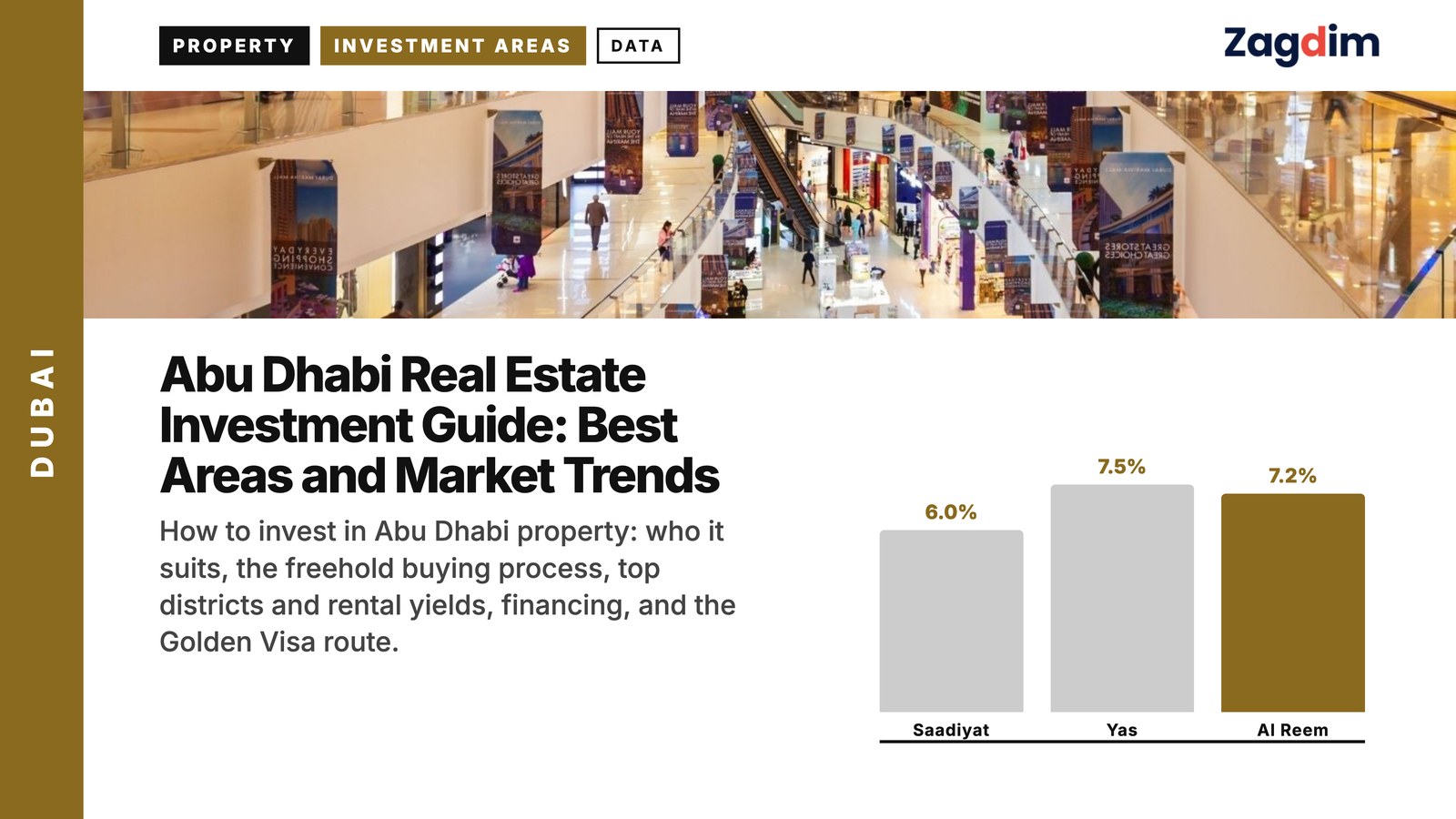
Abu Dhabi’s Four Leading Areas — Rental Yield and Five-Year Supply Outlook
| Area | 2024 | 2025 | 2026 | 2027 | 2028 | Outlook |
|---|---|---|---|---|---|---|
| Saadiyat | 6.0% | 6.1% | 6.2% | 6.3% | 6.4% | Supply expected to rise year by year, concentrated in the premium segment |
| Yas | 7.5% | 7.6% | 7.3% | 7.1% | 6.9% | High demand for short lets; supply set to rise sharply in 2025 |
| Al Reem | 7.2% | 7.1% | 6.9% | 6.7% | 6.5% | High downtown scarcity; supply approaching saturation |
| Masdar | 8.0% | 7.8% | 7.6% | 7.4% | 7.1% | Steady long-term climb, supported by policy direction |
5. FAQ
Can Foreigners Buy Property in Abu Dhabi?
Yes. Under Abu Dhabi’s 2019 regulatory reforms, non-UAE nationals can buy property in designated freehold zones, with full rights of disposal (sale, rental, inheritance). Outside freehold zones, property can only be held through long-term leasehold (Usufruct or Musataha), with a maximum term of 99 years.
What Is the Minimum Purchase Amount?
There is no absolute minimum purchase threshold for Abu Dhabi property in general — small units or properties in the suburbs start from around AED 500,000. However, to use a property to apply for a Golden Visa, the property must meet a minimum value of AED 2,000,000 (about USD 550,000), and must be either completed or an off-plan unit meeting specific conditions.
Can You Get a Mortgage? How Much Can Non-Residents Borrow?
Yes. Some local banks in Abu Dhabi (such as ADCB and FAB) offer mortgages for non-residents, typically with a maximum loan-to-value of 50%–60% and a minimum loan amount of AED 750,000. Applicants must submit documents such as a passport, proof of income and overseas bank statements; interest rates depend on the market and EIBOR.
Does Buying Property Grant UAE Residency?
Not automatically. Buying property alone does not directly grant residency, unless you apply for a Golden Visa (10 years) or a 2-year residency visa. Each has different thresholds and application conditions (such as property value, whether it is mortgaged, and whether there is a single owner) — see the official Abu Dhabi DARI or Golden Visa platforms for details.
Have Prices Risen in Recent Years? Is There Room for Appreciation?
Yes. According to multiple market reports, Abu Dhabi property prices have been gradually recovering since 2021, with some popular areas (such as Yas Island and Saadiyat Island) seeing price growth of 8%–10% in 2023–2024. The overall market is steadier than Dubai’s, with an average rental yield of about 5%–7%, and medium-to-long-term appreciation potential.
Can the Property Be Rented Out? Are Rents Stable?
Yes. Abu Dhabi allows foreign owners to let their property long- or short-term, but this requires the proper license — short lets must be registered with the Department of Culture and Tourism (DCT), and subletting a shared unit with others is not permitted. Rents are relatively stable, with some areas (such as Khalifa City and Al Reem Island) achieving rental yields of 7%–8%, suited to investors whose main return strategy is rental income.
6. Common Misconceptions and Buying Tips
For many overseas buyers new to Abu Dhabi real estate investment, information can be fragmented or come from informal channels, leading to mistaken expectations. Below are the two most common misconceptions, with practical guidance to help avoid them.
Misconception 1: Does Buying Property Automatically Grant UAE Nationality?
Many people mistakenly believe that buying a home in Abu Dhabi directly grants UAE nationality or permanent residency. In fact, buying property does not equate to nationality, nor does it automatically create residency rights.
Correct approach: anyone seeking long-term status through property should understand the Golden Visa system. Currently, owning freehold property worth AED 2,000,000 (about USD 550,000) or more qualifies you to apply for a 10-year Golden Visa, but this requires a separate application and meeting conditions such as income or loan-to-value ratio.
Misconception 2: Can Foreigners Buy in Every Area of Abu Dhabi?
This is a common misunderstanding. While Abu Dhabi significantly relaxed foreign ownership rules starting in 2019, not every area is open to free purchase. Currently, only specific freehold zones allow foreign ownership, including Yas Island, Saadiyat Island and Reem Island.
Practical tips:
- Before viewing a property or contacting a developer, always confirm whether the project is in a freehold zone.
- Choosing a certified developer or a government-affiliated platform (such as DARI) reduces risk and protects your position in the transaction.
If you are planning to move ahead with buying property in Abu Dhabi, clarifying these points before deciding is the key to entering the market on solid footing.
7. Takeaway
Whether you are an overseas investor seeking diversification, or a new resident planning a long-term life and residency, Abu Dhabi real estate investment’s policy stability, freehold ownership system and Golden Visa incentive are creating a viable option in the Middle East market that balances cost of living with residency planning. In a city with clear rules and a steady pace, buying a home is not just an investment — it can be the first step into a new chapter of life. Ask Zagdim if you would like help assessing whether relocating to Abu Dhabi fits your situation.
Have a question about this guide? Leave a comment below, or ask Zagdim directly.
Your first stop for international property and global living.
Research and insights. Know what’s changing. Understand what matters.
Sources
- Abu Dhabi Department of Municipalities and Transport — *Abu Dhabi Real Estate Indicators Q3 2023*
- CBRE — *Abu Dhabi Market Snapshot 2024*
- Cushman & Wakefield Core — *UAE Property Report 2023*
- Bayut & Dubizzle — *Abu Dhabi Property Market Report Q3 2024*
- Abu Dhabi Economic Vision 2030 — *Urban Structure Framework Plan*
- UAE Government Portal — *Foreign Ownership and Golden Visa Guidelines*
- Masdar City — *Sustainability & Investment Overview 2023*
- Property Finder — *Abu Dhabi Housing Guide 2023–2024*
Content note: This article is compiled from public reports and official sources published between 2023 and 2025, intended to give readers a basic reference for understanding the Abu Dhabi property market and buying process; it does not constitute investment advice. Some data reflects official statistics as of end-2024; subsequent updates follow local regulations and market practice.