
































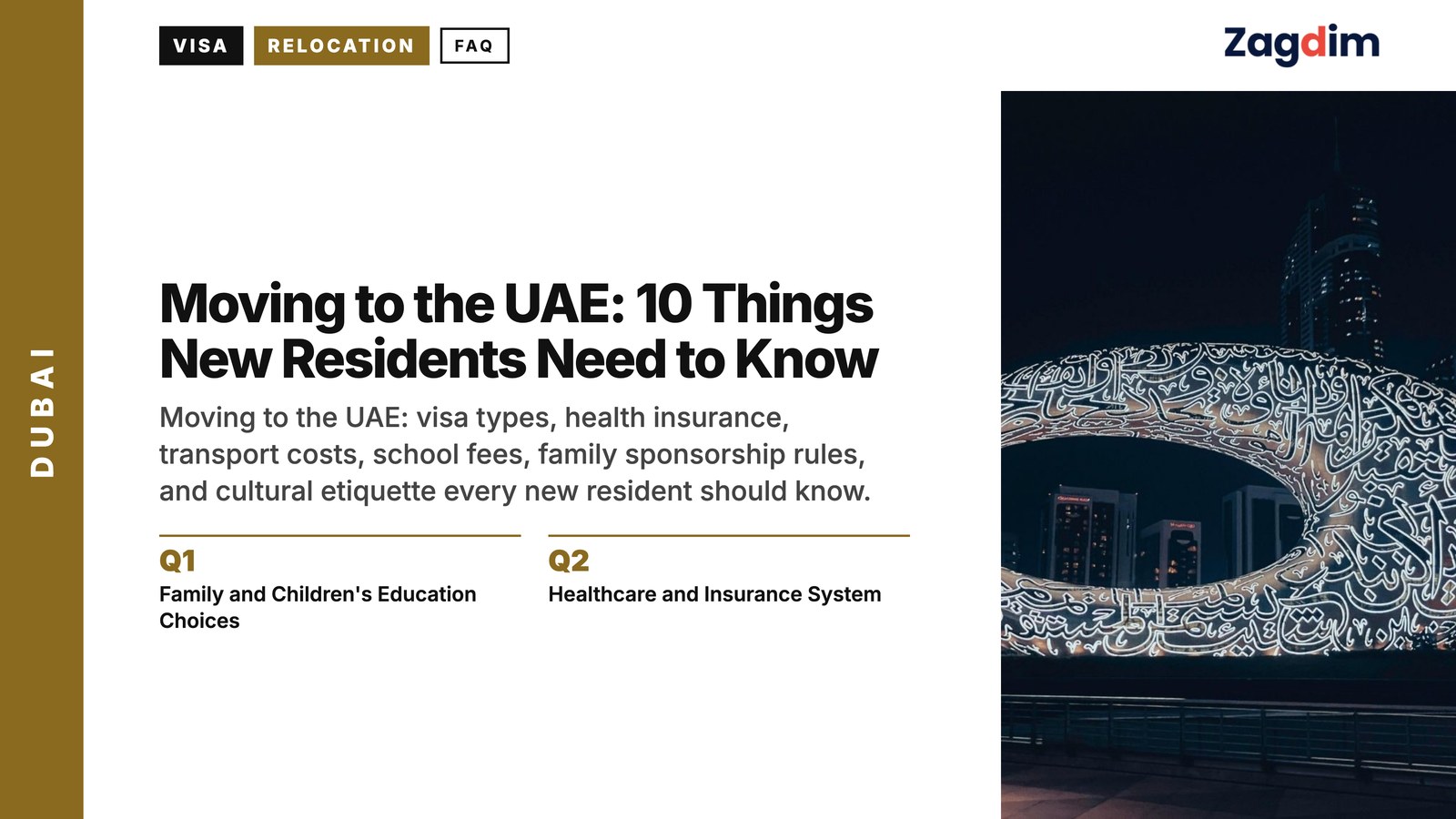
Introduction: Landing in the Desert City — From Cultural Adjustment to Practical Living, Step by Step
The first time you set foot in the UAE, you’ll be struck by the contrast between skyscrapers and mosques, and you’ll feel a distinct tension between the desert heat and high-tech convenience. This is not just an oil-rich nation or a holiday destination — it’s a meeting point for professionals and entrepreneurs from all over the world.
For many new residents, the real challenge isn’t finding a job or renting an apartment — it’s understanding a living environment with clear rules and a deep cultural foundation, and learning to navigate it with ease.
This article uses 10 practical, easily overlooked reminders to walk you through the everyday logic and cultural habits of life in the UAE. Whether you settle into Dubai’s fast urban rhythm or one of Abu Dhabi’s family-oriented communities, this guide is one of the most important “starter manuals” for adjusting to local life.
1. Dress Code and Codes of Conduct: Respecting the Culture Is Where a Smooth Life Starts
Although Dubai and Abu Dhabi are relatively open due to international tourism, the UAE remains a country with Islamic culture at its core, and there are clear limits on dress and behavior in public.
Dress recommendations:
- In malls, government buildings, hospitals and similar places, it’s advisable to avoid bare shoulders and knees — women can opt for a long skirt or loose trousers, and men should avoid sleeveless tops and shorts.
- Swimwear is fine at the beach or pool, but you should change back into regular clothes before leaving the swim area, or you could face a warning or a fine.
Social and behavioral taboos:
- Public displays of affection (such as kissing or hugging) can be treated as indecent behavior, leading to detention or a fine.
- Being overly close with someone of the opposite sex in public (such as holding hands or an arm around the shoulder) should also be avoided, especially in religiously sensitive areas.
- Ask permission before taking photos, especially of Muslim women or children; photography is strictly forbidden at government buildings and mosques.
These rules aren’t just legal obligations — they also reflect respect for the local culture and way of life. Living in the UAE, “keep a low profile and respect the culture” is a safe, lasting approach.
2. Residency Status and Visa Types: Choose the Right One for a Stable Life
The first step to living in the UAE is holding a legal, stable residency status. Different visa types not only determine how long you can stay, but also whether you can work, start a business, or bring family members to live with you.
Common visa types include:
- Employment visa: sponsored by a company; must be reapplied for if you change jobs.
- Freelance Permit: suited to creators, consultants and other individual operators — both Abu Dhabi and Dubai have dedicated schemes, costing roughly AED 7,000–15,000 a year.
- Green Visa: valid for 5 years, requires no employer sponsorship, but requires high income and professional certification.
- Remote Work Visa: suited to remote workers, with a lower bar to qualify — available in both Dubai and Abu Dhabi, valid for up to 2 years.
Family reunification also needs to comply with the rules: if you want to bring a spouse, children or even parents to live with you, proof of income, the size of your home, and a health check are all key conditions. For example:
- A sponsor of either gender needs a minimum monthly income of AED 4,000 (with no employer-provided housing) or AED 3,000 (with employer-provided housing) to sponsor family members.
- All dependent visa holders must complete a health check and purchase health insurance.
Choosing the right visa isn’t just about staying legal — it also gives you more room to plan your life and work. If you’re planning to stay long term, the Green Visa or an entrepreneurship visa are worth serious consideration.
3. Healthcare System and Insurance Arrangements: High-Quality Care, But Don’t Overlook the Policy Details
Healthcare in the UAE is highly international, particularly in Dubai and Abu Dhabi, where many hospitals hold JCI accreditation (an international healthcare quality standard). Expats often choose the private healthcare system, and both service quality and efficiency are generally very good.
A quick look at the basic system:
- Health insurance is mandatory for any expat working or living in the UAE.
- Employers usually provide basic insurance for employees, but whether it covers dependents, or outpatient/dental/chronic-condition care, varies significantly by company.
- If you’re a freelancer or run your own business, you need to buy insurance yourself, costing roughly AED 700–2,000 a year (basic plan) to AED 5,000–10,000 a year (advanced plan).
Practical tips:
- Make sure your insurance plan covers private hospitals and specialist outpatient care, or a visit in a popular area (such as Dubai Healthcare City) can be very expensive.
- Families relocating with children should pay particular attention to whether vaccinations, pediatric and dental care are included in the policy.
- It’s advisable to pair your policy with an Emirates ID + insurance integration for a unified medical card — 92% of hospitals support automatic billing, making reimbursement faster and more convenient.
Emergency medical services in the UAE are also of good quality, but if a hospital isn’t in your insurance network, you may need to pay AED 500–1,000 on the spot for emergency care. So when choosing a policy, look beyond price to the actual scope of coverage.
4. Cultural Adaptation and Public Behavior: Understand the Rules, Earn Respect
The UAE is a highly international country that is still deeply rooted in Islamic culture. For new residents, understanding local customs and laws is key to avoiding missteps and integrating smoothly into society.
Social conduct norms you should know:
- Dress appropriately: even though cities are relatively open, avoid overly short or tight clothing at government offices, mosques, or when interacting with locals.
- Limited public intimacy: hugging, kissing, or even putting an arm around someone’s shoulder in public can draw attention — holding hands may also be seen as inappropriate in some settings.
- Alcohol rules: drinking is only allowed at licensed venues (such as hotels or private clubs); drinking or being intoxicated in the street can result in a fine or detention.
- Photography caution: photographing an individual, police, a mosque or a government building without consent is illegal, carrying a fine of up to AED 2,000 or more.
Cultural interaction tips:
- Use your right hand to give something, shake hands, or eat — the left hand is considered unclean.
- When invited to a local’s home, remove your shoes, and accept the coffee or tea offered — this is a sign of politeness.
- Decline requests tactfully — saying “no” directly can be seen as impolite.
A real-world reminder: in 2023 there were multiple cases of fines or detention over things like “taking a bikini selfie on the beach” or “kissing in public.” So even in an international city, don’t overlook the deeper cultural differences.
Remember this: “In the UAE, you’re not just coming to live — you’re entering a society with a different value system.”
5. Getting Around: Mastering City Efficiency and the Pace of Life
Living in the UAE, whether you can drive, whether you’re comfortable with public transport, and how much taxis cost all directly affect your cost of living and sense of efficiency.
Driving vs. taking transport: which suits you better?
- The top choice for drivers: the UAE’s roads are wide, fuel is cheap (about AED 3.0 per liter in 2024), and parking is widely available. A car rental typically costs about AED 1,500–2,000 a month, and used car prices are also relatively reasonable (a Toyota Corolla is about AED 81,000).
- Convenient license conversion: holders of a Hong Kong, Taiwan, European or international driving license can convert directly to a UAE license — the process is simple and usually completed within about a week.
Public transport and commuting costs
| Item | Dubai | Abu Dhabi |
|---|---|---|
| Monthly pass (metro/bus) | AED 300 | AED 92.5 |
| Taxi (10 km) | AED 45 | AED 35 |
| Nol / Hafilat card | Convenient, integrates multiple transport modes | Also supports most commuting needs |
Dubai’s metro covers a wider area, suiting those living in areas such as Marina, Business Bay or Downtown; Abu Dhabi’s bus service runs less frequently but is cheap and covers a wide area, better suiting budget-conscious relocators.
Ride-hailing platforms are widely available:
- Careem, Uber and Dubai Taxi are all widely used and convenient, though prices rise a little during peak hours.
- Dubai has launched the “Hala Taxi” app, competing on price with Uber and staffed mostly by locally trained drivers.
What about the last mile? Electric scooters (such as Tier and Lime) are common in the city, starting from AED 3 per ride — a flexible option for areas the metro doesn’t reach. Note: some areas prohibit scooter riding, so check the map first.
A helpful tip: there’s no need to rush into buying a car right after moving — try renting or using a transport card first to see what your actual mobility needs and daily routine look like.
6. Healthcare and Insurance System: A Safety Net You Can’t Ignore
Although the UAE doesn’t levy personal income tax, healthcare is certainly not free. For new residents, understanding your insurance obligations and healthcare options is the first step to protecting your quality of life.
Where healthcare is available: mostly private, world-class quality
- Dubai: home to the world-class Dubai Healthcare City, with 67 JCI-accredited facilities; high cultural and language familiarity, with English communication no problem.
- Abu Dhabi: mainly served by the SEHA system, significantly upgraded in recent years, with the average specialist outpatient wait time reduced to 3.7 days.
Insurance system: you must have it! Under UAE law, all expat residents must hold valid health insurance. The rules differ slightly by emirate, but broadly:
| Insurance type | Basic plan | Premium plan (may include US/European treatment) |
|---|---|---|
| Monthly premium range | AED 550–800 | AED 1,200–5,000+ |
| Add-ons | Dental, vision: AED 300–500 | Chronic condition plan: AED 900+ |
| Emergency services (ER) | AED 500 deductible | Usually fully covered if admitted |
Emirates ID x healthcare integration: from 2024, the UAE rolled out a comprehensive Emirates ID x insurance linking system — showing your Emirates ID at most hospitals allows direct batch billing, with 92% of claims processed digitally without paper.
Private vs. public hospitals:
- Private healthcare is the mainstream choice, with stable quality and generally high standards of language and service.
- Public healthcare is only available in some emirates or under specific insurance types, and isn’t well suited to emergencies or English speakers.
Tips for new expats:
- It’s strongly advisable to choose a policy that covers critical illness and overseas referral — some higher-end plans even support emergency and specialist care in Europe or the US.
- For freelancers or the self-employed, arranging insurance is one of the necessary conditions for a residency or work visa application.
7. Family and Children’s Education Choices: How to Choose an International School, and Is It Expensive?
Once you move to the UAE, if you plan to have your children educated there, you’ll quickly discover that choosing a school is a skill, and budget is a key factor.
International schools are the mainstream option: because the UAE has a large expat population, international schools are everywhere, covering British, American, IB, Canadian, French and other curriculums. Parents can choose based on their child’s language background and university plans.
2024 tuition overview: Dubai vs. Abu Dhabi
| City | Average annual tuition (KG–Grade 12) | Top-tier school fee range | IB curriculum premium (vs. national curriculum) |
|---|---|---|---|
| Dubai | AED 63,000 – 88,800 | AED 80,000 – 100,000+ | +18% |
| Abu Dhabi | AED 44,000 – 72,700 | AED 60,000 – 80,000 | +12% |
A reminder: beyond tuition, there are these “hidden costs”:
- Transport: AED 5,000 – 8,000.
- Uniforms, textbooks, tech equipment: AED 2,000 – 6,000.
- Participation in international competitions or extracurricular activities: billed separately.
Popular schools (2024):
- Dubai: Dubai International Academy, GEMS Wellington, Nord Anglia International School.
- Abu Dhabi: Cranleigh Abu Dhabi, British School Al Khubairat, Raha International School.
Tips for choosing a school:
- Apply as early as possible: popular schools need to be booked 12–18 months in advance; some offer sibling priority and tuition discounts (5–15%).
- Check the education rating first: Dubai uses the KHDA rating and Abu Dhabi uses ADEK — it’s advisable to prioritize schools rated “Outstanding” or “Very Good.”
- Be realistic and prioritize stability: if your budget is limited, consider a mid-tier international school in Abu Dhabi (AED 40,000–50,000) — teaching quality at most of these is still solid.
8. Residency Visas and Family Reunification Rules: Income Thresholds and the Process Explained
If you’re planning to bring your spouse, children, or even parents to live with you in the UAE, you’ll need to understand the rules for a “family sponsorship residency visa.” This affects not just the legality of family reunification, but also your monthly expenses and living arrangements.
Who can be a sponsor? Under current rules, any expat resident can apply for a family sponsorship visa regardless of gender, and the income threshold does not differ by gender:
| Category | Minimum monthly income required | Note |
|---|---|---|
| Any sponsor, regardless of gender | AED 4,000/month (no housing) or AED 3,000/month (with employer-provided housing) | Applies to sponsoring a spouse and children |
| Sponsoring parents | A separate, generally higher income requirement applies | Should be confirmed directly with ICP/GDRFA; generally also requires proof of health insurance and housing for both parents |
Required documents and steps:
- Marriage/birth certificate (must be certified by the UAE Ministry of Foreign Affairs, costing about AED 1,500–2,000).
- A valid residency visa (for the sponsor) plus an employment contract or business license.
- Tenancy contract (an official registration document such as Ejari or Tawtheeq).
- A medical check report (TB/HIV test, about AED 350 per person).
- Health insurance (must be purchased for each family member, starting from about AED 1,500).
Total visa cost (per family member)
| Item | Cost range (AED) |
|---|---|
| Entry permit | 1,000 |
| Medical check and health insurance | 1,500–2,000 |
| Emirates ID card | 370 |
| Other document processing fees | 1,000+ |
| **Total** | **About 4,000–6,000** |
Processing time and convenient services:
- Online submissions are usually completed within 7–10 working days.
- Abu Dhabi’s TAMM platform and Dubai’s GDRFA system both support online tracking of application status.
- If the applicant qualifies, a 10-year Golden Visa family package is also worth considering (costing about AED 25,000).
Practical tips:
- If you’ve just arrived in the UAE, it’s advisable to first confirm your housing and income meet the requirements before applying for a family visa.
- Family health insurance is a required expense — it’s advisable to confirm coverage with the insurer in advance.
- If your income isn’t yet stable in the short term, a spouse could also consider applying for their own employment or freelance visa.
9. Healthcare and Insurance System: Are You Ready for Healthcare in the UAE?
Whether you’re working short term, starting a business, or planning to settle long term, understanding the local healthcare system and health insurance rules is absolutely essential. The UAE’s healthcare standards are very high, but costs can also be significant, making insurance coverage critical.
Basic insurance is mandatory: under the 2024 rules, all expat residents must hold valid health insurance to complete their visa process. Here are the common insurance types:
| Insurance type | Monthly cost range (AED) | Coverage |
|---|---|---|
| Basic plan | 550–800 | Public/designated private hospitals, basic outpatient care and emergency care |
| Upgraded plan | 1,200–5,000 | Private clinics, international healthcare, specialist care and hospitalization |
| Dental/vision add-on | 300–500 | Teeth cleaning, orthodontics, eye exams, glasses subsidy, etc. |
| Chronic condition supplement | From 900 | Coverage for high-risk conditions such as diabetes, heart disease, hypertension |
Emirates ID automatically linked to insurance:
- From 2023, most insurance plans are directly linked to the Emirates ID, so a visit only requires the ID for automatic reimbursement.
- The claims process is automated, with roughly 92% of medical expenses processed on the spot at the clinic.
Distribution of medical facilities and usage tips:
- Dubai: has 67 JCI-accredited hospitals and clinics, including Dubai Healthcare City and Mediclinic.
- Abu Dhabi: the government-led SEHA system provides high-quality basic care, and in 2024 reduced specialist wait times to 3.7 days.
- Expats prefer private healthcare, with 82% of users choosing to pay out of pocket or use premium insurance for treatment.
Emergency and special cases:
- Emergency treatment requires a deductible of about AED 500 (waived if admitted to a network hospital).
- UAE nationals and holders of certain insurance types can access free transport and transfer services.
Practical tips for choosing insurance:
- If most of your daily life is in urban areas, it’s advisable to choose a mid-to-high-tier plan covering international clinics (such as Aster or NMC).
- Families with children could consider a dental + vision plan to reduce common children’s medical costs.
- Health insurance is also tied to school admission applications, so it’s worth preparing both at the same time.
10. Cultural Adaptation and Social Etiquette: Understanding Etiquette Is True Integration
The UAE is a highly international Muslim country with an open social atmosphere that also places great value on tradition and respect. For new residents, appropriate behavior and cultural sensitivity aren’t just politeness — they’re key to a smooth life.
Everyday interaction etiquette:
- Handshakes are generally limited to the same sex — if the other person is of the opposite sex, wait for them to offer their hand first.
- Use your right hand to give things, eat, and greet people — the left hand is considered unclean.
- Remove your shoes when entering a UAE household or a mosque — some households even provide indoor slippers.
- Gently shake your cup while drinking coffee to signal “thank you, no more.”
Dress code and public behavior
| Setting | Recommended dress | Behavior to avoid |
|---|---|---|
| Government buildings | Covered knees and shoulders (for both men and women) | Inappropriate photography, not queuing, impolite conversation |
| Malls/offices | Business casual, presentable | Excessive intimacy between couples, chewing gum |
| Beach and pool | Swimwear is fine, but don’t leave the designated area | Wearing swimwear in a public area, photographing others |
Laws and penalties (2024 update):
- Public intoxication → up to 30 days’ detention or an AED 2,000 fine.
- Excessive public kissing or hugging → a warning at minimum, a fine or deportation at worst.
- Secretly photographing others or government buildings → a criminal offense, with fines of up to AED 500,000.
Respecting Muslim customs:
- During Ramadan, avoid eating, drinking, smoking or chewing gum in public, even if you are not Muslim.
- Friday is the Muslim holy day, and some services may be delayed — it’s advisable to avoid scheduling things in the morning.
Tips for cultural integration:
- Take part in local cultural tours or a mosque open day, such as Jumeirah Mosque’s “Open Doors, Open Minds” program.
- When interacting with colleagues from the Middle East or North Africa, it can help to use a few Arabic greetings (such as *Marhaba* and *Shukran*).
Cultural sensitivity and awareness of etiquette like this don’t just help you integrate into the community faster — they also help you avoid accidental misunderstandings or legal risk, showing respect and understanding for local society.
Have a question about this guide? Leave a comment below, or ask Zagdim directly.
Your first stop for international property and global living.
Research and insights. Know what’s changing. Understand what matters.
Sources
- KHDA – *Dubai Private Schools Annual Report 2024*
- ADEK – *Abu Dhabi Private School Fee Framework 2024*
- EdArabia – *Best Schools in UAE 2024 Overview*
- SchoolsCompared – *UAE Education Cost Trends Report*
- Ministry of Education UAE – *National Education Policy Guidelines*
Disclaimer
This article draws on multiple public education reports and official data, based on 2024 figures (with some projections through 2025). All information is subject to the version published by local government and education authorities; readers are advised to check for updates before applying.