






























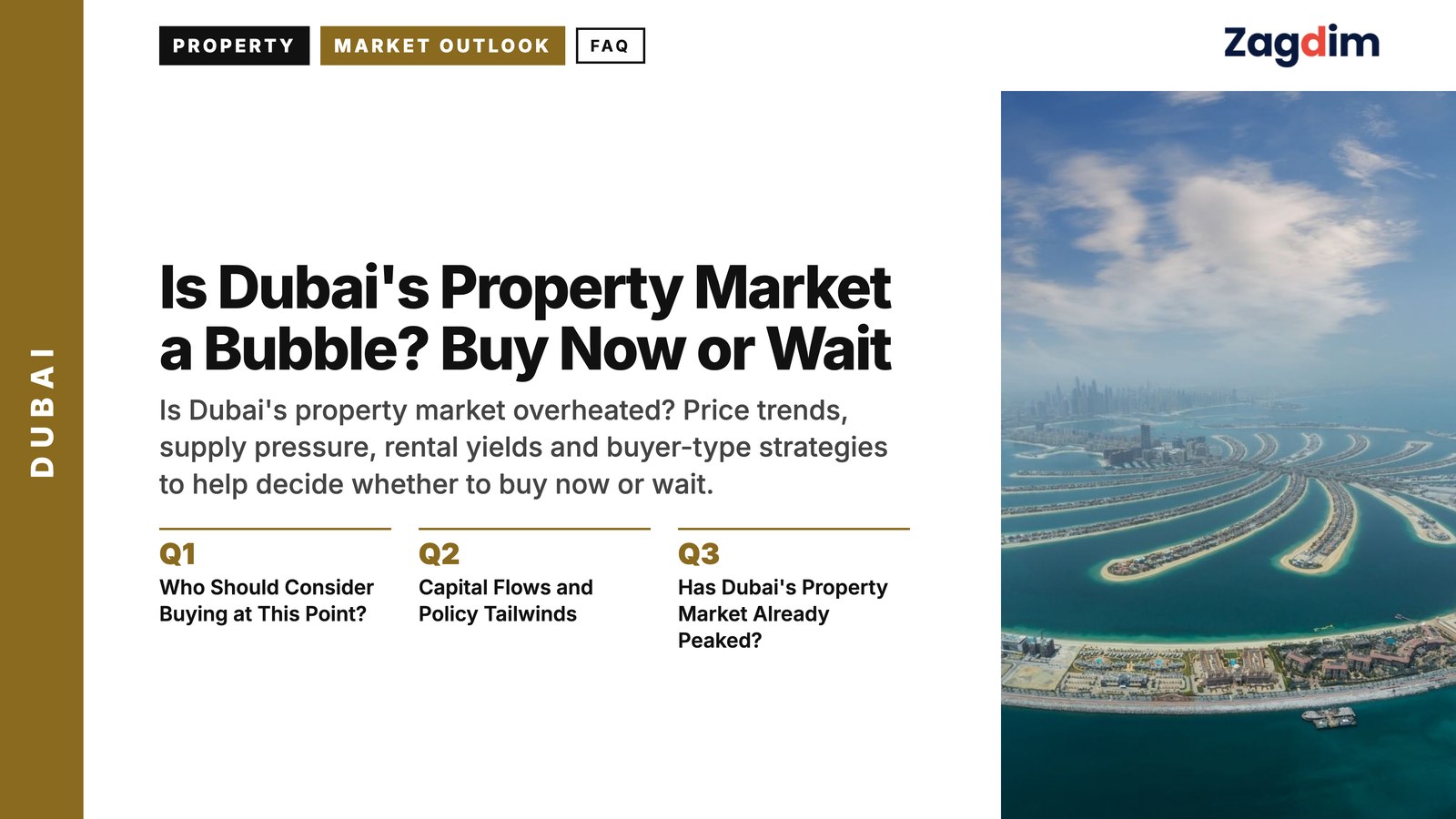
1. Introduction: Soaring Prices, Booming Sales — Is This a Boom or a Bubble?
From a rapid post-pandemic rebound to now setting historic highs, Dubai’s property market has had an extraordinary run over the past few years. According to a 2024 CBRE report, Dubai property prices rose 19.2% year-on-year in 2023 — a near-decade record, putting this Middle East economic hub back in the global spotlight.
Beyond the broader economic recovery, the UAE government’s ongoing Golden Visa policy has also drawn in large numbers of high-net-worth foreign buyers. In recent years, capital inflows from India, China and Russia have accelerated markedly; according to Knight Frank data, foreign buyers now account for a record share of premium residential transactions. This buying rush has further pushed up prices and transaction volumes in core and surrounding districts including Downtown Dubai, Palm Jumeirah and JVC.
But behind this boom, many prospective buyers and investors are starting to wonder: could buying now mean buying right at the top? Is Dubai’s rally a reflection of long-term value, or the result of short-term speculation?
- Dubai property prices rose 19.2% year-on-year in 2023 — far above the global average.
- Foreign buyers’ share of the premium market hit a record high, led by India, China and Russia.
2. Who Should Consider Buying at This Point?
For overseas buyers who are on the fence, whether it is worth buying in Dubai is not really about “has the market peaked” — it depends on your status, your asset-allocation strategy and your risk tolerance.
First, if you plan to live in the property long term, or want to use it as a tool for relocation and rental income, buying now can still make sense. This is especially true since the relaxed Golden Visa rules: buying a property worth AED 2,000,000 gives you a chance to apply for a 10-year residency visa, which has drawn many families planning to settle or send children to school in Dubai to position themselves early.
By contrast, short-term flippers or highly leveraged buyers need to be more cautious given today’s high price base and increased market volatility. With handover volumes expected to rise sharply over the next two years, over-concentrating capital in unbuilt properties or highly volatile districts risks both a price correction and a liquidity squeeze.
Whether or not you already hold a Golden Visa also affects your flexibility and tax planning around buying. Visa holders enjoy more property-holding rights and long-term protection, while non-residents need to pay particular attention to restrictions on bank accounts, resale and moving funds.
- The Golden Visa property threshold was lowered to AED 2,000,000 in 2024, encouraging long-term holders and relocation-minded buyers.
- If your goal is to live in or rent out the property, focus on core locations and mid-to-premium properties with a clear handover date.
Entry Strategy by Buyer Type
| Buyer Type | Risk Tolerance | Recommended Areas | Suggested Strategy |
|---|---|---|---|
| Owner-occupier | Medium-high | Downtown, Marina | Choose completed properties in well-served areas |
| Asset allocator | Medium | JVC, Dubai Hills | Emphasize stable cash flow |
| Short-term flipper | High | Dubai South, off-plan | Watch timing and resale pressure |
| Relocation / retirement buyer | Low | Business Bay, MBR | Align with visa and long-term planning |
If you are also weighing whether your own status fits this point in the market, it helps to clarify your goals and risk appetite first — ask Zagdim.
3. Market Trend Analysis: From Short-Term Swings to Long-Term Value — How to Read Dubai’s Property Cycle
To stand on solid ground in today’s Dubai market, the key is not to “call the bottom,” but to understand where the market sits in its structural cycle. From cooling transaction momentum to shifts in policy and capital flows, here are five checkpoints for reading whether today’s heat is value building up, or an early sign of correction.
Step 1: High-Base Consolidation — Prices Stay High, but Momentum Slows
While prices remain at a high level, CBRE and Bayut data show transaction volumes clearly slowed in Q1 2024, with premium villas and off-plan projects in particular returning to more rational levels. The market is entering a period of high-base consolidation: buyers and developers alike are in wait-and-see mode. Prices have not corrected, but the market has lost the clear upward momentum of the previous two years.
Step 2: Interest Rates — What Happens in the US Sets Dubai’s Direction
The UAE Central Bank’s interest-rate policy tracks the US Federal Reserve closely, so whether the US cuts rates directly affects Dubai’s local financing costs and mortgage conditions. High rates over the past two years have curbed purchasing power for some middle-income buyers, gradually shifting the market from “investment-driven” toward a “cash is king” structure.
If rates turn lower in the second half of the year, this could trigger a second wave of transaction activity, though liquidity preference is likely to stay concentrated in core, completed properties.
Step 3: A New Supply Peak Is Coming — 2024–2026 Is the Key Pressure Window
According to Asteco’s Q1 2024 report, more than 42,000 new residential units are expected to be handed over in Dubai this year alone — the second-highest level on record. This wave of handovers is concentrated in developing areas such as JVC, Dubai South and Meydan; if absorption falls short of expectations, it will inevitably put downward pressure on prices.
Completed core-area properties and off-plan projects in high-density developing areas carry very different risk profiles, and it is worth distinguishing clearly between them.
Step 4: Rental Yields Are Diverging Sharply by Area
Although Dubai’s overall rental yield remains around 5%–7%, there is clear divergence between areas. Marina and Business Bay continue to draw steady short-let demand, while some outer newer areas such as Dubai South are starting to show stalling rental growth and rising vacancy, signaling that returns there are entering an adjustment phase.
Investor-buyers should reassess actual returns after holding costs, rather than reading the headline market average too optimistically.
Step 5: Capital Flows and Policy Tailwinds — Are Chinese and Russian Buyers Cooling Off?
A surge of capital from Russia and China in 2022–2023 pushed up Dubai’s premium market, but according to Knight Frank’s latest tracking, buyers from these countries showed a clear cooling trend in early 2024. Meanwhile, policy tailwinds such as the Golden Visa and free-zone appeal remain in place, but the novelty has faded and the market is returning to a more rational footing.
If no new policy incentives are introduced, capital momentum could shift toward emerging markets, and it is worth preparing early for a cooling cycle.
Every area and product type moves at its own pace — finding the entry timing that fits you matters more than chasing the market blindly.
4. FAQ
Has Dubai’s Property Market Already Peaked?
Prices are currently at a relatively high level, but have not peaked across the board. CBRE and Knight Frank data show 2023’s gains were concentrated mainly in core locations and the premium villa market, with some areas such as Downtown Dubai and Palm Jumeirah now entering a consolidation phase. That said, some developing areas still have room to rise; the key is timing and product selection.
If I Buy Off-Plan, Could I Face Delayed Handover or a Price Correction?
This is one of the market’s biggest potential risks right now. Asteco notes that handover volumes for 2024–2026 are expected to hit a record high, and if demand does not keep pace, price pressure will inevitably build. Handover track records also vary widely between developers, so it is worth choosing a large, reputable developer and understanding the payment schedule and warranty terms clearly.
Can I Still Get the Golden Visa if I Buy Now? Have the Conditions Changed?
Yes. In 2024, Dubai relaxed the Golden Visa conditions for property investors — buying a property worth at least AED 2,000,000 in total now qualifies for a 10-year residency visa, with no additional guarantor required. Note that the property must be completed, or an off-plan project at a specific stage, and the developer must be officially approved.
I’m Not a UAE Resident — Can I Still Get a Mortgage?
Yes, but the conditions vary by nationality and bank. Generally, non-resident mortgages cover about 50%–60% of the property value, with a maximum term of 25 years, and require full income and identity documentation. Many investors also choose an all-cash purchase to avoid bank approval and interest-rate risk.
Core Areas vs. New Areas — Which Is the Safer Choice?
Core areas (such as Downtown, Marina and Business Bay) offer stable rental demand, mature amenities and stronger resilience against downturns, suiting long-term holding and letting; newer areas (such as JVC and Dubai South) offer relatively lower prices and greater growth potential, but with higher risk and return volatility, requiring careful project and timing selection.
Are Rental Yields Really Above 6%? Could They Be Overstated?
Dubai’s overall market average rental yield is about 5%–7%, and some areas do reach 6% or above, especially mid-priced properties and short-let units. But note these figures are mostly “gross yield,” before deducting property management fees, vacancy periods and maintenance costs — actual net returns are typically 1–2 percentage points lower.
Is It Better to Buy for Own Use, or to Rent?
It depends on how long you plan to stay and your budget. If you expect to live there long term (5+ years) or plan to relocate, buying can lock in residency eligibility and stabilize costs; but if your work or study plans are still uncertain, renting offers more flexibility. Especially while prices are at a high point, owner-occupier buyers are advised to choose completed properties rather than off-plan.
5. Watch Out for These Three Common Misconceptions
Even with the data and policy landscape in hand, many buyers still fall into a few common thinking traps when actually buying in Dubai. Have you fallen into any of these three?
Misconception 1: Assuming Every Area Is Rising, When the Gap Is Actually Huge
Seeing headlines about Dubai property prices rising nearly 20% a year, many investors assume every neighborhood has seen the same gains. In reality, core areas such as Downtown Dubai and Palm Jumeirah have far outperformed developing areas such as JVC and Dubai South. These outer areas, with large supply and less stable demand, see sharper price swings and carry higher short-term speculative risk.
Misconception 2: Looking Only at the Headline Rental Yield, Ignoring Net Returns
The market often uses a “6–8% rental yield” as a selling point, but this is mostly gross yield. In practice you also need to deduct property management fees, vacancy losses, maintenance costs and currency risk — actual net yield is often only around 4%–5%. Choosing the wrong location or property type can even result in a loss.
Misconception 3: Overlooking the Handover Peak and Liquidity Pressure
2025–2026 is a key turning point for Dubai’s property market: Asteco data projects more than 80,000 units will be handed over in a concentrated period. If you have bought an off-plan project, entry timing and your resale plan matter especially. Missing the right timing, and finding it hard to sell during the handover wave, could force you into a long hold through a price correction.
- If your holding plan is longer than five years and includes a stable rental strategy, you are better placed to absorb short-term swings and market adjustments.
- Avoid artificially hyped secondary-market resale properties; choose a reputable developer with a clear handover date.
6. Takeaway
Driven by both a capital rush and policy tailwinds, Dubai’s property market has genuinely had a strong run over the past few years. But the market today is no longer a stage where everyone profits easily from across-the-board gains — it is increasingly entering a period of high-base consolidation that tests buyers’ judgment. Buying now should not be about calling the bottom, but about understanding the risks, reading the product, and matching it to your own goals.
If you are primarily investing, focus on your capital structure, rental returns and resale flexibility; if you are considering relocating or living there long term, weigh how mature the neighborhood is and what policy support is available. Choosing the right location, reading the market’s rhythm correctly, and controlling holding costs are the keys to landing safely and winning out over the long run in this market.
If you are also thinking through your own conditions and strategy for entering the market, ask Zagdim to help clarify your direction, timing and the choice that is truly right for you.
Have a question about this guide? Leave a comment below, or ask Zagdim directly.
Your first stop for international property and global living.
Research and insights. Know what’s changing. Understand what matters.
Sources
- CBRE — *UAE Real Estate Market Review Q1 2024*
- Knight Frank — *Dubai Residential Market Review Q3 2024*
- Asteco — *Dubai Property Market Report Q1 2024*
- Dubai Land Department — *Residential Property Price Index 2023*
- Bayut — *Dubai Sales & Rental Market Report 2023*
- The National News — *Golden Visa Policy Updates 2024*
- S&P Global — *Dubai Real Estate Market Correction Outlook 2024*
- JLL — *UAE Real Estate Trends and Forecast 2024*
Content note: This article is compiled mainly from market research reports, official releases and international consultancy analysis published in 2023–2024. All data and trend readings are based on currently published information, for general reference only; anyone considering a purchase should assess carefully based on their own circumstances and the latest policy.