



























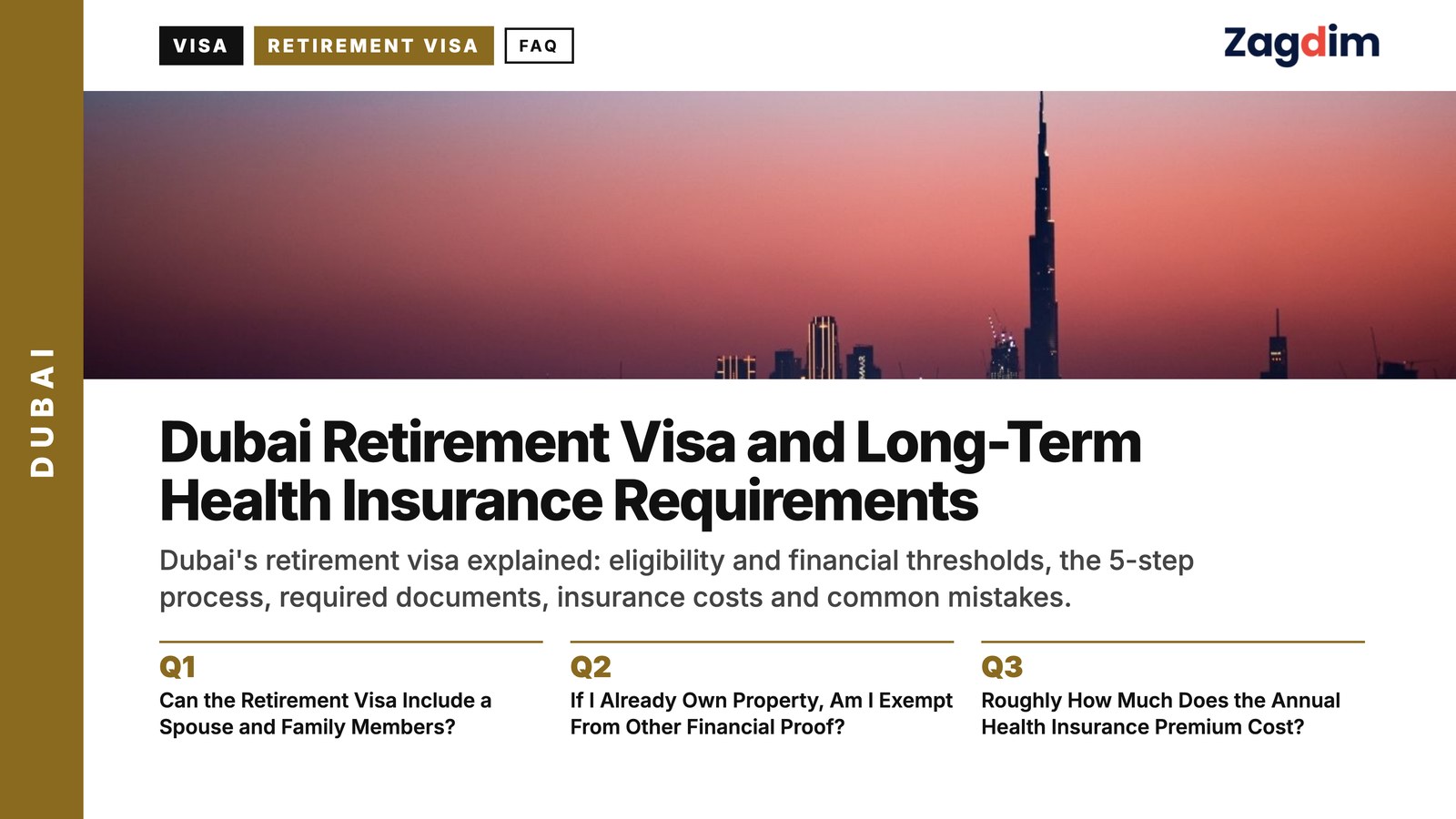
1. The Middle East Option in the Retirement Relocation Wave: Why More People Are Choosing Dubai
In recent years, a wave of “international retirement” has swept the globe, with high-net-worth individuals and early retirees actively searching for their ideal second-life base. Beyond Asia and Europe, the Middle East is emerging as an option, with Dubai in particular drawing attention for its zero income tax, modern healthcare system and image as a safe, stable international city.
For many retirees, Dubai offers more than a luxurious lifestyle — it offers a sustainable retirement option. The Dubai retirement visa, updated in 2024, runs for five years, is renewable, has clear eligibility conditions, and is open to applicants aged 55 and above. This has led many retirees from Europe, Asia and the US to start assessing whether it’s feasible for them.
That said, is moving to Dubai really that simple? Prospective retirees commonly ask:
- Is the retirement visa’s threshold high?
- Will medical costs be expensive?
- Are Dubai’s cost of living, insurance premiums and housing expenses reasonable?
At the core, these questions really come down to two main variables: first, whether you meet the financial and status conditions for the retirement visa; second, whether, once you have the visa, you can afford the required long-term health insurance. Under current rules, long-term health insurance is not just a condition for the retirement visa to be issued — it will also significantly affect your annual budget and risk exposure.
Below, we systematically break down the practical feasibility of Dubai’s retirement visa across eligibility, the application process, insurance plans and cost of living, to help you make an informed choice.
2. Who Should Apply for the Dubai Retirement Visa
The first step to starting retirement life in Dubai is confirming whether you meet the basic eligibility for the retirement visa. This isn’t aimed at general relocators or entrepreneurs — it’s designed specifically for retirees aged 55 and above. You don’t need to work in Dubai, and you don’t need a business background — as long as you can show you’re financially self-sufficient and able to stay long term, you clear the initial bar for assessment.
So who is this retirement visa best suited to?
- Foreigners aged 55 and above, whether from Europe, Asia, the US or elsewhere
- Those with a stable pension, regular savings or property income who want to maintain financial independence
- Anyone drawn to a tax-friendly, well-resourced healthcare, internationally connected lifestyle, and willing to start a new chapter in the Middle East
To apply for this five-year, renewable retirement visa, applicants must meet one of the following three “financial thresholds”:
| Financial Threshold Option | Eligibility Requirement | Required Documents | Restrictions |
|---|---|---|---|
| Fixed deposit route | A three-year fixed deposit of at least AED 1,000,000 (about USD 272,000) at a UAE bank | Bank deposit certificate, transfer undertaking letter | Must be held in the applicant’s own name, and cannot be withdrawn early |
| Income route | Monthly pension or passive income of at least AED 20,000/month (≈AED 240,000/year), the threshold that applies to applications filed from Dubai; the general federal income-route threshold elsewhere is AED 180,000/year | The past six months’ bank statements, letter proving the source of the pension | Only stable income is accepted; one-off or temporary income does not qualify |
| Property route | Owning a mortgage-free property in Dubai worth at least AED 1,000,000 AND holding financial savings of at least AED 1,000,000 (both required) | Title deed, proof the property is unmortgaged, plus proof of the savings/deposit | Limited to properties in Dubai; jointly held title is not accepted |
These three routes differ in nature, but at their core all emphasize the same point: you need demonstrable, stable financial security to be considered an eligible retiree resident. Whether you prefer an asset-based route (property), an income-based route (pension), or a savings-based route (fixed deposit), you can choose whichever fits you best to start your retirement in Dubai.
3. How to Apply for the Dubai Retirement Visa
Applying for the retirement visa is not as complicated as a traditional immigration visa, but you still need to follow official rules, completing document preparation and health verification. The whole process generally takes about 1 to 2 months, with the exact speed depending on how far in advance you’ve arranged your finances and medical insurance.
Step 1: Confirm Financial Eligibility and Choose a Health Insurance Plan
Choose one of the three financial routes, and confirm you can provide complete supporting proof (such as a fixed deposit certificate, title registration, or pension source letter). At this stage, also compare several long-term health insurance plans in Dubai, budgeting the annual premium, coverage and whether pre-existing conditions are covered.
Step 2: Submit the Application and Documents to the Dubai Retirement Office
The formal application is submitted through the Dubai government’s smart platform (such as GDRFA or Dubai Now), or in person at an authorized Amer Center / Customer Happiness Center, with the required data and forms, including a personal photo, passport copy, financial documents and insurance proof.
Step 3: Buy Qualifying Long-Term Health Insurance
Once the initial review passes, you must formally purchase insurance meeting the requirements (such as Daman’s Madeed plan), providing the full policy and personal coverage details. This step is a key part of Dubai’s visa issuance — without valid health insurance, the visa cannot be granted.
Step 4: Complete Biometrics and the Medical Exam
Applicants must undergo fingerprinting and a medical exam, including a chest X-ray and blood test, to confirm compliance with UAE health and safety rules. The medical results are submitted directly to the GDRFA system by the designated medical facility.
Step 5: Receive the Renewable 5-Year Retirement Visa
Once the review and medical exam pass, GDRFA issues a retirement visa valid for five years, and processes the Emirates ID at the same time. As long as you continue to meet the financial and insurance conditions before the visa expires, you can renew online without needing to re-enter the country or resubmit medical documents.
The process may look simple, but many people get stuck at the insurance and document-preparation stage. Ask Zagdim if a similar question applies to your situation, and we can help you work through it.
4. Required Documents
Below are the main documents required for the Dubai Retirement Visa, organized by application route (income / savings / property), plus insurance and family-related items, to help you check everything off in one pass:
Basic Documents (Required for All Applicants)
- A scanned passport copy (at least six months’ remaining validity)
- A white-background photo (meeting UAE ICP specifications)
- A health insurance policy (a DHA-approved comprehensive medical plan, covering the main applicant and dependants)
- A medical exam report (issued by an officially designated medical center)
- Proof of 15 years of work experience (such as a retirement certificate, employment termination letter, or social security retirement letter)
Financial Proof (Submit One, Depending on Application Type)
1. Income route (e.g. a pension):
- The past 6 months of bank account transaction records (showing stable deposits)
- A letter proving the income source, issued by an official body (such as a pension fund, social security office, or former employer)
2. Savings route:
- A “three-year fixed deposit certificate” issued by a UAE local bank, for an amount of at least AED 1,000,000
- If held overseas, a translated and UAE-embassy-notarized proof of equivalent assets
3. Property route (both of the following are required together):
- A property “Title Deed” issued by the Dubai Land Department (DLD), with a value of at least AED 1,000,000
- Proof of financial savings of at least AED 1,000,000
- If jointly held by a married couple, the ownership share must be specified along with a marriage certificate
- If mortgaged, proof that at least AED 1,000,000 has been paid, or proof the mortgage has been settled
4. Combined route:
- Proof of property worth AED 500,000 or more
- Proof of a fixed deposit of AED 500,000, locked in for three years
If Bringing a Spouse or Family
- A marriage certificate (translated and notarized, if applying with a spouse)
- Children’s birth certificates (if applying with children)
- A statement of jointly held assets with a spouse (such as jointly named property, a joint account, or co-owned real estate)
How to Submit
- Upload electronic documents through the official GDRFA website
- Or submit in person at a Dubai “Customer Happiness Center” or “Amer Center”
5. FAQ
Can the Retirement Visa Include a Spouse and Family Members?
Yes. Under current rules, the Dubai retirement visa allows the applicant to apply together with a spouse and children — an unmarried daughter can be included in the family visa, and minor children (under 18) can also be listed as dependants. Submitting a marriage certificate, children’s passports and valid health insurance is enough to include them in the same residency plan.
If I Already Own Property, Am I Exempt From Other Financial Proof?
Not on property alone. Under the federal property route, an applicant needs to show both a mortgage-free property worth at least AED 1,000,000 AND financial savings of at least AED 1,000,000 — owning the property by itself does not remove the savings requirement. Either way, valid health insurance and a passed medical exam are still required.
Roughly How Much Does the Annual Health Insurance Premium Cost?
According to current market data, retirees aged 55–75 buying a qualifying health insurance plan in Dubai typically pay an annual premium of between AED 5,800 and AED 18,000 (about USD 1,600–4,900), depending on the plan chosen, whether chronic conditions are covered, and the coverage level. Daman’s Madeed series is one of the most common retirement insurance plans.
Can the Retirement Visa Be Converted to a Golden Visa?
Yes. As long as the retirement visa holder later owns a property worth more than AED 2,000,000, or meets other Golden Visa investment conditions, they can go through the Dubai Land Department (DLD) or GDRFA to convert and apply for a Golden Visa, valid for 10 years with easier renewal conditions.
If I No Longer Meet the Financial Conditions Partway Through, Will the Visa Be Cancelled?
The retirement visa runs for 5 years, and financial eligibility is reviewed again at renewal. If your financial position can’t be maintained — for example, the fixed deposit amount falls short, or a property is sold without a replacement that meets the conditions — renewal may not be possible. It’s therefore advisable for retirees to keep their assets stable and retain the relevant documents throughout their residency.
Can Retirement Visa Holders Work?
In principle, full-time employment is not allowed. However, under GDRFA’s latest guidance, retirement visa holders who want to take on short-term consulting, teaching or project work can apply for a “temporary work permit.” This is mostly used for government or officially authorized projects and requires separate application and approval.
6. Points to Watch
Applying for the Dubai retirement visa may look straightforward, but a few common mistakes in practice can delay or derail an application. Below are three key points applicants often overlook — pay particular attention to these during preparation:
1. You Cannot Choose Just Any Type of Health Insurance
Retirement visa applicants cannot use travel insurance or short-term health insurance to meet the requirement. Under Dubai Health Authority (DHA) rules, the insurance must be a “Comprehensive Plan” provided by a DHA-approved insurer. Only plans such as Daman’s Madeed series or ADNIC’s dedicated retirement plan meet the basic approval conditions — travel, accident-only or time-limited insurance will not be accepted. Confirm the insurance category and terms in advance.
2. The Source of Funds Must Come With Compliant Proof
Whether choosing the savings-based route or the property route, you need to provide clear, lawful proof of the source of funds. Bank deposit certificates, pension source letters, title deeds or rental income records must all be formally issued and officially stamped. Presenting assets as cash, an overseas transfer, or held through a third party is likely to be treated as non-compliant and rejected.
3. Not All Insurers Accept Older Applicants
Many international insurers place conditions on covering foreigners over age 55, especially those with existing chronic conditions or no local medical history. It’s advisable to allow at least 2 to 4 weeks for assessment and negotiation, and to work with an insurance broker familiar with retirement-visa purposes, such as Pacific Prime, Sukoon or Orient Insurance, to compare options. If you leave it too late, you may not be able to submit the policy in time, affecting whether the visa is issued.
7. Takeaway
For anyone aged 55 or above who wants to start a second life in an international city, the Dubai retirement visa paired with compliant health insurance is not just an entry ticket — it’s the foundation for a smooth retirement. From the financial route and insurance choice to family arrangements, every decision affects your budget and quality of life.
Have a question about this guide? Leave a comment below, or ask Zagdim directly.
Your first stop for international property and global living.
Research and insights. Know what’s changing. Understand what matters.
Sources
- GDRFA — *Dubai Retirement Visa Requirements 2024–2025*
- Dubai Health Authority — *List of DHA-Compliant Insurance Plans*
- Daman — *Madeed Retiree Health Insurance Plans*
- ADNIC — *Retirement Medical Insurance Overview*
- Visit Dubai — *Retire in Dubai Official Portal*
- UAE Federal Authority — *Residence Visa Guidelines for the Retired*
- Knight Frank — *The Golden Years: Real Estate 2023*
- Pacific Prime — *Health Insurance Costs for Expats in UAE*
Content note: This article is compiled mainly from UAE government agencies (such as GDRFA, DHA and the UAE Federal Authority) and mainstream insurers (such as Daman, ADNIC and Cigna) official websites and market analysis reports published between 2023 and 2025, to keep the information accurate and current.