Introduction
Since 2019, people around me who follow overseas markets — friends, industry peers, and even people who had been sitting on the sidelines for a long time — have often asked me the same question: “Should we still be holding onto property in these places? Is there still room for it to rise?”
My advice at the time was consistent: for some properties, particularly certain residential properties in parts of Japan, if circumstances allowed, actively considering an exit was worth doing.
Some people who acted on that advice sold within two or three years and made gains of 70%–80% (one case I know of made 120% in 7 months). Others believed the tourism sector would keep improving and chose to keep holding, and when they eventually sold, the actual return came mainly from rent, with capital gains largely eaten away.
You could say this was because of the pandemic — but then why did returns on property in some regions actually rise during the pandemic? Timing and market structure matter more than gut feeling.
Lately, as interest rates have come down and capital has started moving again, more people have been asking: “Can I still buy now?”
I think it is time to write down the observations and logic that have come up again and again over these past few years.
Economic Structure Is the Most Important Factor
Whenever someone asks me “GDP is up 6%,” “hot money is starting to flow in here,” “will it go up,” or “should I buy,” what I really want to say back is this:
Whether property prices rise is never simply a matter of location or interest rates — it is about whether a city is, or is not, going through an economic transformation.
We often say property prices will rise, but have you ever thought about what actually drives that?
Many people focus on interest rates, inflation, or the demographic dividend, or even talk about subway lines and shopping malls. But if you step back and look at the bigger picture, you find that what truly drives long-term price growth almost always comes down to one core logic: a country or city’s economic structure is undergoing transformation.
This transformation matters far more than short-term interest rates, and far more than any large shopping mall opening. Because it reshapes an entire city’s function and value, and property prices are simply a byproduct of that reshaping.
But this transformation is never a single event — it is a path: an economic progression from agriculture, to industry, to services, to becoming a capital hub. At each stage, capital chases a different direction, the nature of land changes, and the flow of people and the centers of power get reshuffled.
Property prices are simply the visible surface of that reshuffling.
Stage One: Agriculture to Industry
The city begins to produce, and land begins to acquire value — this is the first stage where property has the possibility of appreciating. The city moves from farmland to a place that builds factories, sets up industrial zones, builds worker housing and absorbs labor.
Typical examples include:
- Japan after World War II (1950–1970)
- China around the time it joined the WTO (1990–2005)
- Parts of Vietnam, Cambodia and India today
At this stage, rising property prices are not because speculators are buying — they are because:
Land converts from agricultural to industrial use, large numbers of workers pour in, infrastructure gets built, the urban population starts to cluster, and industry drives genuine need.
What you will see: apartments next to industrial zones suddenly become expensive, worker housing runs short, subway lines are only just being planned, and developments are launched ahead of demand.
But underneath, the essence is: the city’s role has shifted from farming to production — land begins to carry capital value.
Stage Two: Industry to Services
The city no longer just produces — it starts to manage, create, research and export value. Once factories multiply and manufacturing stabilizes, some cities move to the next stage: developing design, R&D, marketing, logistics, business management and financial services, with talent taking center stage.
At this point, land value is reassessed again — not because of more factory floor space, but because capital and talent need “efficiency × connectivity × functional space,” giving rise to office towers, high-end residential property and startup space.
Representative cities include:
- Shenzhen: from a factory town to an innovation city, a biotech and internet R&D base
- Bangkok’s new CBD: shifting from low-cost manufacturing to a Southeast Asian hub for medical care, education and regional headquarters
Property prices no longer come from how many buildings get built, but because: land starts to carry higher-value output — management, decision-making, innovation and connectivity.
Stage Three: Services to Capital Hub
The city moves beyond industry and becomes a vehicle for capital and institutions. Some cities go further still, no longer relying on “physical industry” to drive their economy, but instead on: a stable financial system, a tax and asset-planning regime that is welcoming, sound rule of law and property-rights protection, and high international trust — becoming a global capital “mooring point.”
At this stage, property prices enter a phase that is almost detached from the real economy — you will see luxury homes priced far above their rental yield, with no shortage of supply, yet capital keeps flowing in.
Because these homes are no longer simply tools for living in — they are: a parking spot for assets × a springboard for transferring capital × a hedge against policy risk.
Typical cities include:
- Hong Kong: once a hub connecting mainland Chinese and international capital
- Singapore: tax-neutral, a hub for family offices
- London: still the institutional core of European asset pricing
At this stage, property prices decouple from local demand; the real driver is: trust × liquidity × exit mechanisms.
Capital Never Fires at Random — Speculation Follows Logic
Capital never fires at random — when it speculates, it is because it is choosing cities according to a logic. So you will find that capital migration is never arbitrary; it is a staged choice:
- When a place first enters industrialization, you would naturally choose somewhere like Dongguan — cheap labor, flexible land
- When trade, technology and information demand takes off, you would choose Shenzhen — where talent and business efficiency concentrate
- When companies start raising capital, listing, and need international institutions and trust, you would choose Shanghai — a market with complete capital rules and global pricing
This is the core reason property prices rise “in stages, tied to timing and function.”
One Point That Is “Extremely, Extremely, Extremely” Important
Not every country successfully transitions from industry to services to becoming a capital hub. And a country can stay stuck at the same stage forever — this point matters a great deal.
Take Thailand, for example. It took on industrial transfer from Japan in the 1980s as Japan’s domestic costs rose, and built up a basic industrial base early on; afterward, it built a services sector on the back of tourism and medical care, and appeared to have a chance of moving toward the third stage.
But it is currently stuck in the middle-income trap, with social stratification and insufficient capital accumulation, so property prices have struggled to break out clearly (this does not mean Thailand has no chance at all).
So before deciding to invest overseas, the first question you should ask yourself is not whether the country has oil, or whether GDP growth is 8% — it is what stage the country’s economic transformation is at.
Once you understand which stage a country is in, you will know:
Where should you buy?
What kind of product should you buy?
Who will your tenant be?
How should you estimate the return?
How long do you expect to hold it?
Only then can you avoid the awkward position of having to sell at a low price when you eventually want to exit.
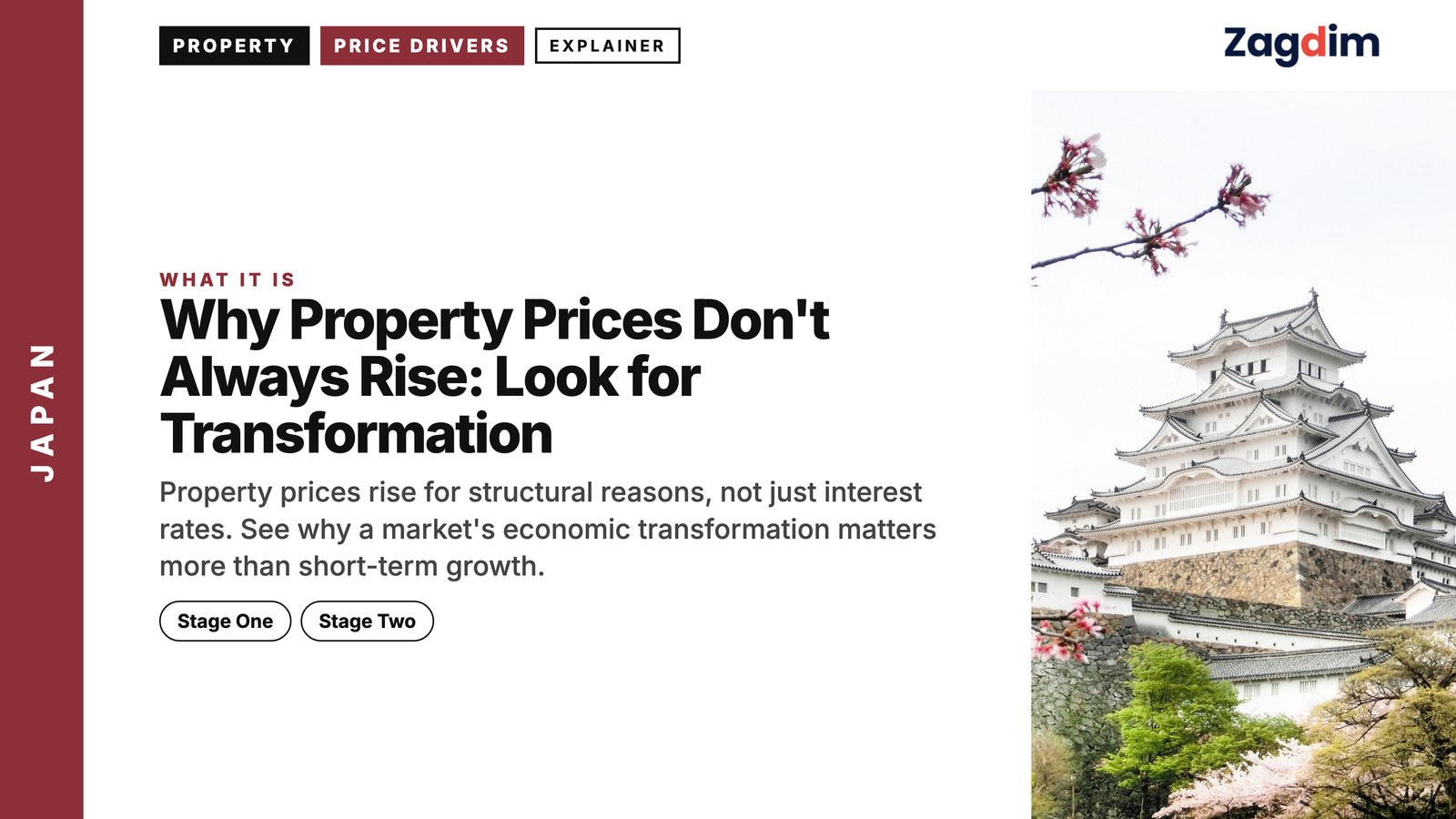
Going forward, I plan to analyze different countries and break down which stage each one is in, and which places are “fake transformation” or “false growth” traps. Let’s start with Japan, since I have recently seen a lot of analysts writing about “going into Japan.”
Disclaimer: The above is not investment advice; it is intended for educational purposes only.
If you have questions about buying property overseas, you are welcome to fill in the form below to ask.
Have a question about this guide? Leave a comment below, or ask Zagdim directly.
Your first stop for international property and global living.
Research and insights. Know what’s changing. Understand what matters.