Zagdim Overseas
Subscribe
  • News
    • Thailand
    • Japan
    • UK
    • Germany
    • Global Reports
  • Country Guides
    • Thailand
    • Japan
    • Malaysia
    • Vietnam
    • Philippines
    • Indonesia
  • Property Research
    • Zagdim Insights
  • Ask Zagdim
  • About
    • Zagdim Research
    • Expert Network
    • Contact Us — LINE / WhatsApp
  • 中文 EN
No Result
View All Result
Zagdim
No Result
View All Result

Why German Property Developers Stay Small and Local

Home Germany
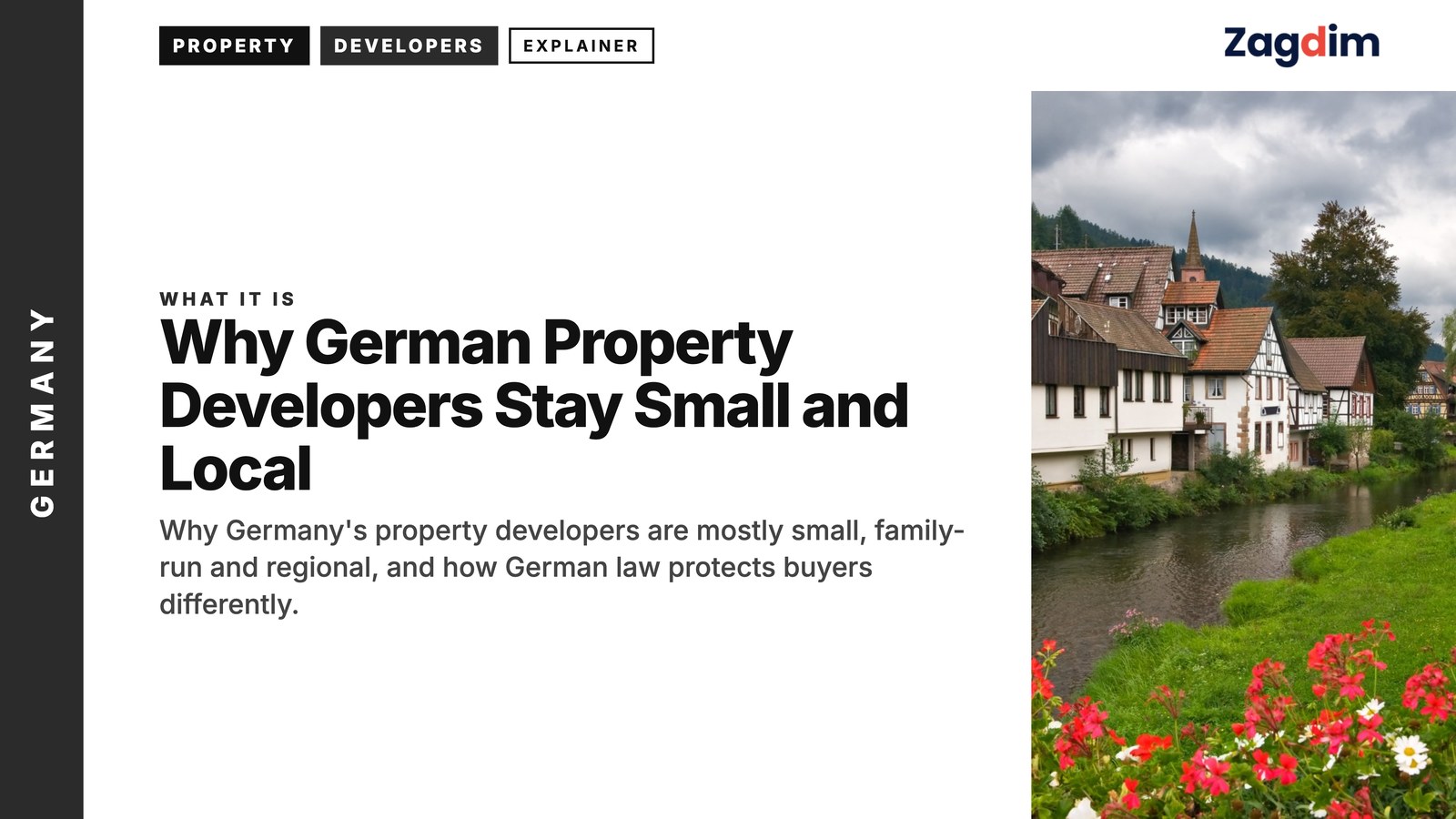
River — Half-timbered village houses along a river with flowers, illustrating Why German Property Developers Stay Small and Local

Image: Zagdim

September 25, 2026
in Germany
Reading Time: 3 mins read
Tags: Buying Property

Investing in German property, especially in a new-build or renovation project, also means dealing with German developers — and the experience is quite different from dealing with developers in Hong Kong.

After the Second World War, Germany rapidly rebuilt its infrastructure and housing stock, and German reunification in 1990 gave development a further push, though that phase had ended by the early 2000s. The typical German property market does not include huge residential estates or skyscrapers. A typical German residential development is much smaller, rarely more than six stories. Strict building codes, and historical constraints such as not building higher than a church spire, make it almost impossible to build very tall or very wide. The old, large developers largely left the market as the sector stopped being attractive to them. Over the past decade, the German property market has continued to be dominated by typical single-family houses and small residential buildings — one reason Germany now has a shortage of more than a million apartments. Germany’s developer market is made up mainly of small and mid-size companies, most of them focused on a single regional market; developers that build projects nationwide are rare.

Family Firms, Not Listed Companies

Most of these small and mid-size companies are family firms with deep construction experience and a good understanding of the regulations, but their capital structure is very different from the large developers in Hong Kong or mainland China. These companies are rarely listed on a stock exchange. Their financial stability mainly comes from 10 to 30 years of accumulated results. They also maintain stable financing relationships with German banks, and new residential developments are mostly funded through loans from German banks or insurers. German developers typically commit 10–30% of the investment amount themselves.

How German Law Protects Buyers

Hong Kong and mainland China are classic buyer’s markets, where a deposit is usually required before purchase, and developers hold more of the bargaining power. Germany has different laws and rules governing the relationship between developer and buyer. The starting point is the highly credible land register. A regulation called the “Makler- und Bauträgerverordnung” (an ordinance covering estate agents and developers) sets out the payment schedule in the contract, along with many other guarantees for the buyer. If a developer does not provide the required guarantee, the contract specifies that no advance payment is required. The contract’s structure and terms are drafted to protect both developer and buyer, rather than favoring one side alone — which makes the contract more complex, but also a form of security for both parties.

Buyers also benefit from the “Forderungssicherungsgesetz” (a law protecting outstanding debts and guarantees), which gives the buyer a guarantee equal to 5% of the investment amount at the start of the project. The same logic runs the other way: if construction progress is achieved on schedule, the buyer must also make the corresponding payment.

German developers are also subject to more extensive legal and safety regulation, and must factor in the winter period from December to March, when outdoor work is not possible — this can push back the building timetable and the handover date, but these delays are already built into the contract, with special circumstances anticipated in advance.

Developers in Hong Kong and mainland China can design a residential project at scale and offer three or four standard floor plans. German developers, by contrast, must plan much more individually for each buyer. If you are considering investing in German property, it is worth meeting the developer and talking things through before you commit.

Related in this series:

  • 5 Documents You Must Check Before Buying Property in Germany
  • Best Regions for Property Investment in Germany
  • How EU and German Climate Rules Are Reshaping Property Requirements
  • Why Germany's Economy Is So Strong (and What It Means for Property Investors)

Have a question about this guide? Leave a comment below, or ask Zagdim directly.

Life abroad? Ask Zagdim.

Your first stop for international property and global living.

Research and insights. Know what’s changing. Understand what matters.

Zagdim AI
All content is researched, written, or authorized for publication by the @Zagdim Overseas team. Sharing and reposting are welcome, but please make sure to credit the source and include the original article link from this website. Any plagiarism or unauthorized use may result in legal action. For article submissions, please contact us via Facebook. Thank you for your support!

For article submissions, press release publication, or interview notices, please contact [email protected]. 

Zagdim Ask

Have a specific question about overseas living, property, visa, or practical arrangements?

Fill in your situation and key concerns through Zagdim Ask. Our team will review your message and get back to you by email where appropriate.

Submit your enquiry →

Similar Topics

UK Landlords Told to Rethink Property Ownership as October Budget Tax Rise Could Wipe Out Profit for Some
News

UK Landlords Told to Rethink Property Ownership as October Budget Tax Rise Could Wipe Out Profit for Some

November 10, 2026
Greece's 15% Property Transfer Tax for Non-EU Tax Residents Is Now a Government Bill in Parliament
News

Greece’s 15% Property Transfer Tax for Non-EU Tax Residents Is Now a Government Bill in Parliament

November 10, 2026
Taiwan's Financial-Proof Thresholds for Naturalisation: NT$5 Million in Assets or Twice the Minimum Wage
News

Taiwan’s Financial-Proof Thresholds for Naturalisation: NT$5 Million in Assets or Twice the Minimum Wage

November 10, 2026
Next Post
Aerial — Aerial view of Spree river bridge and rooftops Berlin, illustrating Why Germany's Economy Is So Strong (and What It Means for Property Investors)

Why Germany's Economy Is So Strong (and What It Means for Property Investors)

Aerial — Aerial view of Berlin skyline with TV Tower and Spree, illustrating How German Housing Demand Has Shifted Since the Pandemic

How German Housing Demand Has Shifted Since the Pandemic

Landmark — Berlin Cathedral dome with tour boat on the Spree, illustrating Can Foreign Buyers Get a Mortgage in Germany?

Can Foreign Buyers Get a Mortgage in Germany?

Facebook Twitter Youtube

About Us

Zagdim is a global knowledge platform focused on international property, global living, relocation, lifestyle, and location-based decision-making.

We provide insights on overseas real estate, market trends, regional analysis, economic developments, and practical relocation information. Through continuous market observation and on-the-ground research, Zagdim helps readers better understand a place before deciding where to live, invest, buy property, or establish a base abroad.

We currently follow markets including the UK, Japan, Thailand, Malaysia, Germany, Australia, the UAE, Greece, Portugal, and Spain, while continuing to track emerging lifestyle, relocation, and property trends worldwide.

Category

  • Australia
  • Buying & Immigration Guide
  • Cambodia
  • Canada
  • Costa Rica
  • Dubai
  • Encyclopedia
  • Europe
  • Expat Lifestyle Guide
  • Germany
  • Global Reports Analysis
  • Hong Kong
  • Human-Picked
  • Indonesia
  • International Property Buying Guide
  • Japan
  • Japan Market News
  • Kenya
  • Living Abroad
  • Malaysia
  • Mallorca
  • Market Trends Overview
  • News
  • Other Market News
  • Overseas Leasing & Long-Term Stay
  • Partner Content
  • Philippines
  • Policy Interpretation
  • Portugal
  • Property
  • Property Law & Tax
  • Real Estate & Economic News
  • Real Estate Law & Taxation
  • Relocation, Immigration & Visa
  • Singapore
  • South Korea
  • Spain
  • Switzerland
  • Thailand
  • Thailand Market News
  • UK Market News
  • United Kingdom
  • United States
  • Vietnam
  • Vietnam Market News
  • Visa & Immigration
  • Zagdim Insights
  • Zagdim Property Insights

Email:[email protected]


Add Friends


WhatsApp
Contact Us


Wechat:Zagdim

Work with Zagdim

For brand and content partnership enquiries, email [email protected].

©2026 Zagdim Overseas All Rights Reserved · Privacy Policy

No Result
View All Result
  • News
    • Thailand
    • Japan
    • UK
    • Germany
    • Global Reports
  • Country Guides
    • Thailand
    • Japan
    • Malaysia
    • Vietnam
    • Philippines
    • Indonesia
  • Property Research
    • Zagdim Insights
  • Ask Zagdim
  • About
    • Zagdim Research
    • Expert Network
    • Contact Us — LINE / WhatsApp
  • 中文 EN

©2026 Zagdim Overseas All Rights Reserved · Privacy Policy