




























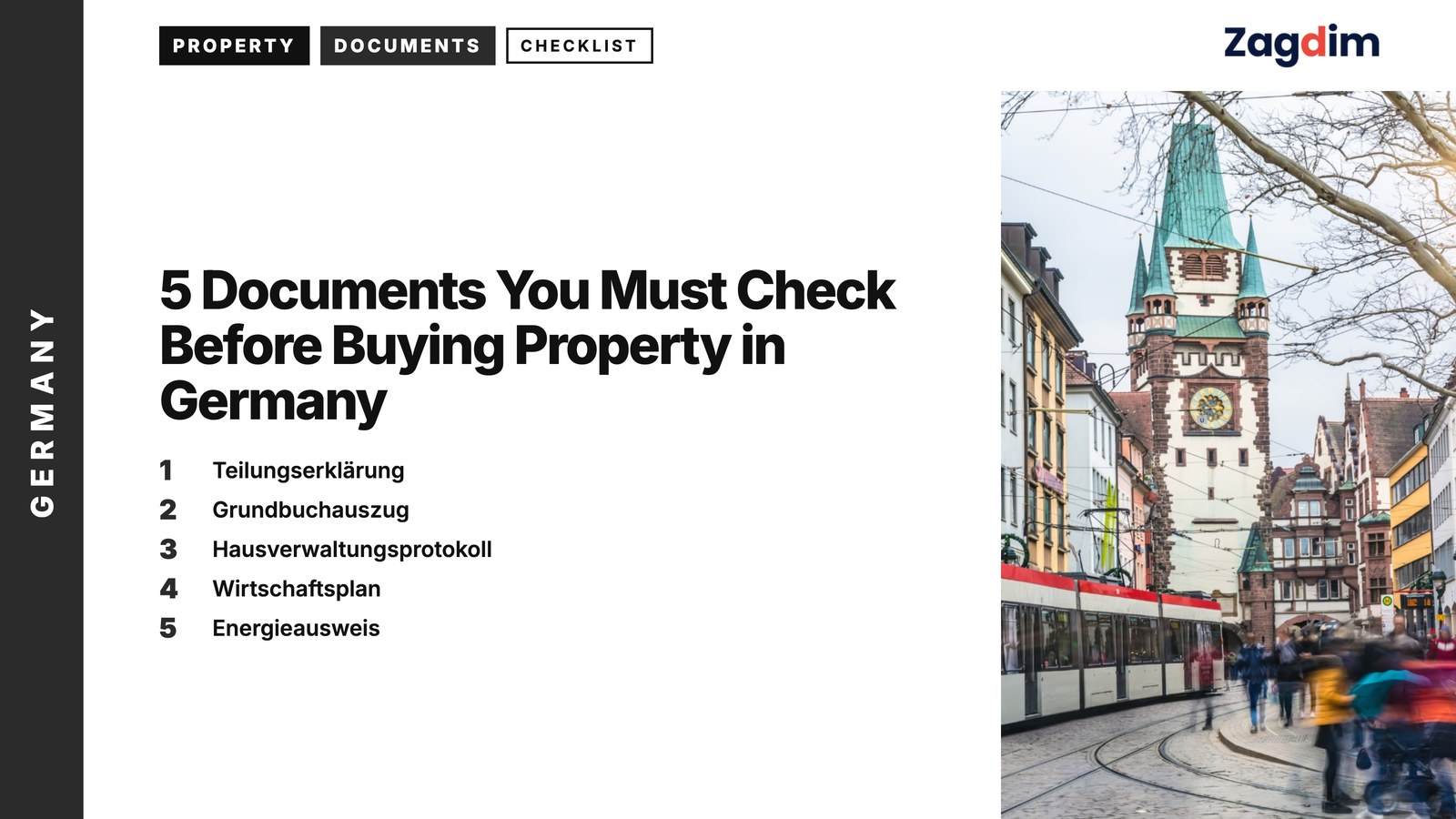
Germany’s property transaction process is clear, and a notary helps coordinate it so that both buyer and seller can complete the transaction on fair terms. Even so, as a buyer you should carefully read the relevant documents before the transaction. This article shares 5 documents that anyone buying property in Germany should look at carefully.
Teilungserklärung — Declaration of Division
If you intend to buy a unit in a German apartment building, be sure to check the building’s declaration of division (Teilungserklärung). This document contains detailed information about the property and sets out each unit owner’s rights and obligations, and it also states how ownership of the building is divided by area, with each divided portion given its own independent number. Before buying, you should read the content carefully and check whether the description of the unit you are buying in the document matches what the seller has told you. The document also states what percentage of the whole building’s ownership the unit represents — this matters because, if the owners later need to jointly fund repairs, the cost is usually calculated according to this share. A few points within it are worth an owner’s particular attention:
Wohnungseigentum — Apartment Ownership
An apartment in Germany refers specifically to a building whose ownership is divided among different holders, where ownership of the building is split into a number of portions, and each owner holds a defined share of the land and the building. If a building’s documents do not state that a property is an apartment in this sense, you should ask exactly what form of ownership applies.
Sondereigentum — Private Property
This refers to the portion of ownership held by the buyer — it can be understood as the exclusive part, over which the owner has the right to deal with the property as they wish, while also being responsible for its upkeep. Generally, private portions refer to the rooms within the apartment, along with the ceiling and interior walls.
Gemeinschaftseigentum — Common Property
This refers to the parts of the building with no single owner, jointly owned by all the owners in the building — mostly common areas such as the stairwell, garden, roof, water pipes and heating. The cost of maintaining these parts is shared among all owners, and the document will state how the cost is split.
Sondernutzungsrecht — Special Usage Right
This refers to parts of the building the buyer does not own but has the right to use, such as a unit’s balcony, a dedicated parking space, or a garden only the buyer may use. The cost of maintaining this portion is also shared among all the owners.
Grundbuchauszug — Land Register Extract
Germany keeps a land register to record every ownership unit; the land register extract is equivalent to a unit’s title deed. The first page of the Grundbuch carries its own reference number, which is the unique label the land registry uses to locate the apartment unit. The land register extract also records the unit’s past transaction history, so you should review this document before any purchase and make sure it is the latest version — we recommend checking a land register extract issued within the past 6 months before buying, to confirm the seller is the current owner. It also lets you check the ownership and usage rights attached to the unit, and you should check whether these match what the seller has told you before the transaction.
Hausverwaltungsprotokoll — Owners’ Meeting Minutes for the Past 2-3 Years
In Germany there is likewise an owners’ association (House Union) responsible for handling building maintenance and providing a platform for owners to deal with matters between themselves. Every year, the association invites all owners to a meeting to discuss matters relating to the building, and the minutes record the discussion and the resolutions passed. This record is the Hausverwaltungsprotokoll. Before buying, a buyer can review these minutes to see what recent renovation work has been carried out, and to check whether the owners have been in dispute over anything, or whether any necessary building repairs have been delayed for any reason — so as to avoid having to help fund building repairs immediately after buying a unit.
Wirtschaftsplan — Building Financial Plan
Also known as the Rücklage, this document is the building’s financial plan, setting out the building’s annual expenditure and the items it covers. Before a transaction, buyers should fully understand the annual running costs of the unit, such as rainwater drainage fees (the building’s cost for draining rainwater) and fees paid to the House Union (similar to a management fee). The most important item is the Hausgeld, which can be understood as the management fee — a monthly charge paid by owners. Buyers should check whether the Hausgeld already covers all likely monthly costs; German apartments typically include heating, water and waste disposal fees within it. You should also check the building’s financial reserve (Rücklage) — the larger the reserve, the smaller the likely additional costs in future. Reviewing this before a transaction helps a buyer understand future outgoings.
Energieausweis — Energy Certificate
This is the official document containing data related to a building’s energy consumption; the energy certificate states its issue date, registration number and type. Buyers can use this document to check the history of certain features of the property. For example, a rule requiring replacement of oil/gas boilers over 30 years old existed under the Energieeinsparverordnung (EnEV) and its successor the GEG, but this mandatory-replacement requirement was itself repealed on 29 July 2026 by the Gebäudemodernisierungsgesetz (GModG) — boilers are no longer required to be replaced solely due to age. Another point to note is the energy efficiency rating of the unit, ranging from A (best) to H (worst). A better energy efficiency rating means lower electricity costs — the electricity cost for a B-to-C rated unit is only about half that of a D-to-E rated unit — and since German winters may not allow you to switch off the heating to save money, we recommend looking for a building with a higher energy efficiency rating.
We recommend that anyone buying an apartment unit in Germany read all 5 of the documents above carefully. Doing so can help you avoid most additional costs, understand the unit’s ownership more fully, and avoid running afoul of the law.
Have a question about this guide? Leave a comment below, or ask Zagdim directly.
Your first stop for international property and global living.
Research and insights. Know what’s changing. Understand what matters.