From 1 July 2026, CIMB began removing its RM1 interbank fee on cash withdrawals at self-service terminals. When you see news about “no fees,” do not assume that withdrawing cash in Malaysia is now free. CIMB’s notice says this is a joint measure across Malaysia’s banking industry: debit cardholders withdrawing at about 14,000 bank ATMs or SRMs (self-service recycler machines) nationwide pay no interbank withdrawal fee, whichever bank issued the card. But what is waived is only that RM1. The notice does not mention foreign cards and does not separately list international network withdrawal fees charged by foreign card issuers. If you use a card from Hong Kong, Taiwan, mainland China or Singapore, separate what the ATM side charges from what your own bank charges.
The short version: no money changer in Malaysia is guaranteed to be the cheapest. What matters is how many ringgit you end up with for the same amount. In the city, look for operators on Bank Negara Malaysia’s list of licensed operators; if you arrive late at night, the 24-hour airport counters can cover an emergency; before an ATM withdrawal, ask your card issuer how it charges; when the screen asks which currency to use, check the rate and fees first, and if you are unsure choose ringgit (MYR); cash and instruments worth more than US$10,000 in total must be declared on both entry and exit.
This guide answers:
- Where should you exchange ringgit: how do you choose between the airport, city money changers and bank counters, and how do you confirm an operator is licensed?
- What layers of fees apply when a foreign card withdraws cash at a Malaysian ATM?
- Which of Alipay, WeChat Pay, Singapore apps and Taiwan mobile payments can scan Malaysia’s DuitNow QR?
- How much cash must be declared, and what extra limits apply to carrying ringgit in and out?
Key Points
- Who should read this: visitors to Malaysia for travel, family visits, property viewing or a long stay, including those from Hong Kong, Taiwan, mainland China and Singapore; also Malaysia-based readers paying abroad, who should check the direction in which each mobile payment works.
- Read “no fee” in layers: what was removed is the RM1 per-transaction interbank withdrawal fee. CIMB’s notice calls it a joint banking-industry measure for debit cardholders and does not mention foreign cards. A foreign card may still carry the issuing bank’s own fees, so ask your own bank.
- Exchanging money: CIMB lists 24-hour counters at KLIA and KLIA2; in the city, look for operators on the central bank’s list, such as HME and Merchantrade. Confirm quotes at the branch itself.
- Mobile payments: Alipay from mainland China, AlipayHK and Singapore’s Changi Pay are listed as Alipay+ partner wallets that can scan DuitNow QR; WeChat Pay (Weixin Pay) has also been integrated, for visitors from China.
- Cash declaration: cash, bearer negotiable instruments, or the two combined worth more than US$10,000 must be declared on Customs Form No.7 on entry and exit.
- Extra limit on carrying ringgit: ringgit worth more than US$10,000 requires prior written approval from Bank Negara Malaysia, and must still be declared after approval.
How Much Cash Should You Bring to Malaysia?
Bring only a small amount of ringgit in cash, because there is no standard figure. There is no upper limit on carrying foreign banknotes in or out, but amounts above the threshold must be declared. How much you need depends on your trip and on which of the following tools you can use:
- Cards: card payments and ATM withdrawals. For foreign cards, ask your card issuer about the fees first.
- Mobile payments: depends on whether your wallet supports DuitNow QR; see the table later in this guide.
- Touch ‘n Go physical card: can be used at designated public transport, retail and dining locations, with a maximum stored value of RM1,500. “Designated” means a limited range; do not assume every shop accepts it.
Zagdim recommends keeping a small amount of ringgit in cash for the first leg of transport and the first meal, using a card or mobile payment for most spending, and topping up when needed.
Where to Exchange Ringgit
Exchange at a licensed money changer in the city or at a bank counter, and use the 24-hour airport counters only if you arrive late at night.
| Method | Best for | What to watch |
|---|---|---|
| ✅ Licensed money changers in the city | People with cash in hand who want to compare rates | Confirm the licence and branch first; website quotes are for reference only, and the branch confirms the rate |
| ✅ Bank exchange counters (for example CIMB) | People who prefer to exchange within the banking system | CIMB’s website says it buys and sells up to 31 foreign currencies; ask at the counter whether it accepts your currency |
| ✅ ATM withdrawals for cash | People whose card is enabled for overseas withdrawals | Ask your card issuer about fees and limits; when the screen asks for a currency, read it carefully before choosing |
| ✅ Airport exchange counters (CIMB’s KLIA and KLIA2 counters) | People arriving late at night or in a hurry | Listed as 24 hours on the website; ask for the rate before deciding how much to exchange |
| ❌ Unlicensed operators, private exchanges | Not recommended | The central bank warns of possible losses if the operator absconds with the money or the authorities seize assets |
At the Airport: 24-Hour Counters at KLIA and KLIA2
KLIA and KLIA2 each have a CIMB exchange counter listed as open 24 hours. When checked, CIMB’s website listed two airport counters:
- KLIA: Arrival, counter MTB-3-A23, 24 hours.
- KLIA2: Gateway, counter L2-145 & 146, 24 hours.
If you arrive late at night, opening hours and on-site stock are still decided by the counter. Also note that a shop name or address containing “KLIA” does not mean it is inside the terminal or that it exchanges banknotes. Check the services offered before you travel.
In the City: Where Can You Go in Kuala Lumpur?
HME, Merchantrade Asia and Max Money are all on the central bank’s list as currency exchange and remittance businesses (Class A).
| Operator | Location | Central bank list | Notes |
|---|---|---|---|
| HME (Hasani Munawarah Exchange) | Bukit Bintang: Hotel Ambassador, 44 Jalan Sultan Ismail | Currency exchange and remittance business (Class A) | Website quotes are for reference only and the branch confirms them; bring valid ID such as a passport |
| Merchantrade Asia | KL Sentral Station: KL City Air Terminal, Level 1 Departure Hall, DH5 | Currency exchange and remittance business (Class A) | The website lists this location as offering currency exchange |
| Max Money | Check each branch on the central bank’s list first | Currency exchange and remittance business (Class A) | Being on the list does not mean every shop is approved |
Can You Exchange Hong Kong Dollars, New Taiwan Dollars and Renminbi for Ringgit?
Ask each operator. CIMB’s website says it buys and sells up to 31 foreign currencies, but that does not mean every counter accepts your Hong Kong dollar, New Taiwan dollar or renminbi banknotes on a given day.
CIMB’s TravelCurrency online ordering list includes Singapore dollars, US dollars, renminbi, Hong Kong dollars and New Taiwan dollars. That list is for ordering foreign currency, which is the opposite direction from bringing foreign banknotes to exchange for ringgit, so it cannot be treated as a guarantee that counters will buy them.
Zagdim recommends calling or asking at the counter about these before you go:
- Does it accept this currency in banknotes today?
- How many ringgit will this amount get?
- Do the denomination, banknote series or condition of the notes affect whether it is accepted or the rate?
- What ID do you need to bring?
How to Confirm a Money Changer Is Licensed
You confirm a licence on the Bank Negara Malaysia MSB Operators page, because a shop sign alone is not enough. A name appearing on a website, or a shop in a mall or near a bank, is not proof that the branch is licensed.
- Go to the Bank Negara Malaysia MSB Operators page (https://www.bnm.gov.my/msb-operators) to check licensed operators and the list of approved agents, and match the operator name, branch, service category and status.
- Ask whether the shop can show the licence issued by the central bank, or the agent appointment certificate issued by the principal licensed operator.
- Eligibility for remittance on the list is not eligibility for currency exchange. The service category must match.

Using a Foreign Card at Malaysian ATMs: Which Fees Apply?
One withdrawal can involve several layers of charges, and this is where “no fee” is easiest to misread. One withdrawal can involve several layers of charges, collected by different parties:
| Layer | Who charges | Current situation | What to do |
|---|---|---|---|
| RM1 interbank withdrawal fee | Banks’ ATMs and SRMs (CIMB’s notice calls it a joint banking-industry measure) | CIMB removed it from 1 July 2026 | The notice does not separately list international network withdrawal fees charged by foreign card issuers, so do not read it as free withdrawals for foreign cards |
| ATM-side fee | The bank whose ATM you use | Do not treat a fixed amount you read elsewhere as your fee | Rely on the withdrawal screen and your card issuer’s explanation; if a fee is shown, read it before pressing confirm |
| Card issuer’s fees | Your bank in Hong Kong, Taiwan, mainland China or Singapore | Each bank’s terms differ | Call your bank before you leave to ask |
| Currency conversion (DCC) | The conversion option at withdrawal or payment | The screen may ask you to choose a currency | See the next section |
When reading a bank’s withdrawal fee schedule on its website, check who it applies to first. Fees and daily limits written for the bank’s own cards cannot be applied to foreign cards.
Which ATMs Accept Foreign Cards, and How Much Can You Withdraw?
Maybank’s ATMs accept Mastercard, Visa, Union Pay and PLUS cards, but no single withdrawal limit is published.
Maybank’s foreign card withdrawal service lists Mastercard, Visa, Union Pay and PLUS logos, and cards that meet the support conditions can withdraw ringgit. The withdrawal limit is set both by your issuer’s card limit and by Maybank’s ATM transaction limit, and the service page does not publish a single figure.
Zagdim recommends confirming four things with your card issuer before you leave:
- Is the card enabled for overseas withdrawals?
- How much does each overseas withdrawal cost?
- How is the foreign transaction fee calculated?
- What are the per-transaction and daily limits?
When the Screen Asks Which Currency to Use for a Card Payment or Withdrawal
Zagdim recommends choosing ringgit (MYR) if you are unsure. If the screen offers two options, ringgit and your billing currency (Hong Kong dollars, New Taiwan dollars, renminbi, Singapore dollars), that is dynamic currency conversion (DCC). Mastercard defines it as an option that converts the amount at the time of the transaction into the cardholder’s billing currency.
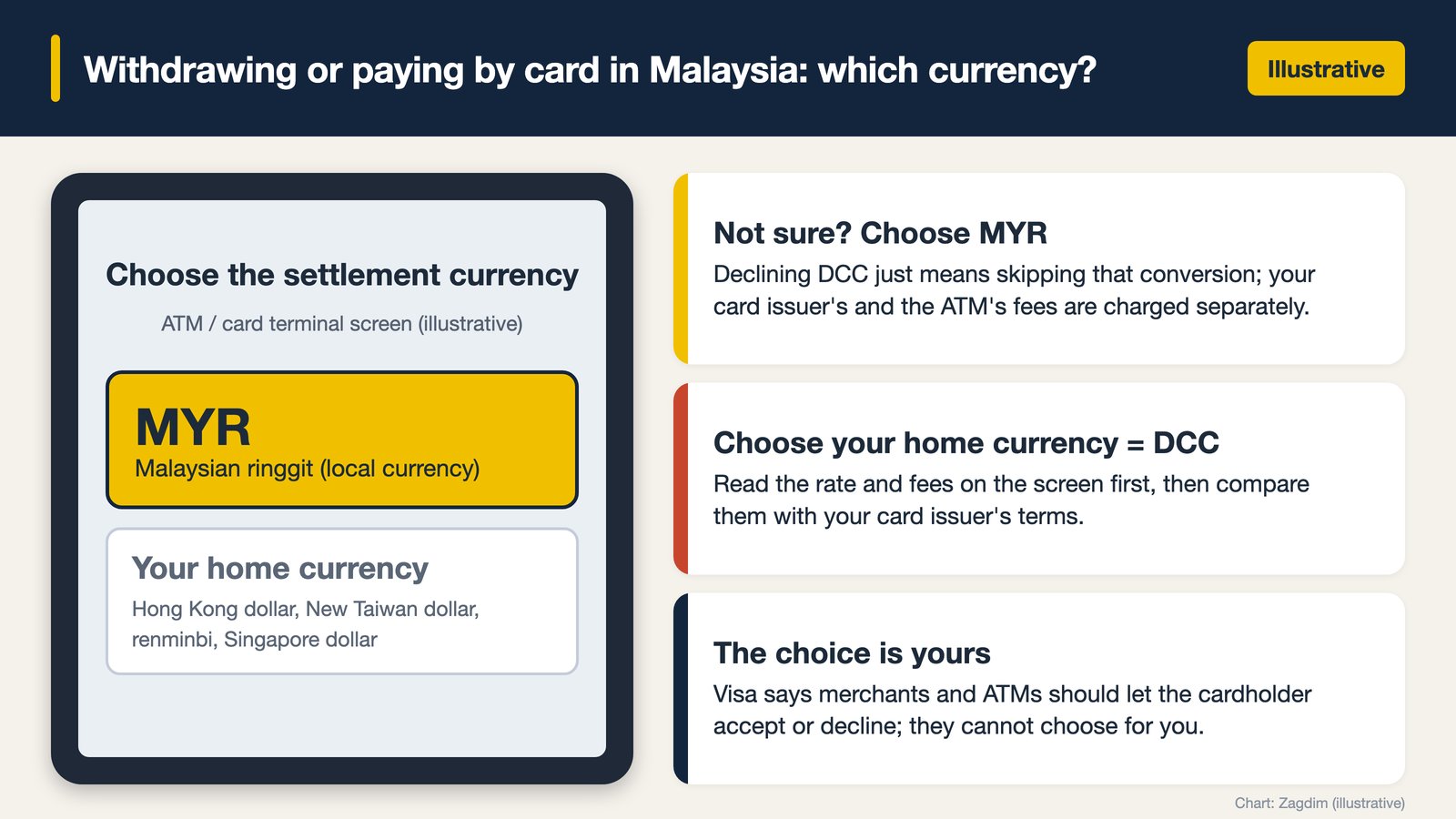
Visa says merchants and ATMs should let the cardholder accept or decline the currency conversion, and must not choose for you.
Zagdim recommends that you read the exchange rate and fees on the screen first and compare them with your card issuer’s terms, and if you are unsure, choose ringgit (MYR). Declining DCC only means no conversion is made at that point. Your card issuer’s overseas fees and the ATM-side fees are a separate matter.
Mobile Payments: Can Your App Scan DuitNow QR?
Whether your app can scan DuitNow QR depends on the wallet. DuitNow QR is Malaysia’s local QR payment system. Whether it works depends on which version of a wallet you use and whether you are making a payment or a transfer.
| Tool you use | Situation in Malaysia | Notes |
|---|---|---|
| Alipay from mainland China | Listed as an Alipay+ partner wallet that can pay through DuitNow QR | Check the overseas payment function in the app first |
| AlipayHK | Same as above | The Hong Kong and mainland China versions are two separate wallets; check each on its own |
| Singapore’s Changi Pay | Same as above | Same as above |
| WeChat Pay (Weixin Pay) | Tencent says it has integrated DuitNow QR, and supported Malaysian merchants can accept payments from visitors from China | Do not assume WeChat Pay HK works the same way |
| Participants in Singapore’s NETS QR | The DuitNow-NETS QR merchant payment link went live on 31 March 2023 | Only for users of participating financial institutions |
| Maybank Singapore Scan & Pay | Can pay Malaysian merchants that support DuitNow QR, with the amount deducted from a Singapore account | Only for Maybank Singapore customers |
| PayNow | The PayNow-DuitNow person-to-person transfer link went live on 17 November 2023 | This is a personal transfer, a different service from merchant QR payments |
| WeChat Pay HK, Hong Kong FPS, Taiwan mobile payments | Check with the app or provider first | Do not rely on them as your only payment method |
Check the direction. On 28 October 2026, PayNet announced that apps supported by Maybank, CIMB and Hong Leong Bank can pay at participating merchants in mainland China, Hong Kong, South Korea, the Philippines and Laos through Alipay+. This is for users of Malaysian banking apps when they travel abroad. It does not apply to visitors paying in Malaysia.
Can Visitors Use TNG eWallet?
Yes, visitors can use TNG eWallet if they qualify. When checked on 30 October 2026, the visitor registration list showed Hong Kong +852, Taiwan +886 and mainland China +86 numbers, and a Malaysian number is not necessarily required; those who qualify can also register before arriving. The list changes, so check the app or the official page before registering.
- What to prepare: a passport with at least 6 months of validity remaining, plus passport photo and selfie verification.
- Verification codes: the official pages mention codes sent by messaging app and by SMS separately, so make sure your number can receive both.
- Limits: after verification, an international number other than a Singapore number can hold up to RM5,000, with the per-transaction, daily and monthly transaction limits all at RM5,000, and RM60,000 per year. An account with a Malaysian or Singapore number can hold up to RM20,000 after verification. Actual limits are as shown in the app.
- Top-up: for cards not issued by a Malaysian bank, the top-up convenience fee is up to 2.6% of the amount, with the card issuer’s fees charged separately. Some international cards cannot be used to top up; alternatives include a Reload PIN, or another TNG eWallet user transferring funds in through DuitNow.
- Balance: visitors cannot withdraw the balance as cash. The official explanation is that withdrawal applies only to holders of the TNG eWallet Visa card, which is not currently open to visitors. Visitors can transfer to another TNG eWallet account or a Malaysian bank account through the payee’s DuitNow QR; after leaving Malaysia, any unused balance can still be used for payments in supported countries.
So Zagdim recommends not topping up too much at once; top up only what you will use.
How Much Does RM100 or RM1,000 Cost?
RM1,000 costs about HK$1,933, NT$8,004, ¥1,641 or S$316 at mid-market rates. The conversions below use the European Central Bank reference rates of 29 October 2026 (for New Taiwan dollars, the same-day US dollar to New Taiwan dollar reference rate from the Taiwan Futures Exchange). These are mid-market rates, without any exchange spread or fees, so the amount you actually pay will differ. They are only to give you a sense of scale.
| Departing from | About how much for RM100 | About how much for RM1,000 | How to prepare |
|---|---|---|---|
| 🇭🇰 Hong Kong | HK$193 | HK$1,933 | Ask the counter about Hong Kong dollar banknotes; AlipayHK can be used for DuitNow QR |
| 🇹🇼 Taiwan | NT$800 | NT$8,004 | Ask the counter about New Taiwan dollar banknotes; check mobile payment first, and rely mainly on cards and ATMs |
| 🇨🇳 Mainland China | ¥164 (renminbi) | ¥1,641 (renminbi) | Check the overseas payment function in Alipay and WeChat Pay first |
| 🇸🇬 Singapore | S$32 | S$316 | Check whether your bank takes part in NETS QR; Maybank Singapore customers can look at Scan & Pay |
| 🇺🇸 US dollar banknotes | US$25 | US$246 | Ask for the rate before exchanging, and confirm the banknote conditions |
Cash Declaration: How Much Can You Bring Into Malaysia?
The threshold is more than US$10,000 or the equivalent. If cash, bearer negotiable instruments or the two combined exceed this amount, you must declare on both entry and exit.
- Add everything together: the threshold covers one currency, or the total of several currencies and instruments, not each currency separately.
- What counts as an instrument: cheques, bills of exchange, promissory notes, traveller’s cheques, bearer bonds, money orders and postal orders.
- How to declare: fill in Customs Form No.7 and hand it to the customs officer on duty. For children under 12, a guardian can act on their behalf.
- Conversion: when the amount is close to the threshold, ask Customs how the conversion is done; do not use an exchange rate you found yourself to calculate an amount just below the threshold.
- Outdated information: older forms and older penalty information are still in circulation; follow Customs’ current Form No.7.

Extra Limits on Carrying Ringgit
There is no upper limit on foreign banknotes, but ringgit is different. Carrying ringgit worth more than US$10,000 into or out of Malaysia requires prior written approval from Bank Negara Malaysia. After approval you must still declare using Customs Form No.7; the two requirements cannot replace each other.
What Happens If You Break the Rules?
Breaking the rules carries up to RM3 million in fines or 5 years in prison for the declaration, and up to 10 years or RM50 million for the ringgit directions.
These are two different violations, each with its own penalties, and they should not be added together:
| Situation | Maximum on conviction |
|---|---|
| Breaching the cash declaration obligation | A fine of RM3 million, imprisonment of 5 years, or both |
| Breaching directions or conditions on carrying ringgit in or out | Imprisonment of 10 years, a fine of RM50 million, or both |
For a large sum such as rent, tuition or a property payment, Zagdim recommends confirming the remittance method with your bank, lawyer or the payee first rather than defaulting to carrying cash. The above are Malaysia’s rules at this end; separate rules apply when you leave Hong Kong, Taiwan, mainland China or Singapore, and you need to check those separately.
Common Situations and Tips
Six situations come up most often when exchanging money in Malaysia.
- Compare what you receive, not slogans: an online order with “no service fee” does not mean there is no spread. For example, CIMB TravelCurrency orders carry no service fee, but cancelling an order carries a cancellation fee.
- Bring your passport to the shop: HME asks customers visiting a shop to bring valid ID such as a passport. To collect foreign currency reserved with CIMB TravelCurrency, you show the CIMB SMS containing the order number, together with ID.
- Do not count on choosing denominations: with CIMB TravelCurrency online orders you cannot specify denominations; you can ask at collection, but the bank does not guarantee it.
- Avoid private street exchanges: exchanging with an unlicensed operator can cost you more than the exchange rate. The central bank warns that money can be lost if the operator absconds with it or the authorities seize assets.
- Do not follow the GST refund process in old guides: Malaysia’s Goods and Services Tax (GST) was abolished on 1 September 2018, so old GST tourist refund guides do not apply. If you are buying a large item and want to ask about a refund, check the current practice with the shop or Malaysian Customs first.
- More than one tax can appear on a bill: the service tax rate is 8% for general taxable services, while food and beverage, parking, logistics and telecommunications services stay at 6%; sales tax has rates of 5%, 10% or specific rates, so not all goods carry one rate.
Frequently Asked Questions
Where is the best place to exchange ringgit in Malaysia?
No operator is guaranteed to be the cheapest. Zagdim recommends going to a licensed operator on the central bank’s list or a bank counter, comparing how many ringgit you end up with for the same amount, and relying on the quote confirmed at the branch.
Can you exchange Hong Kong dollars, New Taiwan dollars and renminbi for ringgit in Malaysia?
Confirm with each operator. CIMB’s website says it buys and sells up to 31 foreign currencies, but whether a given counter accepts the banknotes you hold on the day, and at what rate, needs a phone call or a visit to ask first.
What does a foreign card pay to withdraw cash at a Malaysian ATM?
No single figure applies to all cards. What the banking industry removed is the RM1 per-transaction interbank withdrawal fee, and CIMB’s notice does not separately list international network withdrawal fees charged by foreign card issuers. Ask your own bank, and read the withdrawal screen carefully.
Do Alipay and WeChat Pay work in Malaysia?
Alipay from mainland China and AlipayHK are listed as Alipay+ partner wallets that can pay through DuitNow QR; Tencent says supported Malaysian merchants can accept WeChat Pay from visitors from China. This does not mean WeChat Pay HK works the same way, so check inside the app before you leave.
Can visitors use TNG eWallet?
The visitor list checked at the time showed Hong Kong, Taiwan and mainland China numbers. A passport must have at least 6 months of validity, and you can register before arriving. The balance cannot be withdrawn as cash, so Zagdim recommends topping up only what you will use.
How much cash must you declare when traveling to Malaysia?
Cash, bearer negotiable instruments, or the two combined worth more than US$10,000 must be declared on Customs Form No.7 on both entry and exit. Ringgit worth more than US$10,000 also requires prior written approval from Bank Negara Malaysia.
Is there still a tourist shopping tax refund in Malaysia?
No, the old GST refund does not apply, because GST was abolished on 1 September 2018. Check the current practice with the shop or Malaysian Customs first.
Important Notice
This is a general information summary and is not financial, tax or legal advice. It draws on Royal Malaysian Customs, Bank Negara Malaysia, the Monetary Authority of Singapore, and the websites of banks, money changers, card networks and payment providers, as checked on 30 October 2026. Exchange rates, ATM fees, money changer locations and accepted currencies, e-wallet eligibility and limits all change; rely on the latest announcements from each organization and your card issuer. The converted amounts in the table are mid-market reference figures and exclude any exchange spread and fees.
Have a question about this guide? Leave a comment below, or ask Zagdim directly.
Your first stop for international property and global living.
Research and insights. Know what’s changing. Understand what matters.
Sources
- Royal Malaysian Customs Department – Cash Declarations English pamphlet
- Royal Malaysian Customs Department – MySST Background
- Royal Malaysian Customs Department – MySST FAQ Sales Tax
- Royal Malaysian Customs Department MySST – Goods and Services Tax (Repeal) Act 2018
- Royal Malaysian Customs Department MySST – GST Repeal Act commencement order
- Bank Negara Malaysia – Carrying Physical Notes
- Bank Negara Malaysia – About Money Services Business
- Bank Negara Malaysia – Money Services Business Operators
- Bank Negara Malaysia – Financial Sector Participants Directory: money-changer
- Bank Negara Malaysia – Enforcement Action on Illegal Money Services Business
- Bank Negara Malaysia and Monetary Authority of Singapore – Launch of QR Code Payments Connectivity between Malaysia and Singapore
- Monetary Authority of Singapore and Bank Negara Malaysia – Launch of Real-time Payment Systems Connectivity between Singapore and Malaysia
- CIMB – Waiver Of RM1 Fee For Interbank Cash Withdrawals At CIMB Self-Service Terminals
- CIMB – Currency Exchange Counters
- CIMB – Currency Exchange
- CIMB – What are the currencies offered in this service?
- CIMB – I want specific notes. Can I request for it?
- CIMB – Is there any service charge for ordering?
- CIMB – How to collect the physical foreign currency notes
- Hasani Munawarah Exchange – Customer FAQ on the website
- Hasani Munawarah Exchange – Branch Locator
- Hasani Munawarah Exchange – Exchange Rates
- Merchantrade Asia – Contact / Branch Locator
- Maybank – Maybank ATMs accept overseas-issued cards for cash withdrawal
- Maybank Singapore – Scan & Pay in Malaysia
- Visa – Dynamic Currency Conversion
- Mastercard – Dynamic Currency Conversion Performance Guide 2025
- PayNet – Alipay+ Empowers New Growth Opportunities for Malaysian SMEs
- PayNet – PayNet Enables Malaysian Mobile Banking App Users to Make Overseas DuitNow QR Payments via Alipay+
- Tencent – Weixin Empowers Local Businesses Ahead of Visit Malaysia 2026
- TNG Digital – International Tourists registration list
- TNG Digital – Identification needed for tourist registration (FAQ)
- TNG Digital – Verify your eWallet
- TNG Digital – Can I sign up for TNG eWallet before arriving in Malaysia?
- TNG Digital – Do I need a Malaysian phone number to sign up?
- TNG Digital – Your eWallet limits
- TNG Digital – Why can’t I top up my TNG eWallet using my credit or debit card?
- TNG Digital – Top-up convenience fee rates (FAQ)
- TNG Digital – What alternative top-up methods are available to me?
- TNG Digital – Can I withdraw my eWallet balance in cash?
- TNG Digital – Can I transfer funds or remit to a bank account from my tourist account?
- TNG Digital – What happens to my TNG eWallet balance if I leave Malaysia without using it all?
- Touch ‘n Go – Product Disclosure Sheet: Enhanced Touch ‘n Go Card with NFC Capability
- European Central Bank – Euro foreign exchange reference rates (2026-10-29)
- Taiwan Futures Exchange – Daily foreign exchange reference rates (2026-10-29)