
































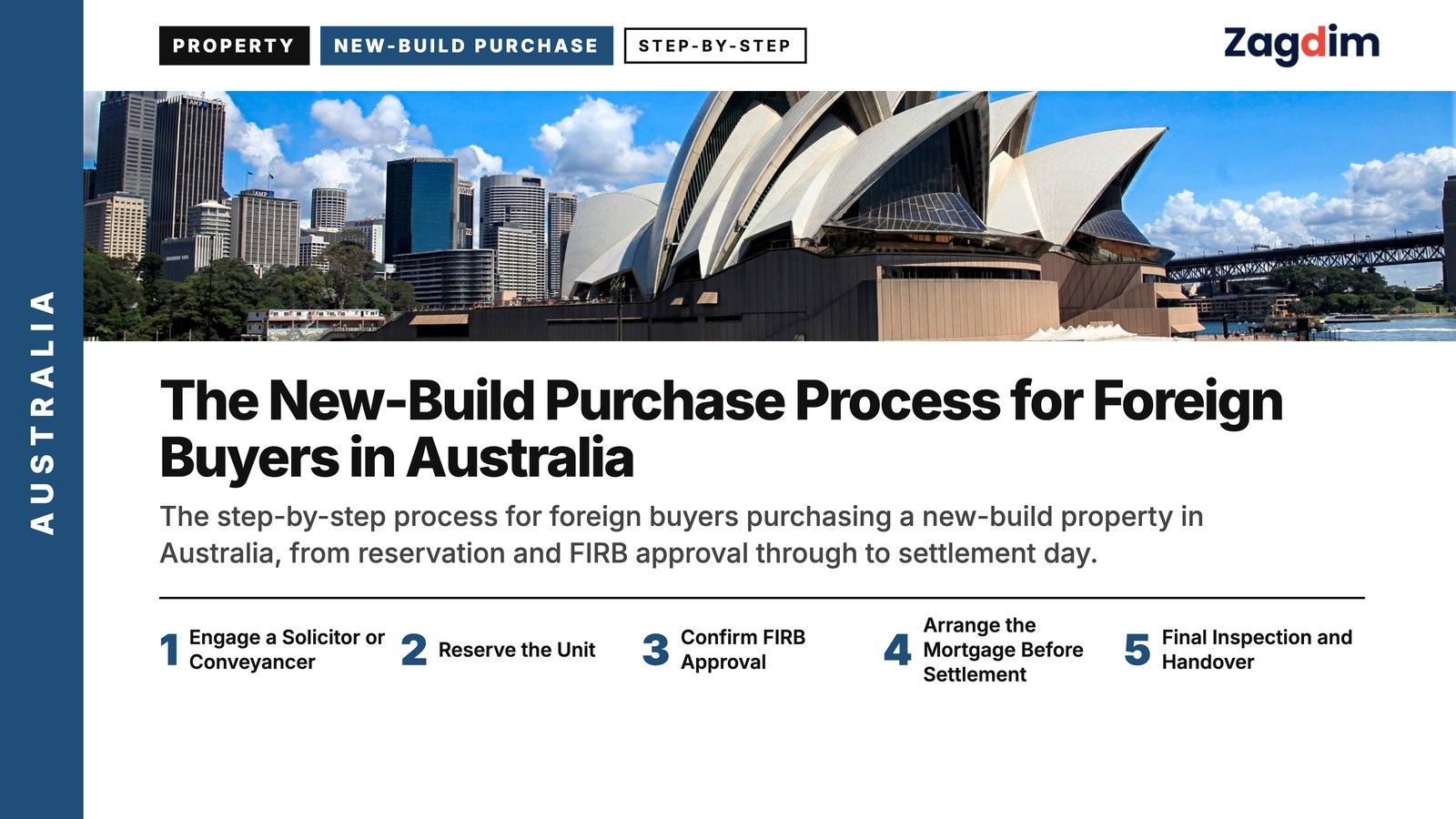
Foreign buyers face restrictions on what property they can buy in Australia, which is why most overseas investors end up buying new-build property, and why the buying process itself looks different from a typical resale purchase. This article walks through the process step by step, from engaging professional help through to settlement day, to help a prospective buyer understand how to protect their own interests and reduce the risk of buying property from overseas.
Engage a Solicitor or Conveyancer
Buying property in Australia requires the help of a solicitor or a licensed conveyancer (called a settlement agent in Western Australia) to handle the transfer of title. Their role is to manage the legal process of transferring land or property from one owner to another. A new-build developer or real estate agent will sometimes recommend a solicitor, and the buyer can decide whether to use them. Importantly, whoever the buyer engages must be licensed to practise in the same state as the property being bought. If the buyer intends to apply for a mortgage, they may also need help from a mortgage broker — in that case, check whether the broker holds an Australian Credit Licence (ACL), and whether they are a member of the Mortgage and Finance Association of Australia (MFAA) and the Australian Financial Complaints Authority (AFCA).
- ACL: https://asic.gov.au/for-finance-professionals/credit-licensees/
- MFAA: https://www.mfaa.com.au/
- AFCA: https://www.afca.org.au/
Reserve the Unit
Because foreign buyers are largely restricted to new-build property, most buy directly from the developer. In this situation, the buyer may first need to sign a reservation form with the developer and pay a reservation fee, typically around AUD 2,000-5,000. This fee should be paid into the developer’s or its solicitor’s trust account — not into an agent’s account or any other account — to reduce risk. Buyers are also advised to read the reservation form’s clauses on FIRB approval carefully and confirm what happens if FIRB approval is not obtained, to avoid a dispute later.
Confirm FIRB Approval
Foreign nationals face restrictions in Australia and generally cannot buy resale (established) property. From 1 April 2025 (extended to 30 June 2029), foreign persons are banned outright from buying established dwellings unless a very limited exception applies, which is why new-build property remains the main route open to foreign buyers. Regardless of the property type, an application must be made to, and approved by, the Foreign Investment Review Board (FIRB). Buyers are advised to apply once they have decided on a property, before making payment.
Sign the Contract of Sale and Pay the Deposit
Once FIRB approval is obtained, the next step is signing the contract of sale. The developer will generally have the contract prepared, and under Australian law the buyer must sign it in the presence of an appointed solicitor, who will explain the contract in detail to protect the buyer’s interests. Australia also provides for a cooling-off period on residential property contracts, though the length varies by state: NSW and QLD allow 5 business days, VIC 3 business days, SA 2 clear business days, while WA generally has no mandatory statutory cooling-off period. After signing, the buyer must pay the deposit within the timeframe stated in the contract, usually around 10% of the purchase price (less the reservation fee already paid). If the buyer signs the contract before FIRB approval has come through, they are advised to read the relevant clauses and procedures carefully.
Arrange the Mortgage Before Settlement
A buyer purchasing off the plan and intending to apply for a mortgage only needs to apply to the bank within three months of the property’s completion and settlement. It is nonetheless advisable to speak to a mortgage broker before purchasing to understand your borrowing capacity and likely loan amount in advance. The loan amount ultimately depends on the buyer’s own financial position and the property itself.
Final Inspection and Handover
Once the property is complete, the developer will notify the buyer to carry out a final inspection and take handover of the property. An owner based overseas can engage a local building inspector to handle this. After the buyer’s inspection, the developer will confirm the exact settlement day. Before settlement day, the buyer should transfer the remaining balance of the purchase price into their solicitor’s trust account; for a buyer using a mortgage, the lender transfers the balance to the developer on settlement day itself.
What Happens on Settlement Day
Settlement day is the point at which the sale is formally completed, both legally and financially. It is handled with the assistance of both parties’ legal representatives (solicitors) and financial representatives (banks). Legally, title is formally transferred; financially, the buyer’s funds are formally transferred to the seller’s account in line with the contract. Settlement day falls on the date set in the contract of sale — the overall transaction typically takes around 30-90 days, depending on the state and the specific deal, and the contract’s final day is usually settlement day itself, marking the last stage of the whole transaction.
On settlement day, the buyer’s and seller’s settlement agents (a solicitor or conveyancer) meet together with the lender’s representative in a three-way meeting. They exchange and sign documents to confirm the transaction, and arrange payment and clearance of the remaining purchase price to the seller.
The lender. The lender registers its mortgage against the property and provides the loan funds under the loan contract, with final confirmation from the buyer’s representative.
The buyer’s representative. The buyer’s representative confirms that any previous mortgage on the property has been discharged, that no third party still holds an interest in the property, and that every condition of the contract of sale has been met. Most importantly, they confirm that the property and mortgage have been registered with the relevant state government authority.
The seller’s representative. The seller’s representative confirms receipt of funds matching the contract of sale.
Preparing for Settlement Day
To make settlement go smoothly, a buyer should have the following ready in advance:
- Confirmed that a solicitor or conveyancer has been engaged to act as the buyer’s representative at the meeting
- Confirmed that the formal contract of sale has been signed, with the correct settlement date recorded
- Confirmed the mortgage is arranged and sufficient to cover the price stated in the contract of sale
- Purchased the relevant property insurance
- Confirmed the property’s building inspection report
After Settlement Day
After settlement day, the bank will typically debit the buyer’s loan account to pay the seller. The buyer must also pay the relevant transaction taxes, such as stamp duty or land transfer duty. Registration of the title transfer is completed once these taxes are confirmed paid, formally transferring title into the buyer’s name. The buyer must also settle any council rates owed to the seller, calculated as of the settlement date. The buyer’s solicitor will help prepare and provide a settlement statement. Afterwards, the buyer can check the property’s Certificate of Title, which records details such as the property’s reference number, registration date and owner’s name, and carries an official Trustseal. Most Certificates of Title are now issued electronically and held in government systems. After this, the buyer receives the keys to the property from their conveyancing representative. From there, all that’s left to think about is how to celebrate.
In Summary
The property purchase process in Australia is broadly similar to that in the UK or Hong Kong, except that Australia has a cooling-off period, and foreign buyers must obtain approval in advance. Buyers should read the contract terms carefully when signing and understand how to handle every possible situation, and should raise any questions actively with their solicitor to protect their own interests.
If you have questions about buying new-build property in Australia as a foreign buyer, ask Zagdim.
Have a question about this guide? Leave a comment below, or ask Zagdim directly.
Your first stop for international property and global living.
Research and insights. Know what’s changing. Understand what matters.