































In recent years, the UAE’s real estate market has once again become a focal point for global capital. As oil prices stabilize, immigration policy continues to open up, and capital seeks safe havens amid a strong US dollar, Middle Eastern real estate has quietly entered a new structural upcycle.
Within that, Dubai and Abu Dhabi — the UAE’s two major cities — are drawing global buyers and investors along two very different paths. Dubai continues to absorb international capital through its Golden Visa program, free zone system and highly liquid residential market, while Abu Dhabi is steadily expanding its sovereign fund resources, investing in infrastructure and cultural city projects to build new communities suited to long-term living and family relocation.
For many overseas buyers considering an investment in Middle Eastern real estate, one key question always comes up: “Which city should I invest in?” That’s not just about comparing prices — it involves rental yield, policy stability, asset liquidity and long-term appreciation potential, among other factors.
- ✅ Dubai leans toward a “high liquidity, high volatility” market, suited to capital-focused investors chasing fast returns.
- ✅ Abu Dhabi is more of a “stable, value-preserving, government-led development” city, suited to buyers who prioritize long-term stability and quality of life.
What Kind of Investor Are You?
When weighing Dubai against Abu Dhabi’s real estate market, the key question isn’t just which offers a higher return — it’s first asking yourself: “What kind of investor am I? What do I actually need?”
The UAE’s two major cities each have their own appeal, but behind that lies a different pace of life, a different asset structure, and a different long-term plan.
Investment vs. Owner-Occupier
If you’re a pure investment buyer chasing high liquidity and short-term rental returns, Dubai’s open market and diverse range of communities give you more room to operate, especially in the short-let market during peak tourist season, where the return potential can be substantial. Conversely, if your priority is buying a home to live in, or finding a stable base for your family, Abu Dhabi’s family-centered community design and city pace offer a more comfortable living experience.
Long-Term Resident vs. Short-Term Capital Allocator
Abu Dhabi’s policy direction leans toward “stable development,” and its pace of planning and cultural atmosphere suit long-term residents better — particularly those who prioritize quality of life and future plans for their children’s education. Dubai, by contrast, is flexible and open, and suits buyers moving capital in and out over the short term well — whether freelancers, founders, or capital-focused investors weighing other pathways to residency.
Family Planning vs. Immigration-Focused
Abu Dhabi performs strongly on lifestyle infrastructure such as education, healthcare and green space, making it the more reassuring choice for families planning to raise children there long-term. But if your goal is to use property to apply for a Golden Visa or other long-term residency, Dubai’s system design and application flexibility make the process more direct and workable.
- ✅ Tip: Abu Dhabi is family-friendly, particularly suited to those planning to relocate with children in school.
- ✅ Tip: Dubai suits investors looking for flexible asset allocation and a path to long-term residency.
Corporate Relocation vs. International Students
Those relocated by a company can enjoy more mature, internationalized lifestyle infrastructure in Dubai — commuting, dining, entertainment and social activity are all relatively concentrated, with abundant short-let and co-working options. International students and their families choosing Abu Dhabi, meanwhile, benefit from a lower cost of living and access to universities and academic institutions backed by government resources, with an overall lower level of everyday stress.
How different investor types fit each city:
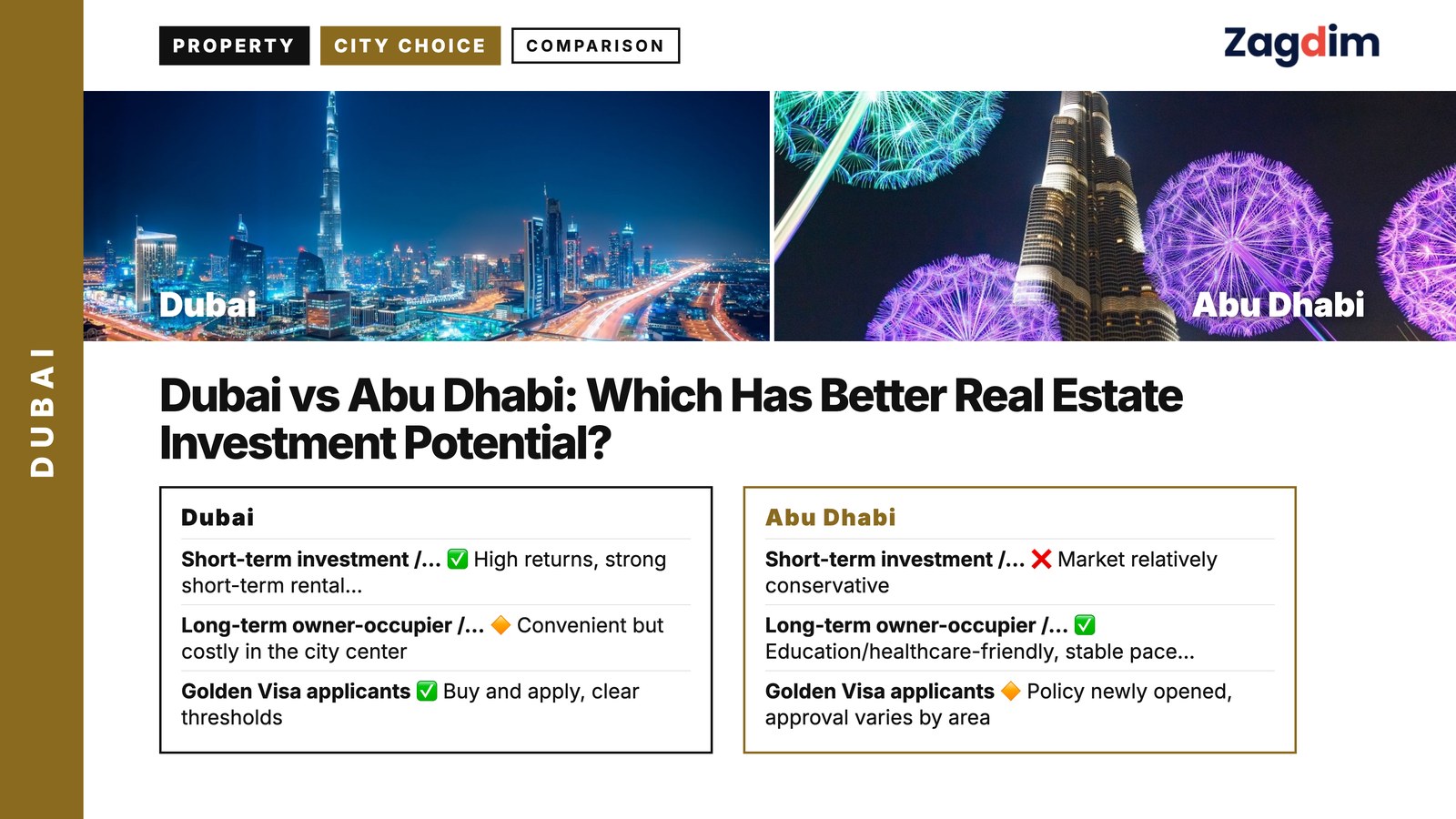
| Investor type | Suits Dubai | Suits Abu Dhabi |
|---|---|---|
| Short-term investment / short-let market | ✅ High returns, strong short-term rental potential | ❌ Market relatively conservative |
| Long-term owner-occupier / family planning | 🔶 Convenient but costly in the city center | ✅ Education/healthcare-friendly, stable pace of life |
| Golden Visa applicants | ✅ Buy and apply, clear thresholds | 🔶 Policy newly opened, approval varies by area |
| Freelancers / remote workers | ✅ Flexible rental/sale market, mature community | ❌ Market not yet fully suited to a freelance lifestyle |
| International student families | 🔶 More education choices, but costly | ✅ Lower tuition and living costs, stable community |
If you can first get clear on your purpose and status, the choice becomes much easier. Between Dubai and Abu Dhabi, it isn’t a question of which is better — it’s which is right for you. Next, we’ll dig into the rental yield and price differences between the two cities, to help you assess investment potential more concretely from a financial angle.
The Buying Process for Overseas Buyers
Whichever city you choose to invest in, getting familiar with the overall buying process as an overseas buyer will substantially reduce uncertainty and the risk of tripping up along the way. Below are the five main steps of the standard buying process, particularly relevant for non-residents, covering the key points and differences that come up in practice.
Step 1: Confirm your eligibility and which areas you can buy in (Freehold vs. Leasehold). The UAE’s real estate market is divided into freehold areas and leasehold areas.
- Dubai: the vast majority of popular communities are freehold, and foreign buyers can hold full title along with resale and rental rights.
- Abu Dhabi: freehold areas are relatively fewer; before buying, you need to confirm whether the community is open to non-local residents, since some areas only permit leasehold or limited ownership rights.
✅ Tip: Dubai has more freehold options, suited to buyers who want to move quickly; in Abu Dhabi, confirm any area restrictions first to avoid buying somewhere you can’t later resell or rent out.
Step 2: Choose a property and location (community amenities, demographics, transport). Choosing a property isn’t just about price — you also need to weigh:
- how developed the surrounding community’s amenities and businesses are
- your expected tenant profile (young professionals, families or tourists?)
- commute distance and transport infrastructure (metro stations, highways, business hubs)
Dubai’s areas are more differentiated, with a wide range from high-end tourist districts to affordable communities; Abu Dhabi is more concentrated in large, developing communities, with more centralized planning.
Step 3: Prepare funds and tax matters (the buying process and bank account opening for non-residents). The UAE has an open policy for non-resident buyers, and funds can be sent via international wire transfer. Before you buy, it’s worth:
- opening a local bank account (such as with Emirates NBD or Mashreq)
- preparing proof of the source of funds and tax-residency information
- understanding whether “global tax reporting” (CRS) requirements from your home country apply
✅ Tip: some banks still set a threshold for non-resident account opening; it’s worth working with a real estate consultant or agent to help handle funds and paperwork.
Step 4: Sign the contract and complete the transfer (MoU → land department registration).
- Both parties sign a Memorandum of Understanding (MoU); the buyer generally pays a 10% deposit at this stage.
- Background checks and the payment process are carried out, and a title-transfer date is scheduled.
- In Dubai, the Dubai Land Department (DLD) handles formal registration and title transfer; in Abu Dhabi, this is managed by the Department of Municipalities and Transport (DMT).
- Once the transfer is complete, the buyer receives an official Title Deed.
✅ Tip: Dubai’s registration and transfer process is highly digitized, and most steps can be completed remotely; some areas of Abu Dhabi still require an in-person signature and physical document submission.
Step 5: Ongoing management and renting out the property (choosing a management company or a long-let/short-let platform). After buying, if you don’t plan to live in the property yourself, you’ll need to appoint a licensed local property management company to handle renting, maintenance, tenant communication and lease renewals.
- Dubai’s short-let market is mature, and many buyers use platforms such as Airbnb or Booking.com to earn returns.
- Abu Dhabi is mainly long-let, with more restrictions on short lets, requiring government permission.
You can also choose a one-stop management package offered by a real estate company, to reduce the burden of holding property from overseas.
Documents Overseas Buyers Need to Prepare
Buying property in the UAE is relatively simple overall, but you still need to prepare the relevant documents in advance to ensure a smooth transaction. This matters especially for non-resident buyers, since some steps require completing bank account opening, title registration and fund verification at the same time — it’s worth preparing a document checklist ahead of time to save time and reduce risk.
Common, essential documents for the buying process:
1. Passport copy and visa information. Whether or not you hold a residency visa, having a valid passport is enough to buy property in specific areas of Dubai and Abu Dhabi. Some banks or management companies may ask for your visa page or entry stamp information.
2. Bank statements and wire transfer records. To meet transparency requirements around the source of funds, you’ll need to provide proof of where your buying funds came from (such as savings statements, payslips, or proof of an asset sale), and keep a complete record of the wire transfer into your local account.
3. Proof of residential address (required by some banks). When opening a local bank account, some banks require proof of address, either locally or in your home country (such as a utility bill or lease agreement), to pass compliance review.
4. Memorandum of Understanding (MoU). Once the property and price are confirmed, both parties sign a Memorandum of Understanding to formally enter the transaction. The buyer generally pays a 10% deposit at this stage.
5. Property registration documents (DLD or DMT).
- In Dubai, the Dubai Land Department (DLD) issues the formal Title Deed.
- In Abu Dhabi, the Department of Municipalities and Transport (DMT) handles registration.
- Once registration is complete, you’ll receive legal proof of ownership of the property.
✅ Tip: most of Dubai’s buying process can be handled remotely, suiting non-resident and international buyers.
✅ Tip: some banks and management companies can help verify documents online — it’s worth choosing a partner with international experience.
Frequently Asked Questions
Can foreigners buy freehold property in Dubai or Abu Dhabi?
Yes, but it depends on the local area designation. In Dubai’s freehold areas, foreigners can legally own full title and enjoy complete rights, including resale and renting out. By comparison, Abu Dhabi has fewer freehold areas, and some locations still carry nationality restrictions, so you should confirm which areas you’re eligible to buy in before purchasing.
Is there a big difference between Dubai and Abu Dhabi in price and rental yield?
Based on 2024 market data, Dubai’s rental yield is about 6-8%, with some short-let hotspots reaching more than 10%; Abu Dhabi is more stable, with yields around 5-6%. On price, some of Dubai’s high-end communities carry higher prices, but overall liquidity is strong and resale is faster; Abu Dhabi’s advantage lies in more affordable pricing and long-term value retention.
Which city is better suited to owner-occupiers or raising children?
If you prioritize pace of life and a child-raising environment, Abu Dhabi is more stable and mature in education, healthcare and residential community design, particularly suiting families settling long-term. Dubai, by contrast, has highly developed everyday amenities and a highly international community, suiting owner-occupiers who want a multicultural, urban lifestyle.
Can buying property lead to a UAE Golden Visa or long-term residency?
Yes. Buying property worth more than AED 2 million in Dubai qualifies you to apply for a 10-year Golden Visa, with a clear and efficient process. Abu Dhabi has a similar policy, but the visa eligibility criteria and area-specific rules are more detailed, and approval is assessed case by case based on the property’s location and actual market value.
Why does Abu Dhabi’s real estate market get less exposure?
This mainly comes down to Dubai’s more globalized marketing and branding, which makes it easier for investors to access information about its projects. Abu Dhabi focuses more on policy direction and infrastructure development, and since some communities aren’t yet fully open to foreign buyers, its visibility is relatively lower. That said, this also means less market competition, which can suit patient long-term investors well.
Risks and Misconceptions to Know Before You Invest
Whether you’re planning to invest in Dubai or Abu Dhabi, real estate is ultimately a physical asset, unlike stocks or funds — it involves more than just the “purchase price.” It also touches on community planning, rental management, resale mechanics and the legal system. Overlooking these details and risks can trip you up even in a market that looks stable on the surface.
Here are a few key ideas and misconceptions overseas buyers most often overlook:
Prices swing and areas differ significantly. This is especially true in Dubai, where price volatility and differentiation between areas are pronounced. Core locations such as Downtown Dubai and Palm Jumeirah command not just higher prices but faster resale; in some up-and-coming areas, though, prices and rents can differ by more than 30%. Choosing the wrong location can amplify both your holding costs and liquidity pressure.
Rental market structures differ. Dubai’s short-let market is mature, and many buyers earn higher returns than long lets through platforms such as Airbnb. In Abu Dhabi, though, short lets remain a regulated activity, requiring government permission in some areas, and the market leans toward long-let contracts. Not understanding local rental regulation and tenant preferences can leave a property vacant or delay the rental process.
Don’t overlook taxes and holding costs. While the UAE has no capital gains tax or rental income tax for individual investors, reselling a property in Dubai still requires paying the DLD’s fixed 4% registration fee (plus an AED 580 administrative fee for ready property), or about 2% in Abu Dhabi, plus property service fees — costs that shouldn’t be underestimated, particularly in high-end communities. If you don’t factor these into your return calculations, your actual net yield could be significantly lower.
Community and property management quality varies widely. Not every development comes with well-run property management and community services; some up-and-coming or attractively priced projects may have inconsistent developer track records and follow-up maintenance quality. It’s worth reviewing a developer’s track record before buying, and confirming whether the community has a stable management company and tenant base.
✅ Tip: choosing a real estate consultant with local experience and international service capability can help you avoid regulatory blind spots and area misjudgments, reducing unnecessary risk and cost.
✅ Tip: before making a purchase decision, don’t look only at price and yield — weigh factors such as residency planning, policy stability and asset liquidity together for a full assessment.
Summary
Whether you’re hoping to start a new life in the Middle East through Dubai’s Golden Visa, or planning to build a stable, livable long-term base in Abu Dhabi, UAE real estate today has moved well beyond a simple price comparison — it’s become a multi-factor decision combining residency planning, policy and regulation, community choice and budget allocation. Choosing the right location and the right approach will shape both your asset’s liquidity and your quality of life. Get clear on your investment purpose and residency status now, and ask Zagdim to help you find the location and structure that fits, and open the door to UAE property investment successfully.
Have a question about this guide? Leave a comment below, or ask Zagdim directly.
Your first stop for international property and global living.
Research and insights. Know what’s changing. Understand what matters.
Sources
- *Engel & Völkers* – Abu Dhabi vs. Dubai: Comparing Two Major UAE Real Estate Markets
- *Global Property Guide* – Gross rental yields in United Arab Emirates: Dubai and 4 other cities
- *Cushman & Wakefield Core* – Abu Dhabi realty saw exponential growth in 2024
- *CBRE* – UAE Real Estate Market Review Q4 2024
- *Asteco* – Q4 2024 Report Highlights Resilient Growth in UAE Real Estate
- *Cavendish Maxwell* – Dubai Residential Market Performance 2024
- *Savills* – Dubai Property Market Report – 2024
- *Property Finder* – 2024 real estate momentum in Dubai and Abu Dhabi
- *Harbor Real Estate* – Dubai’s Rental Market Trends and Insights 2024
- *Bayut* – 2024 Annual Real Estate Market Report: Abu Dhabi’s property market continues to thrive