






























Updated guide (October 2026): Home Loans for Foreigners in Japan: Flat 35, Banks, Rates; Japan Mortgage by Residency Status: PR, Work Visa, Non-Resident
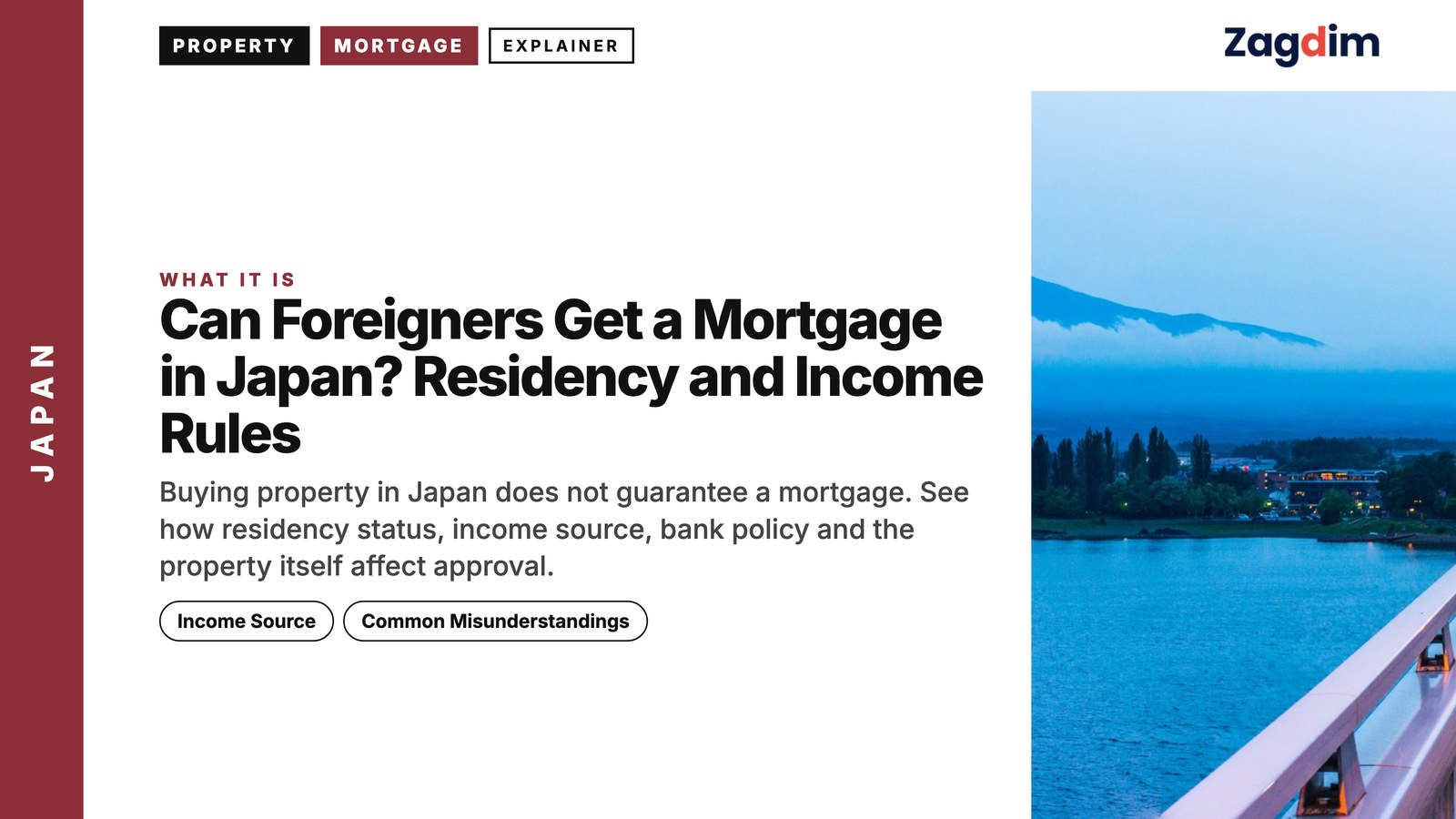
Buying property in Japan and getting a mortgage in Japan are two different things.
In terms of ownership, Japan does not generally prohibit purchases of residential real estate simply because the buyer is a foreign national. Foreign nationals can register ownership of property in Japan, and non-residents can buy Japanese property too. But once the question becomes “can I borrow from a bank to buy it,” the answer gets much more complicated.
A mortgage is not simply a matter of having money, and it is not only about which property you want to buy. Japanese banks typically look at your residency status, income source, documentation history in Japan, purpose of purchase, the collateral value of the property, and the bank’s own risk policy, all at once. For overseas buyers, the easiest mistake is assuming that “I can buy” means “I can get a Japanese mortgage.” In reality, there are many practical hurdles between the two.
This article is for readers who are researching buying property in Japan but are not yet sure whether they can get a Japanese mortgage, especially those evaluating the feasibility of a Japan purchase from overseas. It does not promise that any particular bank will approve an application, and it does not provide interest rate or loan-to-value forecasts. Instead, it walks through the basic logic behind Japanese mortgage review.
Foreigners Can Buy Property in Japan, But a Mortgage Is a Separate Review
In Japan, registering ownership of ordinary residential real estate does not require the buyer to be a Japanese national. In other words, foreign nationals can legally buy property in Japan — that is a question of purchase eligibility.
Mortgage eligibility is not the same thing. A mortgage is a commercial decision a bank makes based on its own lending policy, risk management and documentation requirements. Even if a foreign national can buy a property, that does not mean a bank will necessarily accept their loan application.
This can be broken into three layers:
- The legal layer: whether a foreign national can hold Japanese real estate. For ordinary residential purchases, the answer is generally yes.
- The bank eligibility layer: whether you are the type of applicant a bank is willing to consider — for example, whether you hold permanent residency, live in Japan, or have domestic income in Japan.
- The actual underwriting layer: even if a bank is willing to consider the application, it will still review income stability, existing debt, age, employment history, the collateral value of the property, and the source of funds.
Where many overseas buyers get stuck is not the first layer, but the second and third.
Residency Status Is Usually the First Hurdle
For a Japanese mortgage, residency status usually matters more than many people expect. Banks do not just ask whether you are a foreign national — they look at your status and ties to daily life in Japan.
Permanent Residents: Usually the Most Options, But Approval Is Never Guaranteed
Permanent residents and special permanent residents are usually the closest category of foreign applicant to a Japanese resident. Mainstream city banks and Flat 35 (the home loan program backed by the Japan Housing Finance Agency) are generally more willing to include permanent residents within their applicant pool.
Even so, being a permanent resident does not guarantee approval. Banks will still review income, employment stability, debt ratio, property type and collateral valuation. If income is insufficient, the valuation is unfavorable, or documentation cannot support the application, it can still be rejected.
Non-Permanent Residents Living in Japan: Possible, but Far Fewer Bank Options
If you hold a work visa, spouse visa, long-term resident status or another residence status but are not yet a permanent resident, the situation narrows considerably. Some banks or specialized products may accept non-permanent foreign applicants, but conditions are usually stricter than for permanent residents.
For example, some banks may require higher income, a longer record of residence or employment in Japan, specific language ability, or a Japanese national or permanent-resident spouse or guarantor. This is not a uniform legal rule — it is each bank’s own policy.
So for non-permanent residents, the real question is not “does Japan have mortgages for foreigners,” but “which banks, under what conditions, are currently willing to consider my particular status.”
Non-Residents: Mainstream Japanese Home Loans Are Usually the Hardest Path
If you do not live in Japan, do not hold a residence card, and have no domestic income in Japan, applying for an ordinary residential mortgage at a mainstream Japanese bank is typically very difficult.
That does not mean there is no financing path at all. A small number of products exist for non-residents or investment purposes, and some overseas banks may offer Japan-property-related financing where the buyer is based. But these are exception paths, not what should be understood as a typical Japanese mortgage.
The more common realistic options for non-residents include:
- paying in cash in full;
- checking with banks or financial institutions where you are based about offshore financing tied to the property;
- researching the small number of Japanese or overseas lending products aimed specifically at non-residents;
- and, where an investment or corporate structure is involved, getting legal, tax and financial advice first.
Income Source: Domestic Japanese Income Is Usually Easier to Get Accepted Than Overseas Income
When Japanese banks review a mortgage application, they generally want to see income documentation that can be verified directly through Japan’s own systems.
For salaried employees, common documents include the Withholding Tax Statement (gensen choshuhyo), a certificate of tax payment, resident-tax records and bank transaction records. For self-employed applicants or sole proprietors, banks commonly require a Final Tax Return (kakutei shinkokusho), and usually want to see several years of filing history.
The key point here: domestic Japanese income and Japanese documentation are usually easier for banks to review than overseas income.
Many readers ask: “If my overseas income is stable, can I use it to apply for a Japanese mortgage?” The safer way to put it is: mainstream Japanese banks generally do not treat overseas income as their primary basis for review. Certain specific banks, overseas banks or specialized products may make exceptions, but an exception should not be treated as the general rule.
So if your income is mainly from overseas, even if the amount is high, you should first ask:
- whether the target bank accepts overseas income as a basis for review;
- what tax documents, salary certificates, company documents or proof of assets are required;
- whether documents need translation, notarization or other certification;
- whether remittances and the source of funds need additional explanation;
- and whether the product you are looking at is a Japanese residential mortgage, an investment loan, or offshore financing where you are based.
These differences directly affect feasibility.
Different Types of Banks Judge Applications Differently
When discussing Japanese mortgages, it is not accurate to talk about “Japanese banks” as one group. Different banks, different products and different purposes result in very different attitudes toward foreign applicants.
Mainstream City Banks and Flat 35
Major banks such as MUFG Bank, Sumitomo Mitsui Banking Corporation, Mizuho Bank and Resona Bank, along with Flat 35, generally have stricter status requirements for foreign applicants. Based on currently available information, permanent residency or special permanent residency is usually an important threshold for this path.
This path is closer to an ordinary owner-occupier mortgage, but the entry conditions are also stricter. Non-permanent residents or non-residents should not assume they can apply the same way.
Specialized Banks or Products That Accept Non-Permanent Residents
Some banks and products in the market will accept non-permanent foreign residents. For example, SMBC Trust Bank Prestia, Tokyo Star Bank, and other banks referenced in market information may accept non-permanent residents under specific conditions.
Extreme care is needed here: each bank’s conditions differ, and policy changes. Taking SMBC Trust Bank Prestia as an example, its programs for non-permanent residents carry a higher income threshold; where a specific figure is quoted, the bank’s own current page should be treated as authoritative — the most accurate reference figure available at the time of writing is an annual income of JPY 10 million. Requirements vary by applicant’s location, and applicants should confirm the latest conditions directly with the bank.
So readers should not rely only on bank lists found in online articles, and should instead confirm, bank by bank:
- whether foreign applicants are currently still accepted;
- whether permanent residency is required;
- whether non-permanent residents are accepted;
- whether overseas income is accepted;
- whether the loan is restricted to owner-occupied use;
- whether a Japanese spouse or guarantor is required;
- and whether there are language, income, age or asset thresholds.
Products for Non-Residents or Investment Purposes
Individual banks such as Tokyo Star Bank have real-estate loan products aimed at foreign nationals or non-residents, but the nature of these products needs to be clearly understood. Non-resident products are often tied to investment purposes and should not be described as ordinary owner-occupier mortgages.
For overseas buyers, these products are worth knowing about, but they cannot be used to conclude that “being based overseas still lets you apply for an ordinary residential mortgage the way a Japanese resident would.” The product’s conditions, purpose, cost, property requirements and risks all need to be independently verified.
The Property Itself Also Affects Mortgage Feasibility
Even if the applicant’s status and income appear to meet the requirements, the bank will still look at the property itself.
When Japanese banks review a mortgage, they assess the property’s value as collateral. That collateral value is not necessarily the same as the market transaction price. This is especially true for older resale properties, buildings with higher ages, and properties close to or past their statutory useful life — the bank’s valuation may come in lower than the buyer expects, which in turn affects the amount that can be borrowed.
Owner-occupied use and investment use also need to be considered separately. Some residential loan products apply only to owner-occupied purposes; investment properties may require a different product, with different interest rates, down payment requirements, underwriting logic and documentation.
So when viewing a property, buyers should not only ask “is this property’s price reasonable,” but also:
- whether this property is likely to be accepted by a bank as collateral;
- whether the intended use is owner-occupied or investment;
- how far the bank’s valuation might differ from the transaction price;
- whether more of your own funds will be needed if the valuation comes in low;
- and whether an older property, a wooden detached house, or an investment property will limit your loan options.
These questions should be confirmed before signing, not after the formal underwriting stage reveals a funding gap. In the Japanese mortgage process, the preliminary review (jizen shinsa) is usually only a preliminary or directional assessment based on initial information — it is not a formal approval. Whether the loan is actually approved still depends on the formal underwriting (hon shinsa) and the bank’s final written result.
Down Payment, Remittances and Source of Funds: Do Not Just Look at the Loan-to-Value Ratio
Foreign buyers often ask: “How much of the purchase price can I borrow in Japan?”
There is no single safe, fixed answer to this question. The percentage that can be borrowed varies by bank, status, income, property, purpose and timing. This article will not promise any fixed loan-to-value (LTV) ratio, and readers should not be guided by statements such as “you can generally borrow 80%.”
A safer approach is to treat it as a question of fund preparation:
- do you have a sufficient down payment;
- does the down payment come from traceable, lawful funds;
- when remitting funds from overseas into Japan, can you provide the source-of-funds documentation the bank requires;
- could exchange-rate movement affect the actual funds available at closing;
- and, if the bank’s valuation comes in below the transaction price, can you cover the shortfall.
If funds are being remitted from overseas, Japanese banks or related financial institutions may require the buyer to explain the source of funds, based on KYC (know-your-customer) and source-of-funds screening requirements. Specific requirements vary by bank and by case, and should be confirmed before applying.
Non-Residents Also Need to Watch Reporting and Tax Management
If you are a buyer who does not live in Japan, buying Japanese real estate is not only a mortgage question — it also involves reporting and tax management after you hold the property.
Based on currently available information, non-residents acquiring Japanese real estate may have reporting obligations under the Foreign Exchange and Foreign Trade Act (FEFTA). The current rules carry a risk of change after 2027 — in particular, from April 2027 the scope of reporting requirements for foreign nationals acquiring Japanese real estate is expected to expand. Details of this kind of policy should be reconfirmed against the latest official information before publication.
In addition, holders of Japanese real estate generally must pay Fixed Asset Tax. If the owner lives overseas, they may also need to appoint a Tax Administrator in Japan to receive tax notices and handle related matters. This is a tax administration matter and should be confirmed with a Japanese tax accountant or other qualified professional.
These obligations are not directly tied to mortgage approval, but they do affect the overall cost of holding the property and its ongoing management.
Common Misunderstandings
Misunderstanding One: “Foreigners Can Buy, So They Can Also Borrow From a Japanese Bank”
Being able to buy only means that, for ordinary residential purchases, there is generally no ban on ownership. A mortgage is a bank’s own review, which also looks at status, income, documentation, the property and bank policy. Purchase eligibility does not automatically become mortgage eligibility.
Misunderstanding Two: “High Overseas Income Always Makes It Easier to Get a Japanese Mortgage”
A high income does not mean the documentation can be accepted by a Japanese bank. Mainstream Japanese banks generally place more weight on domestic Japanese income and Japanese documentation. Whether overseas income can be accepted depends on the specific bank and product, and should not be assumed.
Misunderstanding Three: “Buying a Japanese Property Helps You Get Japanese Residency”
Japan has no system that automatically grants residency or a visa because you bought a residential property. Buying property, residency status and mortgage review are three separate matters.
Misunderstanding Four: “A Real Estate Agent Can ‘Sort Out’ the Mortgage for You”
A real estate agent or service consultant can help organize documents, explain the process, or connect you with relevant professionals, but whether a bank approves the loan is the bank’s decision. Any suggestion that approval is guaranteed, or implied to be likely, should be treated with caution.
Misunderstanding Five: “If I See Online That a Bank Accepts Foreigners, I Can Apply Too”
A bank accepting a certain category of foreign applicant usually still comes with detailed conditions, such as permanent residency, income thresholds, guarantors, intended use, age, documentation and language requirements. Different statuses and income sources can lead to completely different outcomes.
What Should You Prepare First If You Are Evaluating a Japanese Mortgage?
Before formally approaching a bank or advisor, it is worth putting together a feasibility information pack first. This does not guarantee approval, but it will let you work out more quickly which path to take.
You can start preparing:
- your nationality, place of residence and Japanese residence status;
- whether you hold permanent residency, a spouse visa, a work visa or another residence status;
- your income sources: Japanese salary, Japanese self-employment income, overseas salary, company income or asset income;
- the income and tax documents you can provide;
- your purpose for buying: owner-occupation, investment, rental, holiday use or undecided;
- your budget, down payment, own funds and where those funds are located;
- whether you need to remit funds from overseas;
- your target city, property type, building age and intended use;
- whether you already have a Japanese bank account or a Japanese address;
- and whether you need tax, legal, visa or corporate-structure advice.
Once this is organized, approaching a bank or professional will be far more effective than simply asking “can I borrow or not.”
Frequently Asked Questions
Q: Can foreigners buy property in Japan?
For ordinary residential purchases, foreign nationals can generally register ownership of real estate in Japan. This is a question of purchase eligibility. Whether a mortgage can be obtained is a separate matter for bank review, and the two should not be conflated.
Q: Without Japanese permanent residency, can I apply for a Japanese mortgage?
Some banks or specific products may accept non-permanent foreign residents, but the options are far fewer than for permanent residents, and there are usually income, residence-status, documentation or guarantor requirements. This needs to be confirmed bank by bank.
Q: If I am based overseas with no Japanese income, can I borrow from a Japanese bank?
Mainstream Japanese residential mortgages are usually very difficult in this situation. A small number of non-resident or investment-purpose products may exist, and offshore bank financing or an all-cash purchase can also be researched, but these are all exception paths.
Q: Can income earned outside Japan be used to apply for a Japanese mortgage?
It should not be assumed that it can. Mainstream Japanese banks generally rely more on domestic Japanese income and Japanese documentation. Whether overseas income can be accepted depends on the specific bank, product and documentation requirements.
Q: How much of the purchase price can I borrow to buy property in Japan?
There is no safe, fixed answer. The loan ratio is affected by the bank, status, income, property, purpose and valuation. Foreign buyers should plan for a more conservative allocation of their own funds.
Q: Will buying a property in Japan help me get a Japanese visa or residency?
Generally, no. Japan has no system that automatically grants residency because you bought a residential property. Visas and residency are determined separately under Japan’s immigration system.
Q: What should I prepare before a Japanese mortgage review?
It is advisable to first organize your status, income, source of funds, purpose of purchase and property information, then confirm a feasible path with a bank or professional. Do not wait until after signing to start checking mortgage conditions.
Q: Can ZDelp help me apply for a Japanese mortgage?
ZDelp can help you organize feasibility information and a list of questions, so you can communicate more clearly with banks, advisors or other professionals. ZDelp is not a mortgage broker and does not guarantee approval. If you have questions about visas, long-term stays or entry status, you can ask Zagdim.
Disclaimer
This article was prepared using information gathered around July 2, 2026. Japanese bank policy, FEFTA reporting requirements, real estate registration and tax rules may change; before applying, confirm the latest requirements with a bank, tax accountant, legal advisor or the relevant official authority. This article does not constitute legal, tax, financial, immigration or mortgage advice.
Have a question about this guide? Leave a comment below, or ask Zagdim directly.
Your first stop for international property and global living.
Research and insights. Know what’s changing. Understand what matters.
Sources
- Japan Ministry of Justice – Real Property Registration
- Japan Ministry of Finance – Reporting on Acquisition of Japanese Real Estate by Non-Residents
- Japanese Law Translation Database – Civil Code
- Japan Ministry of Internal Affairs and Communications – Overview of Fixed Asset Tax
- Tokyo Metropolitan Government Bureau of Taxation – Fixed Asset Tax and City Planning Tax
- SMBC Trust Bank Prestia – FAQ on Borrowing Conditions for Foreign Nationals
- Tokyo Star Bank – Foreign Customers Property Loan
- Diamond Real Estate – Comparison of Home Loans for Foreigners
- Recruit Finance – Explainer on Home Loans for Foreigners Without Permanent Residency
- Plaza Homes – Loan Information for Foreign Buyers of Japanese Real Estate
- Uchi Japan – Can Foreign Investors Get a Real Estate Loan in Japan
- Japan Times – Reporting on Foreigners and Japan Land Registration Policy