































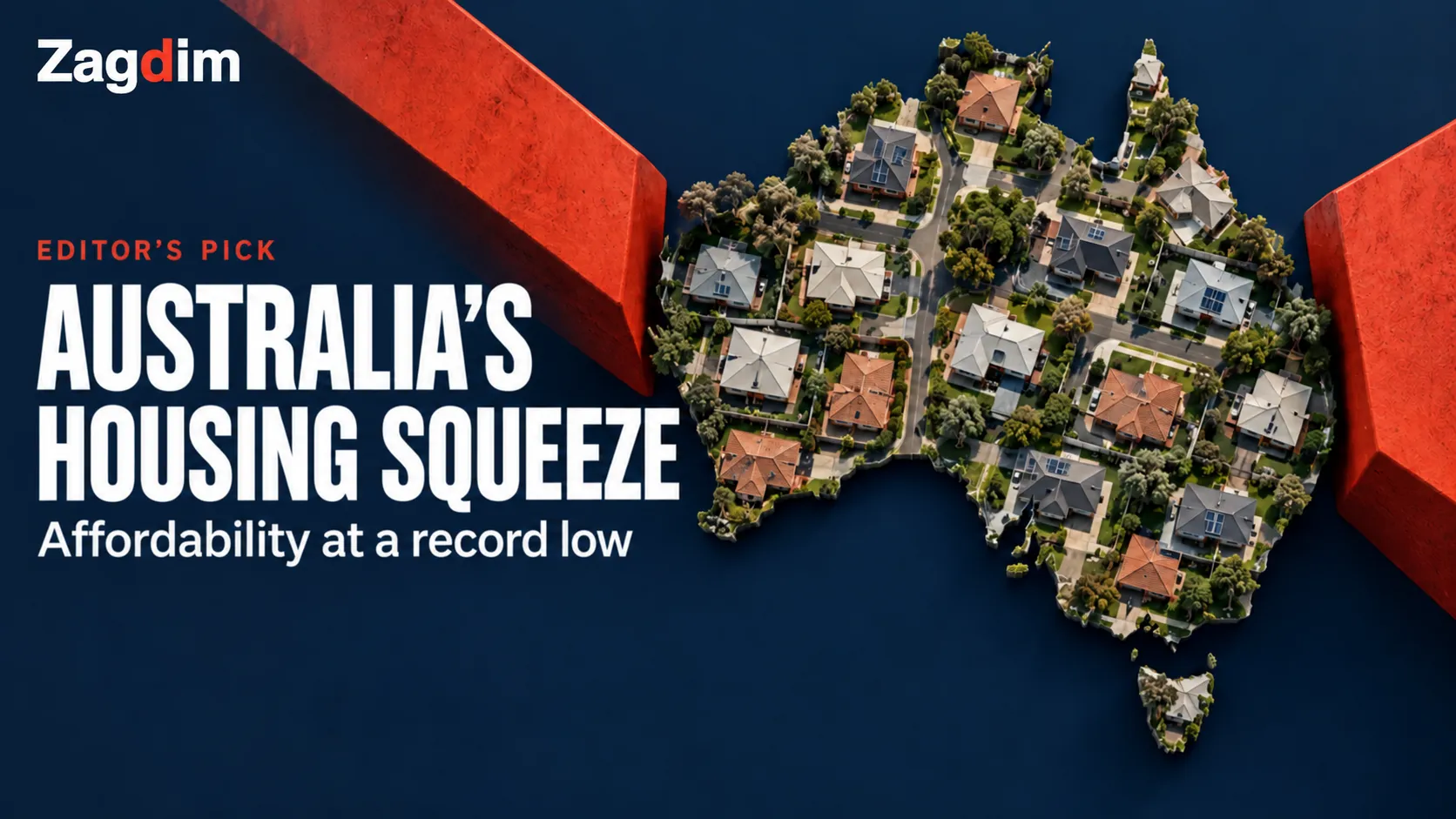
Australian housing affordability has hit a record low both nationally and in New South Wales, with News.com.au reporting the country is now officially less affordable to buy into than it was during the global financial crisis, and realestate.com.au reporting NSW households can afford only 9% of homes currently listed for sale — the lowest share since records began in the 1995 financial year — even though NSW and Sydney prices have been falling for six consecutive months, according to reporting published 4–5 September 2026. The paradox at the centre of both reports is the same: prices going down has not made housing more affordable, because the cost of borrowing has been rising faster than prices have been falling.
That paradox is only part of the story. A separate, opinion-genre column published in the same window points to a second, structural culprit on the supply side — arguing governments have become financially dependent on property-tax revenue in a way that is squeezing builders and developers out of the market. The two explanations are not mutually exclusive, but they are different kinds of claims, and this analysis keeps that difference visible rather than blending a data report with an industry argument.
The price falls aren’t reaching affordability
Realestate.com.au’s own housing affordability index found the share of homes listed at prices an average income earner could afford has fallen to its lowest level since the 1995 financial year, with a household on the average NSW income now able to afford just 9% of homes currently listed for sale, according to the outlet’s reporting via The Daily Telegraph. That is despite NSW and Sydney prices falling for six straight months — Sydney prices are down an average 4.9% since November, per Ray White economist Nerida Conisbee, quoted in the same report.
REA Group economist Luc Redman, also quoted, called it an “irony”: existing homeowners are watching the wealth in the family home erode, with little benefit flowing through to aspiring buyers, because “prices are still elevated compared to previous years” and “the issue for a lot of buyers is that their costs are rising faster than their earnings.” Conisbee added that many buyers’ borrowing power has been cut by more than the price falls have given back — and that recent tax reforms, including negative-gearing restrictions, have pushed investors into the same lower-priced areas first-home buyers are competing for, making “the bottom end of the market… the most competitive.”
That squeeze at the affordable end is echoed by two other named commentators in the same report. Kent Lardner, head of research at analytics group FoundIt, said government claims that price falls are “levelling the playing field” for first-home buyers “didn’t stack up,” pointing to rising rents and living costs that make saving a deposit harder, and to a shortage of homes priced below $750,000 because, in his words, “we are simply not building enough cheap homes.” Buyer’s agent Bek Antognelli said Sydney is a “buyer’s market” in general, but not for buyers targeting roughly $800,000 first-home-buyer-incentive price points, where “the prices aren’t falling much.”
Industry points to a second culprit: the tax burden
Writing in a column explicitly labelled “ANALYSIS” on realestate.com.au, commentator Tim McIntyre argues the deeper problem is on the supply side: governments have become “addicted” to property-tax revenue in a way that is financially crushing the builders and developers the country needs to build its way out of the housing shortage. This is an argued position from a named industry commentator, not a neutral statistical finding, and it is presented here as such.
McIntyre’s column cites, from unspecified “reports this week,” a toll of 1,500 construction firms going out of business in NSW alone in the last financial year, and more than 7,700 developers going under nationally over the past two years. It lists the range of taxes and levies builders and buyers face — GST, developer contributions, windfall gains tax, betterment levies, stamp duty, capital gains tax, foreign-investor surcharges, land tax, council rates, income tax on rental revenue, and vacancy or absence taxes — and notes federal Labor’s proposal to tax trusts at a minimum 30%, which the column says the building industry argues would hit family-owned and mid-tier developers hardest.
On government reliance on property-tax revenue specifically, the column cites NSW stamp duty revenue rising from $7.2 billion in 2014 (a year it says produced a $2.9 billion NSW budget surplus) to $14.3 billion in the 2025–26 financial year, up from $12.4 billion the year before; nationally, it cites states and territories collecting a combined $34.4 billion in stamp duty in the most recent financial year, a national total the column says has hovered around $30 billion annually since the Covid pandemic. From this, McIntyre argues governments have no real incentive to cut the taxes squeezing supply — “if you keep taking more pieces of the pie, the baker will eventually go out of business” — and that cutting property tax, not further buyer incentives, is what would actually let builders build.
A separate piece of modelling cited in the realestate.com.au affordability report underscores how much is riding on the direction prices take from here: Primara analysis prepared for HomeLoanRates.com.au, based on ANZ property modelling forecasting a roughly 14.5% peak-to-trough fall in Sydney home prices, projects that a fall of that size would strip an estimated $653.2 billion from NSW household property wealth by the end of 2027 — taking total NSW housing wealth from $4.5 trillion at the start of 2026 to roughly $3.85 trillion by the end of 2027. That is presented in the original report as a named model’s projection, not a certainty.
Zagdim’s View — The detail worth holding onto is that Australia now has two separate, credible-sounding explanations for the same affordability record low, and they point to different policy levers. The demand-side account — borrowing power falling faster than prices — says the fix runs through interest rates and household incomes catching up, as Redman himself argues. The supply-side account — property-tax dependency crushing builders — says the fix runs through tax reform, but it arrives from a named industry commentator’s opinion column, not from the affordability-index data itself, and that provenance shouldn’t get lost in translation. For anyone tracking Australia as a market to buy into, both threads matter, but only one of them is, so far, a measured finding rather than an argued case.
References
News.com.au – Australian housing affordability sinks to a record low / realestate.com.au (The Daily Telegraph) – NSW housing affordability plunges to record low despite falling prices / realestate.com.au – Government ‘addiction’ to property tax is crushing builders and housing supply