































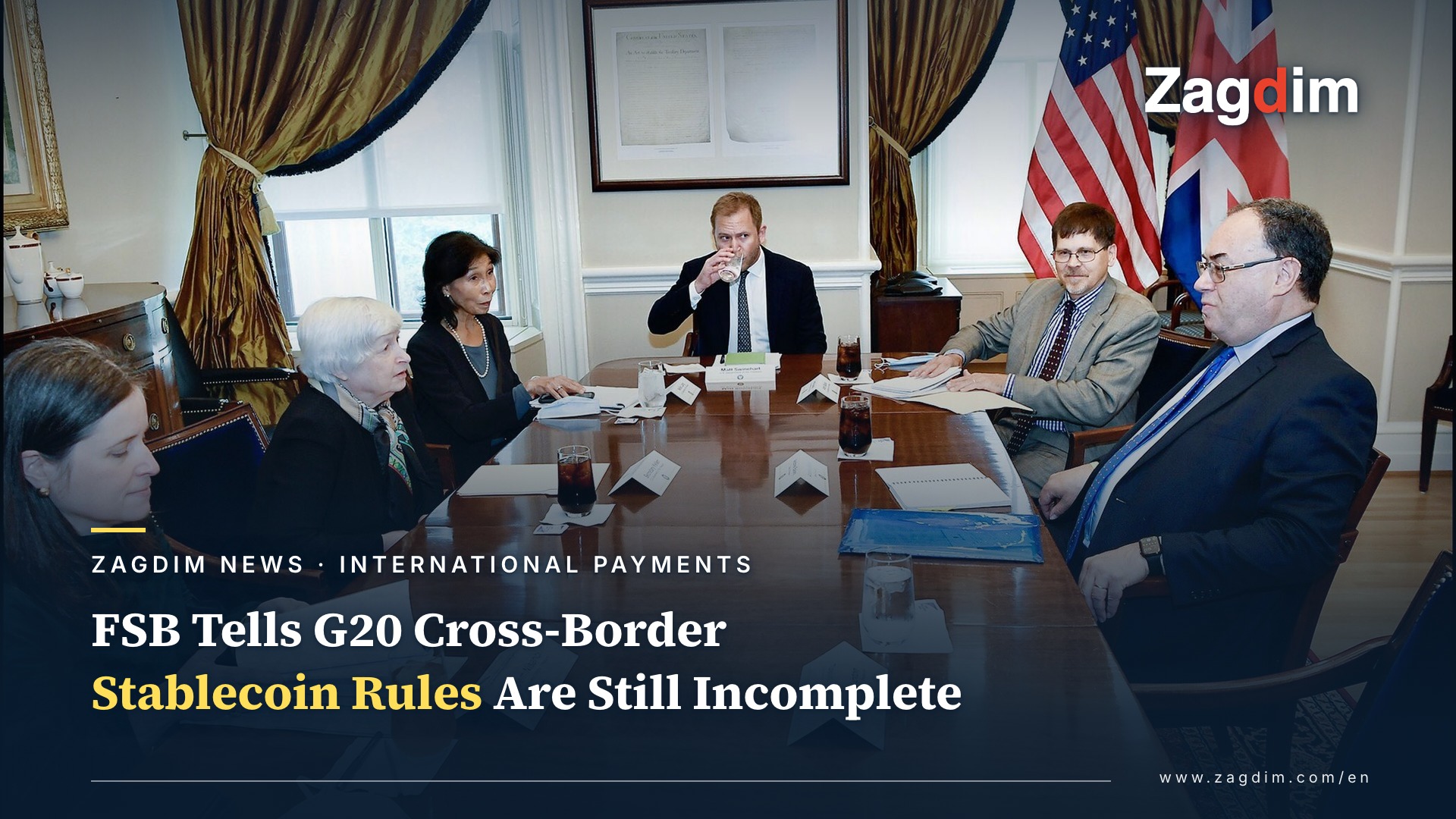
On October 12, 2026, the Financial Stability Board (FSB) — the body that coordinates financial regulation among G20 countries — published a note to G20 finance ministers and central bank governors saying the rulebook for stablecoins used across borders is not finished. In the FSB’s own words: “the interaction of regulatory frameworks across borders remains uncertain or undefined in many jurisdictions, including the treatment of foreign-issued stablecoins.” That line matters beyond crypto markets, because it describes precisely the arrangement most people rely on when they use a stablecoin to send money, pay for property, or hold savings outside their home country.
The note was published alongside a letter from FSB Chair Andrew Bailey ahead of the G20 finance ministers’ and central bank governors’ meeting on October 15, 2026. It puts the total value of stablecoins in circulation at around $300 billion as of mid-2026 — essentially unchanged from a year earlier — with 99% of that value pegged to the US dollar. The note builds on two earlier pieces of FSB work: the 2023 high-level recommendations for regulating “global stablecoins,” and a 2025 peer review of how fully individual jurisdictions had actually put those recommendations into practice. The FSB frames the new note as ongoing monitoring work, not a finished policy.
The gap shows up in a specific, practical way. A global stablecoin issuer, the FSB notes, often does not know who holds its tokens, where those holders are based, or where redemption demand will come from, since the tokens trade pseudonymously and around the clock on public blockchains — unlike a bank, which has an account-based relationship with known depositors. The reserve assets backing those tokens, and the legal protections attached to them, are typically anchored to just one jurisdiction’s framework. In a stress event, the FSB says, “it may be difficult to determine which national insolvency regime(s) would apply” if an issuer fails — and in “multi-issuer” structures, where affiliated issuers share one stablecoin but hold separate reserves, redemption demand can concentrate on a single entity faster than reserves can be moved across borders to meet it.
The FSB flags an added layer of risk for people in emerging and developing economies specifically, where a widely used stablecoin can affect domestic currency use, bank deposits and capital-flow management at a lower threshold than in larger, more diversified markets. On what happens next, the FSB is careful to say only that further international work “may help” close these gaps — it names three areas worth continued attention: better monitoring of cross-border vulnerabilities, more cooperation and information-sharing between national regulators to support the 2023 recommendations, and more groundwork on how a failing global stablecoin arrangement would actually be unwound when it spans several countries. No date is attached to any of it; the FSB’s own framing is that this work is ongoing, not completed. Individual jurisdictions, meanwhile, keep reaching different answers on their own timetables — Zagdim has separately reported on how Hong Kong and Singapore have diverged on who keeps stablecoin reserve-interest income, one concrete instance of the wider “interaction… remains uncertain” the FSB describes at the global level.
Zagdim’s View — If you already use a stablecoin to move money between countries, for a property deposit, a remittance, or simply to hold savings outside your home currency, this note is a reason to be clear-eyed rather than a reason to stop. The FSB is not saying stablecoins fail at cross-border payments today; it is saying that the rulebook which would tell you, in the same way everywhere, what happens to your money if an issuer runs into trouble does not exist yet. Until that changes, treat a stablecoin transfer the way you would any cross-border arrangement without a tested safety net: know which single jurisdiction’s rules actually govern the issuer you are using, avoid leaving more value parked there in transit than you need to, and do not assume the protections you would get from a bank account carry over automatically.
References
Financial Stability Board – Global Stablecoin Arrangements: Cross-border Vulnerabilities and Financial Stability Monitoring / Financial Stability Board – FSB Chair Sets Out FSB Work on AI and Stablecoins / Financial Stability Board – FSB Chair’s Letter to G20 Finance Ministers and Central Bank Governors: October 2026