



























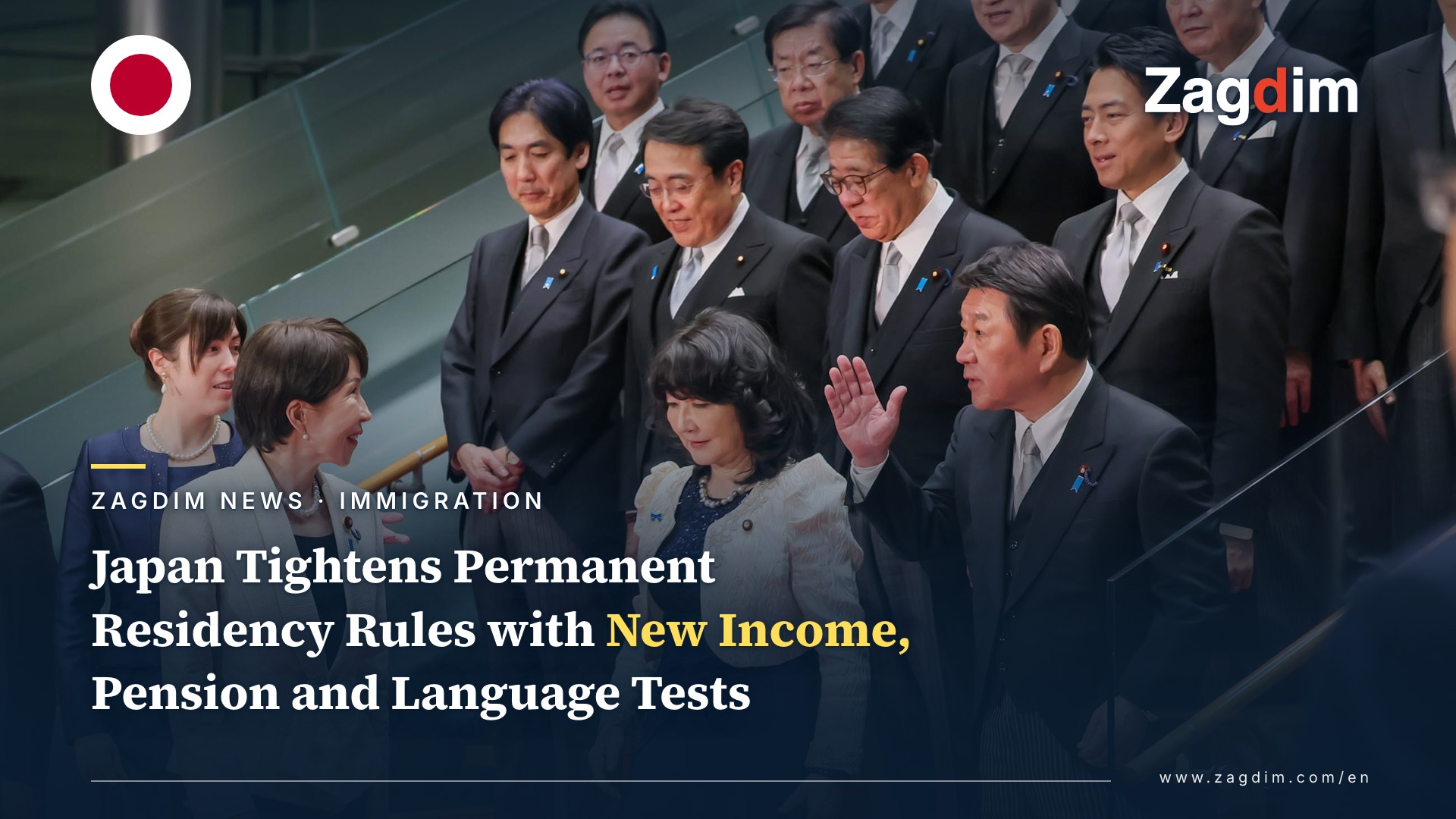
Japan’s Immigration Services Agency (ISA), part of the Ministry of Justice, revised its Guidelines on Permanent Residency Permission on October 1, 2026, raising the income, pension, Japanese-language and civic-knowledge bar used to screen new applications for permanent residency (PR). The same day, the agency also issued a companion guideline spelling out when existing PR status can be revoked, and the government raised PR application fees twenty-fold, from ¥10,000 to ¥200,000.
The stricter screening applies to PR applications filed from April 1, 2027. From that date, an applicant’s household income must continuously exceed the average income of a Japanese household of the same size — ¥5.752 million as of the most recent 2024 data the Ministry of Health, Labour and Welfare published in July 2026, according to BBC. Projected pension benefits must match those of someone who worked 30 years under Japan’s Employees’ Pension Insurance at that above-average income; applicants whose pension outlook falls short can offset the gap with financial assets, with the required asset size scaled to the applicant’s age. Applicants must also show Japanese ability at B1 level or above on the government’s Japanese-language education reference framework, and demonstrate an understanding of the content of the agency’s “Living and Working Guidebook,” confirmed through a method the ISA Commissioner designates. A new provision requires school-age children of applicants to be enrolled in elementary or junior high school. Spouses and children of Japanese nationals, of existing PR holders, and of special permanent residents remain statutorily exempt from the income, asset and public-burden tests, so the tightening falls mainly on applicants coming through the general, work-visa-based route to PR.
People who already hold permanent residency are not required to retroactively meet the new income, pension or language bar — their existing status is not re-screened under the revised guideline. But the companion guideline the agency issued the same day operationalizes revocation grounds added by a 2024 amendment to the Immigration Control and Refugee Recognition Act: a PR holder’s status can now be revoked, or — in most cases the agency describes — administratively changed to another residence status such as “long-term resident,” if the person fails to meet certain immigration-law duties (such as renewing or carrying a residence card), intentionally fails to pay taxes or social-insurance premiums despite having the means to do so, or is sentenced to imprisonment for specified crimes including theft, fraud, extortion, murder, or causing death or injury through dangerous driving. For a conviction in that last category, the guideline indicates even a first offense is expected to trigger at least a change of status. Separately, some pending cases are affected immediately: the tightened income and “not a public burden” provisions also apply to PR applications filed in the six months before the October 1 revision that were still undecided when the new guideline took effect. People currently on other visas who plan to apply for PR after April 2027 will face the full new bar; BBC, citing Japanese media reports, said the approaching deadline has already driven a surge of sign-ups for Japanese-language schools and proficiency tests.
The grounds for revoking permanent residency were added by a 2024 amendment to the Immigration Control and Refugee Recognition Act, which also created a channel for government employees to report suspected violations to the agency. Japan’s Cabinet decided a broader set of “comprehensive measures for accepting foreign nationals and realizing an orderly, coexisting society” on January 23, 2026, which the revised guideline cites as part of its policy backdrop. The Ministry of Justice opened the draft guideline revision for public comment from August 4 to September 3, 2026, before finalizing it on October 1, 2026 alongside the fee increase. The fee change follows a five-fold increase in visa fees in July 2026 — Japan’s first visa-fee rise in roughly 50 years, which officials said was meant to reflect inflation and exchange-rate movements, per BBC. BBC also reported that applicants queued for more than seven hours at Tokyo’s main immigration office in the days before the fee increase took effect, and quoted Mikaiah Stevens, 37, a Tokyo resident of 10 years who could not finish gathering documents before the deadline: she still intends to apply but said foreign residents are “being used too conveniently” — earning above-average salaries and paying high fees just to work and pay tax in Japan, on top of existing language and cultural barriers.
The revised guideline’s new benchmarks are set to take effect for applications filed from April 1, 2027, per the agency’s own published timeline. Tokyo Shimbun, reporting on the same guideline, assessed it as a guideline that would “effectively deter” foreign nationals from seeking permanent residency, and said the income requirement could more than double current levels. Japan’s foreign resident population passed 4.12 million by the end of 2025, up 9.5% year-on-year, according to government data cited by BBC. Prime Minister Sanae Takaichi, who has made foreign-resident policy a priority since taking office in October 2025, wrote on X on September 27, 2026 that the government recognizes public “anxiety and a sense of unfairness” over the growing foreign-resident population and is working to keep “policy on foreign nationals” orderly so that citizens and foreign residents can live safely side by side.
References
Immigration Services Agency of Japan – Guidelines on Permanent Residency Permission (Revised October 1, 2026) / Immigration Services Agency of Japan – Guideline on Revocation of Permanent Resident Status / Immigration Services Agency of Japan – Regarding the Revision of Residence Permit Fees Effective October 1, 2026 / BBC News Japan – Japan Raises Residence Procedure Fees, Permanent Residency Application 20-Fold to ¥200,000