































Thailand’s Ministry of Foreign Affairs has added two new supporting-document requirements to the Destination Thailand Visa (DTV) — the five-year, multiple-entry visa aimed at digital nomads, remote workers, and Thai soft-power participants such as Muay Thai trainees, culinary students, and medical-treatment visitors. Effective from August 31, 2026, DTV applicants across both the Workcation and Thai soft-power tracks must now submit a certificate of criminal record clearance from either their country of nationality or the country where they are applying, plus a document proving permanent residence in the country where the application is filed. The change was announced by Thailand’s Department of Consular Affairs in a circular sent uniformly to Thai embassies and consulates worldwide, titled “Adjustment of Supporting Documents for DTV Applications,” and is now reflected in the official Thailand e-Visa document checklist.
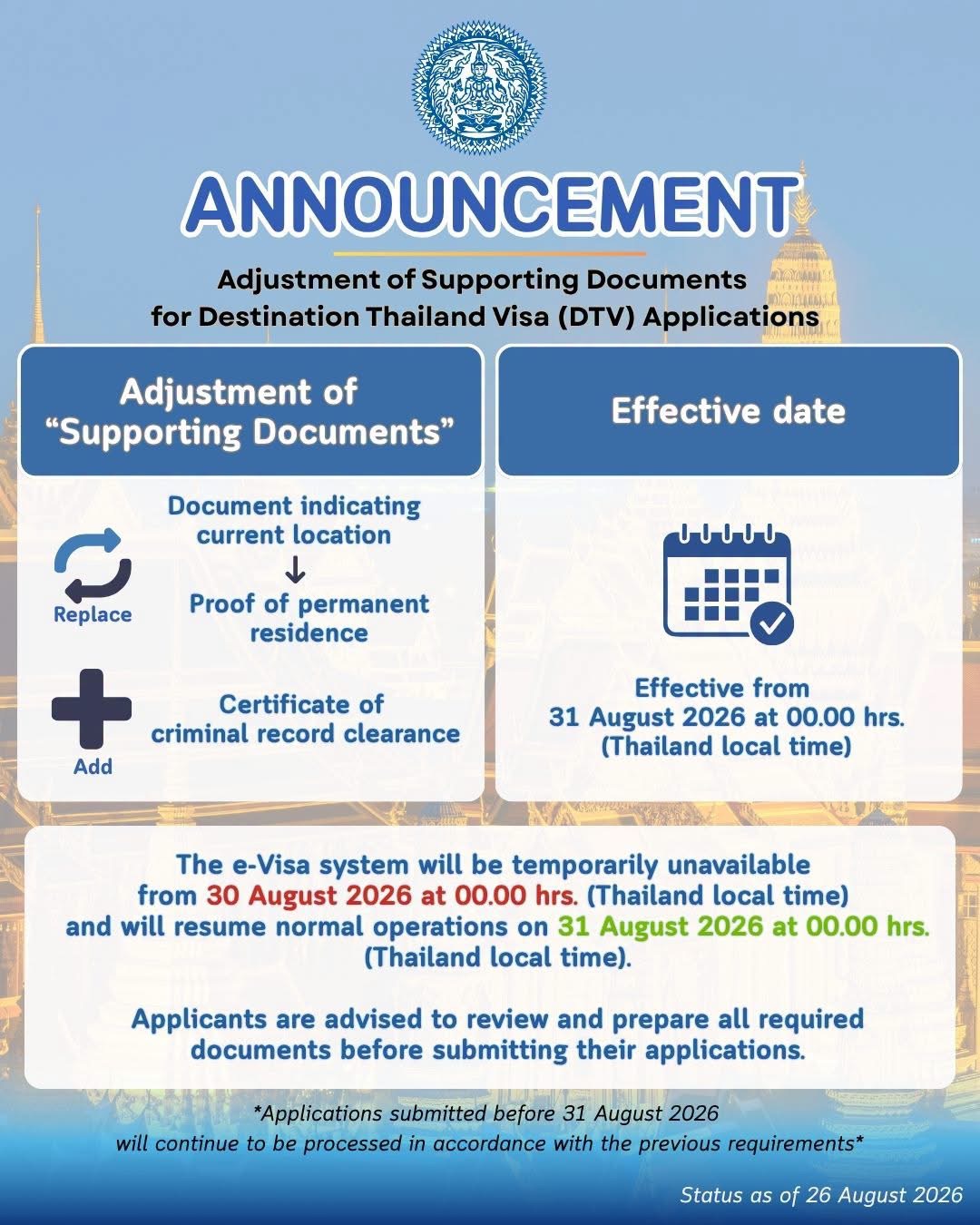
The e-visa system itself was also taken offline for the transition, unavailable from August 30 at 00:00 Thailand time and resuming service at August 31, 00:00. Applications submitted before August 31, 2026 will continue to be processed under the prior document requirements, according to the announcement — so the change affects new applications going forward. Here is what each of the two new requirements actually means for applicants.
Why the change matters
A criminal record certificate — a hurdle DTV never had before
This is an outright addition; DTV applications did not previously require one. It must be issued by the applicant’s country of nationality or the country where they are applying, certifying the absence of a criminal record. This kind of document is more commonly associated with long-stay or immigration-track visas than with a program marketed around remote work and short-term cultural visits. In practice, a criminal record certificate typically requires weeks of processing in the applicant’s home country and, depending on where it is issued, may also need notarization or an apostille before Thai authorities will accept it — a lead time DTV applicants did not previously have to budget for, and of the two new requirements, the one with the longest runway and the most potential to catch first-time applicants off guard.
Proof of residence — and the end of filing from a convenient third country
The residency document replaces a previously accepted proof of current location — a lower bar that simply required showing where an applicant happened to be staying, rather than an established residence. This carries one specific and far-reaching effect: it closes off a filing route that had become common among digital nomads — applying for the DTV through a nearby third country’s Thai embassy rather than through the applicant’s own country of residence. Popular third-country filing points have included Vietnam, Indonesia, and Laos, typically chosen for convenient location, faster processing, or simply because that’s where the applicant happened to be. Because the new rule requires proof of an established, formal residence status in the country where the application is filed — not just physical presence there — nomads without legal residency in these third countries can no longer file from them. In practice, most applicants will now need to apply from their actual country of residence or nationality.
Zagdim’s View — The two requirements test different things: the criminal record certificate tests planning — the earlier it’s started, the better. The residence requirement tests location — filing through whichever nearby country was convenient no longer works. Put together, this reads less like two more forms and more like Thailand narrowing who can use the DTV, and from where.