
































Zagdim Overseas
Subscribe
  • Home
  • Real Estate & Economic News
    • All
    • Japan Market News
    • Other Market News
    • Thailand Market News
    • UK Market News
    • Vietnam Market News
    Prime London Rental Values Jump 67% as Supply Contracts

    Prime London Rental Values Rise 67% as Supply Contracts

    Portugal's One-Bed Rent Now Tops the Minimum Wage

    One-Bedroom Flat Rent in Portugal Now Costs More Than Minimum Wage

    Dubai Rents Fall Up to 15% as Tenants Switch to New Leases

    Dubai Tenants Switch Homes as New-Lease Rents Fall Up to 15%

    Ras Al Khaimah waterfront apartments and palm promenade aerial view

    Ras Al Khaimah Apartment Prices Rise 18% in H1 2026 as Record Hotel Guest Numbers Land

    Halifax Harbour sunset skyline

    Canada Sets 90-Day Deadline for Atlantic Immigration Applicants Facing Employment Changes

    Sydney CBD night skyline

    Australia’s Capital Gains Tax Reform Takes Effect July 2027 — Why a Valuation Now Could Matter

    Trending Tags

  • Zagdim Insights
    • All
    • Market Trends Overview
    • Policy Interpretation
    • Zagdim Insights
    Automated immigration gates at Suvarnabhumi Airport

    Thailand’s Suvarnabhumi Auto Gates Expand to 33 Nationalities: Full List, Eligibility and TDAC Guide

    1960 archive photo of Queen Sirikit at a gala concert in The Hague, with Bank of Thailand specimens of the THB100 and THB500 commemorative notes

    Thailand’s commemorative banknotes return in October: where to exchange the THB100 and THB500 notes

    A document-style cover showing the Thai Revenue Department’s 15 September 2026 GloBE MCAA announcement with the subject line highlighted.

    Thailand joins the global minimum tax information exchange: which businesses need to pay attention, and are individuals affected?

    A 2025 file photo of Australian Home Affairs Minister Tony Burke at a meeting, alongside Zagdim’s analysis title on Australia’s migration reforms.

    Australia announces migration reforms targeting student families, visa switching and longer stays

    China’s Entry-Exit Agency Rules: What Your Business Needs to Prepare. Paper folders labelled Deadlines, Documents and Partners, with a calendar, Chinese gateway and flight route. AI-generated illustration.

    China’s New Entry-Exit Agency Rules: What Your Business Needs to Prepare

    Three UK New-Build Thresholds for 2026: The Building Safety Levy, Second Staircases and the New EPC

    Zagdim Research cover: investigator setting up cameras in an empty Japanese apartment - Japan Prices Death Into Its Housing Market, and Buyers Have Begun to Bite

    Japan Prices Death Into Its Housing Market — and Buyers Have Begun to Bite

    Thailand to Cancel 60-Day Visa Exemption: What Long-Stay Options Are Available for Foreigners?

    Thailand to Cancel 60-Day Visa Exemption: What Long-Stay Options Are Available for Foreigners?

    Thailand Cabinet Approves Cancellation of 60-Day Visa Exemption for 93 Countries; Official Effective Date Still Pending Royal Gazette Publication

    Thailand Cabinet Approves Cancellation of 60-Day Visa Exemption for 93 Countries; Official Effective Date Still Pending Royal Gazette Publication

    • Zagdim Insights
    • Market Trends Overview
    • Policy Interpretation
  • Global Reports
    Zagdim Featured CBRE Thailand Mid-Year Outlook 2026

    CBRE Thailand Mid-Year Outlook: What Is Changing Across Six Real Estate Sectors?

    More Firms, a Busier First Half, a Softer Q2: What Vietnam’s Property Data Show, and Where ‘Repositioning’ Is a Reading

    More Firms, a Busier First Half, a Softer Q2: What Vietnam’s Property Data Show, and Where ‘Repositioning’ Is a Reading

    The Headline Number and the Real One: Reading UK Home Values After Inflation

    The Headline Number and the Real One: Reading UK Home Values After Inflation

    Tokyo’s Property Boom: How to Read AMRO’s ‘Warning, Not a Crisis’

    Tokyo’s Property Boom: How to Read AMRO’s ‘Warning, Not a Crisis’

    A Soft Summer for US Housing: What the Data Show, and Where ‘Hurting’ Is CNBC’s Word

    A Soft Summer for US Housing: What the Data Show, and Where ‘Hurting’ Is CNBC’s Word

    Malaysia’s Property Market Is Getting Choosier — What \”Selective\” Does and Doesn’t Say

    Malaysia’s Property Market Is Getting Choosier — What \”Selective\” Does and Doesn’t Say

    72% at the Top: What Mainland Buyer-Share Data Say About Hong Kong Property — and What They Don’t

    72% at the Top: What Mainland Buyer-Share Data Say About Hong Kong Property — and What They Don’t

    Hong Kong Home Prices Are Up ~10% This Year — but Can the Rebound Last Without Local Owners?

    Hong Kong Home Prices Are Up ~10% This Year — but Can the Rebound Last Without Local Owners?

    193 Deals in Dubai, 94 in Hong Kong: Reading a Super-Prime Quarter Without Calling It a Cycle

    193 Deals in Dubai, 94 in Hong Kong: Reading a Super-Prime Quarter Without Calling It a Cycle

  • Buying & Immigration Guide
    • All
    • Expat Lifestyle Guide
    • International Property Buying Guide
    • Overseas Leasing & Long-Term Stay
    • Real Estate Law & Taxation
    • Relocation, Immigration & Visa
    Five things a first-time overseas buyer must settle before buying in London: entry (SDLT and the two surcharges), financing (interest relief capped at 20%), holding (NRLS and letting compliance), title (leasehold and building safety), exit (NRCGT and your treaty position)

    Is London property worth buying? Five things a first-time overseas buyer must settle first

    Japan’s Revised Condominium Ownership Act (2026): What Overseas Owners Need to Know About Voting Rights, Resolutions, and the New Domestic Manager Requirement

    Japan’s Revised Condominium Ownership Act (2026): What Overseas Owners Need to Know About Voting Rights, Resolutions, and the New Domestic Manager Requirement

    Before You Buy Property in Vietnam: Eligible Assets, Prohibited Categories, and How Land Rights Actually Work for Overseas Buyers

    Before You Buy Property in Vietnam: Eligible Assets, Prohibited Categories, and How Land Rights Actually Work for Overseas Buyers

    Buying Property in London: Key Risks to Check Before You Exchange — Leasehold, Service Charges, Off-Plan Deposits, and Contracts

    Buying Property in London: Key Risks to Check Before You Exchange — Leasehold, Service Charges, Off-Plan Deposits, and Contracts

    Opening a UK Bank Account as an Overseas Resident: Identity, Address, and What to Check Before You Apply

    Opening a UK Bank Account as an Overseas Resident: Identity, Address, and What to Check Before You Apply

    UK Residential Mortgage Readiness for Overseas Buyers: What Lenders Check on Income, Status, and Deposit

    UK Residential Mortgage Readiness for Overseas Buyers: What Lenders Check on Income, Status, and Deposit

    How should overseas owners manage and rent out property in Japan after purchase?

    How should overseas owners manage and rent out property in Japan after purchase?

    The retirees who no longer want to renew their Thai visa every year

    The retirees who no longer want to renew their Thai visa every year

    Same retirement age, different Thailand residence choices: Retirement O, LTR, and Thailand Privilege

    Same retirement age, different Thailand residence choices: Retirement O, LTR, and Thailand Privilege

    Trending Tags

  • About
    • Ask Questions
    • Zagdim Research
    • Contact Us — LINE / WhatsApp
  • 中文 EN
No Result
View All Result
Zagdim
  • Home
  • Real Estate & Economic News
    • All
    • Japan Market News
    • Other Market News
    • Thailand Market News
    • UK Market News
    • Vietnam Market News
    Prime London Rental Values Jump 67% as Supply Contracts

    Prime London Rental Values Rise 67% as Supply Contracts

    Portugal's One-Bed Rent Now Tops the Minimum Wage

    One-Bedroom Flat Rent in Portugal Now Costs More Than Minimum Wage

    Dubai Rents Fall Up to 15% as Tenants Switch to New Leases

    Dubai Tenants Switch Homes as New-Lease Rents Fall Up to 15%

    Ras Al Khaimah waterfront apartments and palm promenade aerial view

    Ras Al Khaimah Apartment Prices Rise 18% in H1 2026 as Record Hotel Guest Numbers Land

    Halifax Harbour sunset skyline

    Canada Sets 90-Day Deadline for Atlantic Immigration Applicants Facing Employment Changes

    Sydney CBD night skyline

    Australia’s Capital Gains Tax Reform Takes Effect July 2027 — Why a Valuation Now Could Matter

    Trending Tags

  • Zagdim Insights
    • All
    • Market Trends Overview
    • Policy Interpretation
    • Zagdim Insights
    Automated immigration gates at Suvarnabhumi Airport

    Thailand’s Suvarnabhumi Auto Gates Expand to 33 Nationalities: Full List, Eligibility and TDAC Guide

    1960 archive photo of Queen Sirikit at a gala concert in The Hague, with Bank of Thailand specimens of the THB100 and THB500 commemorative notes

    Thailand’s commemorative banknotes return in October: where to exchange the THB100 and THB500 notes

    A document-style cover showing the Thai Revenue Department’s 15 September 2026 GloBE MCAA announcement with the subject line highlighted.

    Thailand joins the global minimum tax information exchange: which businesses need to pay attention, and are individuals affected?

    A 2025 file photo of Australian Home Affairs Minister Tony Burke at a meeting, alongside Zagdim’s analysis title on Australia’s migration reforms.

    Australia announces migration reforms targeting student families, visa switching and longer stays

    China’s Entry-Exit Agency Rules: What Your Business Needs to Prepare. Paper folders labelled Deadlines, Documents and Partners, with a calendar, Chinese gateway and flight route. AI-generated illustration.

    China’s New Entry-Exit Agency Rules: What Your Business Needs to Prepare

    Three UK New-Build Thresholds for 2026: The Building Safety Levy, Second Staircases and the New EPC

    Zagdim Research cover: investigator setting up cameras in an empty Japanese apartment - Japan Prices Death Into Its Housing Market, and Buyers Have Begun to Bite

    Japan Prices Death Into Its Housing Market — and Buyers Have Begun to Bite

    Thailand to Cancel 60-Day Visa Exemption: What Long-Stay Options Are Available for Foreigners?

    Thailand to Cancel 60-Day Visa Exemption: What Long-Stay Options Are Available for Foreigners?

    Thailand Cabinet Approves Cancellation of 60-Day Visa Exemption for 93 Countries; Official Effective Date Still Pending Royal Gazette Publication

    Thailand Cabinet Approves Cancellation of 60-Day Visa Exemption for 93 Countries; Official Effective Date Still Pending Royal Gazette Publication

    • Zagdim Insights
    • Market Trends Overview
    • Policy Interpretation
  • Global Reports
    Zagdim Featured CBRE Thailand Mid-Year Outlook 2026

    CBRE Thailand Mid-Year Outlook: What Is Changing Across Six Real Estate Sectors?

    More Firms, a Busier First Half, a Softer Q2: What Vietnam’s Property Data Show, and Where ‘Repositioning’ Is a Reading

    More Firms, a Busier First Half, a Softer Q2: What Vietnam’s Property Data Show, and Where ‘Repositioning’ Is a Reading

    The Headline Number and the Real One: Reading UK Home Values After Inflation

    The Headline Number and the Real One: Reading UK Home Values After Inflation

    Tokyo’s Property Boom: How to Read AMRO’s ‘Warning, Not a Crisis’

    Tokyo’s Property Boom: How to Read AMRO’s ‘Warning, Not a Crisis’

    A Soft Summer for US Housing: What the Data Show, and Where ‘Hurting’ Is CNBC’s Word

    A Soft Summer for US Housing: What the Data Show, and Where ‘Hurting’ Is CNBC’s Word

    Malaysia’s Property Market Is Getting Choosier — What \”Selective\” Does and Doesn’t Say

    Malaysia’s Property Market Is Getting Choosier — What \”Selective\” Does and Doesn’t Say

    72% at the Top: What Mainland Buyer-Share Data Say About Hong Kong Property — and What They Don’t

    72% at the Top: What Mainland Buyer-Share Data Say About Hong Kong Property — and What They Don’t

    Hong Kong Home Prices Are Up ~10% This Year — but Can the Rebound Last Without Local Owners?

    Hong Kong Home Prices Are Up ~10% This Year — but Can the Rebound Last Without Local Owners?

    193 Deals in Dubai, 94 in Hong Kong: Reading a Super-Prime Quarter Without Calling It a Cycle

    193 Deals in Dubai, 94 in Hong Kong: Reading a Super-Prime Quarter Without Calling It a Cycle

  • Buying & Immigration Guide
    • All
    • Expat Lifestyle Guide
    • International Property Buying Guide
    • Overseas Leasing & Long-Term Stay
    • Real Estate Law & Taxation
    • Relocation, Immigration & Visa
    Five things a first-time overseas buyer must settle before buying in London: entry (SDLT and the two surcharges), financing (interest relief capped at 20%), holding (NRLS and letting compliance), title (leasehold and building safety), exit (NRCGT and your treaty position)

    Is London property worth buying? Five things a first-time overseas buyer must settle first

    Japan’s Revised Condominium Ownership Act (2026): What Overseas Owners Need to Know About Voting Rights, Resolutions, and the New Domestic Manager Requirement

    Japan’s Revised Condominium Ownership Act (2026): What Overseas Owners Need to Know About Voting Rights, Resolutions, and the New Domestic Manager Requirement

    Before You Buy Property in Vietnam: Eligible Assets, Prohibited Categories, and How Land Rights Actually Work for Overseas Buyers

    Before You Buy Property in Vietnam: Eligible Assets, Prohibited Categories, and How Land Rights Actually Work for Overseas Buyers

    Buying Property in London: Key Risks to Check Before You Exchange — Leasehold, Service Charges, Off-Plan Deposits, and Contracts

    Buying Property in London: Key Risks to Check Before You Exchange — Leasehold, Service Charges, Off-Plan Deposits, and Contracts

    Opening a UK Bank Account as an Overseas Resident: Identity, Address, and What to Check Before You Apply

    Opening a UK Bank Account as an Overseas Resident: Identity, Address, and What to Check Before You Apply

    UK Residential Mortgage Readiness for Overseas Buyers: What Lenders Check on Income, Status, and Deposit

    UK Residential Mortgage Readiness for Overseas Buyers: What Lenders Check on Income, Status, and Deposit

    How should overseas owners manage and rent out property in Japan after purchase?

    How should overseas owners manage and rent out property in Japan after purchase?

    The retirees who no longer want to renew their Thai visa every year

    The retirees who no longer want to renew their Thai visa every year

    Same retirement age, different Thailand residence choices: Retirement O, LTR, and Thailand Privilege

    Same retirement age, different Thailand residence choices: Retirement O, LTR, and Thailand Privilege

    Trending Tags

  • About
    • Ask Questions
    • Zagdim Research
    • Contact Us — LINE / WhatsApp
  • 中文 EN
No Result
View All Result
Zagdim
No Result
View All Result

Holding Thai Property Through a Company: SPV and Nominee Risk

Home Living Abroad
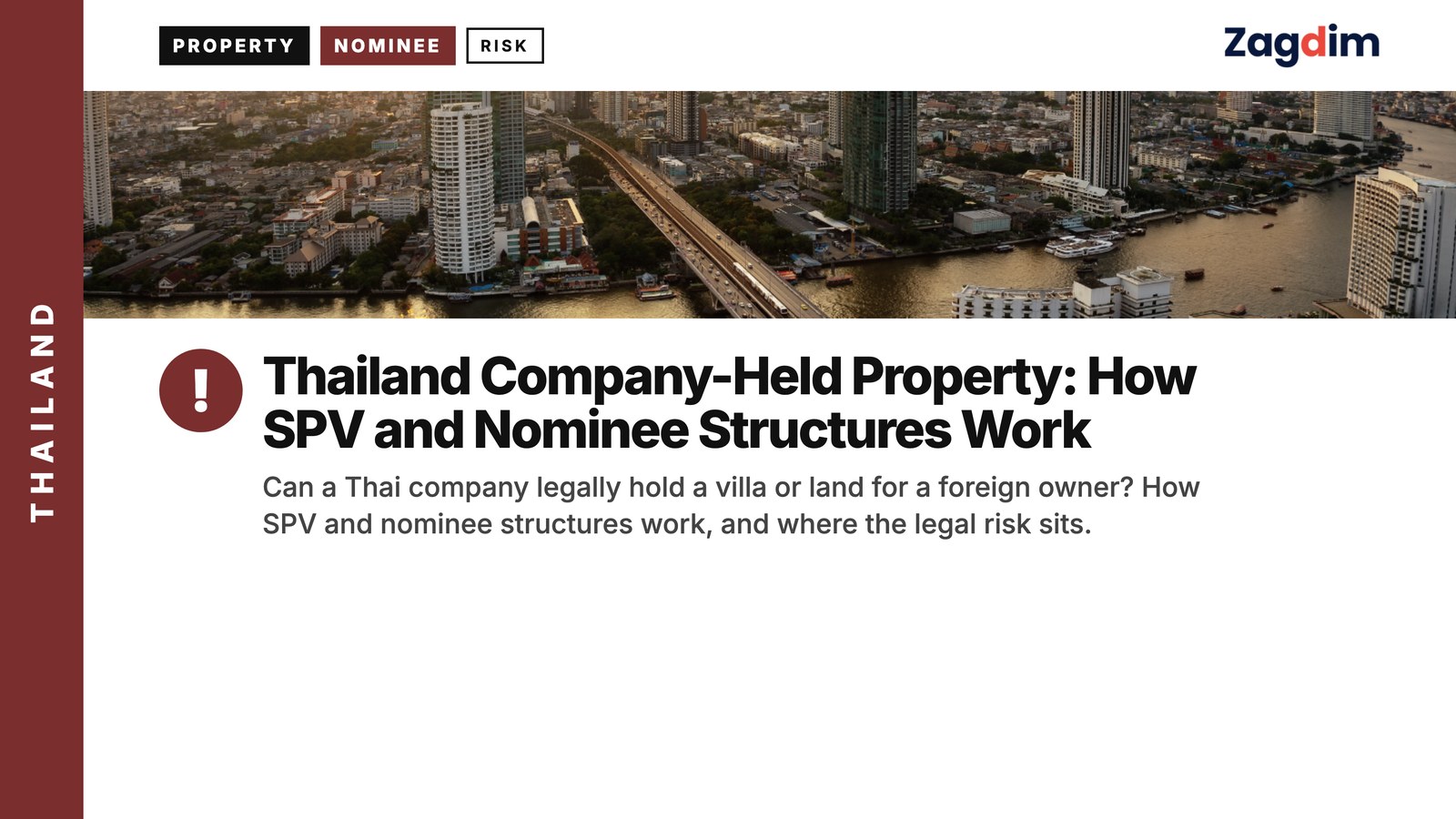
Bangkok Skyline — sunset river bridge, illustrating Holding Thai Property Through a Company: SPV and Nominee Risk

Image: Zagdim

September 24, 2026
in Living Abroad, Property, Thailand
Reading Time: 12 mins read

Understand the Risk First, Then Talk About How to Do It

  • For foreign investors and expatriate residents planning to buy a villa or land-based property in Thailand who have been advised to “hold it through a Thai company” — this article sets out whether that can actually be done, how it works in practice, and what the risk looks like now.
  • It explains the main ways foreigners can hold Thai property, including company ownership, direct individual ownership of a condo, and long-term leasehold, and focuses on comparing the legal, enforcement, and tax differences between a company/SPV structure and the alternatives.
  • It covers Thailand’s Land Code, the Board of Investment’s (BOI) restrictions on company land holding, and the large-scale recent government scrutiny of nominee shareholders and foreign capital disguised as Thai-owned companies, so you know where the risk sits and when to bring in a professional to review a structure.

Who Most Needs to Care About “Holding Thai Property Through a Company”?

Buyers Currently Being Sold a “Company-Held” Plan

Many foreigners looking at a Thai villa, townhouse, or land-based property are quickly told by an agent or a friend: “Foreigners can’t hold land directly, but you can set up a Thai company and buy through it.” It sounds like a clever workaround, but it actually involves the Land Code, the Foreign Business Act, and tax rules — and now also stricter scrutiny of nominee shareholders and ultimate beneficial owner (UBO) checks.

The real question is not “can I set up a company,” but whether that company would be treated as a foreign company, whether the structure substantively breaches the Land Code or the Foreign Business Act, and what could happen if it is later found to be a nominee structure.

Expatriate Residents Who Already Hold, or Plan to Hold, Thai Property Long Term

The other group is expatriate residents already living in Thailand who may already own a villa held through a Thai company, or are planning to move or expand their holdings. Having seen recent government announcements of a large-scale crackdown on nominee companies, they are starting to worry: could the common “51% Thai shareholder plus 49% foreign shareholder” structure be found unlawful?

What this article can offer is a way to think about the risk in an existing structure, which features tend to draw scrutiny, and when to bring in a lawyer or tax adviser to assess whether the structure needs adjusting or unwinding.


Foreigners Holding Thai Property Through a Company: Possible, but Not a Universal Fix

First Clarify: Are You Holding Land, a Villa, or a Condo?

Thailand’s Land Code, in principle, bars foreigners from acquiring land ownership directly, with limited land-holding possible only in specific exceptions (such as major investment, industrial projects, or BOI-promoted projects). This is exactly why, for a property that combines land and a building, foreigners are advised to hold it through a company.

A condominium is different: within the foreign quota for the whole building, a foreigner can hold freehold title directly in their own name, and there is no need to set up a company simply to hold a condo unless a specific tax or estate-planning reason applies. Most “you must use a company” discussions are really about villas, townhouses, and land.

Three Common Company-Holding Scenarios

1. A Genuine Operating Company Holding Business-Use Property. A manufacturing, logistics, or services company, because it genuinely needs to operate, acquires the right to hold land for an office, factory, or staff housing under a BOI or other regulatory framework. Companies like this have real operations, staff, and tax records, and holding property is simply part of running the business.

2. A Foreign Company That Holds Land Under BOI Investment Promotion. A small number of foreign companies apply for BOI investment promotion status and, once they meet the capital, industry, and use-of-land conditions, lawfully hold land for office or staff-housing purposes. There are documented rules and official processes such as e-Land, but the bar to entry is high and the permitted uses are tightly restricted — an individual investor generally cannot use this route simply to hold a personal villa.

3. A Shell Company or SPV Set Up Purely to Hold a Home for a Foreign Buyer. This is the most common scenario, and also the highest-risk one: the company has no real operations and exists only for one villa or a small number of properties, fully funded and controlled by a foreigner, with the Thai shareholder holding shares in name only in exchange for a fixed fee. From the government’s point of view, this is using a nominee structure to get around the Land Code.

The General Process for Holding Property Through a Company

Setting up a Thai limited company: a common design is for at least 51% of the shares to be held, on paper, by a Thai individual or company, with the foreigner holding 49%. Some structures also involve a separate private shareholder agreement or loan agreement that preserves the foreigner’s real control and economic benefit.

Buying property in the company’s name: the company signs the sale and purchase agreement as the buyer, and the property is registered in the company’s name. The Land Department assesses the shareholding structure to judge whether it involves a foreign company or nominee risk, and in recent years has stepped up data cross-checking with the Department of Business Development (DBD).

Ongoing holding and use: the property is mainly used by the foreign shareholder personally or let out short term. The company may have no real trading income, staff, or office, and its filings are often largely formal. If the property is later sold, either the property itself or the company’s shares can be transferred, and the two routes carry different tax and compliance risks and costs.

The core risk is whether the company is genuinely a Thai operating company, or is in substance simply a vehicle a foreigner set up to hold property, using a Thai shareholder as a nominee.

Common Points of Scrutiny

When a land transfer or company check takes place, the authorities have in recent years focused on: whether the company has real operating activity and income, or none at all; whether the Thai shareholder has actually contributed capital and taken part in decisions, or is only named on paper; and whether the company appears on a high-risk profile — for example, heavily involved in property transactions or holding multiple land parcels with no clear operating reason.

Even where a structure is formally compliant on paper, if the overall picture shows it is, in substance, a foreigner holding land through a nominee company, there remains a risk of it being found in breach of the Land Code or the Foreign Business Act.

How This Differs from the BOI Route

Some people hear that “a foreign company can hold land under a BOI structure” and assume that finding any BOI project makes it legal to hold their own home or villa. The BOI’s conditions for a company holding land are quite specific, generally tied directly to investment amount, industry category, and intended land use, and subject to area caps and use restrictions. A BOI-promoted company may hold land for an office or staff housing under specific conditions, but the use and location of that property are clearly regulated, and it is not open to being used freely to hold a purely private residence or holiday villa.

Do not think of a “BOI company” as a property SPV that can be applied at will — it is an investment and land-policy tool tightly bound to a genuine operating plan.


Common Misunderstandings

Misunderstanding 1: “Buying Through a Thai Company Means It Doesn’t Count as Foreign Land Ownership”

The authorities look at actual control, not just the name on the registration. If a company is, in substance, funded, controlled, and benefited from by a foreigner, it can still be treated as a foreign company or a nominee structure. Assessing the risk requires looking at the shareholding ratio, the source of funds, control arrangements, and whether the company has genuine operations — not the shareholding percentage alone.

Misunderstanding 2: “51% Thai Shareholder Plus 49% Foreign Shareholder Is Always Safe”

Recent policy and enforcement are aimed precisely at this kind of surface-level shareholding structure, using data cross-checks and beneficial-ownership investigations to determine whether a nominee arrangement exists. If the Thai shareholder has not actually contributed capital, does not take part in running the company, and receives income only in the form of a fixed “nominee fee,” this kind of structure can be found unlawful.

Misunderstanding 3: “The Risk Is Lower If It’s Purely for My Own Use and Not Rented Out”

The authorities’ focus is whether the land ownership itself is lawful, not whether the property is rented out. As long as the structure itself breaches the Land Code or the Foreign Business Act, it can still be treated as a violation even if there is no rental or business activity at all. Whether or how the property is used does not remove the legal risk built into the structure itself.

Misunderstanding 4: “Holding Property Through a Company Is Always More Tax-Efficient Than Holding It Personally”

Holding property through a company can add compliance costs, accounting, and filing obligations at the company level, as well as tax complexity when the property or the shares are later sold. Any tax “advantage” needs to be assessed together with the owner’s own country of tax residence, international tax treaties, and the long-term holding plan — it cannot be judged by looking at one country or one type of tax alone.

Misunderstanding 5: “Everyone Used to Do It This Way, So It Should Still Be Fine Now”

In the past, there were indeed many cases of property held through an SPV-plus-nominee structure. But recent policy signals show the government steadily narrowing the room for this kind of structure to operate, particularly in areas with concentrated property and land transactions. A practice that was historically tolerated is not guaranteed to escape future review or retroactive scrutiny. For existing holders, periodically reassessing whether an existing structure needs adjusting is part of managing that risk.


Three Typical Scenarios

Scenario 1: A Foreign Investor Preparing to Buy a First Thai Villa

Background: A foreign buyer plans to buy a holiday villa with land on a Thai island. The agent recommends setting up a Thai company to hold the property, with two Thai friends each holding a small number of shares. The buyer is unsure whether this arrangement is really lawful, and is also worried about what happens to the shareholding if the Thai friends later move away or the relationship changes.

What to do: First understand the basic restrictions the Land Code and the Foreign Business Act place on foreign companies and nominee arrangements, and confirm whether this company would have a genuine operating plan or exists purely to hold the property. Weigh other viable ways to hold the property — such as switching to a condo, a long-term lease, or a property in a different area — to see whether a simpler structure can meet the same need. If company ownership is still being considered, get a lawyer or tax adviser to review the shareholder arrangement, the source of funds, and the long-term exit plan, rather than relying only on what an agent says verbally.

If a nominee investigation follows in future, both the Thai friends and the company itself could face legal exposure, and how the property can be dealt with could also be affected.

Scenario 2: An Expatriate Resident Who Has Held a Villa Through a Company for Years

Background: A long-term expatriate resident in Thailand set up a Thai company years ago, with a lawyer’s help, to hold a villa, with a shareholding structure of 51% Thai shareholder and 49% themselves. The company has no other business activity and is normally used only to pay property-related costs. Having recently seen the government announce a large-scale crackdown on nominee structures, they are worried their company could be flagged as high-risk.

What to do: Gather the company’s incorporation and historical documents — shareholder agreements, loan arrangements, and financial statements — and check whether there are obvious nominee features. Discuss the possible risk scenarios with a lawyer familiar with the relevant rules, and assess possible paths forward, such as planning an exit, converting to a different holding structure, or strengthening the company’s genuine operations, while understanding the tax and compliance cost of each option.

Changing the structure hastily, without adequate preparation, can trigger tax, transfer, and contract risk at the same time. Avoid making a rushed decision out of panic.

Scenario 3: A Genuinely Operating Foreign Company Assessing a BOI Land-Holding Option

Background: A foreign company with real operations plans to set up a regional office and staff housing in Thailand, and is considering applying for BOI investment promotion, partly because it wants to hold office and residential land within a lawful framework. Management wants to know whether the BOI route is workable, how long the application process takes, and what restrictions apply to the use and location of the land.

What to do: Have an experienced adviser or lawyer assess whether the company’s industry qualifies for BOI incentive categories, and whether the investment amount, staff size, and planned land area fall within an acceptable range. Understand the use and location restrictions the BOI places on land held for offices and staff housing, and how a change of use or a future divestment would be handled.

BOI land holding exists to support investment and operations, not to provide a private home for a particular shareholder — if the use drifts from what was originally committed, compliance risk can follow.


Frequently Asked Questions

Q1: Is It Actually Legal for a Foreigner to Hold a Villa or Land Through a Thai Company?

In principle, Thai law places strict limits on direct land ownership by foreigners, and whether a company can hold that land depends on whether the company is, in substance, treated as a foreign company, and whether the land holding meets the relevant rules or exceptions. Setting up a nominally Thai company does not by itself make holding the land lawful. If the company genuinely needs the land to operate, or holds it under a lawfully permitted framework, the risk is very different from a pure property SPV.

Q2: Does a Thai Shareholder Holding More Than 51% Automatically Make the Company “Thai-Held”?

Not necessarily. The authorities look at the ultimate beneficial owner and actual control, not the shareholding ratio alone. If the Thai shareholder has not actually contributed capital, is only named on paper in exchange for a fee, or plays no role at all in the company’s decisions and operations, it can still be found to be a nominee structure. Even if the shareholding ratio looks like it meets the standard for a Thai-held company, if the substance shows it was designed by a foreigner to get around the land restrictions, there remains a risk it will be treated as unlawful.

Q3: Is Holding Property Through a Company Always Better for Tax Purposes?

Not necessarily. Holding property through a company brings company-level accounting, filing, and tax obligations, and the tax treatment on selling the property or the shares can differ from holding it personally. Whether it is actually “more tax-efficient” depends on the owner’s country of tax residence, the source of income in Thailand, the holding period, and the exit method — it cannot be summed up in a single sentence.

Q4: I’ve Held Property Through a Company for Years — Now That the Government Is Cracking Down on Nominees, Should I Close the Company or Sell Immediately?

Whether to adjust the structure needs case-by-case analysis. Closing the company or selling the property in haste can trigger extra tax, contract costs, or procedural risk. A more practical approach is to first review the company’s actual condition — for example, whether it has an operating record, and whether the shareholder and funding arrangements too obviously show nominee features — before deciding whether adjustment is needed. Consult a lawyer familiar with the relevant rules where necessary to assess the risk and cost of each option.

Q5: If I Only Plan to Hold a Condo, Do I Still Need to Set Up a Company?

In most cases, no. A foreigner can hold a condo unit directly in their own name within the building’s foreign quota. Using a company to hold a condo may have a reason in certain tax or estate-planning situations, but it also adds compliance obligations and cost at the company level. For most people buying purely to live in or as a simple investment, holding a condo personally is usually simpler and easier to manage.

Q6: If I Plan to Live in the Property Long Term Myself and Never Rent It Out, Does the Government Still Care About the Company Structure?

The authorities’ focus is whether the land ownership itself complies with the rules, not whether the property is rented out or used commercially. Even if the property is used entirely for personal residence, if the company structure is, in substance, designed to get around the land restrictions, it can still be treated as unlawful. Once a self-occupied property is eventually transferred or inherited, the lawfulness of the underlying structure becomes even more important.

Weighing a company, SPV, or other structure for a Thailand property purchase? Ask Zagdim to start working through your situation.


Disclaimer

This article provides general information for foreigners and expatriate residents to help understand the common approaches, legal restrictions, and risk points involved in holding Thai property through a company. It does not constitute legal, tax, financial, or investment advice. The relevant rules and enforcement priorities can change over time, and readers should rely on the latest official announcements and formal documents, consulting a qualified professional familiar with Thai regulations before any major asset allocation or structural change. Individual cases differ considerably in background, purpose, and risk tolerance, and the right approach will not be the same for everyone.

Related in this series:

  • Cost of Living in Thailand: Bangkok vs Chiang Mai vs Phuket
  • Converting an International Driving Permit to a Thai Driver's License
  • Flooded Condo Parking in Thailand: Who Pays for Car Damage?
  • A Guide to Car Insurance Types in Thailand

Have a question about this guide? Leave a comment below, or ask Zagdim directly.

Life abroad? Ask Zagdim.

Your first stop for international property and global living.

Research and insights. Know what’s changing. Understand what matters.

Sources

  • Thailand Board of Investment — foreign companies’ land ownership regulations
  • Thailand Land Code — Thai government land law
  • Department of Business Development (DBD) — nominee company crackdown updates
  • Nation Thailand — reporting on the crackdown on foreign nominee businesses and land holdings
  • ASEAN Briefing — Thailand land ownership rules for foreigners
  • Various law firms and professional bodies — analysis of nominee structures and property-holding risk in Thailand

Zagdim AI
All content is researched, written, or authorized for publication by the @Zagdim Overseas team. Sharing and reposting are welcome, but please make sure to credit the source and include the original article link from this website. Any plagiarism or unauthorized use may result in legal action. For article submissions, please contact us via Facebook. Thank you for your support!

For article submissions, press release publication, or interview notices, please contact [email protected]. 

Zagdim Ask

Have a specific question about overseas living, property, visa, or practical arrangements?

Fill in your situation and key concerns through Zagdim Ask. Our team will review your message and get back to you by email where appropriate.

Submit your enquiry →

Similar Topics

Manchester Town Hall in autumn, illustrating How High-Net-Worth Individuals Get Preferential UK Loan Terms
Living Abroad

How High-Net-Worth Individuals Get Preferential UK Loan Terms

September 24, 2026
White stucco townhouse frontage, illustrating How High-Net-Worth Individuals Get Preferential UK Loan Terms
Living Abroad

How High-Net-Worth Individuals Get Preferential UK Loan Terms

September 24, 2026
Oxford Street with red buses, illustrating Moving to the UK: BNO, Spouse and Work Visa Routes Compared
Living Abroad

Moving to the UK: BNO, Spouse and Work Visa Routes Compared

September 24, 2026
Next Post
Bangkok Skyline — CBD night reflection, illustrating How Thai Property Management Companies Charge: Fees Explained

How Thai Property Management Companies Charge: Fees Explained

Pattaya — bay, illustrating Thailand's Nationality Reform: What It Means for Residents

Thailand's Nationality Reform: What It Means for Residents

Pattaya — sign, illustrating Cost of Living in Thailand: Bangkok vs Chiang Mai vs Phuket

Cost of Living in Thailand: Bangkok vs Chiang Mai vs Phuket

Facebook Twitter Youtube

About Us

Zagdim is a global knowledge platform focused on cross-border property, relocation, lifestyle, and location-based decision-making.

We provide insights on overseas real estate, market trends, regional analysis, economic developments, and practical relocation information. Through continuous market observation and on-the-ground research, Zagdim helps readers better understand a place before deciding where to live, invest, buy property, or establish a base abroad.

We currently follow markets including the UK, Japan, Thailand, Malaysia, Germany, Australia, the UAE, Greece, Portugal, and Spain, while continuing to track emerging lifestyle, relocation, and property trends worldwide.

Category

  • Australia
  • Buying & Immigration Guide
  • Canada
  • Costa Rica
  • Dubai
  • Encyclopedia
  • Europe
  • Expat Lifestyle Guide
  • Global Reports Analysis
  • Hong Kong
  • Human-Picked
  • International Property Buying Guide
  • Japan
  • Japan Market News
  • Kenya
  • Living Abroad
  • Malaysia
  • Mallorca
  • Market Trends Overview
  • News
  • Other Market News
  • Overseas Leasing & Long-Term Stay
  • Policy Interpretation
  • Portugal
  • Property
  • Property Law & Tax
  • Real Estate & Economic News
  • Real Estate Law & Taxation
  • Relocation, Immigration & Visa
  • Singapore
  • South Korea
  • Spain
  • Switzerland
  • Thailand
  • Thailand Market News
  • UK Market News
  • United Kingdom
  • United States
  • Vietnam Market News
  • Visa & Immigration
  • Zagdim Insights
  • Zagdim Property Insights

Email:[email protected]


Add Friends


WhatsApp
Contact Us


Wechat:Zagdim

Work with Zagdim

Put your brand inside the overseas property research process — in English and in Chinese. Reaching buyers, expats and investors across 19 markets.

View partnership packages →

©2026 Zagdim Overseas All Right Reserved

No Result
View All Result
  • Home
  • Zagdim Property Insights
    • Market Trends Overview
    • Policy Interpretation
    • Forest
    • PLACEHOLDER sub-cate for Zagdim Property Insights
  • Global Reports Analysis
    • In-Depth Project Analysis
  • Real Estate & Economic News
    • Thailand Market News
    • UK Market News
    • Germany Market News
    • Japan Market News
  • Buying & Immigration Guide
    • Expat Lifestyle Guide
    • Real Estate Law & Taxation
    • Overseas Leasing & Long-Term Stay
    • Starting a Business & Company Setup
  • Zagdim Ask
  • 中文 EN

©2026 Zagdim Overseas All Right Reserved