






























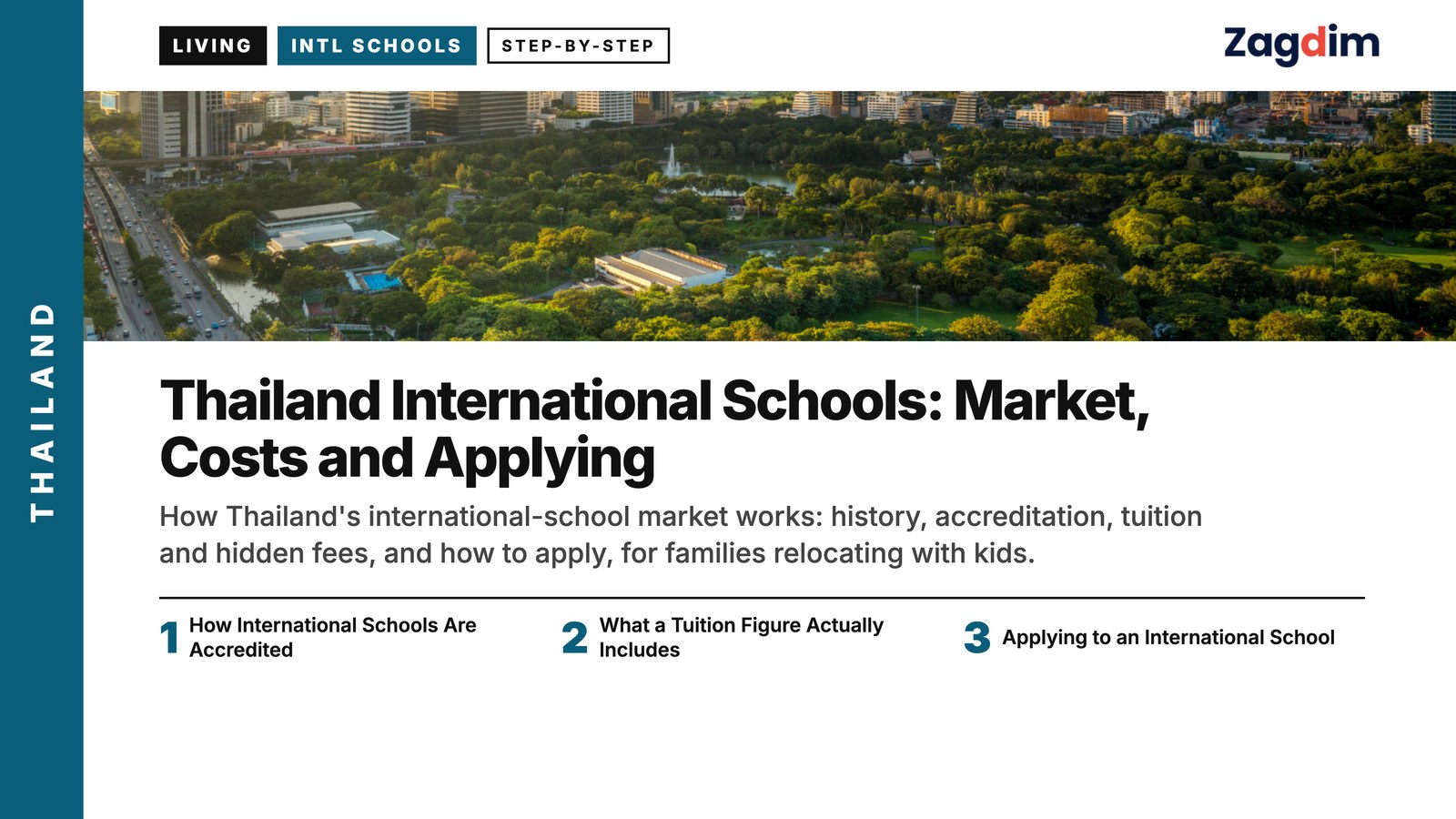
Thailand’s international-school sector has grown into one of the most developed in Southeast Asia, with a genuinely wide choice of curricula, accreditation standards, and price points. For a family relocating with children, the practical challenge isn’t finding a school — it’s understanding how the market is structured, what a tuition figure actually includes, and how to apply, before committing to one path.
This guide brings together the shape of the market (its history, accreditation, and costs) with the practical steps of choosing and applying, so you can evaluate a shortlist with a clearer sense of what you’re looking at.
How Thailand’s International-School Market Developed
Thailand’s international-school sector traces back to the founding of the International School of Bangkok (ISB) in 1951, originally created to serve the children of foreign diplomats posted in Thailand. Over the past two decades the sector has grown rapidly, supported by Thai government policy that eased restrictions on foreign-invested schools and simplified work-permit procedures for foreign teachers. The result is a network centered on Bangkok and extending to cities such as Chiang Mai and Phuket, spanning curricula from the UK, the US, France, Germany, and other countries, with IB, AP, and A-Level among the internationally recognized diplomas on offer.
How International Schools Are Accredited
Thai international schools are generally expected to clear three layers of oversight: a license from Thailand’s Office of the Private Education Commission (OPEC), accreditation from an international body such as the International Baccalaureate Organization (IBO) or the Western Association of Schools and Colleges (WASC), and periodic international review by the relevant education authorities. This layered system is what gives an international diploma earned in Thailand its international recognition.
What a Tuition Figure Actually Includes
Tuition at Thailand’s international schools rises noticeably by level, and the headline number is rarely the full cost. Beyond tuition itself, families should budget for a one-time registration fee, a (sometimes partly refundable) capital or development fund contribution, an assessment fee at application stage (which may cover an academic test and a psychological/learning assessment), a school-bus fee if used, and a meal plan if the school runs one. Some schools also ask for an alumni-fund contribution on top of tuition. None of these extras are usually included in the headline tuition figure, and neither are textbooks, uniforms, or a technology deposit.
Scholarships exist at many of the leading schools, generally awarded for academic merit, and some schools maintain partnerships with corporate sponsors for subject-specific scholarships (such as STEM). As a rule of thumb for financial planning, it is sensible to budget somewhat above the sticker tuition price to allow for these additional costs.
Applying to an International School: What You’ll Need
An application typically requires three categories of documents: academic records (report cards from the last few years, plus any standardized test scores), identity documents (a birth certificate and the visa page of a passport), and health records (vaccination proof and a medical checkup report). Applicants who are not native English speakers are usually asked for an English test score (such as IELTS or TOEFL Junior) above a level the school sets, though some schools offer their own internal language assessment instead. A child with special educational needs may need to submit a professional assessment report, and some schools require this to be from a source recognized by the Thai Ministry of Education.
The assessment itself usually combines an academic test with an interview. A math assessment typically tests logical reasoning and problem-solving and may be tiered by difficulty; an English assessment covers general language ability and, at some schools, an additional writing task; a growing number of schools also include a group activity to observe teamwork and cross-cultural communication.
Once a child is accepted, most schools require the registration fee to be paid within a set number of business days to hold the place. Some schools run a credit-transfer system for students transferring from another school, evaluating the previous school’s curriculum to decide how many required credits carry over. An academic-bridging course before the school year starts is common at some schools, focused on academic English and interdisciplinary study skills, and it is sensible for a family to allow a few months for broader cultural-adjustment preparation as well, including any parent workshops or community-orientation activities the school offers.
*A few well-known names illustrate the range on offer — including British-curriculum, American-curriculum, and Swiss-curriculum schools, among others — but which one fits your child depends on curriculum, accreditation, cost, and location, not any single school’s reputation. Treat any specific school mentioned in research like this as an example, not a recommendation.*
Matching a School to Your Family, Not Just a Ranking
Once you understand how the market is structured, the actual decision comes down to a few practical factors:
- Type of school: a public school (Thai-medium, lower cost, deeper local integration), a bilingual school or English Programme (mixed Thai/English instruction, mid-range cost), or a full international school (English- or foreign-curriculum-medium, mainly serving international families, higher cost).
- Curriculum path: whether the school follows a UK-style system (IGCSE/A-Level), a US-style system (a high-school diploma with AP), the IB Diploma, or another national curriculum, and how that lines up with where your child might eventually study.
- Location and commute: in Thailand, school location often ends up determining which neighborhood a family lives in, particularly in Bangkok, where a long commute is a real daily cost.
- Total, multi-year cost: tuition plus the registration, development-fund, transport, and activity costs above, thought of as a multi-year family budget rather than a single year’s price tag.
- Visa and residency status: the visa types held by parents and children can affect what documents a school asks for, and how straightforward the application is.
A responsible way to evaluate a shortlist is to ask each school directly for its accreditation status, its fee breakdown beyond tuition, and its actual admissions and graduate-outcome record — rather than relying on a school’s own marketing description alone.
If you have questions about a Thailand visa, long-stay status, or entry requirements related to relocating with children, ask Zagdim — Zagdim can help clarify your purpose of stay, entry history, income sources, and the visa routes that may apply, and connect you with relevant Thailand visa and relocation services through ZDelp where useful.
Disclaimer
The schools mentioned in this article are examples only and do not represent a recommendation or a claim that they are the best choice. Parents should evaluate schools based on their own family’s needs and their child’s individual characteristics. This article is general information and does not constitute individualized education, immigration, or financial advice; verify current fees, accreditation, and admissions requirements directly with each school and with the relevant Thai authorities before making a decision.
Have a question about this guide? Leave a comment below, or ask Zagdim directly.
Your first stop for international property and global living.
Research and insights. Know what’s changing. Understand what matters.