





























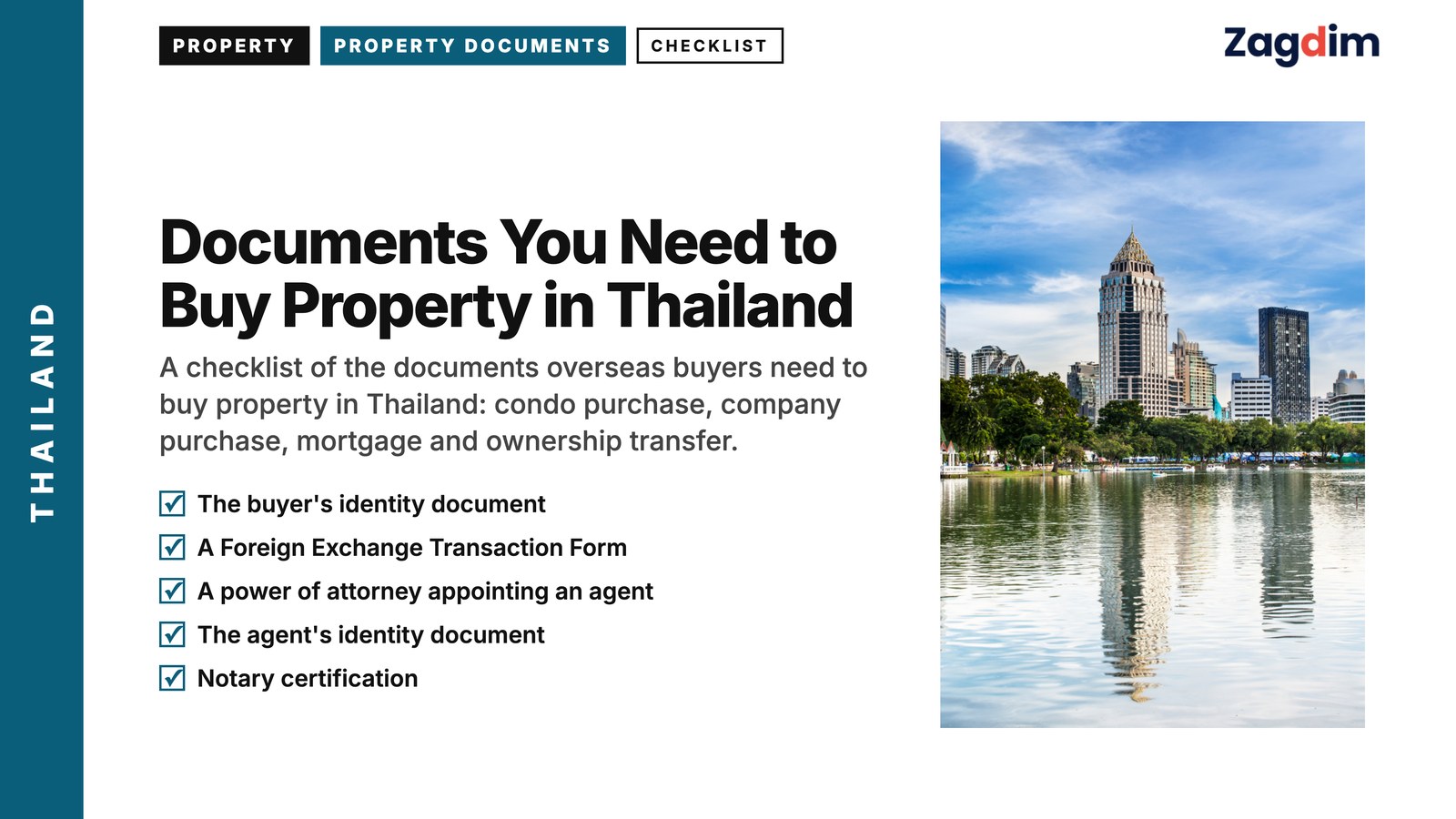
In recent years, Thailand’s economy has continued to show strong growth potential across many sectors, including its property market. Thailand is also a widely loved travel destination, which has long attracted many overseas investors to buy property there. However, the purchase process in Thailand differs from that of many buyers’ home markets, and overseas buyers need specific documents to buy property in Thailand. This article lists the documents overseas buyers need to prepare for property purchases in Thailand under different circumstances.
Three Common Ways for Overseas Buyers to Purchase
Overseas buyers generally have three ways to buy property in Thailand:
- Buying freehold ownership of a condominium unit, provided that foreign ownership in that condominium does not exceed 49% of the total units, with the remaining 51% held by Thai nationals.
- Setting up a company in Thailand and using that company to buy freehold land, though the overseas investor can hold at most 49% of the company’s shares.
- Buying leasehold rights to land. The longest single land lease term is 30 years (Civil and Commercial Code s.540 caps any lease at 30 years). A common market practice frames two further renewals as reaching a 90-year total, but this is not a legal guarantee — each renewal needs a new contract and Land Department re-registration, and is not automatically binding on a future owner of the land.
Documents Needed to Buy a Condominium Unit
If a foreign buyer is purchasing the property in their personal capacity, the following documents are generally needed at transfer:
- The buyer’s identity document (age 18 or above), i.e., a passport
- If jointly held by a married couple, proof of marriage
- A Foreign Exchange Transaction Form (FETF) issued by a Thai bank confirming the foreign currency exchange: the FETF must show the foreign buyer’s name, along with the names of the overseas remitter and the domestic recipient. The name on the recipient’s Thai bank account must match the name in the purchase contract, otherwise the bank may not be able to issue the buyer an FETF.
- A power of attorney appointing an agent
- The agent’s identity document
Documents Needed to Take Possession of Property in Thailand
When taking possession of property in Thailand, you need to prepare the following three documents:
- The land title deed (Chanote): equivalent to a property ownership certificate, also needed when the property is later sold.
The title deed has two sides: the front carries the property information, and the back carries the land registration record.
- The house registration book: registers information about the condominium unit and its owner.
- The sale and purchase contract: the transaction contract and related information for the property purchased.
If the property purchased is newly built, these three documents can generally be collected directly from the developer within 7 to 15 days of taking possession.
Purchasing Property Through a Company
When a foreign buyer is purchasing property through a company, the following documents are needed:
- Certified copy of the company registration certificate
- Certified copy of the memorandum of association
- Notary certification
- Shareholder list in both English and Thai
- Minutes of the board meeting approving the property purchase
- A proposal letter
- A power of attorney, if not transacting in person
- A letter confirming the buyer has no outstanding debts
- A letter regarding any foreign co-owners
- Copy of the identity document of the authorized director
- Copy of the house registration of the authorized director
- The condominium unit’s title deed
In addition, under Thailand’s Land Code, a foreigner who invests at least THB 40 million in Thailand, and maintains that investment for at least three years, is eligible to buy land and a villa with land. Therefore, when a buyer is purchasing leasehold rights to land, proof of this investment must also be provided.
Documents Needed for a Property Loan in Thailand
- The applicant’s passport information
- Work permit or work visa (for those working in Thailand)
- Proof of marital status (if married, the spouse’s passport or ID)
- Proof of income
- Bank statements
- Payslips
- Personal credit rating (required for those not working in Thailand, or who have worked in Thailand for less than a year)
- The purchase contract
Documents Needed to Transfer Property Ownership
The transfer of property ownership should be carried out at Thailand’s Land Department. Buyers need the following documents to complete the transfer:
- Official property-related documents, such as the purchase contract
- Passports/ID documents of both the buyer and seller
- Proof of bank remittance and checks
- The land title deed
- The house registration book (Tabien Baan / Thai House Book) issued by the Thai Land Department
- The building permit
- A power of attorney and the identity documents of the appointed agent, if handling the transaction through an agent
Things to Note
- Buying property in Thailand requires opening a Thai bank account. Requirements vary by bank, so it is worth researching and comparing this in advance of opening an account.
- Overseas buyers commonly choose to buy new-build property, and some of these are still off-plan projects under construction. Buying off-plan from a developer with poor finances or a weak reputation carries the risk of the project being left unfinished. It is therefore best to buy a newly completed or soon-to-be-completed property from a large, reputable developer.
- When a non-resident foreigner buys a condominium in Thailand, they must present a declaration of the source of funds to the local land office when registering property ownership. All funds must be remitted into Thailand as foreign currency, after which the receiving bank will convert the amount into Thai baht.
- When buying property in Thailand from overseas, you cannot pay the developer directly in cash, and you cannot remit funds directly from a domestic bank account to the developer’s account in Thailand — the transfer must go through a bank in Thailand. This is because, at the time of purchase, Thailand’s Land Department requires a “foreign exchange certificate” to verify the legitimacy of the source of funds.
- Always inspect the property before transfer, checking in particular whether all switches work, whether any pipes leak, whether the water heater and air conditioning work properly, and whether the lights turn on and off correctly. Only sign the inspection confirmation with the developer, and proceed with the transfer, once everything has been checked and confirmed correct.
If you have questions about buying property in Thailand as an overseas buyer, ask Zagdim.
Have a question about this guide? Leave a comment below, or ask Zagdim directly.
Your first stop for international property and global living.
Research and insights. Know what’s changing. Understand what matters.