

































In an ordinary detached house in Chiba prefecture, Kazutoshi Kodama sets up four cameras, a thermal imager and an electromagnetic-field meter, and prepares to spend the night. He is not a police officer or a surveyor. His company, Kachimode, sells what amounts to spiritual due diligence: stay overnight in a stigmatised home, log the data, and issue prospective buyers a report certifying that nothing unusual was detected.
Reuters, which profiled Kodama in June 2025, reported that the house had seen two deaths: the owner died there of unnatural causes years ago, and her son later died alone in the same house, undiscovered for around ten days. Under Japanese industry practice, that makes it a textbook jiko bukken — an “incident property,” one where an unnatural death occurred or where a death went long undiscovered.
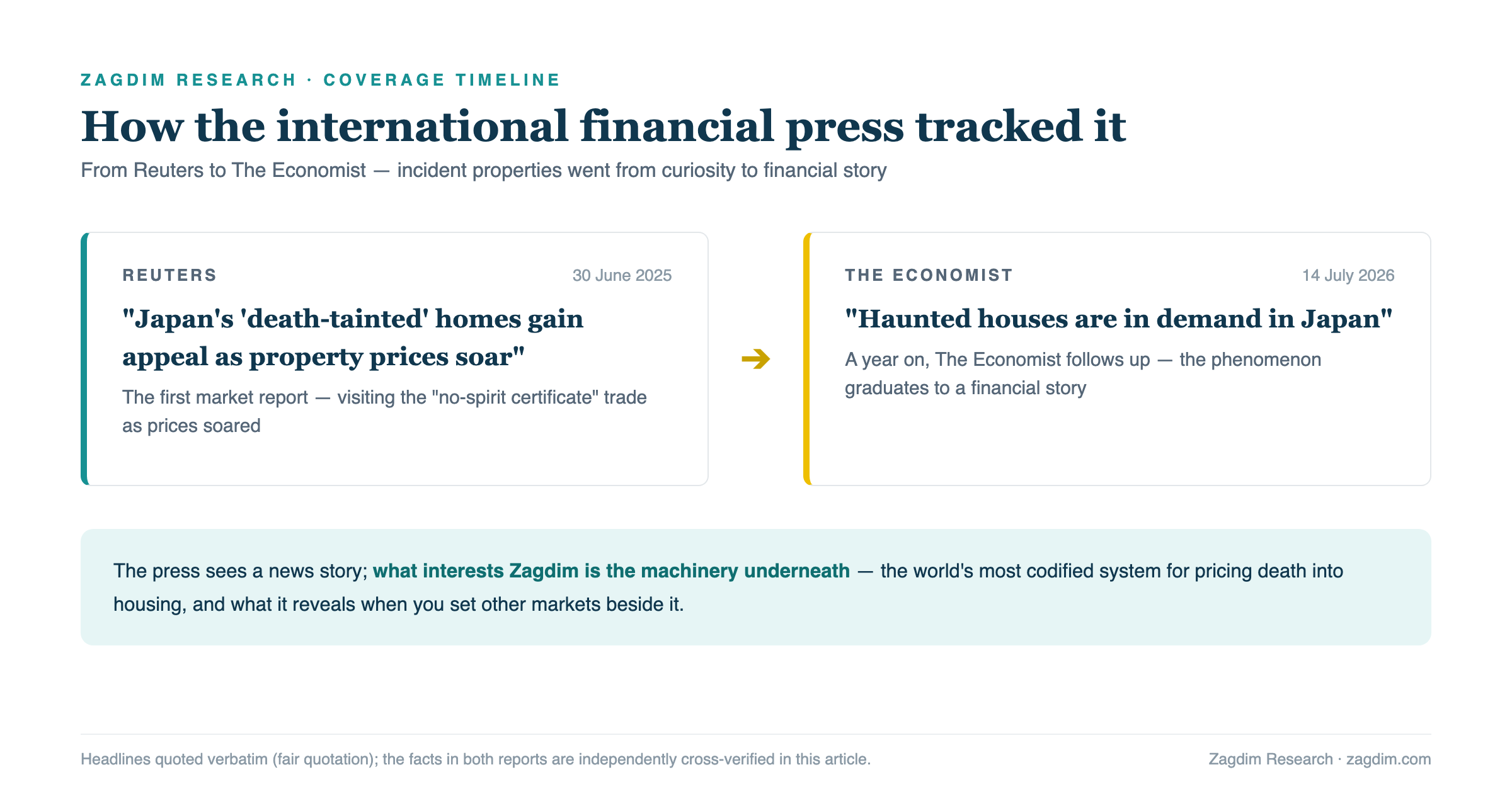
In most markets such a house would face one fate: discounted, unsold, forgotten. But over the past two years, Japan’s incident properties have started attracting competition — enough that The Economist covered the phenomenon on 14 July 2026. One of society’s deepest housing taboos is being repriced. The international financial press sees a news story; what interests us at Zagdim is the machinery underneath — the world’s most codified system for pricing death into real estate, and what it reveals when you set other markets beside it.
Supply: an ageing society produces over 20,000 of these homes a year
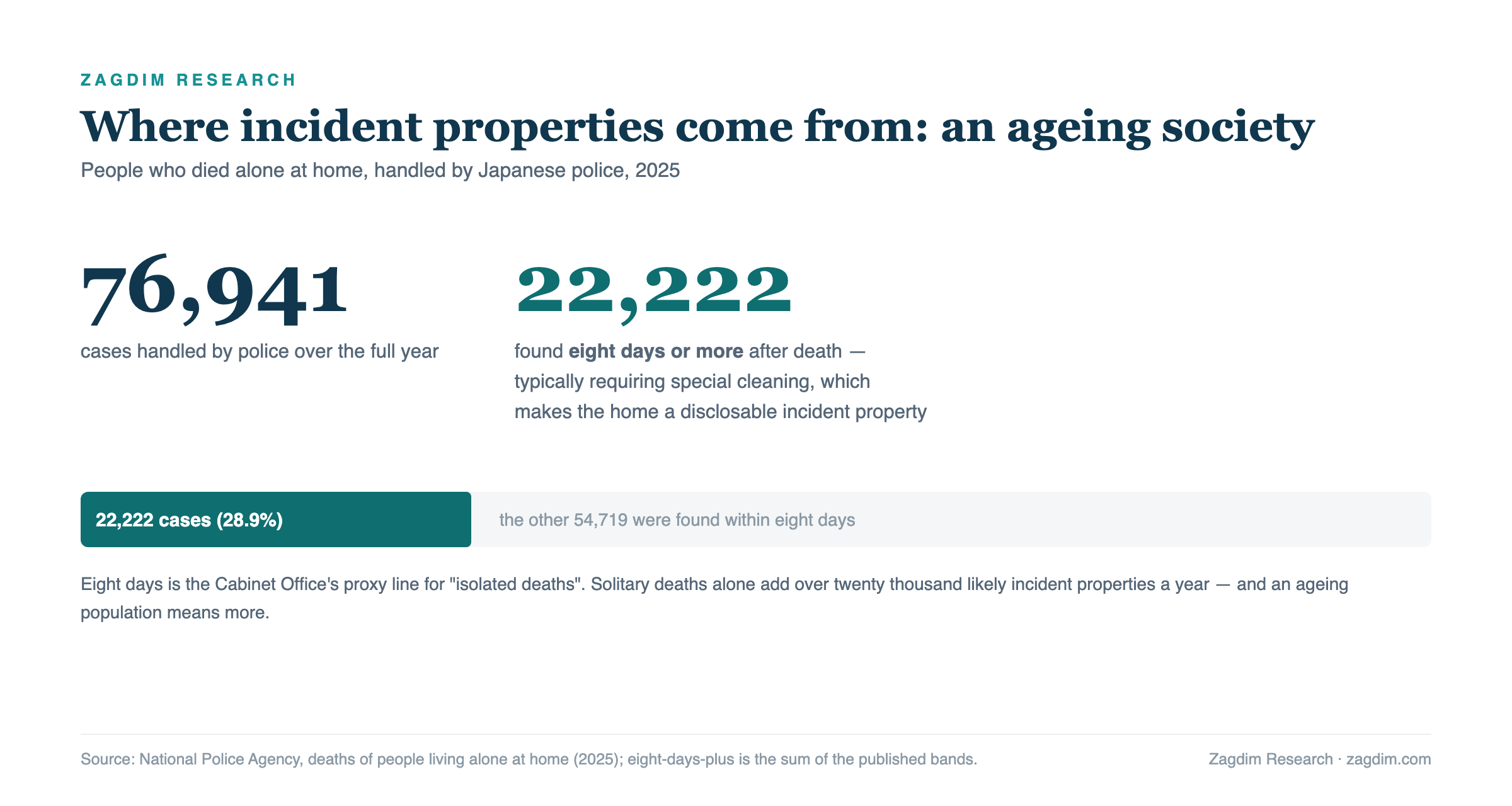
Incident properties are not rare. Japan’s National Police Agency records show that in 2025, police handled 76,941 cases of people who died alone at home; in 22,222 of those cases, the death went undiscovered for eight days or more. Eight days is the threshold Japan’s Cabinet Office uses as a proxy for “isolated deaths” — and in practice, a home past that line typically requires specialised cleaning, which triggers disclosure to the next occupant under industry rules.
That single category of death, in other words, adds more than twenty thousand likely incident properties to Japan’s stock every year, and an ageing population means the number will grow.
The system: three layers no other market has assembled
How Japan handles this is the reason the story is worth your attention, wherever you buy.
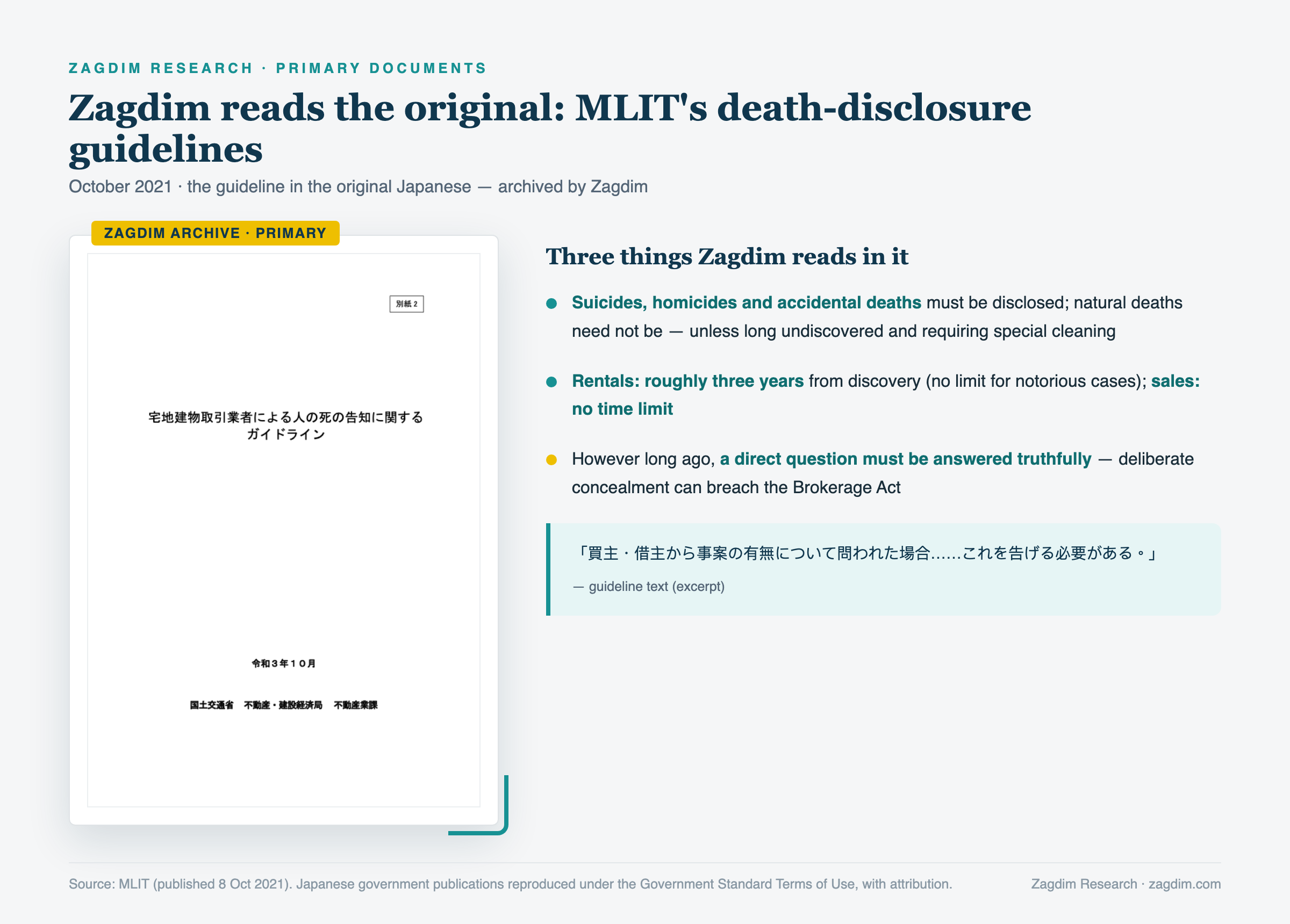
First, codified disclosure. In October 2021, the Ministry of Land, Infrastructure, Transport and Tourism (MLIT) issued guidelines spelling out what must be told to whom: suicides, homicides and accidental deaths must be disclosed; natural deaths need not be — unless the body went undiscovered long enough to require special cleaning, in which case disclosure applies. For rentals, the duty runs roughly three years from discovery of the death, with no time limit for notorious cases; for sales, there is no time limit at all. And regardless of elapsed time, if a buyer or tenant asks directly, the agent must answer truthfully — deliberate concealment can breach the Real Estate Brokerage Act.
Second, public look-up. A crowdsourced website called Oshimaland (Japanese name: Oshima Teru) pins incident properties on a national map, free for anyone to check. It is user-reported and accuracy is not guaranteed (verify independently), but its existence changed the game: sellers can no longer assume buyers won’t know.
Third, an industry. Specialist firms — one is literally named Jobutsu Fudosan, “attaining-Buddhahood real estate” — buy incident properties and run memorial services, specialised cleaning, renovation and resale as a single pipeline. Add Kodama’s “no-spirit certificates,” and death in this market becomes a line item.
Demand: why now
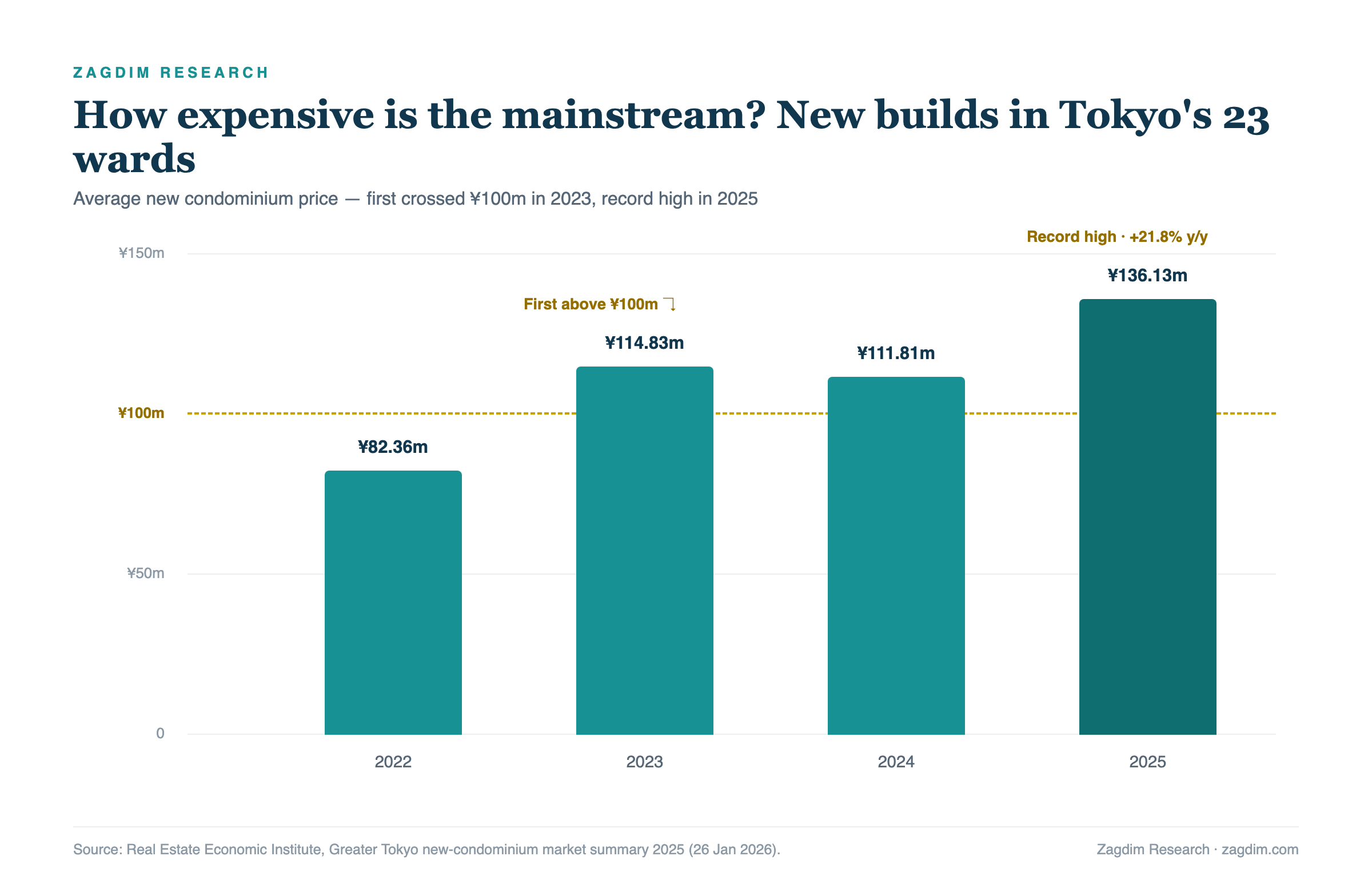
Price, first of all. The Real Estate Economic Institute reports that new condominiums in Tokyo’s 23 wards averaged ¥136.13m in 2025, up 21.8% in a year and a record high; the average had only crossed ¥100m for the first time in 2023. When the mainstream stock costs that much, assets the market once refused get a second look.
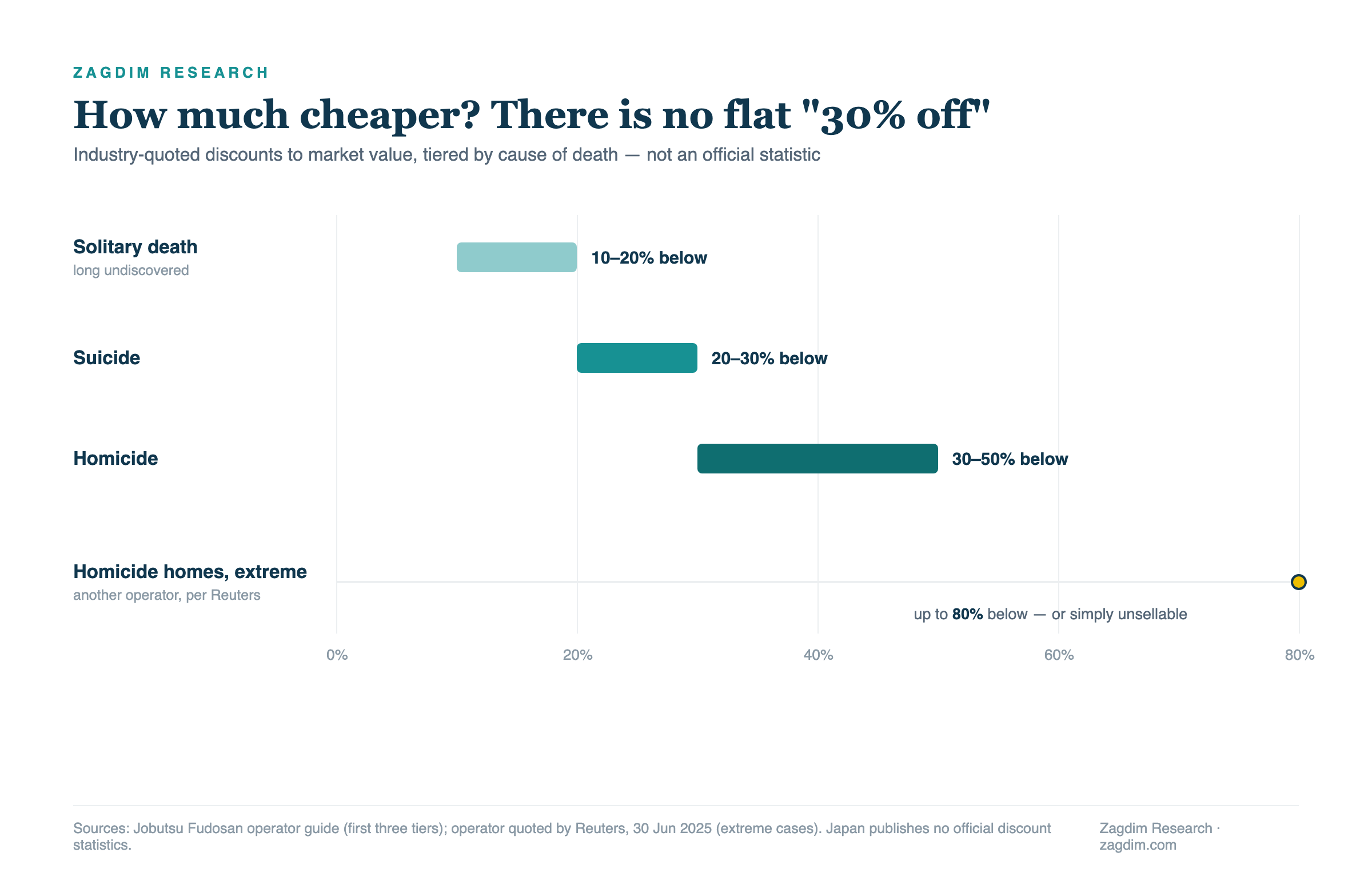
How much cheaper are incident properties? There is no official statistic, and industry figures vary: buyer-operator Jobutsu Fudosan’s own guide puts solitary-death homes at roughly 10–20% below market, suicides at 20–30% and homicides at 30–50%; an operator quoted by Reuters put the typical discount at around 20%, with homes where a homicide occurred going as much as 80% below market, or proving simply unsellable. What every source agrees on is that the discount is tiered by cause of death.
That has split the buyer pool in two. Investors run the numbers: per the same Reuters report, MarksLife — the operator behind Jobutsu Fudosan — earns an average yield of 8.4% on its portfolio, against a 3.55% expected return on central-Tokyo studio flats in a CBRE survey. The two figures aren’t strictly comparable (one is a specialist’s self-reported record, the other a market-wide survey of expectations), but the logic they illustrate is real enough: rental discounts on incident properties run only around 7–8%, far shallower than the sales discount, so an operator that buys at the sales discount and lets at close to par can, in principle, pocket the spread. Owner-occupiers remain another story: in a 500-person survey by AlbaLink, 44% said living in an incident property was out of the question, and when asked what discount would change their minds, the largest group — 35.4% of respondents — wanted the rent cut by half or more. The fear has not gone anywhere. What changed is that it now has a printed price.
One taboo, six legal answers
Stigmatised-property law is a near-universal problem, and the answers diverge sharply — often within a single country.
The United States splits by state. California’s Civil Code sets a three-year line: deaths more than three years before an offer are expressly exempt from disclosure; more recent ones enjoy no such shelter and are treated in practice as material facts — and a direct question must never be answered falsely, however old the death. Georgia’s statute runs the other way: failing to disclose a homicide or suicide creates no cause of action, though agents must answer truthfully if asked. Pennsylvania’s Supreme Court went further in 2014, ruling that a murder-suicide in a home is not a “material defect” requiring disclosure at all — psychological stigma, the court held, is not a physical flaw in the house.
England keeps caveat emptor. The Court of Appeal confirmed in 2004 that a seller has no general duty to volunteer that a killing took place in the home; an honest answer on the standard property information form is enough.
Singapore turns on a single question. Sellers have no statutory duty to disclose. But the Council for Estate Agencies’ Professional Service Manual is explicit: when a buyer asks, the agent must find out from the seller and convey material information — “recent death from unnatural causes” is named on the list. Ask, and the agent owes you an answer; don’t ask, and nobody is obliged to volunteer it. Agents have publicly put typical discounts at a modest 5–8% of asking price, and there is no public look-up database — due diligence means googling the address, asking neighbours, and watching for transactions priced oddly below the block.
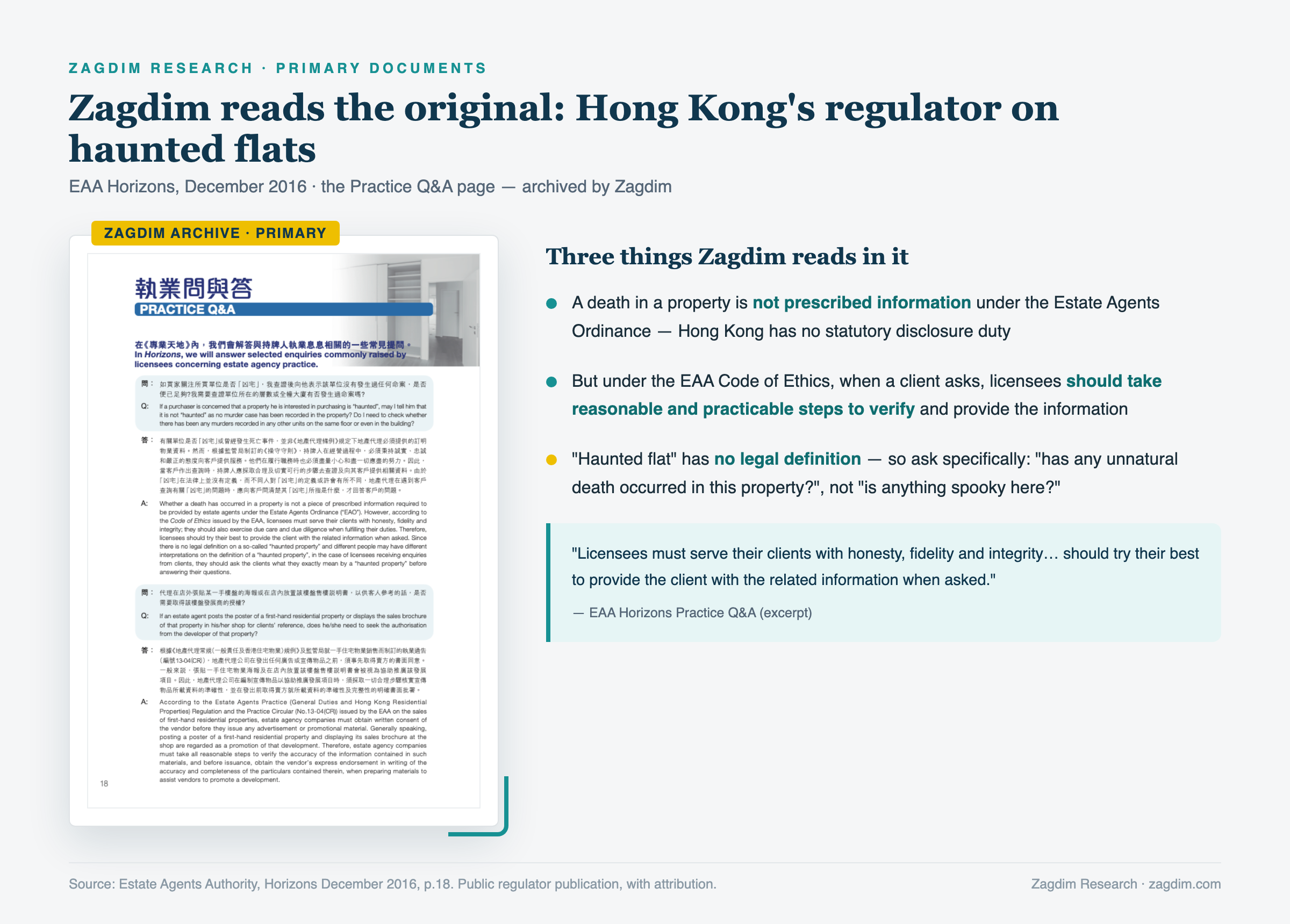
Hong Kong prices the stigma into finance itself. In the city’s resale market, hung chaak, or “haunted flats”, can be valued 20–30% below market by banks, with some declining to lend or provide valuations on the worst cases. There is no statutory disclosure duty; the regulator’s code requires agents to make reasonable inquiries and answer honestly when asked, and buyers lean on privately run haunted-flat databases that have logged thousands of addresses.
Mainland China and Taiwan fill the gaps in their own ways. Chinese courts have repeatedly rescinded sales where an unnatural death was concealed, treating it as fraud under good-faith and public-morals principles — and judicial auctions now disclose deaths up front, to striking effect: a Nanjing flat where a murder had occurred drew over 12,000 online viewers and 113 rounds of bidding in May 2026 before selling at roughly two-thirds of market value. Taiwan mandates disclosure on the standard property statement, but only for deaths during the seller’s period of ownership — a definition that spawned a much-reported laundering workaround: pass the title through an intermediary once, and the record resets. Taiwanese courts, it should be said, do not always indulge the trick; buyers have won rescission after undisclosed second-hand sales.
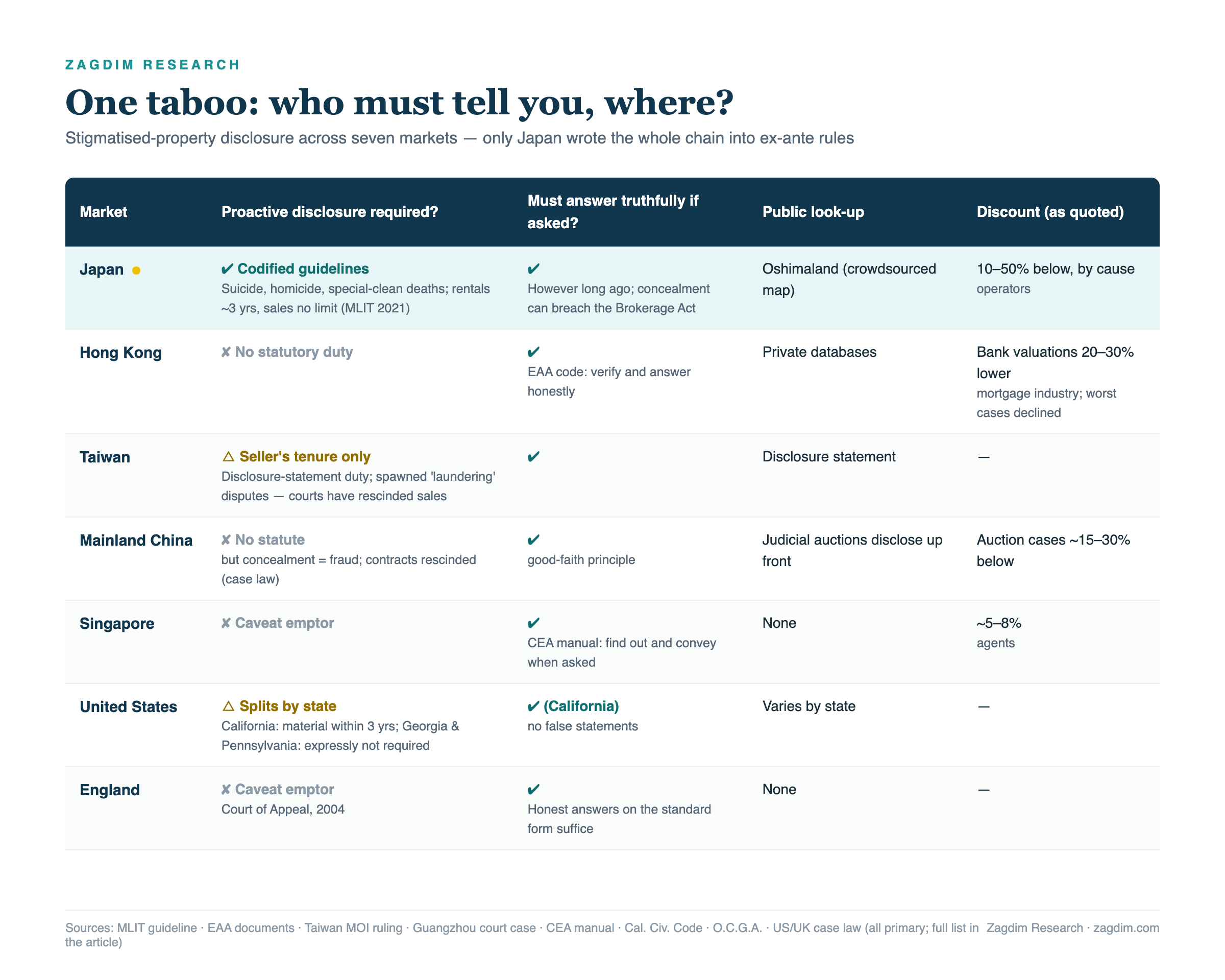
Set these side by side and Japan’s distinctiveness is plain: fear is cultural; knowing is institutional. Every society fears these homes. Most leave “knowing” to a buyer’s question or a court case after the fact. Japan alone wrote the whole chain into ex-ante rules — what you are entitled to know, who must tell you, what happens if they don’t — then added a public map and an industry that processes the properties themselves.
The Zagdim read
Our read: the run on incident properties is a thermometer. A taboo discount is the most stubborn discount in any property market — it reflects no rent, no location, only fear. When even that discount starts to narrow, mainstream prices have forced buyers to reprice their own dread, which tells you more about the heat of a market than any headline average.
The other half matters just as much: Japan shows that a taboo can be carried by institutions. Written disclosure rules plus public information did not make the fear disappear — they made it tradable. Buyers know what they are buying; the discount becomes a price both sides can see rather than a landmine buried in an information gap. The next time you see a market’s “haunted houses” start to sell, you will know what to read into it.
This article is research, not investment advice; whether any property is worth considering is a decision only you can make.
How Zagdim does research — source grading, attribution rules and the “Zagdim read” marker — is documented on our methodology page.
About Zagdim — Zagdim is a research publication on global living and international property. We study how these markets actually work — the rules, the prices, the practices — and publish what we find, welcome or not. Paid partnerships are always labelled, and held to the same evidence rules as everything else.
Sources
- National Police Agency (Japan): statistics on deaths of people living alone found at home — Reiwa 6 [2024] https://www.npa.go.jp/publications/statistics/shitai/hitorigurashi/R6nennreikaisoubetu.pdf / Reiwa 7 [2025] https://www.npa.go.jp/publications/statistics/shitai/hitorigurashi/R7nennreikaisoubetu.pdf (the “undiscovered for 8+ days” figures are summed from the banded data: R6 = 21,856; R7 = 22,222)
- Cabinet Office (Japan), Office for Policy on Loneliness and Isolation: estimate of isolated deaths using the eight-day threshold https://www.cao.go.jp/kodoku_koritsu/torikumi/wg/r6/dai4/pdf/siryou1.pdf
- Ministry of Land, Infrastructure, Transport and Tourism (MLIT): Guidelines on the disclosure of deaths by real-estate brokers, October 2021 https://www.mlit.go.jp/report/press/content/001426603.pdf
- Real Estate Economic Institute: Tokyo-area new condominium market trends, 2025 full-year summary (2026-01-26) https://www.fudousankeizai.co.jp/share/mansion/654/ss2025.pdf
- Reuters (2025-06-30) “Japan’s ‘death-tainted’ homes gain appeal as property prices soar” (original page blocks access; cross-verified via syndicated copies: Devdiscourse https://www.devdiscourse.com/article/headlines/3486446-haunted-houses-sizzle-in-japans-hot-property-market; China Daily HK https://www.chinadailyhk.com/hk/article/614938; Japan Times, 2025-07-01)
- The Economist (2026-07-14) “Haunted houses are in demand in Japan” https://www.economist.com/asia/2026/07/14/haunted-houses-are-in-demand-in-japan (paywalled; used as the hook only, URL verified)
- Jobutsu Fudosan (operated by MARKS): column on incident-property sale prices and discount tiers https://jobutsu.jp/tadashiikaitori/column/jikobukken-baikyakusouba/; Tokyo Theatres property column https://mansion.theatres.co.jp/sittoku/10751/
- AlbaLink survey of 500 respondents on living in incident properties (via PR TIMES) https://prtimes.jp/main/html/rd/p/000000366.000055654.html
- Hong Kong: Wen Wei Po report quoting mReferral Mortgage Brokerage on bank valuations of haunted flats (2021-08-29) https://www.wenweipo.com/a/202108/29/AP612a9e04e4b08d3407d6feb3.html; Centaline Mortgage column https://www.centamortgage.com/information/detail/169913; Estate Agents Authority, Horizons practice Q&A on haunted flats (Dec 2016) http://www.eaa.org.hk/Portals/0/Sections/CC/Horizons/2016_Dec/18.pdf; EAA circular (Apr 2011) http://www.eaa.org.hk/prdoc/2011Apr.pdf; privately run haunted-flat database https://852.house/zh/haunted-houses
- United States: California Civil Code §1710.2 https://leginfo.legislature.ca.gov/faces/codes_displaySection.xhtml?lawCode=CIV§ionNum=1710.2.; Georgia O.C.G.A. §44-1-16 https://law.justia.com/codes/georgia/title-44/chapter-1/section-44-1-16/; Milliken v. Jacono, Supreme Court of Pennsylvania, 2014 https://law.justia.com/cases/pennsylvania/supreme-court/2014/48-map-2013.html
- England: Sykes v Taylor-Rose [2004] EWCA Civ 299 https://www.bailii.org/ew/cases/EWCA/Civ/2004/299.html
- Taiwan: Legislative Yuan research note on the 2008 Ministry of the Interior interpretation and the property-statement disclosure items https://www.ly.gov.tw/Pages/Detail.aspx?nodeid=6590&pid=191207; reporting on the title-laundering workaround (SET News) https://www.setn.com/News.aspx?NewsID=441239; lawyers on the grey area and courts granting rescission (HouseFun News) https://news.housefun.com.tw/news/article/932556311671.html
- Mainland China: case published on the Guangzhou Intermediate People’s Court website (concealing an unnatural death held to constitute fraud; sale rescinded) https://www.gzcourt.gov.cn/ck487/ck335/ck490/2020/12/04100006624.html; Nanjing judicial-auction case (Yangtse Evening Post, May 2026) https://www.yzwb.net/news/sh/202605/t20260509_350850.html; Hangzhou judicial-auction case (Dushi Kuaibao, June 2026) https://mdaily.hangzhou.com.cn/dskb/2026/06/22/article_detail_2_20260622A141.html; Lianjia service pledge (buy-back of up to the original price if its disclosure duty was not met) https://cq.lianjia.com/anxinchengnuo
- Singapore: Council for Estate Agencies, Professional Service Manual §3.8.3(d)(iii) (“Recent death from unnatural causes”) https://isomer-user-content.by.gov.sg/71/4491c656-28fd-47fc-a696-b1b398654fe7/Practice%20Guidelines%20Professional%20Service%20Manual.pdf; PropNex on typical agent-quoted discounts of 5–8% https://propnex.com/picks-details/903/would-you-buy-a-property-with-a-dark-past
- Oshimaland incident-property map https://www.oshimaland.co.jp/ (user-reported; accuracy not guaranteed)