


























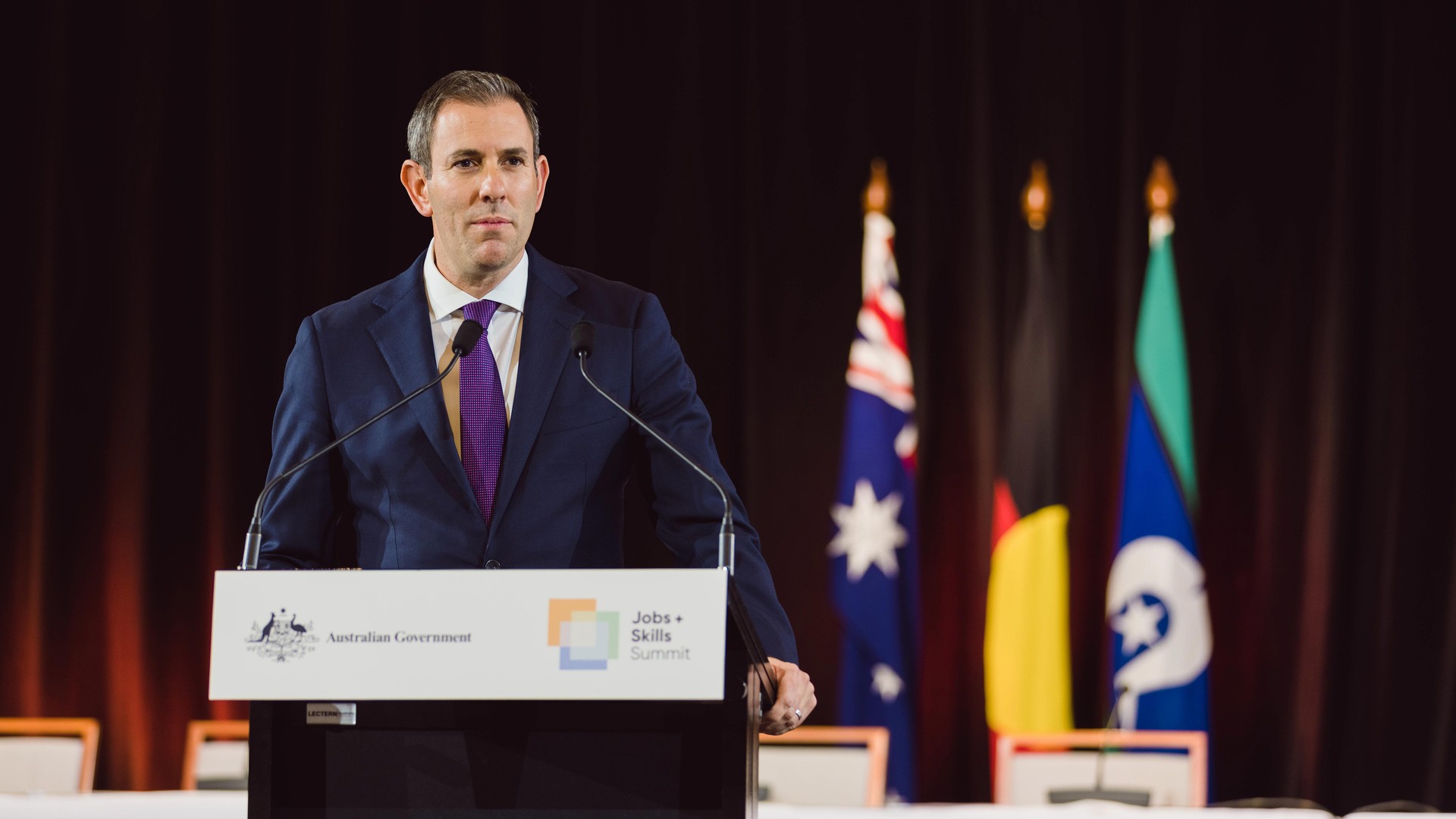
Treasurer Jim Chalmers has retreated for a third time in four months on his 30% minimum tax on family trusts, unveiling on 3 September 2026 a fixed-distribution election that lets existing trusts avoid the tax without restructuring into a company — but the election carries a 47% penalty tax the first time a locked-in trust ever varies a beneficiary’s share, according to Treasury’s own exposure draft legislation and explanatory memorandum, reported by One News Australia and independently corroborated by Accountants Daily and the Australian Financial Review. The retreat resolves one problem — the cost of the restructuring path Chalmers originally demanded — but not the one underneath it: whether family trusts and the businesses inside them can actually avoid state stamp duty at all, a question a state treasurer and two tax lawyers are now openly disputing.
The two threads are connected but distinct, and this analysis keeps them separate rather than treating “Chalmers backed down” as the end of the story. One thread is what the new election actually locks a family into, and what it costs them if they get it wrong. The other is whether the thing the election was built to avoid — a state stamp duty bill — is actually avoided, a claim Treasury makes in its own fact sheet and that Queensland’s state treasurer and two named tax lawyers say has not been established.
Three retreats, and the mechanism that forced the third one
The original policy, announced in the May 2026 budget, told the trustees of some 350,000 active small businesses run through a discretionary trust to pay a new 30% minimum tax on trust income from 1 July 2028, or restructure the business into a company instead — a figure confirmed independently by both the Australian Financial Review and One News Australia, both citing the same Budget 2026-27 factsheet. The tax targeted a real mechanism: discretionary trusts let a trustee split business income across family members on lower individual marginal rates, and Treasury said that without a partial concession already built into the May proposal, “bucket companies” used to cap tax on retained trust profit would otherwise have faced effective tax rates of up to 70%, as reported by the Financial Review’s John Kehoe. Two retreats followed the initial backlash — trusts set up under a will were exempted in June (a concession the government put at $475 million over four years), and a proposed “widow tax” inside the same package was abandoned in August, per One News Australia’s timeline of the government’s own media releases and budget documents.
The third retreat, on 3 September, happened because the first plan ran into a fact Treasury had not addressed in its own consultation process: moving a business out of a trust and into a company is legally a transfer of ownership, and every Australian state and territory charges stamp duty on that transfer. CPA Australia’s tax lead, Jenny Wong, pointed out on 8 July that the government’s original 17-page consultation paper, which asked 17 questions, did not mention state stamp duty once — an observation confirmed independently in both One News Australia’s and Accountants Daily’s separate reporting of the same 8 July remark. Accounting and business-lobby submissions to Treasury put the price of restructuring at $10,000–$50,000 in professional fees per business before any stamp duty (CPA Australia and the Council of Small Business Organisations Australia, or COSBOA, in their respective Treasury submissions), plus state duty of up to 5.5%–5.7% of the value of the assets transferred, depending on which of two industry estimates — the Australian Chamber of Commerce and Industry’s or accounting firm RSM’s — is used. Treasury’s own explanatory memorandum, in paragraphs 1.3 and 1.4, states plainly that the fixed-distribution election was added specifically “reflecting feedback from this consultation” so trusts could “limit the costs that would otherwise be associated with restructuring, including those that are not direct Commonwealth income tax consequences such as state and territory stamp duties” — Treasury conceding, in its own document, that the plan it originally proposed would have landed families with a state tax bill it had not accounted for.
The escape hatch’s own trap
The fixed-distribution election was not imposed on industry — COSBOA proposed it after opposing the tax outright, and CPA Australia’s Wong has called the resulting option a “genuine improvement” that lets businesses avoid the minimum tax without restructuring into a new entity, a characterisation reported independently by Accountants Daily. But the mechanics of the election are unforgiving. Under the exposure draft, a discretionary trust that exists on 1 July 2028 gets exactly one chance, in the 2028-29 tax year, to name every beneficiary and fix the percentage of both income and capital each one receives for as long as the trust exists — a split that must add to 100% and, per explanatory memorandum paragraph 1.8, can only later be changed if a named beneficiary dies or if two named beneficiaries’ relationship breaks down. A grandchild born after the election is made cannot be added to it; a beneficiary whose personal circumstances change — a spouse returning to paid work, a child moving from student to earner — keeps the exact percentage fixed at the outset, with no mechanism to shift it to a family member who needs it more, a restriction independently flagged by Master Builders Australia in comments reported by the Financial Review.
If a locked-in trust ever pays a different split than the one it elected — even once — the consequence, per the explanatory memorandum’s own wording, is that the trustee “is liable to pay income tax on all of the net income of the trust for that income year at the top marginal tax rate plus Medicare levy,” a combined 47% (the 45% top personal rate plus the 2% Medicare levy) applied to the entire year’s trust income, not just the varied portion — and the trust permanently loses access to the election, reverting to the 30% minimum tax for good. COSBOA chief executive Skye Cappuccio has called the penalty “unnecessarily punitive” and said it “does not reflect the realities of family businesses, which can change and evolve over time” — a quote that appears, word for word, in both One News Australia’s and Accountants Daily’s independent reporting, confirming it as an authentic on-record statement rather than a single outlet’s paraphrase. The draft also creates a hard cutoff: only trusts that already exist on 1 July 2028 can use the election at all: a family setting up a trust on 2 July 2028 has no lock-in option and pays the 30% minimum tax from day one.
The stamp-duty question Treasury says is settled — and isn’t
Treasury’s own fact sheet states that the fixed-distribution election “would not require a restructure and is not expected to result in state and territory stamp duties” — the government’s stated position, and a real one, not just spin: it is the specific fix industry groups asked for. But Queensland Treasurer David Janetzki has publicly called on Chalmers to explain how the federal change interacts with Queensland’s own tax law, saying “Jim Chalmers’ budget decisions have left a mess and Queensland taxpayers should not have to clean up after him,” while Queensland’s Treasury and Revenue Office independently reviews the exposure draft, according to the Financial Review’s reporting. Sydney tax lawyer Joanne Seve told the same outlet that New South Wales transfer-duty law applies to any “change in beneficial ownership of dutiable property,” and cited a 2024 NSW Civil and Administrative Tribunal ruling, Baxter v Chief Commissioner of State Revenue, which held that varying a trust deed to make a single beneficiary presently entitled to all income and capital counted as a change in beneficial ownership that triggered transfer duty on the underlying land — meaning the act of making the election itself, not just a full restructure, could arguably be dutiable under existing state case law. An anonymous Melbourne-based lawyer made the equivalent point about Victoria’s own beneficial-ownership provisions in the same report.
Even where the dispute is not live, the gap Treasury’s fix does not close is openly conceded: for businesses that do choose to restructure fully out of a trust into a company — still the only alternative to the 30% minimum tax or the locked-in election — CPA Australia’s Wong states plainly that “the Commonwealth can only relieve Commonwealth taxes. The stamp duty barrier to restructuring still remains,” and has called on the government to make restructuring-related stamp duty tax-deductible as a practical fix, a position reported independently by Accountants Daily. That gap sits against a backdrop in which the states most exposed to this fight have their own reasons to hold the line on stamp duty: NSW and Victoria draw roughly a third of their own-source revenue from property-related taxes, and NSW’s residential stamp duty collections fell 20% year-on-year in July 2026 alone, part of a broader property-market slowdown the state had already used to write down its own stamp duty revenue forecast by $5.4 billion over four years, according to the Financial Review’s separate reporting on state finances. None of this is a claim about the trust-tax dispute directly — it is context for why state governments have limited room to concede stamp-duty ground quickly, even where Treasury says the federal fix has already solved the problem.
Zagdim’s View — The detail worth holding onto is not that Chalmers backed down again — that has now happened three times in four months — but that the backdown converts one clear, if expensive, choice (pay 30% or restructure and pay stamp duty) into a second, less visible one: lock in a beneficiary split for the life of the trust, or risk a 47% tax on an entire year’s income if family circumstances ever require the split to change. Both the size of that penalty and the state stamp-duty question the election was built to sidestep remain open — the exposure draft is still in public comment until 18 September 2026, has not been introduced to Parliament, and the parliamentary opposition has said it will not support the trust measures at all. For anyone whose family business or investment property sits inside a discretionary trust, the fact that the federal fight over the headline 30% rate has quieted down does not mean the structuring question underneath it — what a fixed election actually locks in, and whether it is as stamp-duty-clean as Treasury says — has been answered yet.
References
One News Australia – Jim Chalmers backs down on trust tax again, then leaves family firms facing a 47% penalty trap / Accountants Daily – Trust tax overhaul doesn’t solve stamp duty issue / Australian Financial Review – Trusts might not escape stamp duty hit / Australian Financial Review – Stamp duty revenue plunges as property slump deepens