

This article is for readers who live in the UK, have bank accounts, rental property, shares or fund income outside the UK, and have received, or are worried about receiving, a letter from HM Revenue & Customs (HMRC).
Every year HMRC writes to people who may not have declared all their foreign income, using financial account data exchanged with other jurisdictions. These are often called “nudge letters”. HMRC’s 2024–25 annual report says it received Common Reporting Standard (CRS) information on more than 10 million financial accounts from 106 jurisdictions, and sent 20,000 letters that year to people who may not have declared all their foreign income. HMRC’s guidance is to check your tax affairs first, and to use the Worldwide Disclosure Facility (WDF) only if you find you need to make a disclosure.
Zagdim interviewed James Clerkin, Tax Partner at MGI Midgley Snelling, a UK accountancy firm. His view: whether a disclosure is needed turns on which basis of taxation the person adopted for their overseas income and capital gains, and whether any taxable remittances were made to the UK.
Key points
- A letter is not a tax bill: HMRC’s guidance is to check first, and use the WDF only if a disclosure turns out to be needed.
- The basis of taxation is the key: James Clerkin says this, together with any taxable remittances, determines whether a disclosure is necessary.
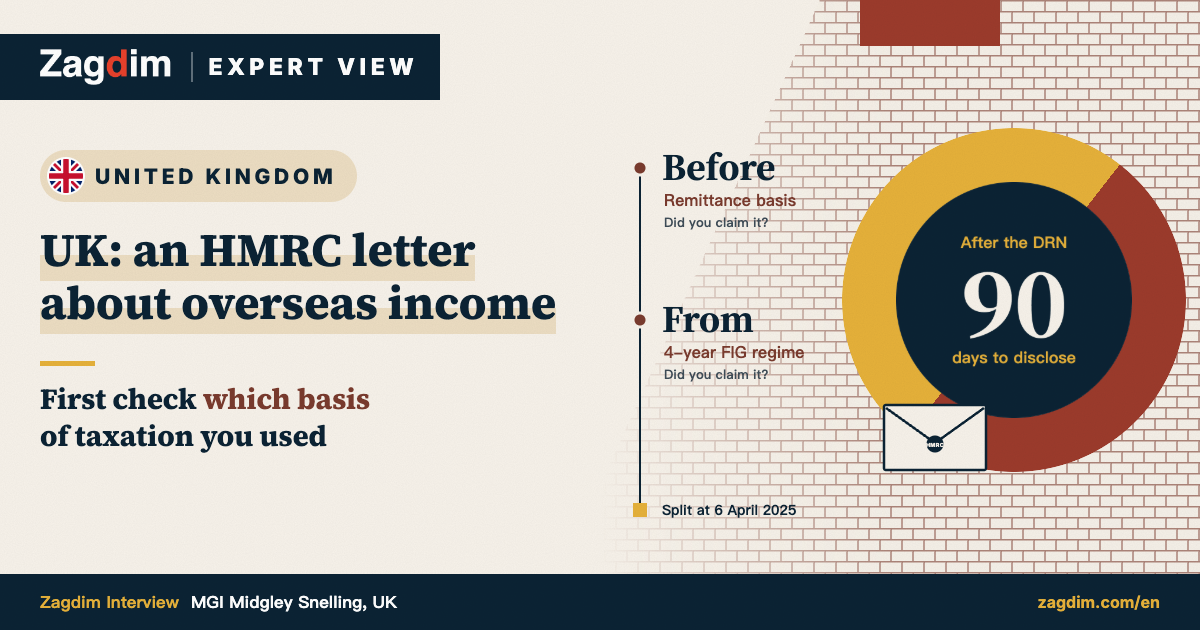
- Split the years at 6 April 2025: before that date, check whether you claimed the remittance basis; from that date, check whether you claimed the 4-year foreign income and gains (FIG) regime. Both must be claimed; neither applies automatically.
- His experience: in most of the cases his firm deals with, a disclosure turns out not to be necessary, but the reasons are explained to HMRC every time.
- If a disclosure is needed: watch two dates, the initial notification and the 90 days after receiving a Disclosure Reference Number (DRN).
1. What is this letter?
HMRC receives financial account data from institutions in other jurisdictions under the CRS and compares it with what taxpayers have declared. CRS covers financial accounts. Property you own directly overseas is not itself reported, but the bank account your rent is paid into can be.
The 20,000 figure is for the 2024–25 year; HMRC has not published a breakdown of who received letters by place or nationality. Letters also differ: some are reminders, others ask for a reply or a signed declaration. Read what your letter asks you to do and by when.
2. The key question: which basis of taxation did you use?
What the rules say. The UK tax year runs from 6 April to 5 April. According to GOV.UK, before 6 April 2025 a UK resident whose domicile was outside the UK could claim the remittance basis and pay UK tax only on foreign income and gains brought to the UK. Those who claimed lost their Income Tax and Capital Gains Tax allowances, and after a number of years of residence also paid an annual charge. If unremitted foreign income and gains were less than £2,000 in the tax year and were not brought into the UK, nothing further needed to be reported. From 6 April 2017, people who had been UK resident for at least 15 of the previous 20 tax years were taxed on their worldwide income and could no longer use the remittance basis.
From 6 April 2025, the 4-year FIG regime replaced the remittance basis. GOV.UK says that if you claim under the regime, you will not pay UK tax on eligible foreign income and gains. You qualify if you are UK tax resident under the statutory residence test (SRT) and still within your first 4 years as a UK tax resident following at least 10 years as a non-UK tax resident. Claiming also means losing your allowances. If your first 4 years started before 6 April 2025, you can only use the years that remain.
What the expert says. James Clerkin notes that before 6 April 2025, UK-resident non-domiciled individuals could claim the remittance basis for up to 15 tax years. He describes this as more generous than the new 4-year FIG regime, which he says is very good for as long as it lasts but is very short. He also notes that from 6 April 2025, a taxpayer who adopts the FIG regime can remit overseas income and capital gains tax-free in the first 4 UK-resident tax years.
In his view, whether a nudge letter relates to the old remittance basis or the new FIG regime, the key issue is whether the taxpayer chose to adopt one of them for their overseas income and gains, as this often means their tax affairs are up to date.
“…the key issue is determining the basis of taxation the individual concerned has adopted for their overseas income and capital gains and whether any taxable remittances have been made to the UK, as this determines whether a disclosure is necessary. In most of the cases we deal with, a disclosure turns out not to be necessary and in all cases, we explain the reasons why to HMRC on behalf of our clients.”
What this means for readers. In Zagdim’s reading, “no disclosure needed” depends on conditions. It is likely only where the person actually claimed the remittance basis or the 4-year FIG regime (or met the £2,000 exception) and made no taxable remittances. If you have never claimed either and have foreign rent, interest or dividends, that income is in principle reported in the normal way. Not having moved the money to the UK does not by itself mean there is nothing to deal with.
3. No disclosure needed? You still reply and explain
In James Clerkin’s experience, a reply to a nudge letter can cite a remittance basis claim or the FIG regime as the reason why the overseas income and gains are not taxable in the UK, and so why no disclosure is needed. This usually closes the matter, and HMRC raises no further queries.
He also stresses that his firm explains the reasons to HMRC on clients’ behalf even when no disclosure is needed. In Zagdim’s reading, the worst response to a letter is no response: even if the answer is that nothing is owed, reply by the deadline on the letter and keep the records that support that answer.
Before replying, work through these questions for each tax year:
- Was I UK tax resident that year?
- Where was my domicile that year?
- Did I file a tax return, and did I claim the remittance basis or, from 6 April 2025, the 4-year FIG regime?
- What foreign income or gains did I have (rent, interest, dividends, sales of assets), and how much?
- Did I bring money from abroad into the UK? Was it capital, or income or gains?
4. If a disclosure is needed: two dates
What the expert says. James Clerkin describes the two dates that matter if a disclosure is needed: “Where a disclosure is needed, there are two main time frames for taxpayers to bear in mind. The first is the initial notification of the intention to make a disclosure which HMRC usually request within 30 days of their nudge letter. The second is the full disclosure submission to HMRC, together with any tax, interest and penalties due, which are due within 90 days of receiving a Disclosure Reference Number (DRN) from HMRC.”
What the rules say. HMRC’s WDF guidance on GOV.UK sets out:
- Notification: tell HMRC you intend to make a disclosure through the Digital Disclosure Service, and HMRC gives you a DRN.
- 90 days: once you have notified HMRC, you have 90 days to gather information, calculate the tax, interest and penalties, and make the disclosure.
- Complex cases: you can ask for 90 extra days, up to 180 days in total. This has to be requested; it is not automatic.
- Payment: the full amount is due when you submit. If you cannot pay at once, agree payment arrangements with HMRC before submitting.
Zagdim note: the WDF guidance itself does not set a 30-day deadline after a letter. James Clerkin confirmed that this is what is usually seen in practice in the letters he deals with, not a general statutory rule. Follow the deadline on your own letter.
5. What readers can do now
- When a letter arrives, note the reply deadline. Do not ignore it because the money never came to the UK.
- Split the tax years in the letter at 6 April 2025 and answer the five questions in section 3 for each year.
- Find your tax returns for those years and check whether you claimed the remittance basis or the 4-year FIG regime.
- If you have never claimed either and have foreign income, ask a UK tax professional to review each year before deciding whether to notify HMRC.
To work out whose name your income, accounts and property are really in, and how long a disclosure realistically takes, see Zagdim’s companion interview: HMRC Letter About Overseas Income? First Establish Whose Income It Is, Says a Tax Disputes Partner.
If you live in the UK, have income or assets elsewhere and are unsure how to handle a letter, you can tell the Zagdim reader desk about your situation. The reader desk will understand your needs and shortlist suitable professionals.
Glossary
- Nudge letter: a letter HMRC sends, based on exchanged data, to people who may not have declared all their foreign income, asking them to check their tax affairs.
- Remittance basis: the basis of taxation available before 6 April 2025 to UK residents not domiciled in the UK, under which only foreign income and gains brought to the UK were taxed.
- 4-year FIG regime: replaced the remittance basis from 6 April 2025. Qualifying people who claim in their first 4 UK-resident tax years do not pay UK tax on eligible foreign income and gains.
- Worldwide Disclosure Facility (WDF): HMRC’s route for voluntarily disclosing tax owed in connection with offshore matters.
- Disclosure Reference Number (DRN): the number HMRC issues after you notify it that you intend to make a disclosure.
About this article
Facts were checked on 20 November 2026. Official rules are based on HMRC’s WDF guidance on GOV.UK (updated 6 April 2026), its guidance on the 4-year FIG regime, GOV.UK’s pages on foreign income for non-domiciled residents and on remittance basis changes, and HMRC’s 2024–25 annual report. The question list in section 3 and the “what this means for readers” passages are Zagdim’s own summary and reading, not the expert’s words.
The expert’s views come from Zagdim’s interview with James Clerkin (written reply of 2 November 2026). Quotes and paraphrases were confirmed by him before publication. This article is not individual tax advice. Whether you need to make a disclosure, and how many years it covers, depends on your residence history, income and past returns. Check HMRC’s latest guidance and consult a qualified UK tax professional.
Experts interviewed
James Clerkin|Tax Partner, MGI Midgley Snelling
References
GOV.UK, “Make a disclosure using the Worldwide Disclosure Facility” (HMRC) / GOV.UK, “Check if you can claim the 4-year foreign income and gains regime” (HMRC) / GOV.UK, “Tax on foreign income: Non-domiciled residents” / GOV.UK, “Remittance basis changes” (HMRC) / HMRC, “HMRC annual report and accounts 2024 to 2025”