

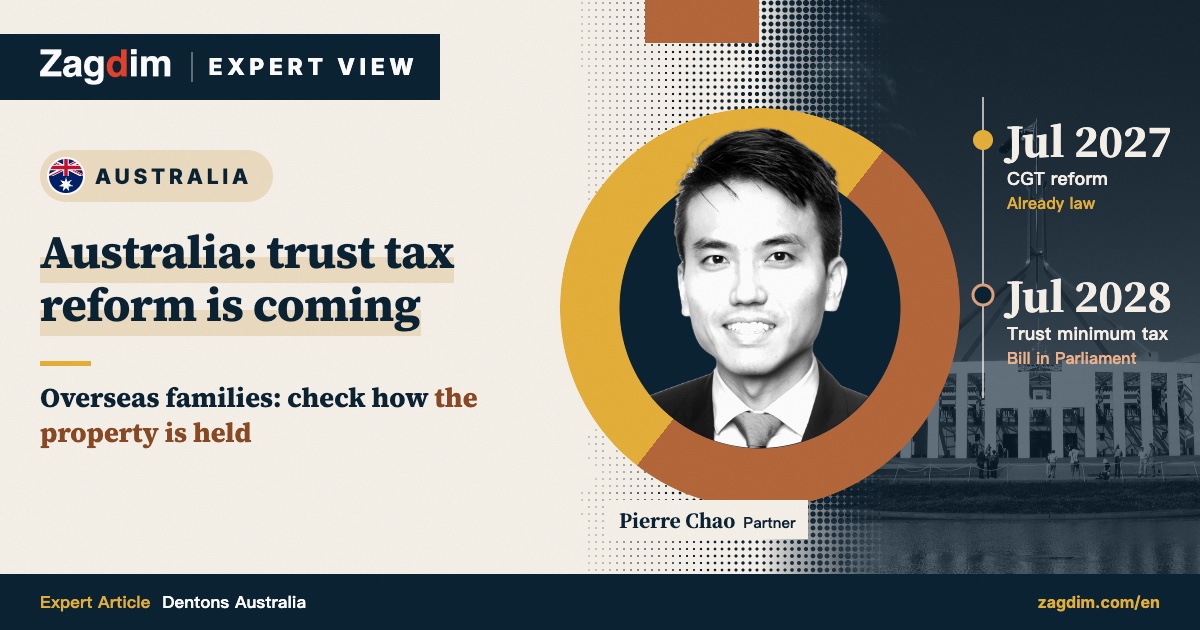
By Pierre Chao 趙哲寧, Partner, Dentons Australia | Edited by the Zagdim Editorial Team
Editor’s introduction Australia’s capital gains tax (CGT) reforms are already law and apply from 1 July 2027. A bill for a 30% minimum tax on discretionary trusts passed the House of Representatives on 29 October 2026 and is now before a Senate committee; it is proposed to apply from 1 July 2028. For families who hold Australian property through a trust while beneficiaries or trustees live overseas, these two reforms need to be read together with FIRB approval and state foreign-owner surcharges. Below is an analysis written for Zagdim readers by Pierre Chao, Partner at Dentons Australia. The author wrote both the English and Chinese versions.
Where the two reforms stand (compiled by Zagdim, as at 10 November 2026)
| Item | Current status | Timing |
|---|---|---|
| CGT reform: the 50% discount replaced by indexation of the cost base, plus a 30% minimum tax on real gains | Law: Treasury Laws Amendment (Tax Reform No. 1) Act 2026, assented to 26 June 2026 | Applies from 1 July 2027; gains accrued before then follow the old rules |
| 30% minimum tax on discretionary trusts | Bill before Parliament: Treasury Laws Amendment (Tax Reform No. 3) Bill 2026 passed the House on 29 October; the Senate Economics Legislation Committee reported on 13 November; introduced in the Senate and second reading moved on 16 November (Parliament of Australia website, as of 22 November 2026) | Proposed to apply from 1 July 2028 |
| Restructure roll-over relief | Part of the same bill | Proposed for three years from 1 July 2027 |
| Excluded election trust (fixed distributions to nominated beneficiaries, outside the minimum tax) | Part of the same bill | Under the draft, a one-off election made in the 2028–29 income year |
| Breach of FIRB approval conditions | Two Federal Court civil penalties in September 2026: two investors who failed to comply with residential development conditions attached to their foreign investment approvals were ordered to pay A$370,000 and A$508,000; the ATO’s 29 September announcement notes the A$508,000 matter is subject to appeal by the investor | September 2026 |
For many families in Hong Kong, Taiwan and Singapore, as well as Chinese families living elsewhere overseas, discretionary trusts have long been a preferred vehicle for holding Australian homes and investment properties across borders. They can help protect assets and make it easier to pass them to the next generation. But as a series of Australian tax reforms takes shape, these longstanding arrangements are coming under scrutiny. Where are families most likely to go wrong, and what should they start preparing for now?
When Beneficiaries Live Overseas, Where Do Problems Arise?
Many families assume that, as long as the trustee is an Australian resident and the trust has only ever made distributions to Australian residents, their structure has nothing to do with “foreign person” status. This is perhaps the biggest misconception underlying the issue. FIRB and the state revenue authorities approach the question under different rules. Families often address one side and assume that they have dealt with both.
Starting with state stamp duty and land tax surcharges. This is where families can find themselves paying tax unnecessarily or, conversely, facing audit assessments for amounts they should have paid. The three main States apply different tests, and that is the first common source of error. In New South Wales, a discretionary trust generally needs to satisfy two requirements to avoid foreign surcharges: no potential beneficiary may be a foreign person, and the trust deed must not permit amendments that would allow a foreign person to become a potential beneficiary. Both requirements matter, subject to the applicable transitional provisions. Many families check only that no foreign person appears on the beneficiary list. They overlook whether the deed leaves room for foreign beneficiaries to be admitted later. It is this second requirement that is most easily missed.
Victoria previously applied a practical approach to certain discretionary trusts whose foreign beneficiaries had never received, and were not expected to receive, distributions. That approach ceased to apply to new transactions from 1 March 2020, subject to transitional arrangements. An assessment based on the pre-2020 approach may therefore no longer be reliable. This is the second common source of error: making decisions under an administrative approach that no longer applies to the transaction.
Queensland takes a different approach again. For additional foreign acquirer duty, the question is whether foreign interests account for at least 50% of the relevant trust interests. In a discretionary trust, the interests of the takers in default are central to that assessment. This differs from the concern in New South Wales and Victoria that a broad beneficiary class may bring foreign beneficiaries within the applicable rules. The third common mistake is to mix these tests together. Families may assume that amending a deed for a New South Wales property also resolves the position in Victoria or Queensland, or apply the same reasoning to properties held across several states.
FIRB involves a separate question. Its concern is not simply how much tax is payable, but whether the transaction itself may proceed.
Under the Foreign Acquisitions and Takeovers Act 1975 (Cth), a trustee may be treated as a foreign person because of interests attributed to foreign beneficiaries. For a discretionary trust, the assessment looks to the maximum entitlement a beneficiary could receive under the deed, not simply whether that person has ever received a distribution. Living overseas does not, by itself, settle every aspect of the statutory test. Nevertheless, an overseas beneficiary can be relevant even where the trust has never distributed anything to them. Family trust deeds often define beneficiaries widely to preserve flexibility, extending to spouses, extended family members and future generations. That drafting practice is a common source of problems.
Beyond the status question, the transaction process itself can create significant risk. The ordinary statutory decision period is 30 days, but extensions and requests for further information can lengthen the process. Families should not assume that approval will arrive in time merely because settlement is approaching. If the parties fail to allow for the approval process in the contract, they may face pressure to complete before approval has been obtained. Proceeding in breach can expose the investor to civil or criminal consequences and potential disposal orders. Any required approval and contractual conditions should therefore be addressed before the purchaser becomes unconditionally committed.
Another common mistake is to assume that obtaining approval ends the compliance process and to overlook the continuing conditions attached to it. In September 2026, the Federal Court dealt with two such cases: two investors who failed to comply with residential development conditions attached to their foreign investment approvals were ordered to pay A$370,000 and A$508,000 respectively. In the latter case, residential construction was not completed within the required four years. These cases show that FIRB approval conditions are ongoing obligations, not paperwork to be filed away after the purchase, and they must continue to be met even when the investor lives overseas. The ATO’s announcement of 29 September noted that the latter matter was subject to appeal by the investor.
A third common mistake is to overlook changes in status over time. Temporary visa holders may remain foreign persons, and visa expiry or a change in residency status may require the position to be reassessed. Depending on the approval and circumstances, further action, including a sale, may be required. Without periodic reviews, a family may discover years later that it has failed to comply with the conditions originally attached to the investment.
Will the July 2027 CGT Rules Change When Families Should Sell?
Possibly, but there is no answer that applies to everyone. The more important issue is often not the CGT reform alone, but its interaction with the proposed minimum tax on discretionary trusts.
First, the CGT reform has already been enacted. It is not simply a proposal still under discussion. Broadly, for affected gains from 1 July 2027, the general 50% discount is replaced by cost-base indexation, together with a 30% minimum-tax mechanism for relevant gains, subject to the applicable exceptions and residency rules. The minimum tax is not an additional 30% imposed on top of the ordinary tax liability. Gains accrued before 1 July 2027 retain their treatment under the transitional rules, including any discount for which the taxpayer is eligible. Families should therefore begin assembling complete cost records and preparing for any valuation required at the relevant transition date.
There is another easily overlooked point. Assets acquired before 20 September 1985, commonly called “pre-CGT assets”, have generally been outside the CGT regime. Under the new rules, affected assets may become subject to CGT on growth after 1 July 2027, while earlier growth remains protected. For properties held in a family trust over many years, perhaps since the previous generation, this introduces a new consideration.
Whether these changes should affect the sale date depends on the individual asset. A property’s historic growth, future growth prospects, acquisition cost, transition value and holding period all matter, as do the taxpayer’s residency and entitlement to discounts. Substantial historic growth does not, by itself, establish that selling before July 2027 is better, because the transitional rules must also be taken into account. For a more recently acquired property with limited growth, the comparison may be different again. There is no sound basis for telling every family to sell before a particular date.
The proposed 30% minimum tax on discretionary trusts needs to be included in the same calculation. If enacted, it is proposed to apply from income years commencing on or after 1 July 2028. The legislation is currently under parliamentary consideration, including Senate committee scrutiny. Its basic approach is to impose a minimum liability at trustee level. Ordinary discretionary family trusts would generally fall within its scope unless an exclusion applies, such as the exclusions for fixed trusts, special disability trusts and deceased estates. Where the relevant existing tax liability is below 30%, the minimum-tax rules would require a top-up.
Non-corporate beneficiaries would receive non-refundable offsets for relevant tax payable by the trustee. Corporate beneficiaries, including the companies commonly called “bucket companies”, would not receive that particular offset. This creates the potential for tax at both trust and company level and calls into question the results of established corporate-beneficiary strategies. It does not mean that every arrangement necessarily produces the same double-tax outcome or that every use of a corporate beneficiary becomes unviable.
Taken together, the reforms mean that families may need to reconsider planning methods they have used for years. For example, a family intending to sell after July 2028 and distribute the gain in its usual way should start comparing the alternatives. What would the overall result be if the property were sold before the trust minimum tax begins? What would change if the sale took place afterwards? The calculation must account for how the CGT rules, trustee liabilities and beneficiary offsets interact, rather than simply adding two 30% taxes together. That interaction is an important part of assessing when to sell.
Should Families Review Their Trust Arrangements Before the Minimum Tax Bill Passes?
Yes, and the review should begin now rather than waiting for the legislation to pass.
The reason is straightforward. Reviewing a trust deed and making any necessary amendments takes time. Some changes also require a legal assessment of whether the existing trust continues or a new trust is created. Beginning early leaves more time to consider those questions properly.
The proposed legislation provides two possible pathways. One is a three-year restructuring roll-over, running from 1 July 2027 to 30 June 2030. The other is an “excluded election trust” regime, under which an eligible trust would nominate beneficiaries and distribution proportions for tax purposes. The election is subject to a specific election window, ongoing requirements and consequences if it is revoked or distributions depart from the nomination. Both pathways can involve long-term decisions and a loss of flexibility. Comparing them now is preferable to making a rushed decision once the legislation is settled.
Where should families start?
- Establish the trust’s current foreign-person status. Review its position under FIRB and the relevant state rules. Check whether any continuing approval condition has already been breached or is approaching its deadline.
- Review the beneficiary provisions. Consider whether the deed satisfies the current requirements in each relevant state, including the two New South Wales requirements discussed above.
- Estimate the minimum tax’s effect on existing arrangements. If the trust would fall within the proposed regime, model how much additional tax could arise under its current distribution strategy, including distributions to a corporate beneficiary. Compare the restructuring roll-over and election against the family’s assets and circumstances.
- Prepare for the CGT transition valuation. Regardless of the final form of the trust minimum tax, the CGT reform has already been enacted. Families should prepare the records and valuation evidence needed for the July 2027 transition.
- Monitor the legislation’s progress. The trust minimum tax remains under parliamentary consideration, and its details may still change.
What Do Chinese and Asian Families Most Often Misunderstand About Holding Australian Property Through a Trust?
Beyond the technical details, the most fundamental misconception is that a trust is a tax- and legally neutral vehicle that can be established once and then left alone. Families may not appreciate that the defining feature of a discretionary trust, the trustee’s discretion over who benefits, is also central to many of the issues discussed above.
When establishing a trust, families often focus on asset protection and succession. They deliberately define the beneficiaries broadly, including spouses, extended relatives and future generations, to preserve flexibility. What they may not recognise is that this same breadth can affect the trust’s treatment under FIRB and state surcharge rules. It can give rise to approval requirements and tax liabilities that the family assumed had nothing to do with its structure.
The second misconception is that amending the deed is simply an administrative exercise: change the beneficiary list and the job is done. In reality, some changes may have consequences for trust continuity, beneficial ownership, stamp duty or CGT. A deed amendment should therefore be approached as substantive legal work, not merely a document update. Not every amendment creates a new trust or triggers tax, but its consequences need to be assessed before it is made. An amendment based on an old precedent may also fail to satisfy current requirements, including requirements for irrevocable foreign-beneficiary exclusions. The exemption the family believes it has secured may therefore not exist.
The third misconception arises where the trust holds assets other than Australian real estate. Families may assume that a foreign-resident beneficiary receives the same CGT exemption that might have applied had the beneficiary held the asset directly. However, the treatment of a capital gain attributed through an Australian-resident discretionary trust is not necessarily the same as direct ownership. The case law and ATO’s published position distinguish gains attributed through resident non-fixed trusts from the exemptions available in other circumstances. This can become a significant issue in tax due diligence or a dispute.
The fourth misconception concerns the cross-border position. Families should not assume that the Australian and home-jurisdiction tax systems operate independently, or that tax paid by an Australian trustee will automatically be credited against a family member’s overseas liability. Whether China will recognise tax already paid at the Australian trust level as a credit, for example, does not yet have a clear answer. For Chinese tax-resident family members, questions concerning the treatment of offshore trusts and foreign tax credits require advice on both sides. Those questions should form part of the decision whether to retain the existing trust structure, rather than being left to assumptions about how the two systems interact.
Experts interviewed


About this article
The author wrote this article in Chinese (submitted on 2 November 2026, revised on 11 and 20 November) and wrote this English version himself (11 November 2026); where the two versions differ, the English version prevails. Zagdim’s editors added the introduction, table and sources; the full text was reviewed by the author before publication. The table draws on the official sources below, read on 26 October and 10 November 2026. This article sets out the author’s general views, not advice on any individual case, and is not legal or tax advice. The trust minimum tax is still a bill before Parliament, and its final form depends on the legislation as passed; please consult a qualified professional about your own situation.
References
Parliament of Australia, Treasury Laws Amendment (Tax Reform No. 3) Bill 2026 (bill progress) / Parliament of Australia, Income Tax Rates Amendment (Minimum Tax on Discretionary Trusts) Bill 2026 (bill progress) / Federal Register of Legislation, Treasury Laws Amendment (Tax Reform No. 1) Act 2026 / Australian Taxation Office, Capital gains tax reform / Treasurer’s media release, 14 October 2026 (introduction of the trust minimum tax bills) / Budget 2026–27, Minimum tax on discretionary trusts explainer / Australian Taxation Office, ATO secures second civil penalty against residential land bankers (29 September 2026) / Foreign Investment Review Board, Guidance Note 2: Key concepts