

This article is for readers who live outside Japan and own, or are thinking of buying, property in Japan, especially those who may sell one day.
On 17 November 2026, the Asahi Shimbun reported, as relayed the same day by TV Asahi’s ANN network, that the Liberal Democratic Party’s tax commission is considering adding about 10 percentage points to the tax rate on gains from selling a newly built condominium within one year of purchase. Today, gains on property held for five years or less are taxed at about 40%. Jiji Press reported the same day that the government and ruling parties are considering a 52% rate for individuals who sell within one year. All of this is under discussion. The rate, scope and start date will not be settled until the FY2027 tax reform outline at the end of the year.
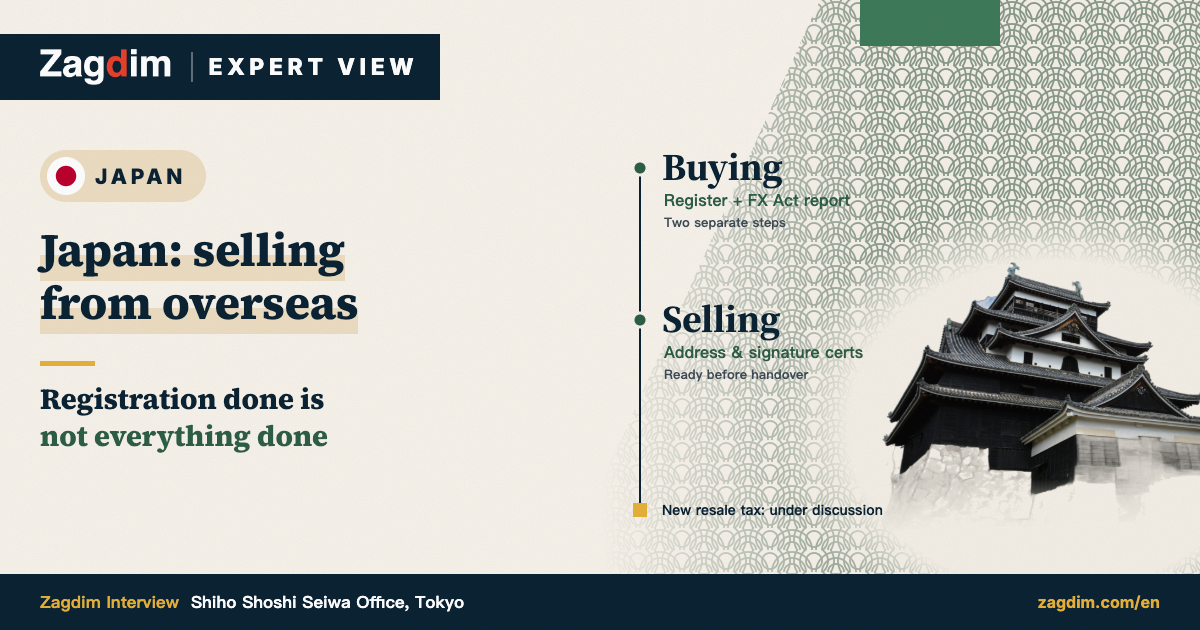
Whatever the final rate, selling will not get any simpler on the paperwork side. Zagdim interviewed Emi Suehiro, Representative and judicial scrivener (shiho shoshi) at Shiho Shoshi & Gyosei Shoshi Seiwa Office, about the practical side of selling Japanese property from overseas. Her message: completing ownership registration does not mean every legal procedure connected with the purchase is done, and preparing for a future sale starts at the time of purchase. She comments only on registration and procedures, not on tax. The tax section of this article is Zagdim’s own summary, set out separately in section 5.
Key points
- The new tax is not decided: the reported proposal would tax one-year resales of new condominiums more heavily, but no official rate or start date has been published.
- Registration is not the last step: Emi Suehiro notes that the real estate acquisition report under the Foreign Exchange Act is a separate procedure from ownership registration. From 1 April 2026, non-residents who acquire Japanese property for their own residence and similar uses must also report within 20 days.
- Sales often stall on documents: whether your name and overseas address match the register, and whether you can provide suitable proof of address, signature certificates and translations, all affect the handover and registration timeline.
- Moving or changing your name means updating the register: from 1 April 2026, registering a change of address or name is mandatory, in principle within two years of the change.
- No one-size-fits-all ownership: sole, joint, personal or corporate ownership should be weighed against who paid, a future sale, inheritance and management.
1. Registration done does not mean everything is done
What the rules say. Japan’s Ministry of Finance announced amended rules on 20 February 2026. From 1 April 2026, acquisitions by non-residents of Japanese property for residential use, non-profit business use or office use are also subject to after-the-fact reporting under the Foreign Exchange and Foreign Trade Act. According to the ministry, a non-resident who acquires Japanese property or related rights must submit a report to the Minister of Finance through the Bank of Japan within 20 days of acquisition. The report can be filed by the non-resident or by a resident agent such as a real estate agent.
What the expert says. Emi Suehiro sees this as the point overseas buyers most need to understand:
“One concept that needs to be clarified is this: completing ownership registration does not mean that all the legal procedures related to acquiring the property have been completed.”
She uses the Foreign Exchange Act as an example. Whether someone is a “non-resident” under that Act cannot be judged by nationality alone. From 1 April 2026, the scope of the reporting system has widened, so non-residents who acquire Japanese property for their own residence and similar uses must also report after the acquisition. Those who are required to report must, in principle, file through the Bank of Japan to the Minister of Finance within 20 days. She advises: “This report is a separate procedure from ownership registration. It is best to confirm at the time of purchase whether it applies and who will be responsible for filing it, so that it is not missed after the handover.”
What this means for readers. When you buy, ask not only who will handle the registration, but also whether you count as a non-resident under the Foreign Exchange Act, whether a report is required, and who will file it within 20 days.
2. Where sales get stuck: names, addresses and certificates
What the rules say. Japan’s Ministry of Justice explains that from 1 April 2024, when a foreign national living abroad becomes the registered owner, proof of address must be either an address certificate issued by the government of their home country or country of residence, or a sworn affidavit certified by a notary in that country together with a copy of their passport. Documents in a foreign language need a translation.
What the expert says. Emi Suehiro points out that for overseas owners selling Japanese property, preparation is often about more than signing the sale contract. Whether the seller’s current name and overseas address match the register, whether suitable proof of address, signature certificates and translations can be provided, and how identity and the intention to sell are confirmed, can all affect the handover and registration timeline.
She stresses: “Systems for issuing documents differ from place to place, and not every notarised document can be used directly for registration in Japan. Before fixing the handover date, it is therefore best to have the judicial scrivener handling the case confirm the content of the documents and how to obtain them, and to allow time for issuing them overseas, sending them, and making any necessary corrections.”
What this means for readers. When you decide to sell, ask the judicial scrivener handling the sale to list the documents needed, check how and how quickly you can obtain them where you live, and only then set the handover date.
3. Moved or changed your name? Update the register
What the rules say. According to the Ministry of Justice, from 1 April 2026 property owners must apply to register a change of name or address within two years of the change. Failing to do so without good reason can lead to a non-criminal fine (karyo) of up to ¥50,000. Changes made before 1 April 2026 that have not been registered are also covered and must be registered by 31 March 2028.
What the expert says. Emi Suehiro reminds owners who have moved or changed their name since buying to keep the register up to date, noting that this change registration must in principle be applied for within two years of the change.
What this means for readers. If you have moved country or city, or the spelling of your name on your passport has changed since you bought, do not wait until you sell. A mismatch between the register and your current documents is a common reason for having to correct paperwork at the time of sale.
4. How to hold title: no answer that fits everyone
Emi Suehiro says: “Sole ownership, joint ownership, or holding in a personal or corporate name: there is no standard answer that applies to everyone. Beyond the arrangement at the time of purchase, you should also consider who actually provided the funds, a future sale, inheritance and management needs during ownership.”
She gives an example: when jointly owned property is sold as a whole, every co-owner usually has to cooperate, and if they live in different places, arranging documents and confirming each person’s intention becomes even more important. Corporate ownership also involves confirming who has authority to represent the company and the company’s certificates.
She also advises checking how your name, the romanised spelling on your passport and your overseas address are recorded at the time of purchase, and keeping important documents such as the registration identification information safe. Comparing the tax burden of different ways of holding title should be assessed separately with a tax accountant (zeirishi).
5. The tax side: current rules and the proposals under discussion (Zagdim summary)
This section is Zagdim’s own summary of official sources and news reports. It is not Emi Suehiro’s comment.
Current rules. According to Japan’s National Tax Agency, gains from an individual’s sale of land or buildings are short-term or long-term depending on the holding period as of 1 January of the year of sale: five years or less is short-term, more than five years is long-term. Using the official rates, Zagdim calculates the 2026 combined rate of income tax, reconstruction surtax and resident tax at 39.63% for short-term gains and 20.315% for long-term gains. These rates apply to the taxable gain (sale price less acquisition cost and selling expenses), not to the sale price. When a non-resident sells Japanese property, the buyer in principle withholds 10.21% of the price; no withholding is needed where an individual buys for their own or a relative’s residence and the price is ¥100 million or less. After withholding, the tax is still settled by filing a return.
The proposals under discussion. In its FY2027 tax reform request published on 28 August 2026, the Ministry of Land, Infrastructure, Transport and Tourism called for measures to curb speculative transactions not based on genuine demand, but set no rate or start date. The 17 November reports add the following:
| Item | What was reported | Status |
|---|---|---|
| Individuals selling a new condominium within 1 year | Asahi Shimbun: about 10 points added to the rate; Jiji Press: 52% | Under discussion |
| Companies | Jiji Press: 10% of the gain added to corporation tax | Under discussion |
| Real estate acquisition tax relief for housing | Jiji Press: not available where the buyer resells within 1 year without living there | Under discussion |
| Timing | Aim to include in the FY2027 tax reform outline at year-end | Not decided |
Table: based on reports by the Asahi Shimbun (as relayed by TV Asahi’s ANN) and Jiji Press on 17 November 2026. The tax reform outline and legislation, when published, take precedence.
The rate, who it covers and how residence would be verified are all still open. For any tax judgement, consult a tax accountant.
6. What readers can do now
- When you buy, ask whether a Foreign Exchange Act acquisition report is needed and who will file it within 20 days.
- Check how your name, passport spelling and overseas address appear in the register, and keep the registration identification information safe.
- After moving or changing your name, register the change within two years; for changes before 1 April 2026, register by 31 March 2028.
- When you decide to sell, ask the judicial scrivener to list the documents first, allow time for overseas issuance, delivery and corrections, then set the handover date.
- On tax, wait for the official tax reform outline, then ask a tax accountant to work through your holding period and status.
If you own property in Japan and live overseas and want to know what to prepare before a sale, you can tell the Zagdim reader desk about your situation. The reader desk will understand your needs and shortlist suitable professionals.
Glossary
- Shiho shoshi (judicial scrivener): a Japanese legal qualification covering property registration and related procedures. Emi Suehiro notes that the role is similar in some ways to a land registration agent in Taiwan, though the qualifications and scope of work are not identical.
- Foreign Exchange Act: Japan’s Foreign Exchange and Foreign Trade Act, which sets the reporting duty for non-residents acquiring Japanese property.
- Non-resident: a category under the Foreign Exchange Act that is not determined by nationality alone.
- Registration identification information: the identifier issued when ownership registration is completed, needed when selling and serving as proof of title.
- Karyo: a Japanese administrative fine, not a criminal penalty.
About this article
Facts were checked on 20 November 2026. The Foreign Exchange Act reporting rules are based on Japan’s Ministry of Finance announcement of 20 February 2026 and its overview of the property acquisition reporting system. Proof of address and the change-registration duty are based on Ministry of Justice guidance. Current capital gains tax and non-resident withholding are based on National Tax Agency answers No.3208, No.3211, No.2879 and No.1932, and the ministry’s tax reform request on materials published on 28 August 2026. The proposals under discussion are based on reports by the Asahi Shimbun (as relayed by TV Asahi’s ANN) and Jiji Press on 17 November 2026; Zagdim has not read the full Asahi Shimbun article. The 39.63% and 20.315% figures are Zagdim’s calculations from the official rates.
The expert’s views come from Zagdim’s interview with Emi Suehiro (written reply of 3 November 2026, in Traditional Chinese, translated into English by Zagdim). She commented only on registration and procedural practice; the tax summary in section 5 is not hers. Quotes and paraphrases were confirmed by her before publication. This article is general information, not individual legal or tax advice. Each case depends on the person’s residence, documents and transaction.
Experts interviewed
Emi Suehiro|Representative and Shiho Shoshi (judicial scrivener), Shiho Shoshi & Gyosei Shoshi Seiwa Office
References
Ministry of Finance, Japan, amendment of the Foreign Exchange Act reporting ordinance (20 February 2026, in force 1 April 2026) / Ministry of Finance, Japan, overview of the reporting system for acquisitions of Japanese property by non-residents / Ministry of Justice, Japan, proof of address for foreign nationals and companies abroad becoming registered owners / Ministry of Justice, Japan, mandatory registration of changes of address and name / National Tax Agency, Japan, No.3211 (short-term capital gains on land and buildings) / National Tax Agency, Japan, No.3208 (long-term capital gains on land and buildings) / National Tax Agency, Japan, No.2879 (withholding when buying land from non-residents) / National Tax Agency, Japan, No.1932 (non-residents selling real estate) / Ministry of Land, Infrastructure, Transport and Tourism, FY2027 tax reform requests / TV Asahi (ANN), “新築マンション1年以内の転売に増税へ 税率10%上乗せを検討 自民税調” (17 November 2026) / Jiji Press, “所有1年以内で税率52%も マンション転売、課税強化へ 政府・与党” (17 November 2026)