
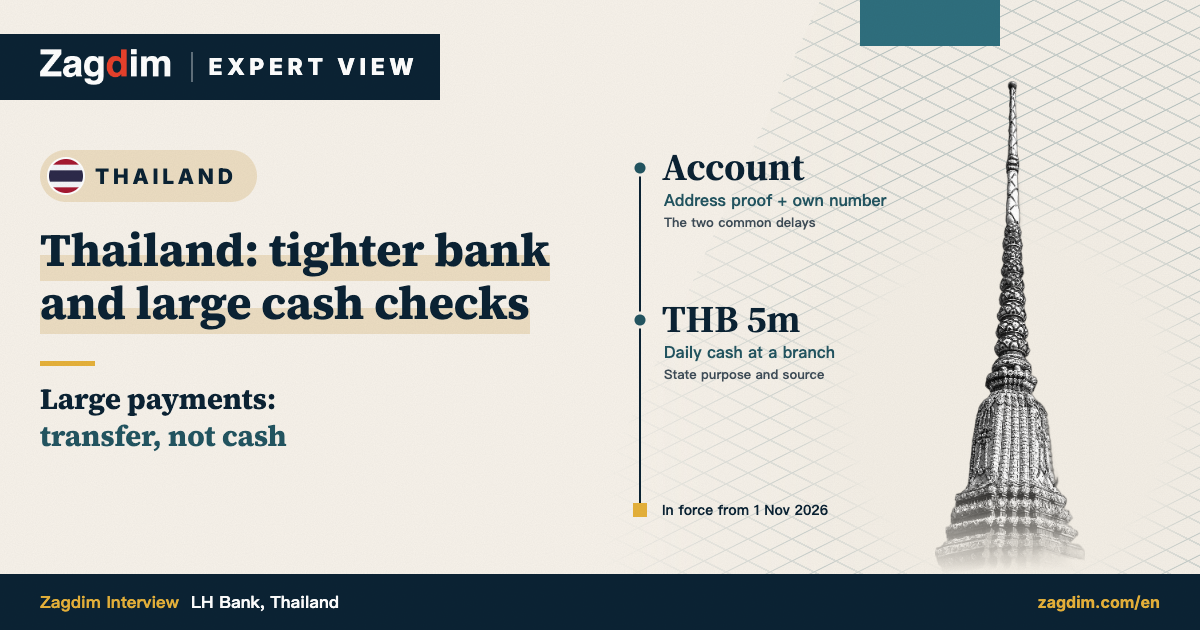
Bank of Thailand Notification No. 57/2569 took effect on 1 November 2026: when a customer’s cash transactions add up to THB 5 million or more in a single day and are carried out at a regular branch, the bank must first ask what the money is for, and for cash deposits, where it came from. Since 2025 the central bank has also required banks to tighten checks on account opening. For foreigners living long-term in Thailand, that means more questions when opening an account, when bringing savings in from abroad, and when depositing or withdrawing large amounts of cash at a branch. Zagdim interviewed LH Bank in Thailand on these changes. LH Bank’s view: account-opening delays mostly come from incomplete proof of address or a mobile number not registered in the applicant’s own name; transfers are credited more smoothly when the remitter and the Thai recipient are the same person and the stated purpose stays consistent; and large physical cash transactions are best avoided.
Key Points
- Bank of Thailand Notification No. 57/2569 took effect on 1 November 2026. When cash transactions total THB 5 million or more in one day and are made at a branch, the bank must obtain information on their purpose, and for cash deposits, on the source of funds.
- If a transaction does not match the stated purpose, or the bank has doubts, it must carry out enhanced due diligence (EDD); if it cannot, it must not process that cash transaction.
- LH Bank says that, beyond a passport, visa and other basic documents, applicants should take particular care to prepare proof of a Thai residential address and a Thai mobile number in their own name.
- For transfers from abroad, LH Bank recommends that the remitter and the Thai recipient be the same person and that the purpose be stated; when the bank asks to confirm, the purpose given should match the one stated when the money was sent.
- LH Bank does not recommend large physical cash transactions, and the notification also requires banks to encourage customers to use traceable methods such as transfers first.
Opening an Account: Proof of Address and a Mobile Number in Your Own Name Cause the Most Delays
The official direction is tighter control. Nation Thailand reported on 30 January 2025 that the Bank of Thailand was requiring banks to step up action against mule accounts: account opening would become stricter, and banks could refuse an application when the applicant’s circumstances are unclear, or limit transactions or account access from the start.
Asked where account opening most often gets stuck in practice, LH Bank explained:
“LH Bank said that, beyond a valid passport, the LTR visa and other basic documents, applicants should take care to prepare proof of a residential address in Thailand (for example, a sale and purchase agreement for a property they own, or a tenancy agreement) and a Thai mobile number registered in their own name. In practice, delays in the review are mostly caused by incomplete proof of address, or by a mobile number that is not registered in the applicant’s own name; as long as these two items are prepared in advance, the account-opening process is usually very smooth.”
LH Bank was answering about account opening for holders of the Long-Term Resident (LTR) visa. What this means for readers: beyond your passport and visa, get two things ready first. One is a document showing where you live in Thailand, such as the purchase agreement for your own property or your tenancy agreement. The other is a Thai mobile number registered in your own name. Using a number registered to someone else, or incomplete address documents, can slow the review.
For the documents each visa type needs to open an account with LH Bank, see Zagdim’s guide Can You Open an LH Bank Account in Thailand? Visa Status and Document Checklist.
Bringing Savings from Abroad: Same Name at Both Ends, Same Purpose Throughout
Many people living long-term in Thailand transfer their living expenses and property funds from where they used to live. LH Bank explained how incoming transfers are credited:
“To ensure funds are credited smoothly, LH Bank recommends that customers make sure the ‘remitter’ and the ‘Thai recipient’ are the same person when sending money, and clearly state the purpose of the transfer (for example, living expenses or a property purchase). When the funds arrive, LH Bank will proactively contact the customer by email to confirm the purpose; the customer only needs to reply briefly and make sure the declared purpose matches the one given when the money was sent.”
On large transfers, LH Bank added: “For large sums, preparing the relevant supporting documents in advance will allow the crediting process to be completed.”
What this means for readers: before sending money, check that both the sending account and the receiving account in Thailand are in your own name, and state the purpose clearly on the transfer. When the money arrives and the bank writes to confirm, give the same purpose as on the transfer. For large amounts, prepare documents that explain the funds in advance.
From 1 November 2026: Large Cash Transactions Need a Stated Purpose and Source
The following is Zagdim’s summary of the rules based on the original text of Bank of Thailand Notification No. 57/2569. It is not LH Bank’s statement.
- Scope: the notification applies to all financial institutions governed by Thailand’s Financial Institutions Businesses Act. It was issued on 20 October 2026, took effect on 1 November 2026, and replaces Notification No. 16/2569 of 18 March 2026.
- THB 5 million threshold: when a customer’s cash transactions across all channels total THB 5 million or more in one day and are carried out at a regular branch, the bank must obtain information: for cash withdrawals, the purpose; for cash deposits, the source of funds and the purpose. Buying, selling or exchanging foreign banknotes totalling THB 5 million or more in one day, across any channel, also requires information on the source of funds and the purpose.
- Enhanced checks when things do not match: the bank compares the customer’s explanation with the information it holds to judge whether the transaction is reasonable. If it does not match, or the bank has doubts, the bank must carry out enhanced due diligence (EDD); if it cannot complete EDD, it must not process that cash transaction.
- Transfers first: for cash transactions of THB 5 million or more, banks must first encourage customers to use non-cash methods whose flow of funds can be traced. The notification’s own example is withdrawing a very large amount of cash to buy land or property: such payments can usually be made by crossed cheque or transfer, and the bank should ask the customer to use those methods instead.
- Identification every time: for cash transactions at a branch, foreigners must show a passport or an identity document issued by a Thai government agency, and provide a contact phone number or email address and a signature.
LH Bank’s answer on this point was: “As anti-money laundering rules become increasingly strict, LH Bank does not recommend that customers carry out large physical cash transactions. From 1 November 2026, all banks in Thailand are required under the rules to apply Enhanced Due Diligence (EDD) to large cash transactions.” LH Bank’s answer on this question was a general explanation and did not list specific documents to prepare.
Zagdim’s note: under the notification, for branch cash transactions of THB 5 million or more in a day, banks must always obtain information on the purpose (and, for deposits, the source of funds); enhanced due diligence (EDD) applies when the bank finds that the transaction does not match the explanation, or has doubts. How far the questions go in practice depends on each bank’s procedures and the customer’s circumstances.
What this means for readers: for property purchases and other large payments, use transfers or bank cheques where possible rather than withdrawing or depositing large amounts of cash. If you do need to make a large cash transaction at a branch, be ready to explain what the money is for and where it came from.
What Readers Can Do Now
- If you plan to open an account in Thailand, prepare, in addition to your passport and visa, proof of a Thai residential address (such as the purchase agreement for your own property, or your tenancy agreement) and a Thai mobile number registered in your own name.
- When sending money to Thailand from abroad, use accounts in your own name at both ends and state the purpose on the transfer (for example, living expenses or a property purchase); when the bank writes to confirm, give the same purpose.
- For large transfers, prepare documents that explain the funds in advance.
- Use transfers or bank cheques for property purchases and other large payments. If your cash transactions in one day total THB 5 million or more and you make them at a branch, be ready to explain the purpose, and for cash deposits, the source of funds.
If you are planning to open an account, bring savings into Thailand or buy property there and are unsure which documents to prepare, tell the Zagdim Reader Desk about your situation. The Reader Desk will understand your needs and identify suitable professionals.
Glossary
- Bank of Thailand Notification No. 57/2569: the Bank of Thailand’s rules on risk management for cash-related transactions at financial institutions. 2569 is the year in the Thai Buddhist calendar, equivalent to 2026.
- Enhanced due diligence (EDD): Enhanced Customer Due Diligence, a deeper check than usual on a transaction or customer, such as finding out more about the source of funds and the purpose of the transaction.
- Crossed cheque: a cheque that can only be paid into an account and cannot be cashed directly, so the flow of funds can be traced.
About This Article
The official rules are drawn from Bank of Thailand Notification No. 57/2569 (issued 20 October 2026 and published in the Royal Gazette on 22 October 2026). Zagdim read the original Thai text on the Bank of Thailand website on 20 November 2026; the effective date is set out in clause 6 of the notification. The 2025 tightening of account-opening checks is based on reporting by Nation Thailand.
LH Bank’s views come from Zagdim’s interview: LH Bank’s written reply of 18 November 2026 (in Chinese, translated into English by Zagdim), and its note of 20 November that it had nothing to add on the third question. Quotations were confirmed by LH Bank before publication. LH Bank is a Zagdim partner; this article was written independently by Zagdim’s editorial team, and LH Bank confirmed only its own quotations. This article covers banking practice and published rules only, does not address any individual case, and is not financial or legal advice.
Experts interviewed
LH Bank (Thailand)
References
Bank of Thailand, Notification No. 57/2569 on Risk Management Criteria for Cash-Related Transactions of Financial Institutions (in Thai), 20 October 2026 / Bank of Thailand, index of regulations for financial institutions (in Thai) / Nation Thailand, ‘Bank of Thailand issues new rules on cash transactions of THB5m or more’, 26 October 2026 / Nation Thailand, ‘Bank of Thailand gets tougher on mule accounts with new rules’, 30 January 2025