
*Researched and verified by: Zagdim Research Team. Last verified: 24 November 2026.*
From 1 November 2026, the pay-as-you-go single fare for an adult traveling only by bus or tram in London rose from £1.75 to £1.85, and the daily cap rose from £5.25 to £5.55. The fare was decided by the Mayor of London and published by Transport for London (TfL). London buses and trams take contactless cards or phone taps, so on your first day in the UK you need to know whether the foreign card in your hand and the phone in your pocket will work. This UK payments guide, compiled by Zagdim, explains how to pay in the UK with cash, contactless cards and phone wallets, and what to watch for on London transport.
The short answer: in the UK, Visa and Mastercard are the main cards listed by VisitBritain, but there is no official list that guarantees every card issuer in Hong Kong, Taiwan, mainland China, Singapore or Malaysia will work. Before you travel, confirm three things with your card issuer: that the card can be used abroad, that it can be added to a phone wallet, and that overseas cash withdrawal and the PIN are switched on. On London transport, tap with the same card or the same device on every leg so the journeys count toward the daily cap.
This guide answers these questions:
- Can a card issued abroad pay contactless in UK shops and on London transport?
- How do you set up a phone wallet, and how do you use it once you are in the UK?
- How are the fare caps on London buses and the Tube worked out, and where do you check a missed tap or an extra charge?
- When the screen asks whether to pay in pounds or in your account’s currency, which should you choose?
For how much cash to exchange and where to exchange pounds, see the 2026 UK currency exchange guide, which this guide does not repeat. For a UK number, eSIM and receiving verification codes, see the 2026 UK phone number guide.
Key Points
- Who should pay attention: travelers from Hong Kong, Taiwan, mainland China, Singapore and Malaysia visiting the UK for travel, business, to visit relatives or to view property, and people going to the UK to study, work or live.
- Cash: the pound is legal tender, but the Bank of England explains that a shopkeeper can decide which forms of payment to accept, so you cannot assume every shop takes cash. UK Finance reports that cash made up 8% of all payments in the UK in 2025.
- Contactless cards: VisitBritain explains that the main cards in Great Britain are Visa and Mastercard, and that American Express and Diners Club are accepted only by some merchants.
- Contactless limits: a new Financial Conduct Authority (FCA) rule that took effect on 19 March 2026 lets firms with sound anti-fraud measures set their own contactless payment limits. For what you can actually tap, check your own card issuer.
- Phone wallets: the bank decides which cards can be added to a wallet, and the merchant must also accept the payment network the card belongs to. These are two separate matters.
- London transport: one card or device carries only one passenger at a time, and you must use the same card or the same device to tap in and tap out.
- Currency choice: when the screen asks whether to pay in pounds or in your account’s currency, choosing your own currency means accepting the conversion offered on the spot.
- Cash withdrawals: the machine’s fee and your card issuer’s fee are charged separately, and LINK’s ATM map does not show charges at banks that are not LINK members.
Which Kind of Traveler Are You?
Which payment methods you need to prepare depends first on whether you are a short-stay visitor, a student or worker, or a long-term resident. The three start from different places:
| Your situation | Options | What you must still confirm |
|---|---|---|
| Short-stay visitor | A contactless credit or debit card, a card added to a phone wallet, a small amount of cash | Whether the card issuer has switched on overseas card use and withdrawals; whether the card can be added to a wallet |
| Student or worker | The above, plus a local card once a UK bank account is opened | Whether your existing foreign card incurs an overseas transaction fee each time; whether a Railcard and contactless travel can be used together |
| Long-term resident | A local bank card first, with a foreign card as backup | For travel in cities outside London and on national rail, check the contactless rules for each route |
This table is a reading guide, not an approval of your personal eligibility.
Payment Methods Compared
There are 4 payment methods travelers use most often in the UK: cash, a physical contactless card, a phone wallet and cash from an ATM.
| Payment method | Who can use it | What to prepare | Where it works |
|---|---|---|---|
| Cash | Everyone | Pound notes and coins | Places where the shop chooses to take cash; a backup when cards fail |
| Physical contactless card | Holders of a Visa or Mastercard contactless card | A contactless symbol on the card, and the issuer has enabled overseas transactions | Shops whose card reader shows the contactless symbol; London buses, the Tube and eligible rail |
| Phone wallet (Apple Wallet, Google Wallet) | People whose card issuer supports adding the card to a wallet | A phone with the card linked; on Android, NFC switched on | Tills where the merchant accepts the card’s payment network; London transport |
| Cash from an ATM | People who have enabled overseas withdrawals and have a PIN | Your withdrawal PIN and a withdrawal limit set before you leave | LINK, Cashzone and other ATMs |
How to Get Started With Each Method
Keep a small amount of cash as a backup, check with your card issuer before you rely on cards, confirm the card type before you rely on a phone wallet, and switch on overseas functions before you rely on withdrawals.
Cash: Do You Still Need Pound Cash in the UK?
Zagdim suggests bringing a small amount of cash as a backup for when a card fails: do not rely on cash alone, and do not bring none. UK Finance reports that cash made up 8% of all payments in the UK in 2025, and 9% in 2024. An FCA survey adds that in May 2024, 4.8% of UK adults said they had paid for all or most of their spending in cash over the past 12 months. The two figures ask about different things, so they cannot be compared with each other, and they cannot be used to estimate how many shops take cash.
The Bank of England explains that when you shop, the shopkeeper can decide which forms of payment to accept. The pound is legal tender, which does not mean every shop must take cash on every transaction. To work out how much cash to bring and how to exchange it, see the currency exchange guide.
Physical Contactless Cards: Will a Foreign Card Work?
Whether a foreign card works depends on three things together: the card’s payment network, the card issuer, and the shop’s card reader. VisitBritain lists Visa and Mastercard as the main cards in Great Britain, and says only some merchants accept American Express or Diners Club. UK Finance reports that in August 2026, among transactions made in the UK by local and overseas cardholders, 68% of credit card transactions and 77% of debit card transactions used contactless. That is a statistic about all transactions, and not a merchant acceptance rate, so you cannot use it to infer that a given shop accepts your card.
There is currently no official acceptance list covering the card issuers of Hong Kong, Taiwan, mainland China, Singapore and Malaysia. Before you travel, confirm three things with your card issuer:
- Whether the card has overseas card use switched on.
- How overseas transaction fees are charged.
- Whether you may be asked to enter a PIN on a contactless transaction.
Contactless limits are where the old and new rules meet. FCA 2025/62, the instrument that revises the authentication rules for contactless payments at physical points of sale, took effect on 19 March 2026, and lets firms with sound anti-fraud measures set their own limits. How much an individual card can tap at a given shop depends on the card issuer and the merchant’s settings. Visa also explains that a contactless transaction in a shop may ask for the card PIN. If you get a prompt, enter the PIN as the terminal asks, and insert the card if necessary. Zagdim suggests confirming before you travel that your card’s PIN works, and bringing a second card on a different payment network.
At the card reader, hold the card near the reader and listen for the terminal’s tone. Visa explains that this completes the payment.
Phone Wallets: How Do You Check a Card Can Be Added, and How Do You Tap in the UK?
First check that the card issuer supports it, then check your phone settings, and finally check the payment network the merchant accepts. These are three separate questions.
Check that the card can be added. Apple explains that even if an issuer takes part in Apple Pay, some of its cards may still not be supported, so before you travel check your issuer on Apple’s Asia-Pacific list. Google explains that a bank decides which of the cards it issues can pay through Google Wallet.
Check your phone settings.
- iPhone: when you pay, hold the top of the phone near the contactless reader until the screen shows Done and a check mark.
- Android: NFC must be switched on, and Google Wallet must be set as the default NFC wallet on the phone.
Check that the merchant accepts it. Apple explains that besides accepting Apple Pay, the merchant must also accept the payment network of the card in the wallet.
UK Finance explains that the 2026 changes to the UK’s contactless rules for physical cards did not set a fixed £100 per-transaction limit on Apple Pay or Google Pay. That is an industry explanation, and it does not mean phone payments have no limit at all, because you may still be asked to verify.
Cash Withdrawals: How Do the ATM Fee and the Card Issuer’s Fee Split?
A withdrawal can carry two charges: the fee charged by the ATM itself, and a separate fee charged by your card issuer. One does not replace the other, and no single table covers every card and every machine.
Cashzone explains that fees on its own machines vary by location, and are charged on top of any fee your financial institution may charge. LINK explains that if a bank is not a LINK member, a cardholder withdrawing at that bank’s machine may be charged, and such charges do not show on LINK’s ATM map, so confirm with your card issuer.
What to do before you travel:
- Confirm with your card issuer that overseas withdrawal is switched on and that the withdrawal PIN works.
- Confirm with your card issuer how overseas withdrawal and currency conversion fees are calculated.
- Read the fee displayed on the machine’s screen before you withdraw.
When the Screen Asks Which Currency to Use for a Card Payment or Withdrawal
This is the dynamic currency conversion (DCC) screen. If you choose your account’s currency, you accept the conversion offered by the merchant or the ATM. If you choose pounds, you can decline that on-the-spot conversion. Visa explains that the merchant or ATM should let the cardholder decide whether to accept the conversion, and may not choose for them. Visa also explains that to use Visa’s exchange rate, you can pay in the local currency, pounds.
Regulation 57 of the UK Payment Services Regulations 2017 requires that, when currency conversion is offered at an ATM, at a point of sale or by the payee before the payment is initiated, the provider must disclose all charges and the exchange rate that applies to the payer. DBS Bank in Singapore also explains that when a cardholder chooses to be charged in Singapore dollars at an overseas merchant under DCC, the exchange rate is set by the merchant or its currency conversion provider.
What Regulation 57 requires is disclosure of charges and the exchange rate. It does not say which currency is cheaper, so it cannot be read as meaning pounds are cheapest, and it cannot be read as meaning your own currency carries no overseas transaction fee. Zagdim suggests reading the exchange rate and charges on the screen before you decide. If you are not sure, choose pounds, and then confirm with your card issuer how overseas transaction fees are charged.
**Mini glossary | DCC**: when you pay by card or withdraw cash, the shop or ATM first converts the amount into your account’s currency and then charges you.
How to Pay on London Transport
TfL explains that its services do not take cash, so on London transport you rely on a contactless card, your phone or an Oyster card, and you cannot treat cash as a backup for the fare.
You do not need to register an account first to travel in London. TfL explains that passengers do not need to register an online account before using its network, and can simply tap a contactless card or phone and travel.
Buses and Trams: Tap Once
Buses and trams need a tap only at the start of the journey. TfL explains that on a bus or tram you only touch in. On a tram, tap at the yellow card reader at the tram stop before you board.
From 1 November 2026, the adult pay-as-you-go single fare is £1.85, and the daily cap for traveling only by bus or tram is £5.55. The Hopper fare covers each bus or tram journey you tap for with the same card or the same device within one hour of your first tap, and the eligible journeys in that period come to £1.85 in total.
The Tube and Rail: Tap In and Out With the Same Device
On the Tube you tap at both entry and exit, and you must use the same card or the same device for the fare to be charged correctly. TfL also explains that at any one time one contactless card or device carries only one passenger, so each family member must tap with their own. TfL further explains that if you use your phone in the morning and a physical card in the evening, the two fares are not combined under the daily cap.
Zagdim suggests that if you tap in with your phone, you tap out with your phone, and if you tap in with a physical card, you tap out with the same physical card. Using a different card or device to enter and exit can produce two incomplete journeys.
How the Daily Cap Is Worked Out
TfL works out the daily cap from 4:30 am local time until 4:29 am the next day. How a late-night journey is assigned to a day depends on TfL’s journey records. Each eligible journey must use the same card or the same device for the daily and Monday-to-Sunday caps to add up.
In 2026, the adult all-day zonal caps in London are £8.90 for Zones 1 to 2 and £16.30 for Zones 1 to 6, applying to journeys included in the cap. Fares on the Heathrow Express airport train and on Southeastern high-speed services do not count toward the zonal caps TfL publishes, so before you travel into the city from the airport, confirm which line you will take.
National Rail and Railcards
On eligible sections in London and the south east of England, you can travel by rail with a contactless bank card, Google Pay or Apple Pay. National Rail explains that many contactless cards issued outside the UK can be used directly to travel, and the cardholder may pay an overseas transaction fee on top. TfL’s March 2026 contactless payment briefing (published by National Rail) states that some Visa and V PAY cards issued outside the UK are not accepted, so you must still confirm your own card before you travel.
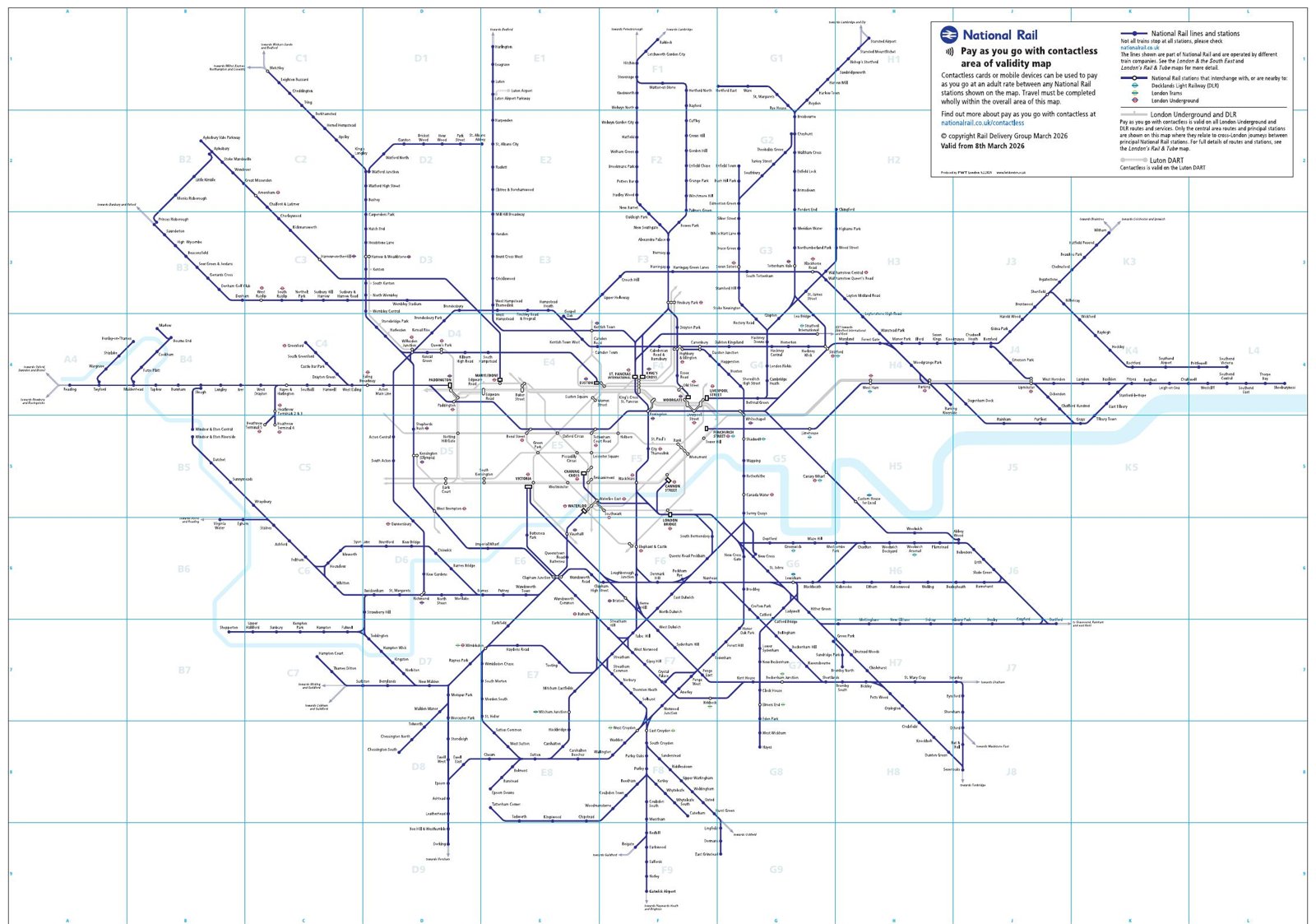
Students should watch out for Railcards. Southeastern explains that when you tap a bank card or device directly to travel, a Railcard discount cannot be applied. If you have a Railcard, you need to compare for yourself the conditions of buying a discounted ticket separately with those of tapping to travel. In other UK cities and on national rail, eligible routes and rules differ, so check by route.
Where to Check a Missed Tap or an Extra Charge
When your journey record is incomplete, check with TfL. TfL explains that if you are charged one or two maximum fares because of an incomplete journey record, you can check your journeys and may get a refund. Whether you get a refund depends on the case, and a refund is not guaranteed automatically.
People without a TfL account can use TfL’s unregistered card lookup service to see contactless journeys from the last 7 days. After 7 days you cannot look them up, so deal with anything unusual quickly. To apply for a refund, a person who paid with a contactless card must first register that card in an online account. TfL also explains that this kind of online account can only be used within Europe, so deal with it before you leave Europe, or check with TfL first. Apple Wallet can also be set to Express Transit mode, in which you choose and confirm the card to use in Apple Wallet’s Express Transit settings.
Do the Tools From Your Home Market Work?
Whether the cards and wallets of each place work depends on the card issuer and the card type, and no official list covers them all. The table below lists only what each institution officially says. It is preparation to do before you travel, and does not mean UK merchants or machines will definitely accept it:
| Home market | Tool | Official explanation | What to watch for |
|---|---|---|---|
| Hong Kong | Overseas ATM withdrawal with a bank card | The Hong Kong Monetary Authority reminds cardholders who plan to withdraw cash overseas that they can switch on overseas withdrawal before they leave, and set a withdrawal limit and an effective date | Switch it on before you travel, and confirm your withdrawal PIN |
| Taiwan | Chunghwa Post VISA debit card | Chunghwa Post specifies that a 6-digit VISA PIN is needed to withdraw at overseas ATMs | Confirm before you travel that you have this PIN, and follow your card issuer’s terms |
| Mainland China | Adding an international Mastercard or Visa card to Apple Wallet | Apple explains that in mainland China, some international Mastercard or Visa debit and credit cards can be added to Apple Wallet through the issuer’s app, for use in overseas transactions | Only some card types; confirm in your card issuer’s app |
| Singapore | DBS cards | DBS explains that when a cardholder chooses to be charged in Singapore dollars at an overseas merchant under DCC, the exchange rate is set by the merchant or its currency conversion provider | Read the rate and charges on the screen before you choose |
| Malaysia | Maybank debit card | Maybank advises that overseas use of a debit card should be switched on only while you travel | Switch it on before you go, and off when you are back |
FAQ
Do I still need pound cash for the UK?
Zagdim suggests bringing a small amount of cash. The pound is legal tender, but the Bank of England explains that a shopkeeper can decide which forms of payment to accept, and there is no official basis for saying that every shop takes cash.
Can my Visa or Mastercard pay contactless in the UK?
It depends on the card, the card issuer and the shop. VisitBritain explains that Visa and Mastercard are the main cards in Great Britain, but there is no official list guaranteeing that every card issuer’s card will work. Before you travel, confirm with your card issuer that overseas card use is switched on, and bring a second card on a different payment network.
Can I still tap contactless above £100?
It depends on your card issuer and the merchant’s settings. The FCA’s new rule, in force from 19 March 2026, lets firms with sound anti-fraud measures set their own contactless limits, so it cannot be written as a fixed amount. UK Finance also explains that most consumers will not see an immediate change. Do not assume a large payment will always work by tapping, and have your card to insert and your PIN ready. If a verification prompt appears, enter the PIN as the terminal asks.
Can a phone wallet pay with no limit at all?
No. UK Finance explains that the changes to the contactless rules for physical cards did not set a fixed £100 per-transaction limit on Apple Pay or Google Pay, but that does not mean there is no limit, and you may still be asked to verify.
Can I use one card to tap two people in on the London Tube when traveling with family?
No. TfL explains that at any one time one contactless card or device carries only one passenger, so each person must use their own card or device.
If I tap in with my phone and out with my watch, how is the fare worked out?
It may be treated as two incomplete journeys. TfL explains that you should tap the same card or the same device in and out for the fare to be charged correctly. A phone and a watch are different devices, so use the same one for each journey.
I have no TfL account. How do I check what I was charged?
You can use TfL’s unregistered card lookup service to see contactless journeys from the last 7 days. If you were charged a maximum fare, you can apply to TfL for a refund for an incomplete journey, and whether you get one depends on the case.
The card screen asks about pounds or my own currency. Can I refuse the conversion?
Yes. Visa explains that the merchant or ATM should let you decide whether to accept the conversion. Choosing pounds declines the on-the-spot conversion, but your card issuer may still charge an overseas transaction fee, so confirm with your card issuer before you travel.
Important Notice
This article is general information and is not financial, tax or legal advice. It draws on the websites and explanations of UK Finance, the Financial Conduct Authority, the Bank of England, Transport for London, the Greater London Authority, VisitBritain, LINK, Cashzone, Visa, Apple and Google, and of card issuers and rail operators, checked on 24 November 2026. Fares, contactless limits, the lists of wallet support and rates can change, so rely on the latest announcements from each institution and operator. No official acceptance list for foreign cards was found, and it cannot be guaranteed that an individual card will work at a particular merchant. The tools listed here are a compilation of information. They are not recommendations or rankings.
Have a question about this guide? Leave a comment below, or ask Zagdim directly.
Your first stop for international property and global living.
Research and insights. Know what’s changing. Understand what matters.
Sources
- UK Finance, Digital payments continue to grow, mobile wallets become more popular
- UK Finance, Card spending
- UK Finance, Contactless cards information
- Financial Conduct Authority, Financial Lives 2024 survey key findings
- Financial Conduct Authority, FCA 2025/62 instrument in force
- Financial Conduct Authority, Stepping back, staying safe
- Bank of England, What is legal tender?
- VisitBritain, Useful information
- Visa UK, Changes in payment security
- Visa UK, Dynamic currency conversion
- Visa UK, Travel
- Visa UK, Contactless
- Apple, Apple Pay merchant requirements
- Apple, Apple Pay card issuers in Asia-Pacific
- Apple, Pay in stores with iPhone
- Apple, Add a card to Wallet in mainland China
- Apple, Apple Pay and transit
- Google, Cards supported by Google Wallet
- Google, Pay by tapping your phone
- Transport for London, Visitors to London
- Transport for London, Contactless cards and devices conditions of use
- Transport for London, Conditions of carriage
- Transport for London, Fare capping
- Transport for London, Adult fares
- Transport for London, Bus and tram fares
- Transport for London, Contactless
- Transport for London, Apply for incomplete journey refund
- Transport for London, Refunds
- National Rail, Pay As You Go with Contactless staff brief, March 2026
- Greater London Authority, MD3517 July 2026 fare changes
- Greater London Authority, MD3464 March 2026 Transport for London fare changes
- National Rail, Pay as you go with contactless
- Greater Anglia, Contactless
- Greater Anglia, Oyster and contactless
- Southeastern, Pay as you go
- LINK, Charges for cash
- Cashzone, FAQ
- legislation.gov.uk, The Payment Services Regulations 2017, regulation 57
- DBS Singapore, Overseas transaction fees
- Hong Kong Monetary Authority, ATM safety tips
- Chunghwa Post, VISA debit card terms
- Maybank Malaysia, Cards safety tips