For most visitors to the UK, the common worry is not where to exchange money but how much to exchange. On the London Underground, in supermarkets and in coffee shops, a tap of a phone or card settles the bill. A thick wad of pound sterling carried in from abroad often goes home untouched, and changing it back costs you the exchange spread a second time.
The short answer: bring only a small amount of sterling in cash and pay mainly by card or phone tap. When an ATM or card machine asks which currency to charge, always choose pound sterling (GBP). Also, England, Scotland and Wales ended tourist tax refunds in 2021 (Northern Ireland is the exception), so do not expect to claim back 20% VAT at a London airport on the way home.
This guide answers:
- How many people still use cash in the UK, and how much do you need to exchange?
- Where can you get sterling if you are travelling from Hong Kong, Taiwan, mainland China, Singapore or Malaysia?
- How can you avoid extra charges when withdrawing cash, paying by card or riding the London Underground?
- How much cash must you declare on arrival, and can you still claim tax back on shopping?
Key Points
- Who should pay attention: travellers visiting the UK for tourism, family visits, arrival for study or property viewing, whether you hold a Hong Kong, Taiwan, mainland China, Singapore or Malaysia passport or travel from those places, and people planning to move to the UK who do not yet have a local bank account for the first few months.
- Cash is a minority of payments: UK Finance reports that cash made up only 8% of all payments by number in the UK in 2025.
- Where people most often overpay: when an ATM or card machine offers to charge you in your home currency (dynamic currency conversion, DCC). Choose sterling and let your card issuer convert.
- Cash declaration: if you carry cash of £10,000 or more in total between England, Scotland or Wales and a country outside the UK, you must declare it. Travelling family members are counted together. Northern Ireland has a separate euro threshold.
- Tax refunds: England, Scotland and Wales no longer have a tourist VAT refund. The only tax-free route is for the shop to send goods directly to an address outside the UK. Northern Ireland has its own exception.
Do You Still Need Cash in the UK? Work Out How Much to Exchange
You need only a small amount of cash in the UK, because you are far less likely to run short of cash than to be left with cash you cannot spend. UK Finance’s *UK Payment Markets 2026* report shows that in 2025 there were 3.9 billion cash payments in the UK, only 8% of all payments by number. Put another way, fewer than one in ten payments uses cash.
That figure is the share of payments by number across the whole UK. It does not mean every shop takes cards, or that you will never need cash. Zagdim recommends the following approach:
- Carry only a small amount of cash for tips, market stalls and the occasional shop that takes cash only.
- Pay mainly by card. Bring two or more cards on different networks (for example one Visa and one Mastercard), carry one on you and keep one in your luggage as a backup.
- Call your card issuer before you leave to confirm that the card is enabled for overseas use and overseas withdrawals, and to ask what the foreign transaction fee is.
Contactless Payments: No Single Limit Since March 2026
There is no single UK contactless limit since 19 March 2026, and each card issuer sets its own. Many people remember a £100 limit on contactless payments in the UK. That was the limit UK Finance introduced from 15 October 2021. The Financial Conduct Authority (FCA) removed the uniform regulatory contactless limit on 19 March 2026, so banks and payment providers now set their own limits as part of their fraud prevention.
In practice, how much you can pay by contactless depends on your card issuer, not on a fixed UK figure. Being asked to insert your card and enter your PIN for a larger amount is normal.
Where to Get Pounds: Before You Go, After You Arrive, or at an ATM
Zagdim recommends exchanging a small amount of sterling before you leave and withdrawing at a UK ATM after you arrive; airport counters suit urgent needs only, and exchanging foreign notes in the UK comes with more conditions.
| Method | Best for | Watch out for |
|---|---|---|
| ✅ Exchange a small amount of sterling at a local bank or licensed exchange shop before you leave | People who want cash the moment they land | Compare several shops’ sterling selling rates; exchange only what you need |
| ✅ Withdraw at a UK ATM | People who have confirmed their card works for overseas withdrawals | Read any fee shown on the screen; choose GBP at the DCC prompt |
| ⚠️ Airport exchange counters in the UK | Urgent needs | Compare rates first; exchange only enough for the ride into town and a first meal |
| ⚠️ Exchanging Hong Kong dollars, Taiwan dollars, yuan, Singapore dollars or ringgit for sterling after arriving in the UK | People who happen to be holding those notes | Being accepted does not mean good terms, and receipts and ID may be required |
Travelling From Five Places: What to Bring
From all five places, Zagdim recommends exchanging a small amount of sterling before you leave and using a card for the rest. The figures below use the European Central Bank reference rates of 28 October 2026 (Taiwan dollars use the Taiwan Futures Exchange US dollar/Taiwan dollar reference rate of 27 October 2026). These are mid-market rates. Actual exchanges always cost a little more, so treat the table as a rough guide only.
| Travelling from | Approx. cost of £100 (mid-market) | Suggested approach |
|---|---|---|
| 🇭🇰 Hong Kong | About HK$1,042 | Exchange a small amount of sterling in Hong Kong before you leave and use a card for the rest. |
| 🇹🇼 Taiwan | About NT$4,312 | Exchange a small amount of sterling in Taiwan before you leave and use a card for the rest. |
| 🇨🇳 Mainland China | About ¥886 (yuan) | Exchange a small amount of sterling before you leave; confirm the withdrawal and card payment terms for your UnionPay or other card in the UK. |
| 🇸🇬 Singapore | About S$170 | Exchange a small amount of sterling before you leave and use a card for the rest. |
| 🇲🇾 Malaysia | About RM542 | Exchange a small amount of sterling before you leave and use a card for the rest. |
Zagdim recommends exchanging before you go, because once you are in the UK, there are few options for turning Hong Kong dollars, Taiwan dollars, yuan, Singapore dollars or ringgit into sterling, and they come with conditions:
- Post Office: its currency buy-back calculator lists Hong Kong dollars, Taiwan dollars, Chinese yuan, Singapore dollars and ringgit. The conditions are inconsistent, though: the buy-back main page says more than 2,500 branches can buy back without a purchase receipt while smaller branches still need one, whereas the help page asks for the original Post Office purchase receipt. There is also no guarantee that a visitor without a UK account can get sterling banknotes at any branch.
- M&S Travel Money: the exchange-rate table for converting foreign currency back to sterling also lists these five currencies, but it only accepts current, usable banknotes, requires valid ID and does not take coins.
- Airports: Heathrow’s website currently lists Global Exchange as its currency exchange operator, while Travelex’s website says it currently has no exchange counter at Heathrow. Operators differ by airport, so do not rely on old information.
Exchange Tips
Three habits keep exchange costs down.
- Zagdim recommends checking the day’s rate on your phone before you exchange, and comparing it with the posted rate at the counter.
- Consider exchanging the amount you need in one go to avoid repeat trips to the exchange shop.
- Sterling coins generally cannot be exchanged back, so Zagdim recommends spending them in the UK before you leave.
Withdrawing Cash in the UK: Read the Fee on the Screen
UK ATMs that charge an operator fee must display a charge message on the screen, so read it before you confirm. LINK, the UK cash machine network, explains that most withdrawals are free for holders of debit cards issued by its member banks, but some machines still charge (this refers to cards issued by UK member banks, and your overseas card may not be covered). LINK’s rules require that machines that charge an ATM operator fee must display a charge message on the screen.
For overseas visitors, there are two separate fees to consider:
- Whether the ATM itself charges: check the screen. If it shows a charge and you would rather not pay it, cancel and use another machine.
- Whether your card issuer charges: for example an overseas withdrawal fee or a foreign transaction fee. You need to ask your own bank, as this is not visible in the UK.
The Big Card and ATM Trap: “Pay in Your Home Currency?”
When you pay by card or withdraw cash in the UK, the machine may ask: “Pay in Hong Kong dollars (or Taiwan dollars, yuan, Singapore dollars, ringgit)?” This is called dynamic currency conversion (DCC), and the better answer is to choose pound sterling.
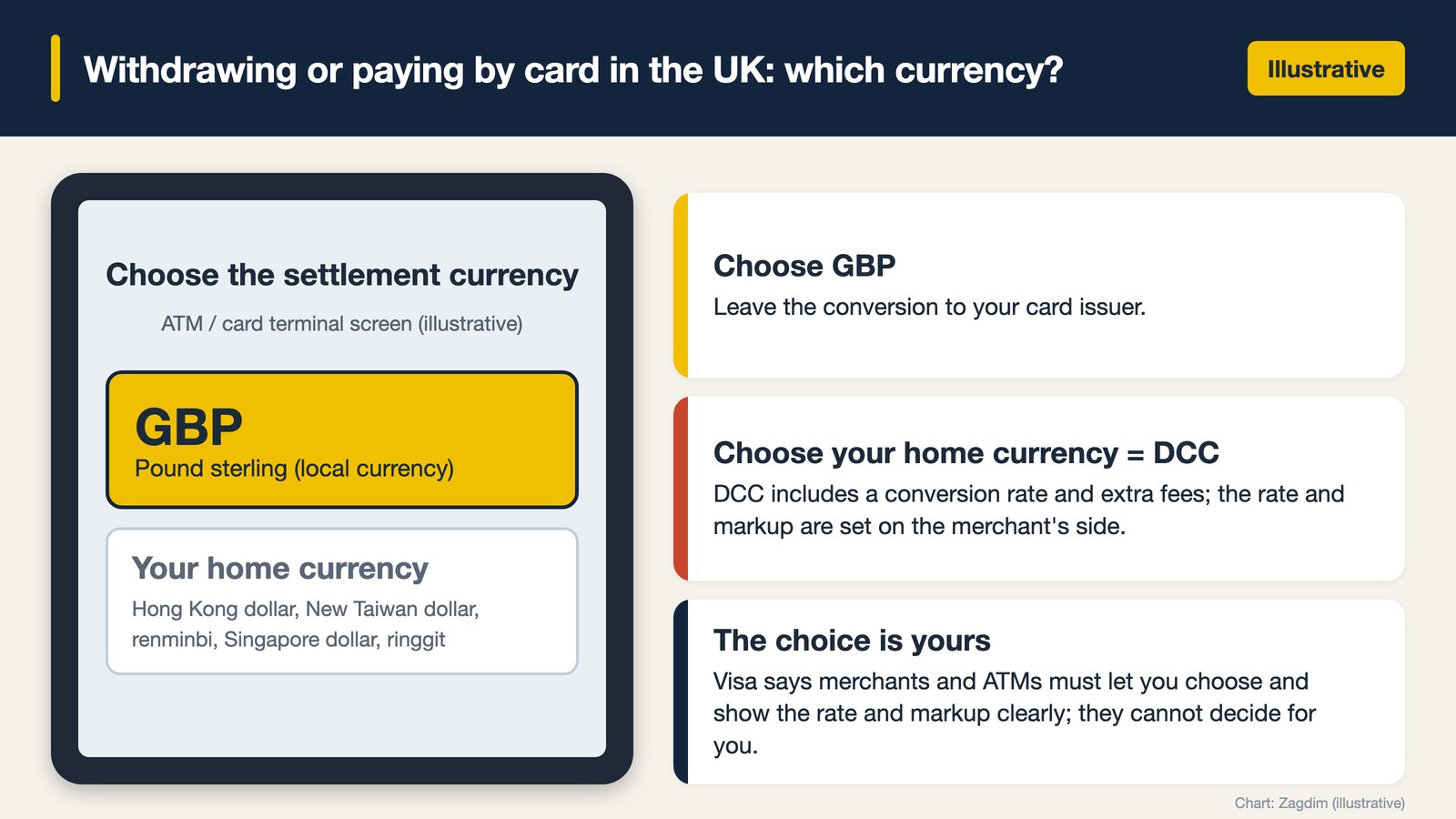
- Visa explains that DCC is an option for cardholders to settle in their home currency, and includes a conversion rate and extra fees. Merchants and ATMs must let you choose, and must clearly show the exchange rate and markup. They cannot decide for you.
- Mastercard explains that when you choose to transact in the local currency, the conversion uses the rate provided by your card issuer.
Zagdim recommends that in the UK, you choose pound sterling (GBP) when the screen asks for a currency, and leave the conversion to your card issuer. Choosing your home currency looks as if it tells you at a glance what you spent, but the exchange rate and markup are set on the merchant’s side.
Paying for the London Underground and Buses
You can pay for the Tube and buses with a contactless card or phone, without buying an Oyster card. On the Tube and buses in London you can pay directly with a contactless card or phone, and you do not have to buy an Oyster card:
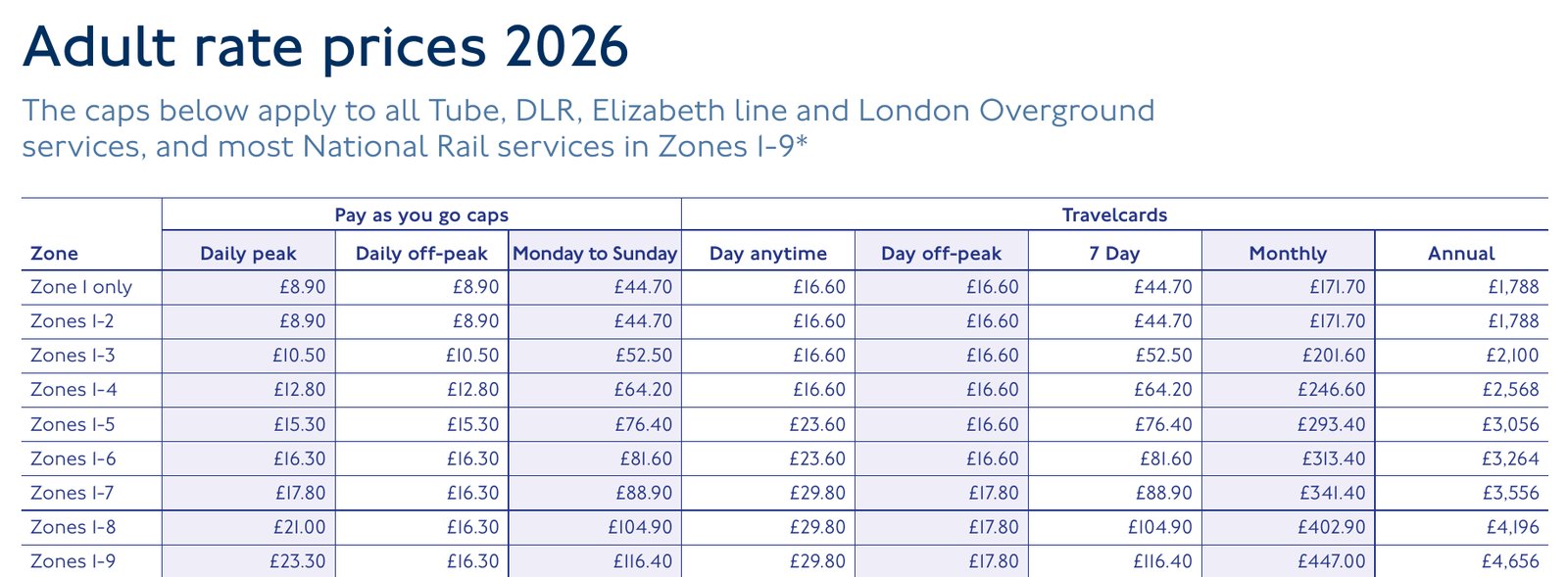
- Transport for London (TfL)’s fares and tickets book states that single fares are the same whether you use Oyster or contactless payment. The exception is that daily caps for travel to and from Radlett and Potters Bar may differ (June 2025 edition of the book).
- Both Oyster and contactless payment have daily caps and weekly caps, and the adult weekly cap runs on a fixed Monday to Sunday week. However much you travel, what is charged for the day and the week has a ceiling.
- Always use the same card or the same phone. TfL explains that capping only counts journeys made with the same card or the same device, and journeys on a phone and on a physical card are not combined. If you use your phone one day and a physical card the next, you may not reach the weekly cap.
- TfL also notes that many contactless cards issued outside the UK work, but your card issuer may charge an extra foreign transaction fee.
How Much Cash Must You Declare When Entering the UK?
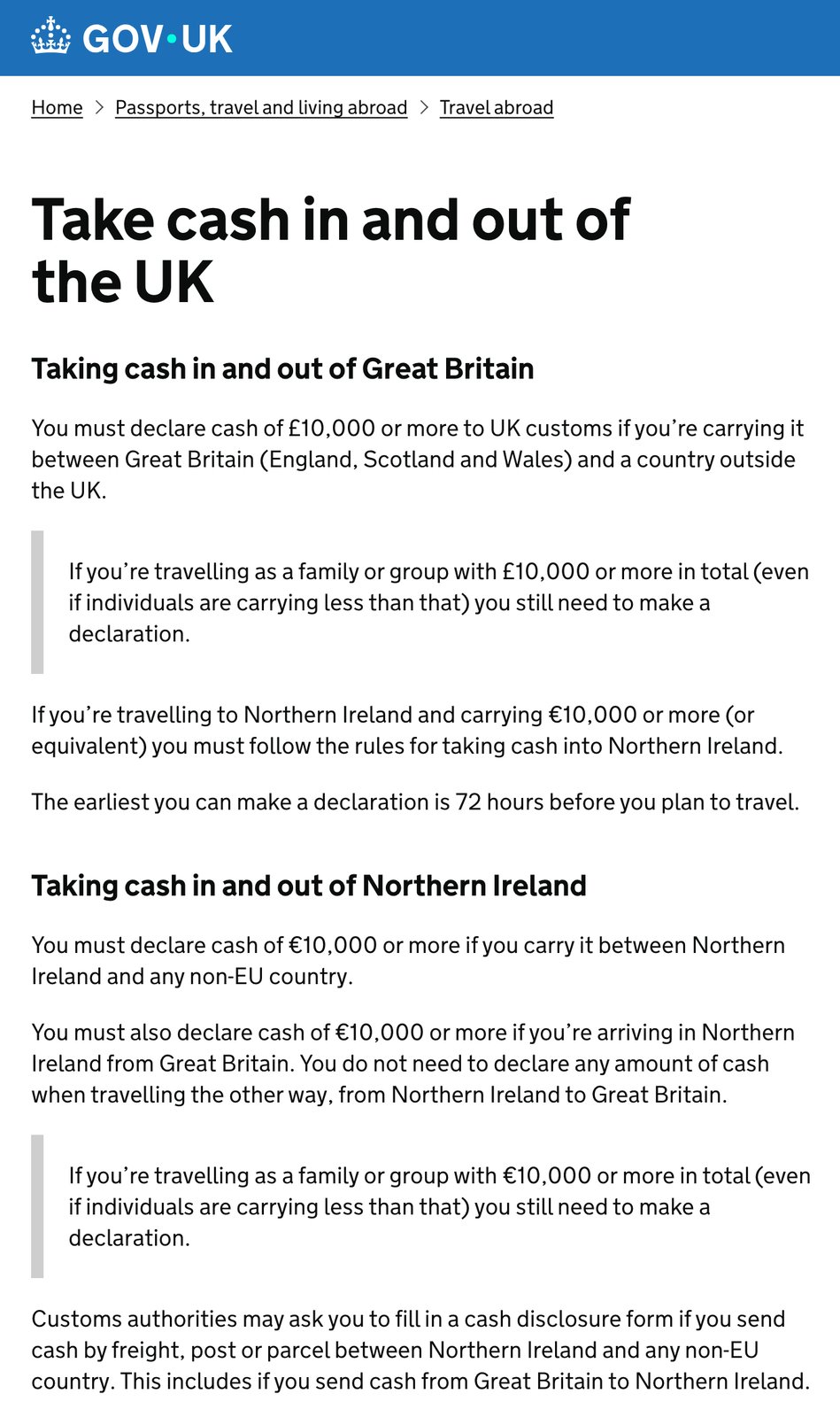
You must declare cash of £10,000 or more in total when travelling between Great Britain and a country outside the UK, and the threshold is €10,000 for Northern Ireland. According to the guidance from HM Revenue and Customs (HMRC) and UK Border Force on GOV.UK:
| Situation | Declaration threshold |
|---|---|
| Travelling between Great Britain (England, Scotland and Wales) and a country outside the UK, including EU countries | £10,000 or more in total, or the equivalent in foreign currency |
| Family or group travelling together | Even if each person carries less than £10,000, you must declare if the total reaches the threshold |
| Travelling between Northern Ireland and a country outside the EU; the same applies when arriving in Northern Ireland from Great Britain | €10,000 or more in total, or the equivalent |
Points to note:
- “Cash” is more than banknotes. It also includes coins, bearer bonds, traveller’s cheques, and cheques that are signed but leave the payee blank. For travel to and from Northern Ireland, bills of exchange, gold coins, gold bars, gold bullion and prepaid cards also count.
- You can declare online. GOV.UK provides an online declaration, which you can make as early as 72 hours before you travel; Great Britain and Northern Ireland use different declaration services.
- A declaration is not a limit. You are not forbidden from carrying that amount; at this amount you must declare it first.
- Consequences of not declaring. Border Force can seize all the cash you are carrying, and getting it back may require paying a penalty of up to £5,000.
For a large sum such as a rental deposit, tuition fees or a property purchase deposit, Zagdim recommends a bank transfer rather than carrying cash, as it is safer. If you do carry cash, declare it first.
Can You Still Claim Tax Back on Shopping in the UK?
England, Scotland and Wales: the tourist tax refund has been abolished. HM Treasury and HMRC regulations state that Great Britain stopped the VAT Retail Export Scheme for non-EU visitors from 1 January 2021, and did not extend it to EU visitors either. The standard rate of UK value added tax (VAT) is 20%. The price you pay in a shop in Great Britain includes VAT, and it cannot be reclaimed at the airport on departure.
The tax-free shopping arrangement GOV.UK currently lists is: ask the shop to send the goods directly to an address outside the UK, and first confirm that the shop offers this service.
Northern Ireland is an exception. Northern Ireland still has a tourist refund scheme, which applies to eligible visitors who live outside Northern Ireland and the EU and who buy from Northern Ireland retailers that offer the service.
Know Your Banknotes: Withdrawn Notes and Scottish Notes
Only current polymer Bank of England notes are valid in England and Wales, old paper notes have been withdrawn, and Scottish and Northern Irish notes are accepted in England at each shop’s discretion.
- Current Bank of England notes: there are four denominations, £5, £10, £20 and £50, and all are polymer (plastic) notes. Notes bearing the portrait of King Charles III have been issued since 5 June 2024. The current polymer notes bearing the portrait of Queen Elizabeth II remain valid, and both circulate together.
- Old paper notes are no longer valid: the old paper £20 and £50 notes (Series F) stopped being valid on 30 September 2022, and the earlier paper £5 and £10 notes are also withdrawn. These old paper notes are no longer legal tender and should not be used for payment. Under Bank of England rules, you can exchange them by post (there is no deadline, and posting is at your own risk) or over the counter (bring ID and documents showing the source of funds), or, if you have a UK bank account, deposit them at a bank that accepts old notes.
- Scottish and Northern Irish notes: banks in Scotland and Northern Ireland issue their own sterling banknotes. The Bank of England explains that in England and Wales, the legal tender banknotes are Bank of England notes, and whether a shop in England accepts Scottish or Northern Irish notes is up to the shop. If you receive these notes in Scotland, spend them before you leave Scotland where you can.
Pre-Departure Checklist
Zagdim recommends seven steps before you leave:
- Call your card issuer: enable overseas card payments and withdrawals, and ask about the foreign transaction fee.
- Bring two cards on different networks and keep them separately.
- Exchange a small amount of sterling cash before you leave, and compare rates first.
- When card payments or withdrawals offer a currency choice, choose pound sterling (GBP).
- In London, always use the same card or the same phone for travel.
- If you carry cash of £10,000 or more in total between Great Britain and a country outside the UK, declare it; for Northern Ireland the threshold is €10,000.
- If you need to apply for the UK electronic travel authorisation (ETA), the official application fee is £20; whether you need one depends on your nationality and the purpose of your trip.
Summary: Exchange Right, Pay Right, Spend the Savings
In the UK, the key to saving money is not finding the exchange shop with the best rate but exchanging less cash, choosing the right currency at the card machine, and using the same card for travel. Sterling you exchange but do not spend costs you the spread both ways when you convert it back. Choosing the wrong currency can add cost to every payment. And switching between a phone and a card on the Tube may stop you reaching the weekly cap.
The money you save is enough for one more afternoon tea in London, or a ticket to a special museum exhibition.
FAQ
How much sterling cash should I take to the UK?
Exchange only a small amount; there is no standard figure. Cash was only 8% of all payments by number in the UK (UK Finance, 2025 figure), but that does not mean every shop takes cards. Zagdim recommends exchanging only a small amount for tips, markets, small shops and emergencies, and using a card for the rest.
Should I pay in sterling or my home currency when using a card in the UK?
Choose sterling (GBP). Choosing your home currency is dynamic currency conversion (DCC), where the exchange rate and markup are set by the merchant or ATM. If you choose sterling, your card issuer does the conversion.
Can I exchange Hong Kong dollars, Taiwan dollars or Chinese yuan for sterling in the UK?
The Post Office and M&S Travel Money buy-back lists both name Hong Kong dollars, Taiwan dollars, Chinese yuan, Singapore dollars and ringgit, but with conditions on receipts, ID and the state of banknotes. Zagdim recommends exchanging the sterling you need before you leave.
What is the contactless payment limit in the UK?
A limit of £100 per payment has applied since 2021, but the FCA removed the uniform regulatory limit on 19 March 2026, and each bank and payment provider now sets its own. How much you can pay by contactless depends on your card issuer.
Can I still claim tax back on purchases in the UK?
Not in England, Scotland or Wales: the tourist refund was abolished from 1 January 2021, and the tax-free method GOV.UK lists is for the shop to send goods directly to an address outside the UK. Northern Ireland still has a tourist refund scheme.
How much cash must I declare when travelling to the UK?
If you carry cash of £10,000 or more, or the equivalent in foreign currency, between England, Scotland or Wales and a country outside the UK, you must declare it, with family members counted together. You can declare online on GOV.UK, as early as 72 hours before you travel.
Important Notice
This article is general information and does not constitute financial, tax or legal advice. It draws on the UK government, the Bank of England, the FCA, TfL, UK Finance, LINK, and the websites of exchange operators and card networks, as checked on 29 October 2026. Exchange rates, fees, exchange operators’ terms of acceptance and airport counters change, so rely on the latest announcements from each institution and your card issuer. The converted amounts in the tables are mid-market reference figures and do not include any exchange spread or fees.
Have a question about this guide? Leave a comment below, or ask Zagdim directly.
Your first stop for international property and global living.
Research and insights. Know what’s changing. Understand what matters.
Sources
- GOV.UK (HMRC
- UK Border Force) – Taking cash in and out of Great Britain or Northern Ireland: https://www.gov.uk/bringing-cash-into-uk
HMRC – Travellers communication pack: https://www.gov.uk/government/publications/hmrc-brexit-transition-communications-resources/travellers-communication-pack-plain-text
Border Force – UK customs information: Northern Ireland: https://www.gov.uk/government/publications/travelling-to-the-uk/uk-customs-information-northern-ireland-accessible-version
UK Finance – UK Payment Markets 2026 Summary: https://www.ukfinance.org.uk/system/files/2026-08/PaymentMarketsReport_2026Summary.pdf
UK Finance – Contactless limit increase to £100 on 15 October: https://www.ukfinance.org.uk/press/press-releases/contactless-limit-increase-100-15-october
FCA – Handbook Notice 136: https://www.fca.org.uk/publication/handbook/handbook-notice-136.pdf
FCA – Greater flexibility to be given in setting future contactless limits: https://www.fca.org.uk/news/press-releases/greater-flexibility-be-given-setting-future-contactless-limits
LINK – Charges for cash: https://www.link.co.uk/helping-you-access-cash/learn-more-about-accessing-cash/charges-for-cash
Post Office – Currency buy back: https://www.postoffice.co.uk/travel-money/currency-buy-back
Post Office – Travel money help: https://www.postoffice.co.uk/help-support/travel-money
M&S Travel Money – Sell currency exchange rates: https://mandstravelmoney.com/travel-money/sell-currency/exchange-rates
M&S Travel Money – Sell currency: https://mandstravelmoney.com/travel-money/sell-currency
Heathrow Airport – Currency exchange: https://www.heathrow.com/at-the-airport/airport-services/currency-exchange
Travelex UK – Heathrow Airport: https://www.travelex.co.uk/our-stores/heathrow-airport
Visa – Dynamic currency conversion: https://www.visa.co.uk/travel-with-visa/dynamic-currency-conversion.html
Mastercard – DCC Guide 2025: https://www.mastercard.com/content/dam/public/mastercardcom/na/global-site/documents/DCC-Guide-2025-Merchant-Version.pdf
Transport for London – Fares and tickets (June 2025): https://foi.tfl.gov.uk/FOI-1000-2526/Book%201%20Fares%20and%20Tickets%20-%20FOI%20Request%20-%20June%202025_Redacted.pdf
Transport for London – Capping: https://tfl.gov.uk/fares/find-fares/capping
Transport for London – Pay as you go: https://tfl.gov.uk/fares/ways-to-pay/pay-as-you-go
GOV.UK – The Travellers’ Allowances and Miscellaneous Provisions (EU Exit) Regulations 2020: https://www.gov.uk/government/publications/the-travellers-allowances-and-miscellaneous-provisions-eu-exit-regulations-2020/the-travellers-allowances-and-miscellaneous-provisions-eu-exit-regulations-2020
GOV.UK – Tax-free shopping: https://www.gov.uk/tax-on-shopping/taxfree-shopping
GOV.UK – Claim VAT back on tax-free shopping in Northern Ireland: https://www.gov.uk/guidance/claim-vat-back-on-tax-free-shopping-in-northern-ireland
GOV.UK – VAT rates: https://www.gov.uk/vat-rates
Bank of England – Current banknotes: https://www.bankofengland.co.uk/banknotes/current-banknotes
Bank of England – Withdrawn banknotes: https://www.bankofengland.co.uk/banknotes/withdrawn-banknotes
Bank of England – Exchanging old banknotes: https://www.bankofengland.co.uk/banknotes/exchanging-old-banknotes
Bank of England – King Charles III banknotes: https://www.bankofengland.co.uk/banknotes/king-charles-banknotes
Bank of England – Banknote FAQs: https://www.bankofengland.co.uk/faq/banknote
Bank of England – What is legal tender?: https://www.bankofengland.co.uk/explainers/what-is-legal-tender
GOV.UK (UKVI) – Electronic travel authorisation (ETA): https://www.gov.uk/eta
European Central Bank – Euro foreign exchange reference rates (2026-10-28): https://www.ecb.europa.eu/stats/policy_and_exchange_rates/euro_reference_exchange_rates/html/index.en.html
Taiwan Futures Exchange – Daily foreign currency reference rates (2026-10-27): https://www.taifex.com.tw/cht/3/dailyFXRate
Transport for London (TfL) – Adult rate prices 2026: https://content.tfl.gov.uk/adult-fares.pdf