
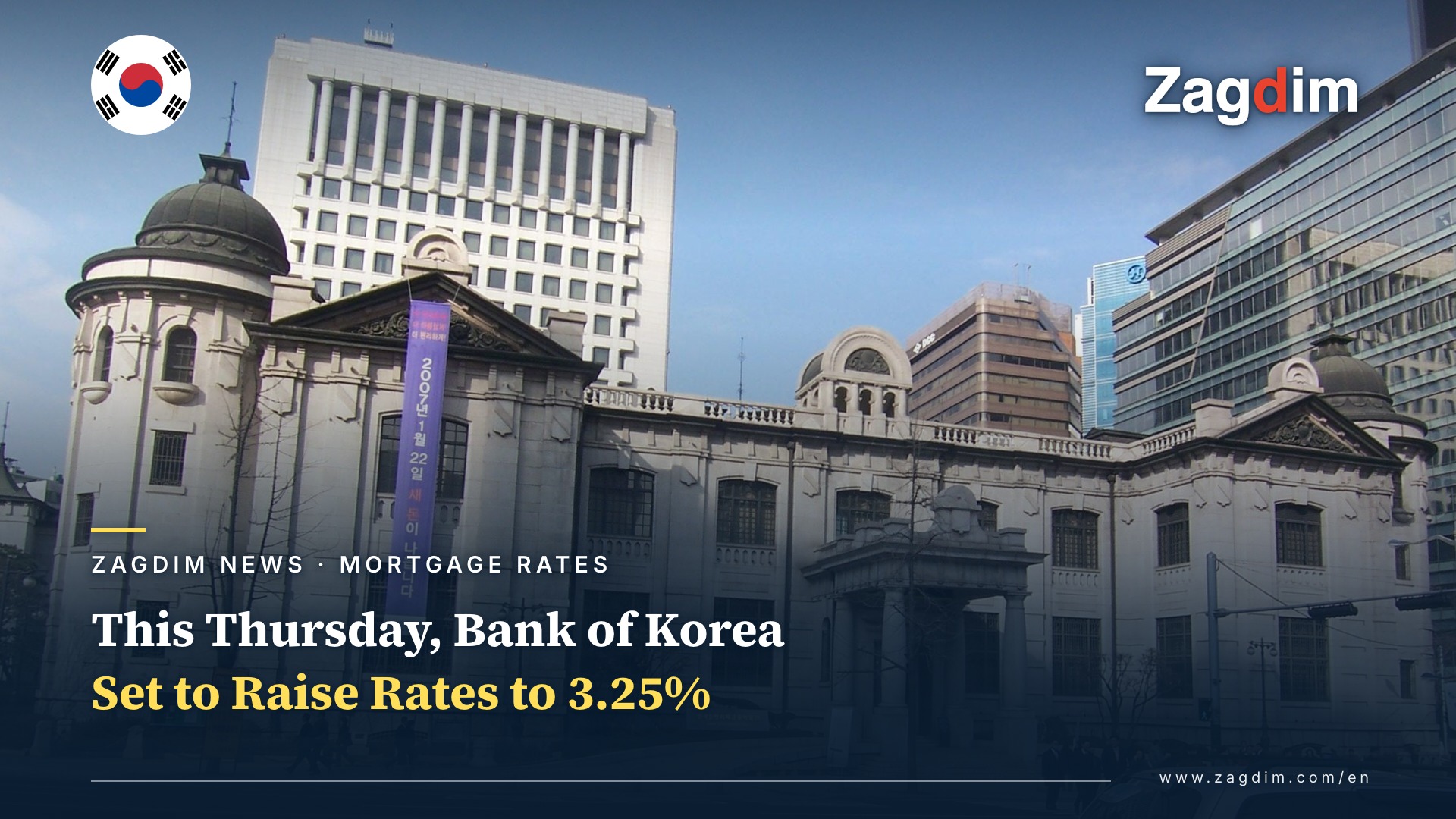
The Bank of Korea (BOK) is widely expected to raise its benchmark interest rate by 25 basis points, from 3% to 3.25%, at its final policy meeting of the year this Thursday, November 26, 2026. In a survey of 34 economists conducted November 17-23 and reported Tuesday, 32 expected a hike and only two expected the rate to stay unchanged. The median forecast in that survey points to one more 25-basis-point hike in the first quarter of 2027, which would bring the rate to a peak of 3.5% before holding steady for the rest of that year. As of this writing, the BOK has not yet announced its decision; Thursday’s meeting outcome is still a market expectation, not a confirmed result.
How the Expectation Built Up
The BOK’s current tightening cycle began in July 2026. On July 16, it raised the benchmark rate from 2.5% to 2.75%, citing export- and investment-driven growth, inflation expected to stay above target, and ongoing financial-stability risks. It raised rates again by 25 basis points in August, to 3%, while also lifting its 2026 GDP growth forecast from 2.6% to 3.3% and its 2027 forecast from 2.1% to 2.9%. At the October meeting, all seven Monetary Policy Board members voted to hold the rate at 3%, citing uncertainty tied to developments in the Middle East and major economies’ policies, while keeping a bias toward further hikes. South Korea’s consumer price index rose 2.8% year-on-year in October, down from 2.9% in September but still above the BOK’s 2% target.
Who Is Affected
The decision matters most directly to anyone holding or shopping for a mortgage or other variable-rate loan in South Korea, since the benchmark rate feeds into bank lending rates. It also matters to prospective property buyers weighing timing, because named analysts cite still-rising South Korean housing prices as one reason the case for a hike remains intact. More broadly, the decision affects South Korea’s won exchange rate and KOSPI-linked investments: the won has appreciated roughly 7% against the US dollar so far this year, one of the best performances among Asian currencies, while the KOSPI index has roughly halved in value since June amid global AI-stock volatility.
Background
South Korea’s export boom, driven largely by global AI-infrastructure investment and memory-chip demand, has been the main engine of growth behind the tightening case. Government data show cumulative exports topped $1 trillion for the first time as of November 19, 2026, making South Korea the fourth country after China, the United States and Germany to reach that annual export scale; the government projects full-year exports of about $1.17 trillion, up roughly 65% from $709.3 billion in 2025. But that export strength has not spread evenly through the economy: named analysts say the windfall is concentrated in two chipmakers, Samsung Electronics and SK Hynix, and has yet to broadly lift household income or consumption, which limits how far the BOK can keep raising rates without hurting growth.
Outlook, From Named Sources
Michelle Lam, an economist at Societe Generale, said this week’s expected hike has already been fully priced in by markets, and that a hold would be the surprise rather than a hike; she pointed to stronger-than-expected third-quarter GDP, strong semiconductor exports, inflation still above target, and still-rising housing prices as reasons the case for a hike remains valid, and said she does not expect inflation to return to the BOK’s target until the second half of 2027. Goohoon Kwon, senior Asia economist at Goldman Sachs, holds the opposite view, expecting the BOK to hold rates this week — though he acknowledged the decision could be very close — and said that if the BOK does hike, it is likely to be a “dovish” move paired with moderate guidance, with policymakers’ own rate-path median not expected to exceed 3.5% over the next six months. Kwon argued that stabilizing the won may do more to curb inflation than further rate hikes, since current price pressure stems more from import costs than domestic demand; he expects the won to strengthen to around 1,280 per US dollar next year, a forecast he said depends on the US Federal Reserve’s own rate path not working against it, and expects South Korean inflation to ease back toward 2% in the second half of 2027 as the won strengthens, policy stays tight and government price-stabilization measures take effect.
References
36Kr Europe (via CLS/WeChat Official Account) – Bank of Korea Interest Rate Hike: Potential Thursday Announcement – Latest BOK Monetary Policy Update / Korea Times – BOK Keeps Rate Steady at 3%, but Further Hikes Remain on Table