
This article is for people who hold, or are considering, a Portuguese Golden Visa (residence permit for investment activity, ARI), especially families who planned around the old five-year route to citizenship.
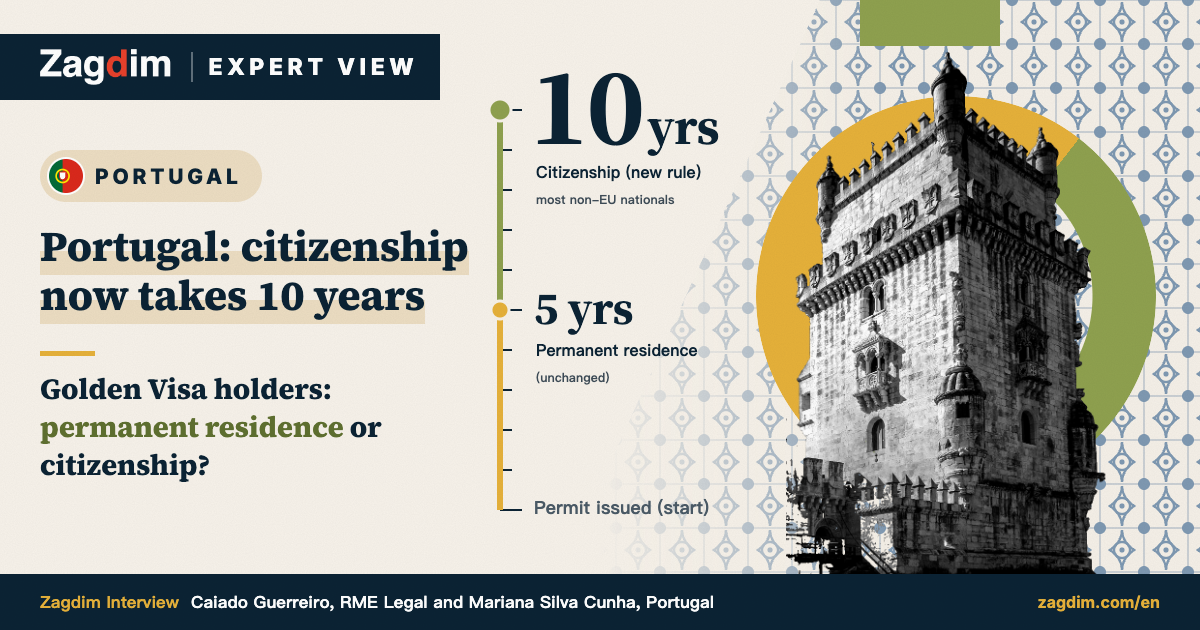
Portugal’s amended Nationality Law (Lei Orgânica n.º 1/2026) took effect on 19 May 2026. For nationals of countries other than Portuguese-speaking countries and EU Member States, the legal residence requirement for ordinary naturalisation rose from five years to ten. The provision that counted the waiting time on a residence-permit application towards that period was also repealed. For many Golden Visa families who invested expecting “a passport in five years”, the timeline needs to be recalculated.
But the ten-year rule changes the route to citizenship. The five-year condition for permanent residence has not changed. Zagdim interviewed Cátia Pereira Baptista, Head of the Immigration Department at Caiado Guerreiro; Raquel Matos Esteves, Founding Partner of RME Legal; and Mariana Silva Cunha, a Portuguese immigration lawyer, on how families should re-plan under the new rules, organised around the questions readers ask most.
Key Points
- Ten years is the threshold to apply for citizenship, not an investment term: the interviewees stress that permanent residence and citizenship are separate milestones. The investment does not have to be held for ten years, and permanent residence remains available after five years if the conditions are met.
- The old law protects only nationality applications already filed: nationality applications pending when the new law took effect on 19 May 2026 remain under the old law. An early investment or Golden Visa application does not, by itself, preserve the five-year route.
- Re-check where your residence period starts: application waiting time no longer counts, so neither the investment date nor the filing date can be treated as the start. Lawyers suggest using the first residence card as the planning reference and assessing any other periods individually.
- Release the investment only once permanent residence is issued: it does not become possible automatically on the fifth anniversary.
- What to do now: build a separate residence timeline and document file for every family member, especially if a child is approaching adulthood.
Who Should Pay Attention
- Golden Visa holders who have not yet applied for citizenship and planned to do so after five years
- Applicants still waiting in the Golden Visa queue, or who have just received their first residence card
- Families who applied with minor children
- Anyone considering a Portuguese Golden Visa who wants to understand the difference between permanent residence and citizenship
1. What Changed, and Does the New or Old Law Apply to Me?
According to the text of the new law published in Portugal’s official gazette, the Diário da República, there are three main changes:
| Item | Old law | New law (from 19 May 2026) |
|---|---|---|
| Ordinary naturalisation by residence | 5 years | 7 years for nationals of Portuguese-speaking countries and EU Member States; 10 years for nationals of other countries |
| Waiting time on a residence-permit application | Counted once the permit was granted | Provision repealed; no longer counted |
| New conditions | — | Knowledge of the Portuguese language and culture, history and national symbols, and civic rights and duties; adherence to the principles of the democratic rule of law; ability to support oneself |
Table: compiled from the text of Lei Orgânica n.º 1/2026 (Articles 6 and 5)
The transitional rule covers only nationality applications already in progress. Article 7 of the new law provides that administrative procedures pending when it entered into force remain under the previous law. A notice from Portugal’s Ministry of Justice also states that pending nationality cases continue under the previous rules.
Raquel Matos Esteves of RME Legal explains: “An earlier Golden Visa application or investment does not, by itself, preserve the former five-year nationality route.” Cátia Pereira Baptista of Caiado Guerreiro adds: “Investors who had submitted Golden Visa applications but had not yet applied for citizenship should not assume that the previous rules remain applicable.”
In other words, what decides which rules apply is whether a nationality application was filed and pending before 19 May, not the investment date or the Golden Visa filing date.
2. When Does the Ten-Year Clock Start?
With application waiting time no longer counted, the starting point needs to be re-checked. Article 15(4) of the old law allowed the time between applying for temporary residence and its approval to count, provided the application was approved. The new law repealed that paragraph.
Mariana Silva Cunha, a Portuguese immigration lawyer, points out: “Consequently, investors should not assume that the date of their investment or the submission of their Golden Visa application automatically marks the beginning of the qualifying residence period.”
Raquel Matos Esteves’s view: “For the typical Golden Visa applicant, the first residence card therefore becomes the key planning reference, rather than the investment or initial application date. Any other potentially qualifying periods of legal residence should be assessed individually.”
Zagdim note: the text of the new law does not say that residence always runs from the date on the residence card. The law defines legal residence as being in Portugal with a regularised status under any of the titles, visas or permits provided for in the foreigners’ entry and residence regime. If you lived legally in Portugal under another status before your Golden Visa, that period needs to be assessed separately. The application date, approval date, card validity dates and the date you collected the card should not be treated as the same thing.
Mariana Silva Cunha says: “I recommend reviewing each investor’s residence history individually, paying particular attention to the periods of legal residence officially recognised by AIMA, the continuity of their residence status and any periods affected by administrative delays.”
Residence can be accumulated, within a time window. Under Article 15(3) of the new law, periods of legal residence can be added together whether continuous or interrupted, provided they fall within a set interval. Mariana Silva Cunha explains: “For third-country nationals subject to the ten-year requirement, this means ten years of qualifying residence within a maximum twelve-year period.”
“The Portuguese Golden Visa program has always been a Residency by Investment program and not a Citizenship by Investment program.”
Reaching ten years does not mean an automatic passport. Raquel Matos Esteves says: “The residence period determines when someone may become eligible to apply. It does not guarantee approval or establish when a passport will be issued.” Article 6 of the new law requires all conditions to be met at the time of application, and nationality registration is a further step, so processing time needs to be allowed for.
3. Does the Investment Have to Stay for Ten Years? When Can It Be Released?

“The ten-year requirement concerns eligibility for Portuguese citizenship. It does not mean that investors must necessarily maintain their qualifying investment for ten years, nor does it eliminate the possibility of obtaining permanent residence after five years, subject to the applicable requirements.”
The key question is what status keeps you in Portugal when you exit. As long as you renew on the Golden Visa’s temporary residence, you must keep showing the investment is maintained. AIMA’s FAQ says that once an autonomous permanent residence has been granted, your situation is assessed under the requirements of that status, but you should check which title was issued and whether the decision attached any specific conditions.
Raquel Matos Esteves cautions: “Investment withdrawal should be coordinated with the issue of the appropriate permanent residence title, rather than assumed to become possible automatically on the fifth anniversary.” Mariana Silva Cunha adds: “However, investors must still consider the requirements for renewing temporary Golden Visa residence before deciding to liquidate their investment.”
Whether and when you can actually exit also depends on the investment’s own contract terms, such as a fund’s redemption period.
4. Permanent Residence, Citizenship, or Permanent Residence First?
The interviewees agree: think about permanent residence and citizenship separately. It is not a choice of one or the other.
Cátia Pereira Baptista says: “Golden Visa holders should always approach permanent residence and Portuguese citizenship as two distinct legal milestones.” Raquel Matos Esteves puts it similarly: “Permanent residence and citizenship should be viewed as separate, optional steps, which can form part of the same long-term strategy.” Mariana Silva Cunha says: “I believe permanent residence deserves considerably more attention under the new framework.”
For those who only want long-term residence, the reform changes little. Raquel Matos Esteves says: “For families whose objective is permanent residence, there is, in practice, no change to that five-year objective.” Cátia Pereira Baptista also shares an observation from her firm’s clients: “In our experience with Chinese clients, many have sought long-term residence rather than Portuguese citizenship, particularly given the implications of acquiring another nationality under the rules applicable in their home jurisdiction.” That describes her firm’s clients; whether to naturalise depends on the rules of each person’s existing nationality and on family plans.
Permanent residence obtained by Golden Visa holders is exempt from the ordinary cancellation rules for absences. Cátia Pereira Baptista explains: “Importantly, Golden Visa holders who obtain permanent residence under the special ARI regime benefit from exemptions from the ordinary rules on cancellation of residence permits due to absences from Portugal. The Golden Visa regime requires only limited physical presence, equivalent to an average of seven days per year. Applicants are therefore not required to relocate to Portugal or make it their main home, although they must have an address in Portugal.”
Zagdim note: the legal basis Cátia Pereira Baptista cites is Articles 65-C and 65-K of Regulatory Decree No. 84/2007 of 5 November (Decreto Regulamentar n.º 84/2007), as amended. Article 65-C sets the minimum physical presence for Golden Visa holders, seven days in the first year and fourteen days in each subsequent two-year period, which is where the average of seven days per year comes from. Article 65-K provides for the special permanent residence regime for Golden Visa holders, including the exemption from the ordinary cancellation rules based on absences. Zagdim checked Articles 65-C and 65-K against the consolidated text of the Decree in the Diário da República (27 November 2026); the minimum stay listed in AIMA’s Golden Visa FAQ is consistent with this.
| Your goal | Possible route | Watch out for |
|---|---|---|
| Long-term legal residence only | Apply for permanent residence after five years; the five-year goal is unchanged | Language, means of subsistence, address, tax and social security, criminal record conditions |
| Citizenship, but exit the investment earlier | Obtain permanent residence first, then keep building residence towards citizenship | Time the exit to the issue of the permanent residence title; permanent residence does not shorten the citizenship requirement |
| Citizenship, keeping the investment | Keep renewing the Golden Visa and apply for citizenship after ten years | More frequent renewals; maintain the investment and minimum stay throughout |
| Undecided | Obtain permanent residence first, then reassess | Manage each family member’s timeline separately |
Table: compiled from the three interviewees’ answers, AIMA and the text of the new law; individual cases remain subject to AIMA and IRN review

“The key practical question is therefore no longer simply “When can I apply for citizenship?” but also “How can each member of my family maintain a secure residence status until then?””
5. What Do Permanent Residence and Citizenship Require, and Where Do Problems Arise?
Permanent residence conditions. The conditions listed by AIMA include holding a temporary residence permit for at least five years, means of subsistence, proof of address, compliance with tax and social security obligations, basic Portuguese, and no sentence exceeding one year’s imprisonment in the last five years of residence in Portugal. Raquel Matos Esteves says: “Golden Visa holders may apply for permanent residence after five years counted from their first residence card, provided they meet the remaining requirements, including basic Portuguese, means of subsistence and the applicable criminal-record conditions.”
Raquel Matos Esteves also notes: “The permanent residence card is renewable every five years; the underlying status is not limited to that period.” This matches AIMA’s guidance.
New conditions for citizenship. The new law requires proof, by test or certificate, of sufficient knowledge of the Portuguese language and culture, history and national symbols; knowledge of civic rights and duties and of the political organisation of the state; a solemn declaration of adherence to the principles of the democratic rule of law; and the ability to support oneself. Raquel Matos Esteves says: “A language qualification already obtained for permanent residence can generally support the later nationality application without repeating the language examination. However, the reform additionally introduced requirements concerning Portuguese culture, history, national symbols, civic knowledge and adherence to democratic principles, whose practical implementation awaits further regulation.”
Zagdim note: as of 27 November 2026, the Nationality Regulation (Regulamento da Nacionalidade Portuguesa, Decree-Law No. 237-A/2006) had not yet been amended under the new law. Portugal’s Council of Ministers approved a decree-law regulating the new law on 29 October 2026, including the conditions for the tests of Portuguese language, culture, history and institutions, but it had not yet been published in the Diário da República. How the test works will depend on the regulation as officially published.
Where problems most often arise. Cátia Pereira Baptista says: “In practice, the main challenges often concern maintaining the qualifying investment, complying with renewal requirements, documenting the relevant residence periods, and meeting the additional conditions for permanent residence, including basic Portuguese language proficiency.” Mariana Silva Cunha’s list: “In practice, the most common difficulties include administrative delays, incomplete or inconsistent residence records, renewal issues and misunderstandings about the requirements for permanent residence.”
Families with children nearing adulthood should plan early. With a longer timeline, a child’s status may change well before the parents can apply for citizenship. Cátia Pereira Baptista cautions: “Children who enter the program as minors may reach adulthood well before becoming eligible for citizenship, making it essential to plan for their continued residence status.”
Case study | A residence card that never arrived
Mariana Silva Cunha describes a case she handled: a Golden Visa investor attended his biometric appointment in January 2026 and had submitted all the required documentation. Nothing was outstanding on his side, and the residence card was expected to follow. Months passed with no card. On examining the file, she found that an internal administrative issue had prevented the instructions for producing the card from being forwarded.
She says: “Following my intervention with AIMA, the issue was resolved, and the residence card was delivered to my office within a week.”
The delay had nothing to do with the investor’s compliance. She warns: “Nevertheless, delays of this nature can create uncertainty regarding the date from which legal residence is officially recognised, potentially affecting an investor’s future eligibility for permanent residence or citizenship.”
This is a single case. The causes of delay, how they are handled and how long they take vary; it does not mean that hiring a lawyer will always resolve a delay within a week.
Cátia Pereira Baptista also notes: “For investors affected by significant administrative delays, the application of the new rules, potential transitional issues and the protection of legitimate expectations may warrant individual legal assessment.”
6. What Readers Can Do Now
1. Work out which situation you are in. Was your nationality application filed and pending before 19 May 2026, or not yet filed? Is your goal permanent residence, citizenship, or still undecided?
2. Build a separate residence timeline for each family member. Cátia Pereira Baptista says: “We recommend maintaining a comprehensive record of each applicant’s immigration history, including application submissions, approval decisions, residence permits, renewals and any other periods of legally recognized residence. Each family member’s timeline should be documented separately.”
3. Gather the documents. Raquel Matos Esteves’s list: “Applicants should retain the original application and payment records, approval decisions, first and subsequent residence cards, renewal receipts, and correspondence with SEF or AIMA. Periods covered by legal extensions or pending renewals should also be documented. Each family member should have an individual residence chronology.” Mariana Silva Cunha adds: “Obtaining an official certificate confirming their registered residence history is also an important step.” She is referring to the residence period certificate issued by AIMA (Certidão de Contagem de Tempo de Residência), explained in question 7 of AIMA’s FAQ on residence permits.
| Document | Why it matters |
|---|---|
| Original Golden Visa application records and payment receipts | To compare the application date with the approval date |
| Approval decisions | To confirm the approval date and the type of title issued |
| First and every subsequent residence card | To confirm each period of legal residence |
| Renewal application receipts | To show your status did not lapse during renewals |
| Correspondence with SEF and AIMA | To record delays and how they were handled |
| Records of legal extensions and pending renewals | To cover gaps between cards |
| Records of each entry into Portugal | To show the minimum stay was met |
| Language certificate | Required for permanent residence and possibly useful for citizenship later |
Table: compiled from the recommendations of Raquel Matos Esteves and Cátia Pereira Baptista and from AIMA information
4. Before releasing the investment, confirm your permanent residence title has been issued and check the investment’s exit terms.
5. If a child is nearing adulthood, confirm early what status they will use to stay on as an adult.
If you hold a Portuguese Golden Visa and want to know how your residence is counted, or whether to apply for permanent residence first or wait for citizenship, tell the Zagdim reader desk about your situation. The reader desk will understand your needs and identify suitable professionals.
Life abroad? Ask Zagdim.
Your first stop for international property and global living.
Research and insights. Know what’s changing. Understand what matters.
Glossary
- Golden Visa (ARI): Portugal’s residence permit for investment activity (Autorização de Residência para Atividade de Investimento), a form of temporary residence.
- Permanent residence: applied for under Article 80 of Portugal’s Foreigners’ Law; Golden Visa holders receive a permanent residence permit for investment activity.
- Naturalisation: acquiring nationality under Article 6 of the Nationality Law, based on a period of legal residence in Portugal and other conditions.
- AIMA: Portugal’s Agency for Integration, Migration and Asylum, which took over the residence functions of the former SEF.
- SEF: Portugal’s former Immigration and Borders Service, since restructured.
- IRN: Portugal’s Institute of Registries and Notary, which handles nationality applications and registration.
About the Sources
Official sources were first read on 26 October 2026 and checked again before publication on 27 November 2026. The new statutory text, transitional rule and accumulation rule follow Lei Orgânica n.º 1/2026 as published in the Diário da República; the continued application of the old law to pending cases follows the Ministry of Justice notice; permanent residence conditions and card validity follow AIMA’s permanent residence page; Golden Visa minimum stay, maintenance of investment and assessment after permanent residence follow AIMA’s Golden Visa FAQ; the legal basis for the Golden Visa minimum stay and special permanent residence regime (Articles 65-C and 65-K of Regulatory Decree No. 84/2007) was provided by Cátia Pereira Baptista and checked against the text of the Decree in the Diário da República; the residence period certificate follows AIMA’s FAQ on residence permits. The status of the Nationality Regulation follows the Portuguese Government’s Council of Ministers communiqué of 29 October 2026 and the consolidated text of the Regulation in the Diário da República (checked 27 November 2026; its most recent change listed there dates from 2025).
The experts’ views are their own professional opinions. Quoted text has been approved by each expert. This article is general information and not individual legal advice; individual cases are subject to review by AIMA and IRN and to the rules as officially published. Please consult a professional.
Experts interviewed
Cátia Pereira Baptista, Head of Immigration Department, Caiado Guerreiro
Mariana Silva Cunha, Portuguese Immigration Lawyer, Mariana Cunha — Immigration Lawyer in Portugal
Raquel Matos Esteves, Founding Partner, RME Legal
References
Diário da República, “Lei Orgânica n.º 1/2026” (amendment to the Nationality Law, published 18 May 2026) / Diário da República, “Declaração de Retificação n.º 17/2026/1” / Portuguese Ministry of Justice, “Lei da Nacionalidade: novas regras entram em vigor a 19 de maio” / AIMA, “Autorização de Residência Permanente – Art. 80.º” / AIMA, “Autorização de Residência para Investimento – Art. 90.º-A” / AIMA, “Perguntas Frequentes: Autorização de Residência para Investimento (ARI)” / AIMA, “Títulos de Residência” FAQ (PDF) / Diário da República, “Decreto Regulamentar n.º 84/2007” (consolidated text, Articles 65-C and 65-K) / Portuguese Government, “Comunicado do Conselho de Ministros de 29 de outubro de 2026” / Diário da República, “Regulamento da Nacionalidade Portuguesa” (consolidated Decree-Law No. 237-A/2006)