


























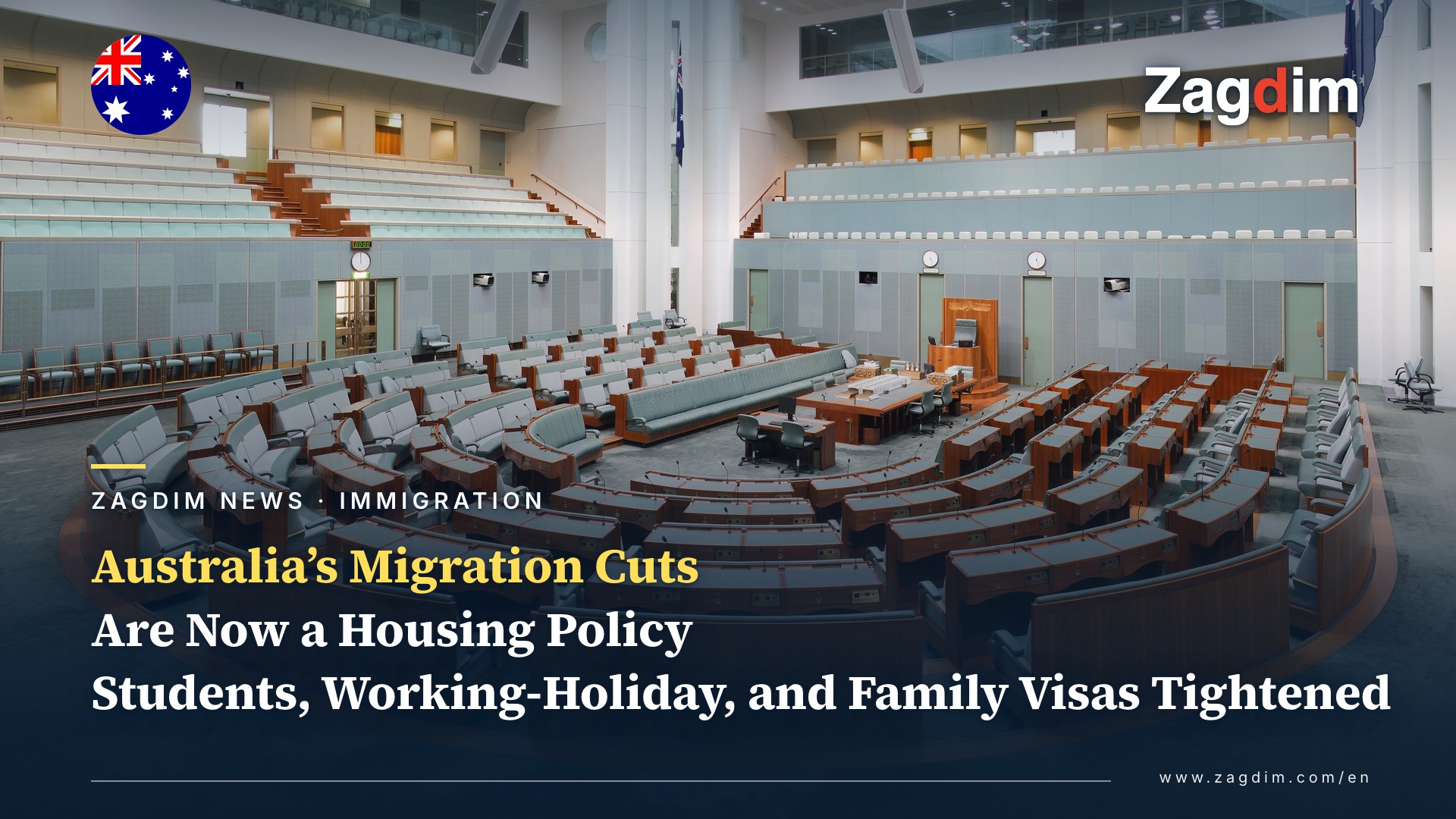
Australia’s Home Affairs Minister Tony Burke used a National Press Club address in Canberra on 17 September 2026 to unveil a migration reform package and, in the same breath, tie it explicitly to the housing crisis: “We need immigration to soften enough that housing has a chance to catch up,” he said, according to AFP reporting the same day, while stressing the housing shortage was “not caused by migrants.” The package tightens rules across four visa channels at once — international students, working-holiday makers, family and visitor visas, and overstayer enforcement — with an explicit numeric goal: bringing net overseas migration (NOM) down to roughly 225,000 within about two years, from around 300,000 now, according to Reuters.
No single wire report connects all four channels to what they mean for people already mid-pathway, or to what the government’s own housing-crisis framing signals about the political mood around migration-linked demand. That connection is Zagdim’s own analytical work; every figure and policy detail below is attributed to Reuters, AFP (via Yahoo News Singapore), or The Nightly, all reporting the same 17 September announcement.
What Canberra Actually Announced
The headline mechanics, per Reuters: foreign students will be barred from bringing partners and children while they study, in most categories; working-holiday visa rules are tightened; and all visitor visas will now carry a “no further stay” provision. Enforcement is being toughened too — 100 additional compliance officers, and the government is exploring repurposing a pandemic-era quarantine facility in Melbourne to house immigration detainees. Overstayers will face a return to a decade-old policy: two weeks to leave the country voluntarily or face detention and deportation, Burke said, while explicitly distancing the approach from harder-edged enforcement elsewhere — “this is not the sort of operation that some people have seen on TV happening in other countries,” a clear reference to the United States, per AFP.
The numbers behind the announcement vary slightly by source, and it’s worth naming that rather than smoothing it over: AFP reports net overseas migration peaked at 538,000 in 2022 during the post-Covid border-reopening surge, then fell to 292,100 in the year to March, with Burke targeting 225,000 “next year.” Reuters instead cites NOM of 306,000 in the year to 30 June 2025 (international students more than half of that, down from a 2023 peak of 518,000) against a reform goal of “about 225,000 by 2028.” The Nightly cites the government’s own May budget forecast trajectory — 245,000 this financial year, stepping down to 225,000 in 2027/28. These are three different official data cuts and forecasts rather than one contradicted number, but the direction across all three is the same: migration is already well down from its post-reopening peak, and the government wants it lower still, on a roughly two-year runway.
Students, Working-Holiday Makers and Family Sponsors: Who Is Directly Affected
International students are the largest single arrival group — 753,000 currently in Australia, mostly from China and India, per AFP — and they sit at the centre of the reform. Two mechanics matter specifically for anyone on a study-to-permanent-residency track: student visas can now only be renewed if the holder moves up the qualification scale, closing off the practice of shifting sideways between courses to extend a stay (what Burke, per The Nightly, called “visa hopping” — “[they] effectively jump from visa to visa, use the appeals process to be able to stay here as long as possible”); and family members will generally no longer be able to join students in Australia, with an exception carved out for some students from Pacific Island nations and Southeast Asia. Reuters also notes the cost side has already been rising well before this announcement: student visa application fees are up almost 300% to A$2,500 over the past four years, with English-language requirements and minimum-savings thresholds for graduate-visa applicants also tightened. Universities Australia CEO Luke Sheehy told the ABC the changes are “chipping away the confidence in what has been a great national asset for this country” — a reminder that international education contributed A$53.6 billion to the Australian economy in the year to June 2025, its fourth-largest export, even as it remains the government’s primary lever for cutting numbers.
Working-holiday makers face a narrower but concrete change: a ballot system for anyone seeking to extend into a second or third year, with only 5,000 visas available for the third year specifically, per AFP. A backlog of a record 80,000 UK working-holiday applications will keep being processed slowly, a matter AFP reports is under active discussion with the UK government, while The Nightly adds that the government intends to “stabilise” standard processing times to three months. Family and visitor sponsors are affected through the same “no further stay” mechanic applied across the board: visitor visas will no longer allow holders to remain in Australia while applying for another visa category, such as a partner visa — closing a pathway that family sponsors have used to bring relatives in on a visitor visa before converting their status onshore. Notably, this restriction is general rather than targeted only at low-skill categories: Burke, defending the package against an even harder line from One Nation (which has proposed barring skilled migrants from bringing spouses and children entirely), argued the opposite case for skilled workers specifically — “Imagine half of the construction workers who we have to build the houses that we need, not coming. Imagine two-thirds of the people we rely on in aged care … not coming,” per The Nightly. That is a real asymmetry worth registering: family migration is being tightened hardest for students and short-term visa holders, while the government is actively defending it for skilled workers in construction and aged care.
The Housing Argument — and the Political Fight Around It
Burke’s own framing is unusually direct for a policy announcement of this kind: he told the Press Club that current housing shortages were “not caused by immigration,” but that “immigration needs to be part of the solution” and that the government is “both improving supply and reducing demand,” per The Nightly. Migrants with construction and housing-relevant skills are being prioritised for visas even as overall numbers fall — the same skilled-sector priority list, per The Nightly, extends to healthcare, education, law enforcement, defence, resources, agriculture, aquaculture and fishing. In other words, the government isn’t cutting migration across the board; it is trying to cut the categories it argues add to housing demand without matching supply (students, short-stay visitors, some working-holiday makers) while protecting or prioritising the categories it argues help build housing supply (construction-skilled migrants) or staff essential services.
That framing sits inside a genuinely contested political moment, not a settled consensus. Burke explicitly denied the reform was a reaction to the hard-right One Nation party, which announced its own — considerably harsher — policy just days earlier: cutting temporary visa holders and unlawful non-citizens by more than 750,000 over three years, then capping annual net migration at 130,000, reviewed yearly, and surging in the polls on the pledge, per Reuters. Burke called any suggestion of political motivation “demonstrably wrong.” From the opposite direction, Greens leader Larissa Waters described the package as “a culture war and a dog whistle” and accused Labor of reviving former prime minister Tony Abbott’s migration approach, contrasting it with “Trump-style ICE agents,” per The Nightly. Liberal frontbencher Andrew Hastie took a third position, arguing the changes don’t amount to “real cuts” at all and blaming Labor’s “divided caucus” for not accepting tougher Coalition-proposed measures that would require legislation Labor says it cannot pass alone. Business groups, per AFP, separately warned that migration cuts of this scale risk economic damage — a caution echoed in Universities Australia’s specific concern about the international-education sector. Cost of living and immigration have consistently ranked among voters’ top concerns in recent polling, Reuters notes, which is the backdrop against which all three critiques — from the right, from the left, and from industry — are being made simultaneously.
The Signal for Foreign Property Buyers
None of the three sources report any change to Australia’s rules on foreign purchases of residential property — this package is entirely about migration and visa categories, not about who can buy a house. That distinction matters, because it’s easy to conflate “migration policy tied to housing” with “foreign-buyer policy,” and the evidence here supports only the former. What the announcement does establish, on the record, from a sitting minister at a National Press Club address, is that the Australian government now treats population inflow itself as a lever it is willing to pull specifically to relieve housing pressure — and that it is doing so under real political pressure from a resurgent hard-right party campaigning on even deeper cuts.
That is a signal about political mood and direction rather than a new buyer rule: a government publicly building the case that migration numbers and housing supply are causally linked, in an environment where a party well to its right is gaining ground on the argument that cuts should go further and faster, and where at least three distinct political voices (Greens, Liberal, industry groups) are contesting the balance from different angles. For anyone tracking Australia’s housing-policy direction — including people evaluating Australia via a family member’s study or work visa pathway, since those are the specific channels now being tightened — the open question this announcement raises is not whether this particular package changes property-purchase rules (it doesn’t), but whether the political logic on display here, treating migration as a housing-supply dial, becomes the frame future Australian housing-policy debates get built around.
Zagdim’s View — The concrete fact worth holding onto is which channels actually tightened and which didn’t: student family-reunification and course-switching pathways, working-holiday extensions beyond year one, and the visitor-to-onshore-visa route are all now harder, on the record, as of 17 September 2026; skilled migration into construction, healthcare and aged care is being defended and prioritised, not cut. Nothing here changes who can buy Australian property. What has changed is that the government has now said, on the record, that migration reduction is a housing-supply tool — a claim currently being pulled in three different political directions at once (a harder-right party wanting deeper cuts, a left party calling the framing a “dog whistle,” and an opposition disputing whether real cuts exist at all). Anyone with a stake in an Australian study, work, or family visa pathway is dealing with a live, contested policy area rather than a settled one — the specific mechanics above are what changed on 17 September; how the wider political argument resolves is still open.
References
Reuters – Australia cracks down on student and backpacker visas to curb migration / Yahoo News Singapore (AFP) – Australia to cut migration to fix housing crisis: minister / The Nightly – Tony Burke unveils Labor’s migration reform with visa hopping crackdown, green card lottery, backpacker ballot