





























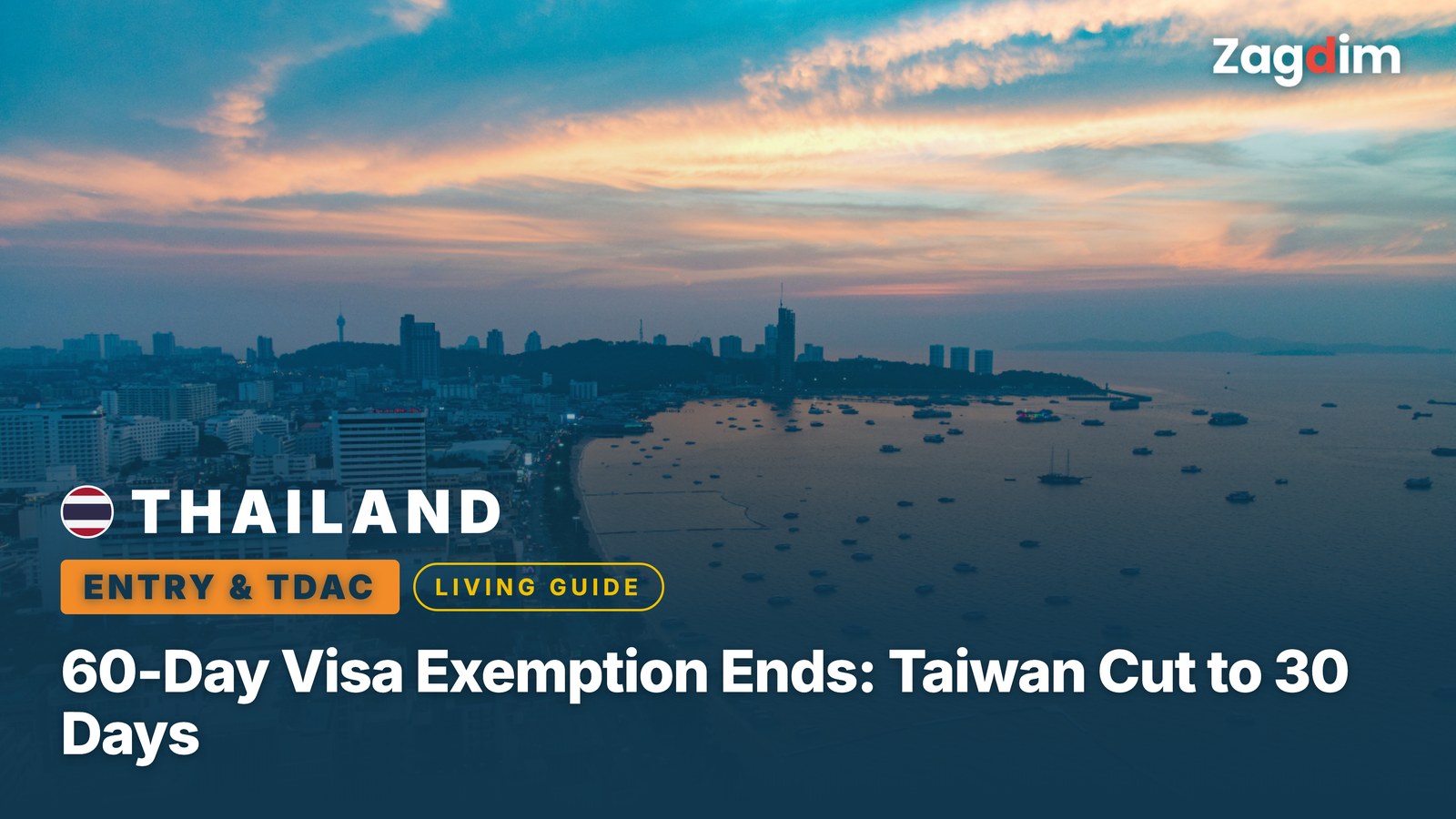
Thailand’s Ministry of Interior published a new notice in the Royal Gazette on August 31, 2026, formally canceling the 60-day visa exemption that covered 93 countries and territories. The new rules take effect September 15, 2026: travelers from Taiwan and the other countries and territories on the new list will have their tourist visa-exempt stay reduced to a maximum of 30 days.
This is not a case of all 93 countries simply moving to 30 days. The arrangements have been reorganized into a 30-day exemption, a 15-day exemption, visa on arrival, and bilateral exemption agreements.
Data current as of: September 2, 2026
How Is the New System Categorized?
| Entry Arrangement | Coverage | Stay Allowed |
|---|---|---|
| Visa exemption | 60 countries/territories | Up to 30 days |
| Visa exemption | Mauritius, Seychelles | Up to 15 days |
| Visa on arrival | Azerbaijan, Belarus, Serbia | Per visa-on-arrival rules |
| Bilateral exemption | Mainland China, Hong Kong, Macau, and others | 14, 30, or 90 days per individual agreement |
The new 30-day exemption applies to tourism purposes only. Work, study, media activities, or other activities that require prior approval still require the corresponding visa based on actual purpose.
What Is Different for Taiwan, Hong Kong, Macau, and Mainland China Travelers?
| Passport | Arrangement From September 15 | Actual Change |
|---|---|---|
| Taiwan | 30-day tourist exemption | Cut from 60 days to 30 days |
| Hong Kong SAR | 30-day bilateral exemption | Stay length unchanged |
| Macau SAR | 30-day bilateral exemption | Stay length unchanged |
| Mainland China | 30-day bilateral exemption | Stay length unchanged; capped at 90 days cumulative within any 180-day period |
| Indonesia | 30-day tourist exemption | Cut from 60 days to 30 days |
Taiwan’s passport is included in the newly announced 60-country list, so it represents an actual reduction from 60 days to 30 days. Hong Kong, Macau, and mainland China passports continue to use their existing bilateral exemption arrangements, and after this adjustment they can still stay visa-free for 30 days.
Under the China-Thailand ordinary passport mutual visa exemption agreement, each stay is capped at 30 days, and cumulative stay within any 180-day period must not exceed 90 days; residence, work, study, media activities, and other activities requiring prior approval are excluded from the exemption. The Thailand Ministry of Foreign Affairs’ explainer on the China-Thailand mutual visa exemption sets out these limits.
Which Countries and Territories Qualify for the 30-Day Exemption?
The final 30-day tourist exemption list covers 60 countries and territories in total:
| Australia | Austria | Bahrain | Belgium |
| Bulgaria | Bhutan | Brunei | Canada |
| Croatia | Cyprus | Czech Republic | Denmark |
| Estonia | Fiji | Finland | France |
| Georgia | Germany | Greece | Hungary |
| Iceland | Indonesia | India | Ireland |
| Israel | Italy | Japan | Jordan |
| Kuwait | Kyrgyzstan | Latvia | Liechtenstein |
| Lithuania | Luxembourg | Malta | Malaysia |
| Maldives | Netherlands | New Zealand | Norway |
| Oman | Philippines | Poland | Portugal |
| Qatar | Romania | Saudi Arabia | Singapore |
| Slovakia | Slovenia | South Africa | Spain |
| Sweden | Switzerland | Taiwan | Turkey |
| Ukraine | United Arab Emirates | United Kingdom | United States |
Using this 30-day exemption to enter by land border is, in principle, limited to twice per calendar year. Malaysia, Brunei, Indonesia, Singapore, and any other countries or territories separately designated by the Minister of Interior are not subject to this limit; the restriction applies specifically to land-border entry and does not mean all air arrivals are capped at twice a year. The Royal Gazette notice on the 30-day exemption and full country list sets out the relevant conditions.
What Happens if You Already Entered Before September 15?
Anyone who entered under the previous system before the new rules take effect may stay until the period granted at entry expires. If an immigration officer already granted 60 days, that stay will not automatically shorten to 30 days just because the new rule takes effect on September 15. The Consular Affairs Department of the Thailand Ministry of Foreign Affairs has confirmed this transitional arrangement.
The key factor for determining whether the old or new rules apply is the actual date of entry, not the date you booked your flight, reserved a hotel, or filled out the Thailand Digital Arrival Card. The final permitted stay is still based on the passport entry stamp or the immigration system record.
Can You Extend Your Stay After 30 Days?
Travelers can still apply to Thai Immigration for an extension of up to 30 days, but the extension is not automatic — approval is at the discretion of immigration authorities on a case-by-case basis.
If a trip needs to run longer than 30 days from the outset, or involves remote work, study, retirement, or other long-term activities, you should consider a tourist visa, DTV, or the corresponding non-immigrant visa rather than treating a visa-exemption extension as a guaranteed 60-day arrangement.
This announcement only changes the visa exemption and visa on arrival arrangements. It does not change the stay rules for DTV, LTR, Thailand Privilege, retirement, work, student, or dependent visas.
Planning a Longer Stay in Thailand?
If you are not sure which entry arrangement applies to your passport, or whether you should switch to a DTV, retirement visa, or another long-term visa, feel free to ask Zagdim.
This article summarizes public policy information only and does not constitute individual immigration or legal advice. Entry eligibility and the permitted length of stay are ultimately determined by Thai immigration authorities.
FAQ
Has Thailand’s 60-day visa exemption officially been canceled?
Yes. Thailand’s Ministry of Interior published a notice in the Royal Gazette on August 31, 2026, revoking the 60-day special visa exemption introduced in 2024 for 93 countries and territories; the new rules take effect September 15, 2026. This is now a confirmed change, not just a cabinet proposal or approval in principle. The new system does not simply convert all 93 countries to 30 days — it reorganizes arrangements into a 30-day tourist exemption, a 15-day tourist exemption, visa on arrival, and bilateral exemption arrangements. The final 30-day list covers 60 countries and territories, and some passports continue to receive 14, 30, or 90 days under separate bilateral agreements. Travelers should check the arrangement that applies to their own passport rather than assuming “everyone goes from 60 to 30 days.”
How long can Taiwan, Hong Kong, Macau, and mainland China passport holders stay visa-free?
Taiwan’s passport is on the new 30-day tourist exemption list, so its stay is reduced from 60 days to 30 days. Hong Kong SAR and Macau SAR passports continue to use their own respective bilateral arrangements with Thailand and remain at 30 days visa-free. Mainland China’s ordinary passport also continues under the China-Thailand mutual visa exemption agreement, capped at 30 days per stay and 90 days cumulative within any 180-day period. All four end up with a 30-day stay going forward, but the actual change differs: Taiwan is a reduction from 60 days, while Hong Kong, Macau, and mainland China simply retain their existing 30-day arrangements. These exemptions apply only to the purposes allowed under the relevant notice or agreement and do not automatically cover residence, work, study, media activities, or other activities requiring prior approval.
If I entered before September 15, will my existing 60 days be shortened?
No. Thailand’s Ministry of Foreign Affairs has stated that anyone who entered under the previous exemption system before the new measure takes effect may stay until their originally granted period expires. If an immigration officer already granted 60 days on the passport entry stamp or in the electronic record, it will not automatically change to 30 days once the new rule takes effect. What determines which rules apply is the actual date of arrival in Thailand and completion of immigration clearance — not the date of ticket purchase, hotel booking, or filling out the Thailand Digital Arrival Card. Travelers should still check the permitted stay date immediately after entry; if the entry stamp or electronic record does not match expectations, raise it before leaving the arrival area, or check with Thai immigration authorities as soon as possible.
Sources
- Thailand Royal Gazette – Notice Revoking the 60-Day Special Visa Exemption for 93 Countries and Territories
- Thailand Royal Gazette – Notice on the 30-Day Tourist Visa Exemption for 60 Countries and Territories
- Thailand Royal Gazette – Notice on the 15-Day Tourist Visa Exemption for Mauritius and Seychelles
- Thailand Royal Gazette – Notice on Visa on Arrival for Azerbaijan, Belarus, and Serbia
- Consular Affairs Department, Thailand Ministry of Foreign Affairs – Update on Thailand’s Visa Exemption and Visa on Arrival Measures
- Thailand Ministry of Foreign Affairs – China-Thailand Ordinary Passport Mutual Visa Exemption Agreement
Have a question about this guide? Leave a comment below, or ask Zagdim directly.
Your first stop for international property and global living.
Research and insights. Know what’s changing. Understand what matters.