






























Zagdim Overseas
Subscribe
  • Home
  • Real Estate & Economic News
    • All
    • Japan Market News
    • Other Market News
    • Thailand Market News
    • UK Market News
    • Vietnam Market News
    Prime London Rental Values Jump 67% as Supply Contracts

    Prime London Rental Values Rise 67% as Supply Contracts

    Portugal's One-Bed Rent Now Tops the Minimum Wage

    One-Bedroom Flat Rent in Portugal Now Costs More Than Minimum Wage

    Dubai Rents Fall Up to 15% as Tenants Switch to New Leases

    Dubai Tenants Switch Homes as New-Lease Rents Fall Up to 15%

    Ras Al Khaimah waterfront apartments and palm promenade aerial view

    Ras Al Khaimah Apartment Prices Rise 18% in H1 2026 as Record Hotel Guest Numbers Land

    Halifax Harbour sunset skyline

    Canada Sets 90-Day Deadline for Atlantic Immigration Applicants Facing Employment Changes

    Sydney CBD night skyline

    Australia’s Capital Gains Tax Reform Takes Effect July 2027 — Why a Valuation Now Could Matter

    Trending Tags

  • Zagdim Insights
    • All
    • Market Trends Overview
    • Policy Interpretation
    • Zagdim Insights
    Automated immigration gates at Suvarnabhumi Airport

    Thailand’s Suvarnabhumi Auto Gates Expand to 33 Nationalities: Full List, Eligibility and TDAC Guide

    1960 archive photo of Queen Sirikit at a gala concert in The Hague, with Bank of Thailand specimens of the THB100 and THB500 commemorative notes

    Thailand’s commemorative banknotes return in October: where to exchange the THB100 and THB500 notes

    A document-style cover showing the Thai Revenue Department’s 15 September 2026 GloBE MCAA announcement with the subject line highlighted.

    Thailand joins the global minimum tax information exchange: which businesses need to pay attention, and are individuals affected?

    A 2025 file photo of Australian Home Affairs Minister Tony Burke at a meeting, alongside Zagdim’s analysis title on Australia’s migration reforms.

    Australia announces migration reforms targeting student families, visa switching and longer stays

    China’s Entry-Exit Agency Rules: What Your Business Needs to Prepare. Paper folders labelled Deadlines, Documents and Partners, with a calendar, Chinese gateway and flight route. AI-generated illustration.

    China’s New Entry-Exit Agency Rules: What Your Business Needs to Prepare

    Three UK New-Build Thresholds for 2026: The Building Safety Levy, Second Staircases and the New EPC

    Zagdim Research cover: investigator setting up cameras in an empty Japanese apartment - Japan Prices Death Into Its Housing Market, and Buyers Have Begun to Bite

    Japan Prices Death Into Its Housing Market — and Buyers Have Begun to Bite

    Thailand to Cancel 60-Day Visa Exemption: What Long-Stay Options Are Available for Foreigners?

    Thailand to Cancel 60-Day Visa Exemption: What Long-Stay Options Are Available for Foreigners?

    Thailand Cabinet Approves Cancellation of 60-Day Visa Exemption for 93 Countries; Official Effective Date Still Pending Royal Gazette Publication

    Thailand Cabinet Approves Cancellation of 60-Day Visa Exemption for 93 Countries; Official Effective Date Still Pending Royal Gazette Publication

    • Zagdim Insights
    • Market Trends Overview
    • Policy Interpretation
  • Global Reports
    Zagdim Featured CBRE Thailand Mid-Year Outlook 2026

    CBRE Thailand Mid-Year Outlook: What Is Changing Across Six Real Estate Sectors?

    More Firms, a Busier First Half, a Softer Q2: What Vietnam’s Property Data Show, and Where ‘Repositioning’ Is a Reading

    More Firms, a Busier First Half, a Softer Q2: What Vietnam’s Property Data Show, and Where ‘Repositioning’ Is a Reading

    The Headline Number and the Real One: Reading UK Home Values After Inflation

    The Headline Number and the Real One: Reading UK Home Values After Inflation

    Tokyo’s Property Boom: How to Read AMRO’s ‘Warning, Not a Crisis’

    Tokyo’s Property Boom: How to Read AMRO’s ‘Warning, Not a Crisis’

    A Soft Summer for US Housing: What the Data Show, and Where ‘Hurting’ Is CNBC’s Word

    A Soft Summer for US Housing: What the Data Show, and Where ‘Hurting’ Is CNBC’s Word

    Malaysia’s Property Market Is Getting Choosier — What \”Selective\” Does and Doesn’t Say

    Malaysia’s Property Market Is Getting Choosier — What \”Selective\” Does and Doesn’t Say

    72% at the Top: What Mainland Buyer-Share Data Say About Hong Kong Property — and What They Don’t

    72% at the Top: What Mainland Buyer-Share Data Say About Hong Kong Property — and What They Don’t

    Hong Kong Home Prices Are Up ~10% This Year — but Can the Rebound Last Without Local Owners?

    Hong Kong Home Prices Are Up ~10% This Year — but Can the Rebound Last Without Local Owners?

    193 Deals in Dubai, 94 in Hong Kong: Reading a Super-Prime Quarter Without Calling It a Cycle

    193 Deals in Dubai, 94 in Hong Kong: Reading a Super-Prime Quarter Without Calling It a Cycle

  • Buying & Immigration Guide
    • All
    • Expat Lifestyle Guide
    • International Property Buying Guide
    • Overseas Leasing & Long-Term Stay
    • Real Estate Law & Taxation
    • Relocation, Immigration & Visa
    Five things a first-time overseas buyer must settle before buying in London: entry (SDLT and the two surcharges), financing (interest relief capped at 20%), holding (NRLS and letting compliance), title (leasehold and building safety), exit (NRCGT and your treaty position)

    Is London property worth buying? Five things a first-time overseas buyer must settle first

    Japan’s Revised Condominium Ownership Act (2026): What Overseas Owners Need to Know About Voting Rights, Resolutions, and the New Domestic Manager Requirement

    Japan’s Revised Condominium Ownership Act (2026): What Overseas Owners Need to Know About Voting Rights, Resolutions, and the New Domestic Manager Requirement

    Before You Buy Property in Vietnam: Eligible Assets, Prohibited Categories, and How Land Rights Actually Work for Overseas Buyers

    Before You Buy Property in Vietnam: Eligible Assets, Prohibited Categories, and How Land Rights Actually Work for Overseas Buyers

    Buying Property in London: Key Risks to Check Before You Exchange — Leasehold, Service Charges, Off-Plan Deposits, and Contracts

    Buying Property in London: Key Risks to Check Before You Exchange — Leasehold, Service Charges, Off-Plan Deposits, and Contracts

    Opening a UK Bank Account as an Overseas Resident: Identity, Address, and What to Check Before You Apply

    Opening a UK Bank Account as an Overseas Resident: Identity, Address, and What to Check Before You Apply

    UK Residential Mortgage Readiness for Overseas Buyers: What Lenders Check on Income, Status, and Deposit

    UK Residential Mortgage Readiness for Overseas Buyers: What Lenders Check on Income, Status, and Deposit

    How should overseas owners manage and rent out property in Japan after purchase?

    How should overseas owners manage and rent out property in Japan after purchase?

    The retirees who no longer want to renew their Thai visa every year

    The retirees who no longer want to renew their Thai visa every year

    Same retirement age, different Thailand residence choices: Retirement O, LTR, and Thailand Privilege

    Same retirement age, different Thailand residence choices: Retirement O, LTR, and Thailand Privilege

    Trending Tags

  • About
    • Ask Questions
    • Zagdim Research
    • Contact Us — LINE / WhatsApp
  • 中文 EN
No Result
View All Result
Zagdim
  • Home
  • Real Estate & Economic News
    • All
    • Japan Market News
    • Other Market News
    • Thailand Market News
    • UK Market News
    • Vietnam Market News
    Prime London Rental Values Jump 67% as Supply Contracts

    Prime London Rental Values Rise 67% as Supply Contracts

    Portugal's One-Bed Rent Now Tops the Minimum Wage

    One-Bedroom Flat Rent in Portugal Now Costs More Than Minimum Wage

    Dubai Rents Fall Up to 15% as Tenants Switch to New Leases

    Dubai Tenants Switch Homes as New-Lease Rents Fall Up to 15%

    Ras Al Khaimah waterfront apartments and palm promenade aerial view

    Ras Al Khaimah Apartment Prices Rise 18% in H1 2026 as Record Hotel Guest Numbers Land

    Halifax Harbour sunset skyline

    Canada Sets 90-Day Deadline for Atlantic Immigration Applicants Facing Employment Changes

    Sydney CBD night skyline

    Australia’s Capital Gains Tax Reform Takes Effect July 2027 — Why a Valuation Now Could Matter

    Trending Tags

  • Zagdim Insights
    • All
    • Market Trends Overview
    • Policy Interpretation
    • Zagdim Insights
    Automated immigration gates at Suvarnabhumi Airport

    Thailand’s Suvarnabhumi Auto Gates Expand to 33 Nationalities: Full List, Eligibility and TDAC Guide

    1960 archive photo of Queen Sirikit at a gala concert in The Hague, with Bank of Thailand specimens of the THB100 and THB500 commemorative notes

    Thailand’s commemorative banknotes return in October: where to exchange the THB100 and THB500 notes

    A document-style cover showing the Thai Revenue Department’s 15 September 2026 GloBE MCAA announcement with the subject line highlighted.

    Thailand joins the global minimum tax information exchange: which businesses need to pay attention, and are individuals affected?

    A 2025 file photo of Australian Home Affairs Minister Tony Burke at a meeting, alongside Zagdim’s analysis title on Australia’s migration reforms.

    Australia announces migration reforms targeting student families, visa switching and longer stays

    China’s Entry-Exit Agency Rules: What Your Business Needs to Prepare. Paper folders labelled Deadlines, Documents and Partners, with a calendar, Chinese gateway and flight route. AI-generated illustration.

    China’s New Entry-Exit Agency Rules: What Your Business Needs to Prepare

    Three UK New-Build Thresholds for 2026: The Building Safety Levy, Second Staircases and the New EPC

    Zagdim Research cover: investigator setting up cameras in an empty Japanese apartment - Japan Prices Death Into Its Housing Market, and Buyers Have Begun to Bite

    Japan Prices Death Into Its Housing Market — and Buyers Have Begun to Bite

    Thailand to Cancel 60-Day Visa Exemption: What Long-Stay Options Are Available for Foreigners?

    Thailand to Cancel 60-Day Visa Exemption: What Long-Stay Options Are Available for Foreigners?

    Thailand Cabinet Approves Cancellation of 60-Day Visa Exemption for 93 Countries; Official Effective Date Still Pending Royal Gazette Publication

    Thailand Cabinet Approves Cancellation of 60-Day Visa Exemption for 93 Countries; Official Effective Date Still Pending Royal Gazette Publication

    • Zagdim Insights
    • Market Trends Overview
    • Policy Interpretation
  • Global Reports
    Zagdim Featured CBRE Thailand Mid-Year Outlook 2026

    CBRE Thailand Mid-Year Outlook: What Is Changing Across Six Real Estate Sectors?

    More Firms, a Busier First Half, a Softer Q2: What Vietnam’s Property Data Show, and Where ‘Repositioning’ Is a Reading

    More Firms, a Busier First Half, a Softer Q2: What Vietnam’s Property Data Show, and Where ‘Repositioning’ Is a Reading

    The Headline Number and the Real One: Reading UK Home Values After Inflation

    The Headline Number and the Real One: Reading UK Home Values After Inflation

    Tokyo’s Property Boom: How to Read AMRO’s ‘Warning, Not a Crisis’

    Tokyo’s Property Boom: How to Read AMRO’s ‘Warning, Not a Crisis’

    A Soft Summer for US Housing: What the Data Show, and Where ‘Hurting’ Is CNBC’s Word

    A Soft Summer for US Housing: What the Data Show, and Where ‘Hurting’ Is CNBC’s Word

    Malaysia’s Property Market Is Getting Choosier — What \”Selective\” Does and Doesn’t Say

    Malaysia’s Property Market Is Getting Choosier — What \”Selective\” Does and Doesn’t Say

    72% at the Top: What Mainland Buyer-Share Data Say About Hong Kong Property — and What They Don’t

    72% at the Top: What Mainland Buyer-Share Data Say About Hong Kong Property — and What They Don’t

    Hong Kong Home Prices Are Up ~10% This Year — but Can the Rebound Last Without Local Owners?

    Hong Kong Home Prices Are Up ~10% This Year — but Can the Rebound Last Without Local Owners?

    193 Deals in Dubai, 94 in Hong Kong: Reading a Super-Prime Quarter Without Calling It a Cycle

    193 Deals in Dubai, 94 in Hong Kong: Reading a Super-Prime Quarter Without Calling It a Cycle

  • Buying & Immigration Guide
    • All
    • Expat Lifestyle Guide
    • International Property Buying Guide
    • Overseas Leasing & Long-Term Stay
    • Real Estate Law & Taxation
    • Relocation, Immigration & Visa
    Five things a first-time overseas buyer must settle before buying in London: entry (SDLT and the two surcharges), financing (interest relief capped at 20%), holding (NRLS and letting compliance), title (leasehold and building safety), exit (NRCGT and your treaty position)

    Is London property worth buying? Five things a first-time overseas buyer must settle first

    Japan’s Revised Condominium Ownership Act (2026): What Overseas Owners Need to Know About Voting Rights, Resolutions, and the New Domestic Manager Requirement

    Japan’s Revised Condominium Ownership Act (2026): What Overseas Owners Need to Know About Voting Rights, Resolutions, and the New Domestic Manager Requirement

    Before You Buy Property in Vietnam: Eligible Assets, Prohibited Categories, and How Land Rights Actually Work for Overseas Buyers

    Before You Buy Property in Vietnam: Eligible Assets, Prohibited Categories, and How Land Rights Actually Work for Overseas Buyers

    Buying Property in London: Key Risks to Check Before You Exchange — Leasehold, Service Charges, Off-Plan Deposits, and Contracts

    Buying Property in London: Key Risks to Check Before You Exchange — Leasehold, Service Charges, Off-Plan Deposits, and Contracts

    Opening a UK Bank Account as an Overseas Resident: Identity, Address, and What to Check Before You Apply

    Opening a UK Bank Account as an Overseas Resident: Identity, Address, and What to Check Before You Apply

    UK Residential Mortgage Readiness for Overseas Buyers: What Lenders Check on Income, Status, and Deposit

    UK Residential Mortgage Readiness for Overseas Buyers: What Lenders Check on Income, Status, and Deposit

    How should overseas owners manage and rent out property in Japan after purchase?

    How should overseas owners manage and rent out property in Japan after purchase?

    The retirees who no longer want to renew their Thai visa every year

    The retirees who no longer want to renew their Thai visa every year

    Same retirement age, different Thailand residence choices: Retirement O, LTR, and Thailand Privilege

    Same retirement age, different Thailand residence choices: Retirement O, LTR, and Thailand Privilege

    Trending Tags

  • About
    • Ask Questions
    • Zagdim Research
    • Contact Us — LINE / WhatsApp
  • 中文 EN
No Result
View All Result
Zagdim
No Result
View All Result

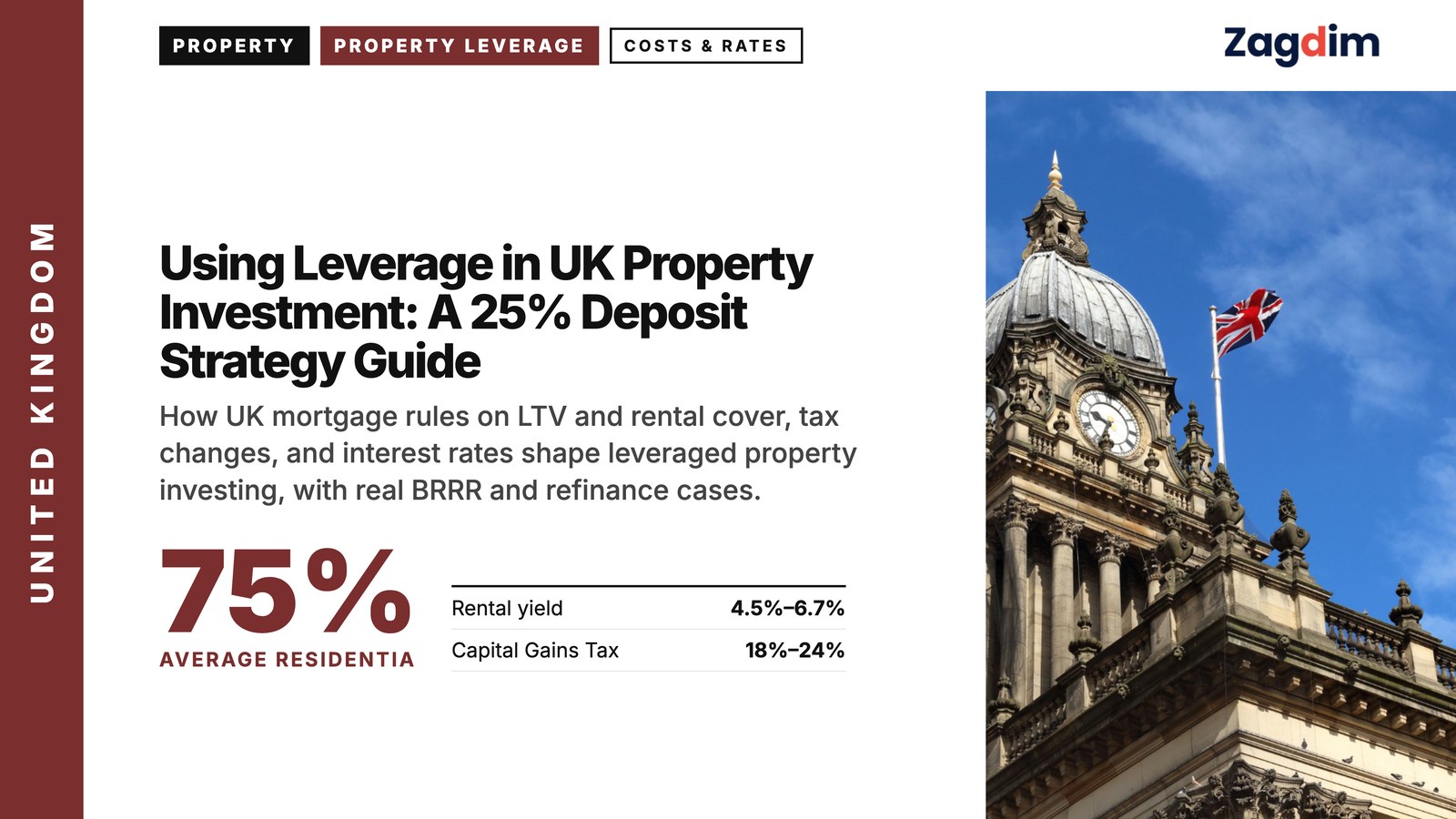
Using Leverage in UK Property Investment: A 25% Deposit Strategy Guide

Home Living Abroad
Leeds Town Hall with Union flag, illustrating Using Leverage in UK Property Investment: A 25% Deposit Strategy Guide

Image: Zagdim

September 24, 2026
in Living Abroad, Property, United Kingdom
Reading Time: 13 mins read

Part One: The Latest Regulatory and Policy Changes Affecting Leverage

As the UK property market recovers, leverage has become a key tool for investors looking to amplify returns. But since 2023, the UK’s Financial Conduct Authority (FCA) has tightened lending conditions, imposing stricter requirements on Loan-to-Value ratios (LTV) and Rental Cover Ratios (RCR). These new rules directly affect how investors allocate capital and manage cash flow, meaning leveraged investing now comes with both greater challenges and new opportunities.

LTV Limits Have Tightened — Breaking the Old Leverage Rules

In the past, investors in the UK property market could generally borrow 75% to 80% of a property’s value, giving them plenty of room to leverage. But since 2023, lending policy has shifted noticeably — particularly in high-value areas such as London, where the maximum LTV has been lowered, putting pressure on investors’ room to manoeuvre.

Within this shift, policy has become clearly divided by region:

  • The maximum LTV in high-value areas such as central London has fallen to 65%
  • Northern cities such as Manchester and Leeds remain at 75%
  • The Mortgage Works (TMW) has explicitly stated that LTV products above 75% apply only to energy-efficient properties rated EPC C or above

This means that to secure a higher LTV, investors need to prioritise more energy-efficient properties, or upgrade a property after purchase to meet energy-efficiency standards.

➡️ Strategic takeaway: Investors who want to maximise their leverage room need to factor energy efficiency (EPC rating) into their property selection, and make sure the property meets the latest lending-approval standards.

Rental Cover Ratio (RCR) Requirements Have Risen — Strengthening the Cash-Flow Safety Net

In the UK property market, the Rental Cover Ratio (RCR) is an important measure of an investor’s cash-flow safety. In the past, stress tests were typically calculated using “product rate + 2%,” but the latest policy has raised the bar further, to make sure investors have enough rental income to cover their loan costs.

The latest changes are:

  • The stress-test standard has risen to as high as 7.5%
  • The RCR calculation method has changed to a “four-quarter rolling average,” to reduce the impact of seasonal fluctuations

This means that properties with less stable rental income, or a pronounced peak/off-peak seasonal pattern, may not pass lending approval. This change poses a bigger challenge for short-let properties (such as Airbnb), since their cash flow tends to be less stable.

➡️ Strategic takeaway: Choosing properties with stable rental returns and an RCR of 145% or above will be key to leveraged investing. At the same time, optimising a property’s letting structure and increasing the proportion of long-term tenancies can help stabilise cash flow and reduce stress-test risk.

Tax Policy Changes — Squeezing Leveraged Returns

Alongside tighter leverage room, important changes have also taken place in UK tax policy affecting individual landlords and foreign investors. These policy adjustments will further affect investors’ after-tax returns, making “capital allocation” and “tax optimisation” key to how leverage is used.

First, mortgage interest relief for individual landlords has been withdrawn, replaced with a fixed 20% tax credit. This means landlords can no longer deduct mortgage interest in full, so actual holding costs will rise.

In addition, Capital Gains Tax on residential property was 18%/28% (basic/higher rate); from 30 October 2024 it was reduced to a unified 18%/24%, aligning with the general CGT rate rise for other assets, and the “enveloped dwellings” tax exemption has been withdrawn — for investors hoping to profit from short-term price appreciation, this change may squeeze capital returns.

Finally, the tax environment for foreign investors has also become stricter. From 1 April 2025, the standard Stamp Duty nil-rate threshold reverted from £250,000 to £125,000 for all buyers; non-UK-resident buyers separately pay an additional 2% surcharge on top (unchanged, in force since April 2021), meaning foreign buyers will face higher transaction costs.

➡️ Strategic takeaway:

  • For heavily taxed individual landlords, setting up a limited company (SPV) to hold property has become a common way to reduce the tax burden
  • Through a company structure, mortgage interest can still be deducted in full, and Capital Gains Tax can effectively be reduced to the Corporation Tax rate — currently a tiered structure: 19% on profits up to £50,000, 25% on profits above £250,000 (with Marginal Relief in between), not a flat 19%
  • Completing a transaction before the new Stamp Duty policy takes effect helps reduce one-off transaction costs

Practical Recommendations — Leverage Strategy Under the New Regulatory Environment

Under the latest regulatory environment, investors need to reassess their capital allocation and leverage strategy. The following directions are worth considering:

  1. Prioritise properties rated EPC C or above → Energy-efficient properties not only help with loan approval, but may also qualify for policy incentives
  2. Keep LTV below 70% → Maintain enough cash-flow headroom to avoid cash-flow risk from market volatility
  3. Choose properties with a Rental Cover Ratio above 145% → Stable rental income will be key to securing loans and maintaining cash flow
  4. Use an SPV to optimise tax structure → Effectively reduces holding costs and allows more flexible asset-management options

Part Two: Comparing Leverage and Returns Across Regional Markets

In the UK property market, leverage room and returns vary noticeably between cities. Northern cities (such as Manchester and Leeds) offer higher rental yields and more relaxed lending conditions, attracting large numbers of investors hoping to amplify returns through leverage. By comparison, southern markets such as London and Birmingham have more limited leverage room, but still offer attractive capital-appreciation potential, suiting long-term allocation and steady-growth strategies.

Understanding each market’s leverage characteristics and return potential will be key to improving investment returns.

Leverage and Returns by City

Below is a comparison of maximum leverage, rental yield and five-year price growth across major UK cities:

City Average House Price (£) Max LTV Rental Yield 5-Year Growth
Manchester 253,982 75% 6.73% 27.12%
Birmingham 301,246 70% 4.57% 21%
Leeds 219,955 75% 9.5% 30%
London 599,652 65% 4.4% 11%

Interest Rate Environment and Leverage Cost Trends

In leveraged investing, interest rates are a key factor affecting both investment returns and cash-flow stability. Over the past few years, the UK’s benchmark interest rate has swung sharply, directly affecting property mortgage rates and leverage costs. As rates have climbed rapidly from historic lows, investors have faced higher borrowing costs and greater cash-flow pressure. However, the market broadly expects the Bank of England to start gradually cutting rates over the next two to three years, which would open up new room and opportunity for leveraged investing.

UK Benchmark Rate and Mortgage Rate Trends

The UK’s benchmark interest rate fell to a historic low of 0.1% in 2020, a period when leveraged investing was highly attractive, letting investors use low-cost borrowing to amplify capital returns. However, to combat inflationary pressure, the Bank of England (BoE) began raising rates consecutively from 2022, and by 2024 the benchmark rate had risen to 4.5%.

Below is the historical trend and forecast for the UK benchmark rate and five-year fixed mortgage rate:

Year Benchmark Rate 5-Year Fixed Mortgage Rate
2020 0.1% 1.8%–2.2%
2022 3.5% 4.0%–4.5%
2024 4.5% 4.8%–5.2%
2025 (forecast) 4.2% 4.5%–4.9%
2027 (forecast) 3.0% 3.8%–4.2%

How Rate Changes Affect Leveraged Investing

Rate movements don’t just affect the lending rate itself — they are directly tied to an investor’s leverage room and cash-flow pressure.

1. When rates rise → cash-flow pressure increases

  • A higher lending rate → higher leverage cost
  • For example: if the benchmark rate rises 1%, the five-year mortgage rate could rise to 5.5%–6%
  • In a leveraged position, cash-flow pressure and monthly repayment costs will rise noticeably

2. When rates fall → leverage costs come down

  • A lower benchmark rate → investors can lower their leverage costs through refinancing
  • Rates falling back toward the expected 3%–3.5% range would help improve leverage flexibility

📊 Interest-Rate Sensitivity Analysis

Taking a £500,000 loan as an example, here is how different interest-rate levels affect monthly repayment cost and leveraged investing:

Mortgage Rate Monthly Payment (£) Annual Payment (£) RCR Requirement (145% standard)
3% £2,108 £25,296 £3,057/month
4% £2,387 £28,644 £3,461/month
5% £2,675 £32,100 £3,876/month
6% £2,978 £35,736 £4,314/month

🏦 Fixed vs Variable Rate Strategy

UK mortgage products are generally split into “fixed rate” and “variable rate” — the right choice differs depending on whether rates are rising or falling:

✅ Fixed rate → suited to a rising-rate environment

  • Rate-lock periods are typically 2 or 5 years
  • Helps control cash flow and reduces the uncertainty that comes with rate volatility
  • Current 5-year fixed rates are around 4.8%–5.2%

✅ Variable rate → suited to a falling-rate environment

  • The rate tracks market movements
  • The market broadly expects rates to fall between 2025 and 2027, so choosing a variable rate may bring lower financing costs

Part Four: Success and Failure Cases in Leveraged Investing

Leveraged investing is a “high-risk, high-return” strategy — whether it succeeds often comes down to how well the leverage ratio is controlled, how stable the cash flow is, and how well the investor responds to market change. In the UK property market, successful leveraged strategies tend to combine “low-cost financing” with “high rental returns” to boost overall investment returns; failed cases are more often the result of over-leveraging, which leads to a funding squeeze or cash flow that can no longer be sustained.

👉 Two successful cases and one failed case below illustrate the common factors behind success and failure in leveraged investing, drawing out practical, real-world strategy lessons.

Success Case 1: The BRRR (Buy, Refurbish, Refinance, Rent) Model

📍 Location: Manchester M14 (student area)
Property type: 3-bedroom terraced house
Leverage method: BRRR (Buy, Refurbish, Refinance, Rent)

The Process:

1. Buy:

  • In 2021, the investor bought a 3-bedroom terraced house in central Manchester for £173,000
  • Using a 75% LTV leveraged loan, the deposit required was just £43,250

2. Refurbish:

  • The investor put in about £15,000 on interior renovation, including a kitchen and bathroom upgrade and double-glazed windows
  • This raised the property’s EPC rating from D to B, meeting the lender’s refinancing standard

3. Refinance:

  • After renovation, the property’s valuation rose to £245,000
  • On the same 75% LTV basis, the investor successfully refinanced £183,750
  • After deducting the original loan, the investor recovered £40,500 in cash

4. Let:

  • After renovation, monthly rent rose from £850 to £1,200
  • Annual rental yield reached 6.7%
  • The Rental Cover Ratio (RCR) reached 150%, keeping cash flow stable

Result Analysis:

✅ Capital appreciation: the property gained 41% in value in a short period
✅ High RCR: a 150% rental cover ratio kept cash flow healthy
✅ Refinancing successfully recovered part of the original investment, improving capital flexibility

➡️ Strategy highlights:

  • The key to success was “EPC upgrade + choosing the right location”
  • Choosing a student area meant stable rental demand and good room for rent growth
  • A high rental cover ratio kept cash flow healthy after refinancing

Success Case 2: Low Leverage + Capital Appreciation

📍 Location: London Zone 2 (upscale residential area)
Property type: 2-bedroom flat
Leverage method: Low leverage + long-term holding

The Process:

1. Buy:

  • In 2020, the investor bought a 2-bedroom flat in London Zone 2 for £580,000
  • Using 60% LTV leverage, the deposit was about £232,000

2. Let:

  • Monthly rent was about £2,200
  • Rental yield was about 4.5%
  • RCR was about 145%, keeping cash flow stable

3. Hold for Appreciation:

  • London property prices rose about 18% between 2020 and 2024
  • The property’s value rose from £580,000 to £685,000

4. Refinance:

  • Refinanced in 2024, with a valuation of £685,000
  • Refinanced amount was £410,000, an increase of £58,000 over the original loan
  • Successfully recovered part of the capital, creating more funding flexibility for future investment

Result Analysis:

✅ Capital appreciation: 18% growth over four years, a steady return
✅ Healthy cash flow: RCR of 145%, easily covering the mortgage interest
✅ Low-leverage strategy → reduced the risk from market volatility

➡️ Strategy highlights:

  • In the London market, capital-appreciation potential is an important safeguard in leveraged investing
  • Low leverage reduces market-volatility risk, keeping cash flow stable and the position flexible

Failure Case: High Leverage + a Funding Squeeze

📍 Location: Central London (commercial property)
Property type: Commercial office
Leverage method: High LTV + no cash-flow buffer

The Process:

1. Buy:

  • In 2022, the investor bought a commercial property in central London for £800,000
  • Using 80% LTV leverage, the loan amount reached £640,000

2. Problems Emerge:

  • In 2023, interest rates rose to 5.0%, and the monthly payment rose from £2,600 to £3,500
  • As vacancy rose, rent fell from £3,200 to £2,800
  • RCR fell to 80%, no longer meeting the lending standard

3. Refinancing Fails, and the Property Is Sold:

  • The bank refused to refinance and asked for a larger deposit
  • Unable to sustain the cash flow, the investor was forced to sell the property for £750,000
  • The final loss exceeded £50,000, including roughly £40,000 of the original investment

Result Analysis:

❌ High leverage → increased interest-rate risk and cash-flow pressure
❌ A market downturn → both price and rent fell, unable to support the mortgage interest
❌ No risk buffer → the funding chain broke, forcing a sale

➡️ Lessons and strategic recommendations:

  • Keep LTV below 70% to reduce interest-rate risk
  • Prioritise properties with “high rental yield + low vacancy”
  • Build a cash reserve of 6–12 months to cope with rate volatility

Part Five: Comparing Leverage Strategy in the UK vs the US vs Singapore

Across the world’s major property markets, leverage has become a core strategy for investors seeking higher returns and capital growth. However, regulatory policy, Loan-to-Value ratios (LTV), rental yields and holding costs differ significantly by country, meaning how well leverage works, and how it should be applied, varies from market to market.

👉 Below is a comparison of the core differences in leverage strategy across the UK, US and Singapore, along with each market’s strengths and weaknesses, to help investors build a more flexible international allocation strategy.

🌍 Market Fundamentals Compared

Indicator UK US Singapore
Average residential LTV 75% 80%–90% 55%–60%
Rental yield 4.5%–6.7% 3.8%–5.2% 2.5%–3.5%
Mortgage rate 4.8%–5.2% (fixed) 6%–7% (variable) 3.5%–4.0% (fixed)
Loan term Up to 30 years Up to 30 years Up to 35 years
Restrictions on foreign participation No major restrictions Some states restrict Additional tax required (ABSD)
Capital Gains Tax 18%–24% None (except in some states) None
Stamp duty Up to 15% (for foreigners) Up to 2% (some states) Up to 35% (for foreigners)
Holding costs High (property tax, maintenance) Moderate (varies significantly by state) High (stamp duty, management fees)

🇬🇧 UK: Medium-to-High Leverage, Balancing Capital Growth and Cash Flow

Leverage conditions and advantages
✅ Average LTV can reach 75% (up to 80% in some northern markets)
✅ Rental yields as high as 4.5%–6.7%, with stable market demand
✅ Banks offer flexible loan products, including 2-year, 5-year and 10-year fixed rates

Operating model

  • Through the “Buy, Refurbish, Refinance” (BRRR) model, capital can be recovered quickly in the short term
  • Rental growth in the UK market is stable, making it easier to cover leverage costs through “high leverage + rental return”

Risks and challenges

  • Holding costs are relatively high (property tax, maintenance)
  • Capital Gains Tax and Stamp Duty may affect short-term returns

👉 Suitable strategy:
🔹 High leverage + short-term returns → suited to northern markets (Manchester, Leeds)
🔹 Low leverage + capital growth → suited to London and other core locations

🇺🇸 US: High Leverage, Low-Tax Environment

Leverage conditions and advantages
✅ Average LTV reaches 80%–90%, offering plenty of leverage room
✅ No Capital Gains Tax (except in some states), attractive for long-term capital allocation
✅ Steady price growth, averaging around 3%–5% a year

Operating model

  • US-market leverage strategies commonly run “cash flow + capital growth” side by side
  • High leverage is common in both residential and commercial property
  • REITs (Real Estate Investment Trusts) are an important tool for high-leverage strategies

Risks and challenges

  • Rates are relatively high (currently around 6%–7%), creating greater cash-flow pressure
  • Some states have rent control, limiting how much rent can be adjusted

👉 Suitable strategy:
🔹 High leverage + short-term arbitrage → suited to more volatile markets (Florida, Texas)
🔹 Steady leverage + long-term holding → suited to markets like California and New York

🇸🇬 Singapore: Low Leverage, High Holding Costs

Leverage conditions and advantages
✅ Average LTV is only 55%–60%, limited leverage room
✅ Steady price growth, averaging around 2%–3% a year
✅ A stable economy with relatively low market risk

Operating model

  • The Singapore market runs mainly on “low leverage + stable returns”
  • Foreign buyers must pay an Additional Buyer’s Stamp Duty (ABSD) of 35%
  • Property holding tax and management costs are relatively high

Risks and challenges

  • High stamp duty and holding costs squeeze capital returns
  • Rental yields are relatively low (around 2.5%–3.5%)

👉 Suitable strategy:
🔹 Cash purchase + long-term holding → suited to high-net-worth individuals or institutional investors
🔹 Low leverage + rental return → suited to central-area or luxury properties

This article takes an in-depth look at UK property leverage strategy, helping investors understand how to use loans (LTV) to amplify investment returns. It compares leverage conditions in the UK, US and Singapore, highlighting the UK market’s advantages in rental yield (up to 6.7%), leverage flexibility (LTV up to 75%) and capital-appreciation potential, and sets out practical strategies such as the “Buy, Refurbish, Refinance” (BRRR) model. For investors looking to improve returns on property investments worldwide, this is a valuable action guide.


*The content above is for reference only, provided as market analysis and strategy discussion, and does not constitute investment advice of any kind. Before making any investment decision, please carry out a full assessment based on your own financial situation, risk tolerance and market conditions, or consult a professional financial adviser.*

Related in this series:

  • Transport Hubs and Property Prices: What Drives the Premium
  • Why Manchester Is Popular With International Property Investors
  • What Cadogan and Chelsea Reveal About UK Leasehold Ownership
  • How UK Household Recycling Works: A Council-by-Council Guide

Have a question about this guide? Leave a comment below, or ask Zagdim directly.

Life abroad? Ask Zagdim.

Your first stop for international property and global living.

Research and insights. Know what’s changing. Understand what matters.

Zagdim AI
All content is researched, written, or authorized for publication by the @Zagdim Overseas team. Sharing and reposting are welcome, but please make sure to credit the source and include the original article link from this website. Any plagiarism or unauthorized use may result in legal action. For article submissions, please contact us via Facebook. Thank you for your support!

For article submissions, press release publication, or interview notices, please contact [email protected]. 

Zagdim Ask

Have a specific question about overseas living, property, visa, or practical arrangements?

Fill in your situation and key concerns through Zagdim Ask. Our team will review your message and get back to you by email where appropriate.

Submit your enquiry →

Similar Topics

Architecture — Roemerberg square with half-timbered houses and fountain at dusk Frankfurt, illustrating How to Buy Property in Germany: Process, Costs, and Taxes
Germany

How to Buy Property in Germany: Process, Costs, and Taxes

September 25, 2026
Landmark — Neuschwanstein Castle at sunset overlooking green valley, illustrating A Landlord's Checklist for Letting Property in Germany
Germany

A Landlord’s Checklist for Letting Property in Germany

September 25, 2026
Landmark — Neuschwanstein Castle among forested hills and mountains, illustrating Maintenance and Repairs in German Rentals: Landlord vs. Tenant Duties
Germany

Maintenance and Repairs in German Rentals: Landlord vs. Tenant Duties

September 25, 2026
Next Post
London Underground train at the platform, illustrating UK Education and Residency: A Guide for International Families

UK Education and Residency: A Guide for International Families

Construction crane and Big Ben at sunset, illustrating How UK Household Recycling Works: A Council-by-Council Guide

How UK Household Recycling Works: A Council-by-Council Guide

Aerial view of the Thames at dusk, illustrating LLP vs LTD in the UK: Which Suits Foreign Investors?

LLP vs LTD in the UK: Which Suits Foreign Investors?

Facebook Twitter Youtube

About Us

Zagdim is a global knowledge platform focused on cross-border property, relocation, lifestyle, and location-based decision-making.

We provide insights on overseas real estate, market trends, regional analysis, economic developments, and practical relocation information. Through continuous market observation and on-the-ground research, Zagdim helps readers better understand a place before deciding where to live, invest, buy property, or establish a base abroad.

We currently follow markets including the UK, Japan, Thailand, Malaysia, Germany, Australia, the UAE, Greece, Portugal, and Spain, while continuing to track emerging lifestyle, relocation, and property trends worldwide.

Category

  • Australia
  • Buying & Immigration Guide
  • Canada
  • Costa Rica
  • Dubai
  • Encyclopedia
  • Europe
  • Expat Lifestyle Guide
  • Germany
  • Global Reports Analysis
  • Hong Kong
  • Human-Picked
  • International Property Buying Guide
  • Japan
  • Japan Market News
  • Kenya
  • Living Abroad
  • Malaysia
  • Mallorca
  • Market Trends Overview
  • News
  • Other Market News
  • Overseas Leasing & Long-Term Stay
  • Philippines
  • Policy Interpretation
  • Portugal
  • Property
  • Property Law & Tax
  • Real Estate & Economic News
  • Real Estate Law & Taxation
  • Relocation, Immigration & Visa
  • Singapore
  • South Korea
  • Spain
  • Switzerland
  • Thailand
  • Thailand Market News
  • UK Market News
  • United Kingdom
  • United States
  • Vietnam Market News
  • Visa & Immigration
  • Zagdim Insights
  • Zagdim Property Insights

Email:[email protected]


Add Friends


WhatsApp
Contact Us


Wechat:Zagdim

Work with Zagdim

Put your brand inside the overseas property research process — in English and in Chinese. Reaching buyers, expats and investors across 19 markets.

View partnership packages →

©2026 Zagdim Overseas All Right Reserved

No Result
View All Result
  • Home
  • Zagdim Property Insights
    • Market Trends Overview
    • Policy Interpretation
    • Forest
    • PLACEHOLDER sub-cate for Zagdim Property Insights
  • Global Reports Analysis
    • In-Depth Project Analysis
  • Real Estate & Economic News
    • Thailand Market News
    • UK Market News
    • Germany Market News
    • Japan Market News
  • Buying & Immigration Guide
    • Expat Lifestyle Guide
    • Real Estate Law & Taxation
    • Overseas Leasing & Long-Term Stay
    • Starting a Business & Company Setup
  • Zagdim Ask
  • 中文 EN

©2026 Zagdim Overseas All Right Reserved