





























1. Introduction
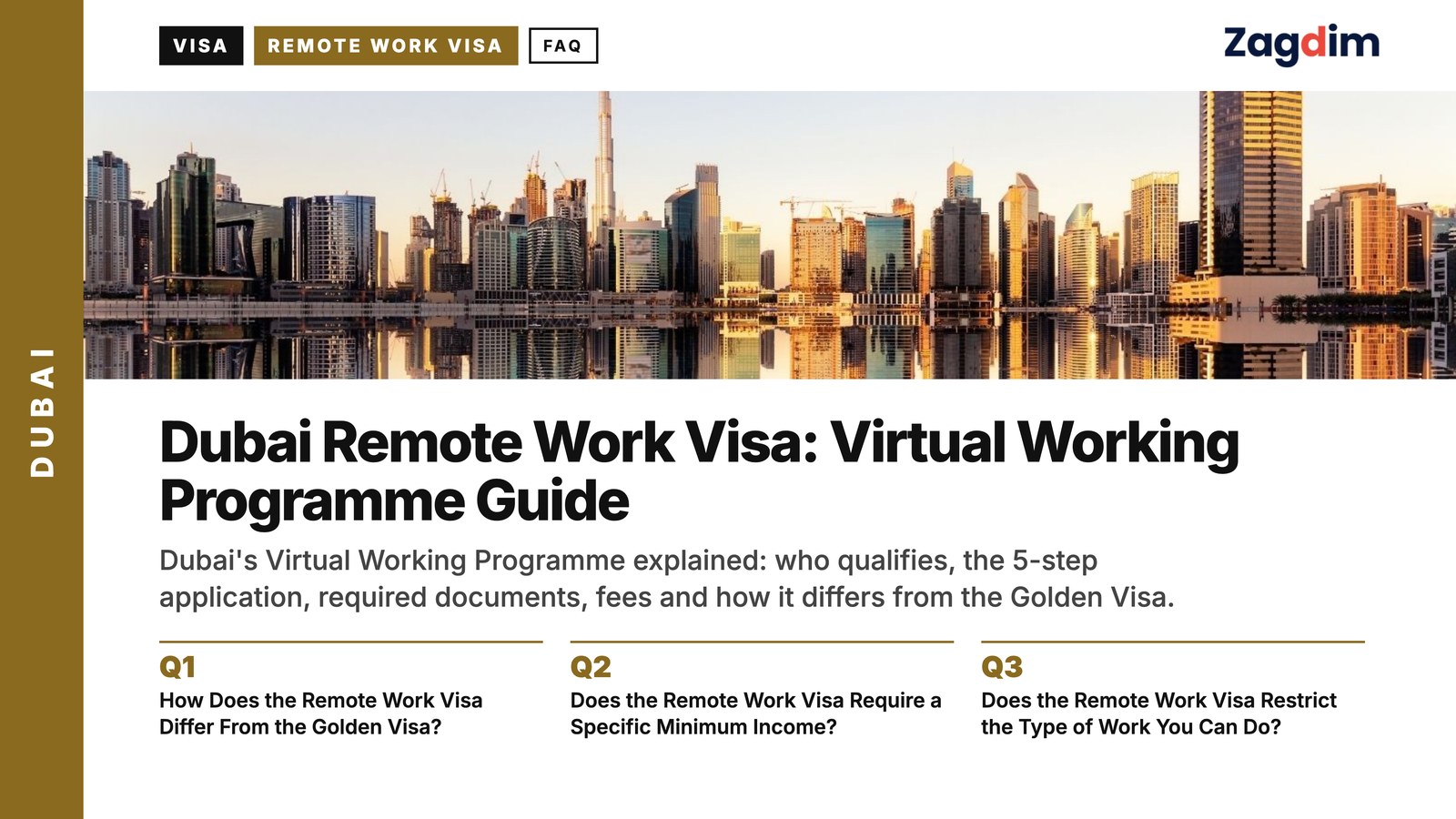
As remote work becomes the norm worldwide, Dubai’s Virtual Working Programme has become a popular option for digital nomads, the self-employed and remote employees drawn to the city’s status as an international business and innovation hub. The program offers a chance to relocate to Dubai while letting global professionals continue their international business or remote work, all while enjoying the city’s efficient infrastructure and high standard of living.
The Dubai remote work visa was introduced to attract more remote workers and give them a stable environment with clear rules for living and working. It’s good news not only for digital nomads and the self-employed, but also for anyone who wants to live under a highly mobile global work arrangement.
That said, many people wonder: how does Dubai’s remote work visa differ from other visas, such as the Golden Visa? Does it suit your own or your family’s needs? This guide answers these questions, helping you understand the core details of the program and assess whether it’s the right choice for you.
2. Who the Remote Work Visa Suits
Dubai’s Virtual Working Programme is designed for professionals seeking work-life balance on a global scale. It is open to several types of workers — whether you’re self-employed, a freelancer or a remote employee, you may well be eligible. Below are the specific conditions for each type:
Remote Employees
Remote employees must come from a country that supports remote work, with a job provided by an employer based in another country. This means you need to work for a company registered overseas, and be able to show that you carry out your work remotely. To qualify, you generally need to provide a valid employment contract and a recent payslip, and show that you meet the minimum income requirement (at least USD 3,500 a month). This requirement ensures you have enough financial support while living in Dubai without relying on local resources.
Self-Employed and Freelance Workers
Self-employed and freelance applicants need to provide documents showing their business is international, such as a business registration certificate or partnership agreement, along with at least a year of operating history. Beyond meeting the income requirement, this group also needs to show their business is stable and can keep operating from a global business hub like Dubai. Applicants in this category typically need to submit bank statements, financial statements and other supporting materials to demonstrate their business’s profitability and stability.
Digital Nomads
Digital nomads are freelancers or self-employed individuals who can work from anywhere in the world, relying on online tools to carry out their work. For this group, Dubai’s remote work visa is especially appealing, particularly for professionals who want to explore different cities and cultures while continuing to work. Digital nomads need a stable source of income (usually at least USD 3,500 a month) and must be able to show their work meets the definition of remote work.
Dubai’s remote work visa gives you a flexible way to live and work in a global city. If you have questions about the application process, conditions or other details, ask Zagdim to find out whether your situation fits.
3. Step-by-Step Application Process
Here are the specific steps for applying for Dubai’s remote work visa, to help you understand what to prepare and watch for at each stage.
Step 1: Preparation Before Applying
Before you start, make sure you meet all the basic conditions, including:
- Stable remote income: check whether you can provide sufficient proof of income, and confirm your monthly income is at least USD 3,500 (or the equivalent in another currency).
- Health insurance: make sure you have valid health insurance that covers medical costs during your stay in Dubai.
- Passport validity: confirm your passport has at least six months of remaining validity.
This preparation forms the foundation for a smooth application.
Step 2: Submit the Application Online
You can apply online through the Dubai government’s “Work Remotely from Dubai” program website. During the application, you’ll need to provide:
- Basic personal information, such as name, nationality and date of birth.
- A scanned passport copy (valid for at least six months) and other proof of identity.
At this stage, make sure all information is accurate to avoid delays caused by errors.
Step 3: Submit Financial Proof and Your Employment Contract
This step requires documents proving you meet the minimum income requirement:
- Proof of income: such as bank statements or payslips, showing income over the past three months.
- Employment contract: remote employees need a valid employment contract of at least one year; self-employed applicants need a business registration certificate or partnership agreement.
Be sure to prepare all relevant financial documents and make sure they are genuine and complete.
Step 4: Processing and Approval
Once submitted, Dubai authorities will review your materials and confirm whether you meet all requirements. This process generally takes 48 hours. During this time, be prepared to pay the following fees:
- Application fee (USD 287)
- Health insurance costs and other processing fees
The Dubai government will notify you of the approval decision once the review is complete, along with next steps.
Step 5: Receive Your Visa and Complete Entry
Once your remote work visa is approved, you’ll receive an e-visa document. You can plan your entry based on the visa’s validity (typically one year). At this point, you can:
- Enter Dubai using the remote work visa and start working.
- Renew the visa as needed once it expires.
Once these steps are complete, you’re ready to start your remote-work life in Dubai.
4. Document Requirements
When applying for Dubai’s remote work visa, you’ll need to prepare the following documents to ensure a smooth process:
Valid Passport
- Applicants must provide a valid passport with at least six months of remaining validity.
- The passport must have complete, undamaged pages.
Financial Proof
- Proof of bank deposits: the past three months’ bank statements, showing a stable source of income meeting the minimum requirement (at least USD 3,500 a month).
- Proof of income: remote employees need a payslip or other proof of income; the self-employed or freelancers need proof of business income.
Remote Work Contract or Proof of Self-Employment
- Remote work contract: remote employees need a valid employment contract with a foreign employer, generally for a term of one year or more.
- Proof of self-employment: the self-employed or freelancers need a business registration certificate, partnership agreement or other proof of operations, showing the business has operated for at least a year.
Proof of Health Insurance
- Applicants must provide proof of valid health insurance that covers medical costs during their stay in Dubai. This requirement protects both the applicant and the local healthcare system, ensuring the applicant does not need to rely on public resources while in Dubai.
Make sure all documents are complete, and translated and compressed as needed before submission, to avoid delays caused by non-compliant files.
5. FAQ
How Does the Remote Work Visa Differ From the Golden Visa?
The Golden Visa is a long-term residency permit generally aimed at high-net-worth individuals or large-scale investors, requiring a substantial investment in Dubai. By comparison, the remote work visa is designed specifically for global remote workers, requires no large investment in Dubai, and suits professionals employed by a foreign company or running an overseas business.
Does the Remote Work Visa Require a Specific Minimum Income?
Yes. Dubai’s remote work visa requires applicants to have a stable income, generally requiring proof of income showing at least USD 3,500 a month or the equivalent in another currency. This requirement is meant to ensure applicants can maintain a basic standard of living in Dubai.
Does the Remote Work Visa Restrict the Type of Work You Can Do?
No. Holders of the remote work visa are free to choose the work they want to do, as long as it fits the remote-work format. Whether a freelancer, remote employee or self-employed, holders can carry out their work duties freely on a global basis.
Can Family Members Relocate Too?
Yes. Remote work visa holders can apply for additional visas for a spouse and children, so the whole family can relocate to Dubai together and enjoy the city’s quality of life and education resources. If you have questions about the conditions or process for bringing family, ask Zagdim — everyone’s situation is different, and we can help answer your questions.
Do You Need a Local Job in Dubai?
No. The remote work visa is for remote workers operating globally, and does not require a local employer in Dubai. This lets remote workers from anywhere in the world enjoy convenient working and living conditions in Dubai without changing their existing work arrangement.
6. Points to Watch
Income Requirement
Make sure you meet the minimum income requirement for Dubai’s remote work visa. Applicants must show a monthly income of at least USD 3,500 or the equivalent in another currency. If your income falls short, your application may be rejected, so carefully confirm your financial situation and prepare the relevant financial proof before applying.
Proof of Residency
Dubai’s remote work visa does not grant permanent residency. This means holders need to renew or reapply before the visa expires. If you plan to live in Dubai long term, make sure to arrange a visa renewal or alternative plan in advance, so your residency status isn’t affected once the visa expires.
Health Insurance
Applicants must hold valid international health insurance covering the duration of their stay in Dubai. If you cannot provide health insurance that meets the requirement, your application may be rejected, so confirm and choose a suitable health insurance plan ahead of time.
7. Takeaway
Dubai’s remote work visa gives global professionals a flexible way to work and live, especially suited to the self-employed, digital nomads and remote employees seeking work-life balance. Whether you want to work in an international city, or enjoy Dubai’s efficient infrastructure and luxurious lifestyle, this visa offers an ideal opportunity. If you’re considering living or working in Dubai long term, the remote work visa is certainly worth considering, letting you enjoy the city’s prosperity and convenience without giving up your career.
Have a question about this guide? Leave a comment below, or ask Zagdim directly.
Your first stop for international property and global living.
Research and insights. Know what’s changing. Understand what matters.
Sources
- UAE Government — *Residence Visa for Working Outside the UAE*
- Visaguide.world — *Dubai Digital Nomad Visa*
- Remotepass.com — *UAE Residency Visa: Everything Remote Workers Need to Know*
- Numbeo — *Cost of Living in Dubai*
- Propertyfinder.ae — *Cost of Living in Dubai 2024*
- Damac Properties — *Remote Work Visa Dubai: Digital Nomad Visa Dubai UAE*
- GDRFAD — *Virtual Working Programme in Dubai*
Content note: This material is sourced from the latest official reports and market analysis from 2023–2025, covering the eligibility conditions, process, cost and cost of living related to Dubai’s remote work visa.