




























Staying in Bali recently, one small thing has made me increasingly curious: why do shops here stay open even outside peak tourist season, even when the streets are quiet and business isn’t especially good? Roadside grocery stores, motorbike repair stands, coconut-water stalls, even the massage place that looks like it hasn’t had a customer in three days — almost none of them close down.
It reminded me of Chiang Mai, where I used to live. After the pandemic, the Nimman area looked like a scene of capital in full retreat — half the street shut down.
I started asking myself: what exactly is the difference?
At first, I thought it was cheap rent. But digging deeper, I learned that in Bali, a lot of these shops aren’t rented at all — they’re built right at the family’s own front door.
Many families hold ancestral land passed down through generations. Add a lean-to roof, set up a table, and you can open a warung (a small eatery) or a homestay. So even when income is poor, as long as the electricity bill and the rice money come out even, and there’s something to do and a sign worth hanging with some pride, the shop stays open. That living logic is completely different from Chiang Mai’s model of capital doing business and capital leaving the moment there’s no profit.
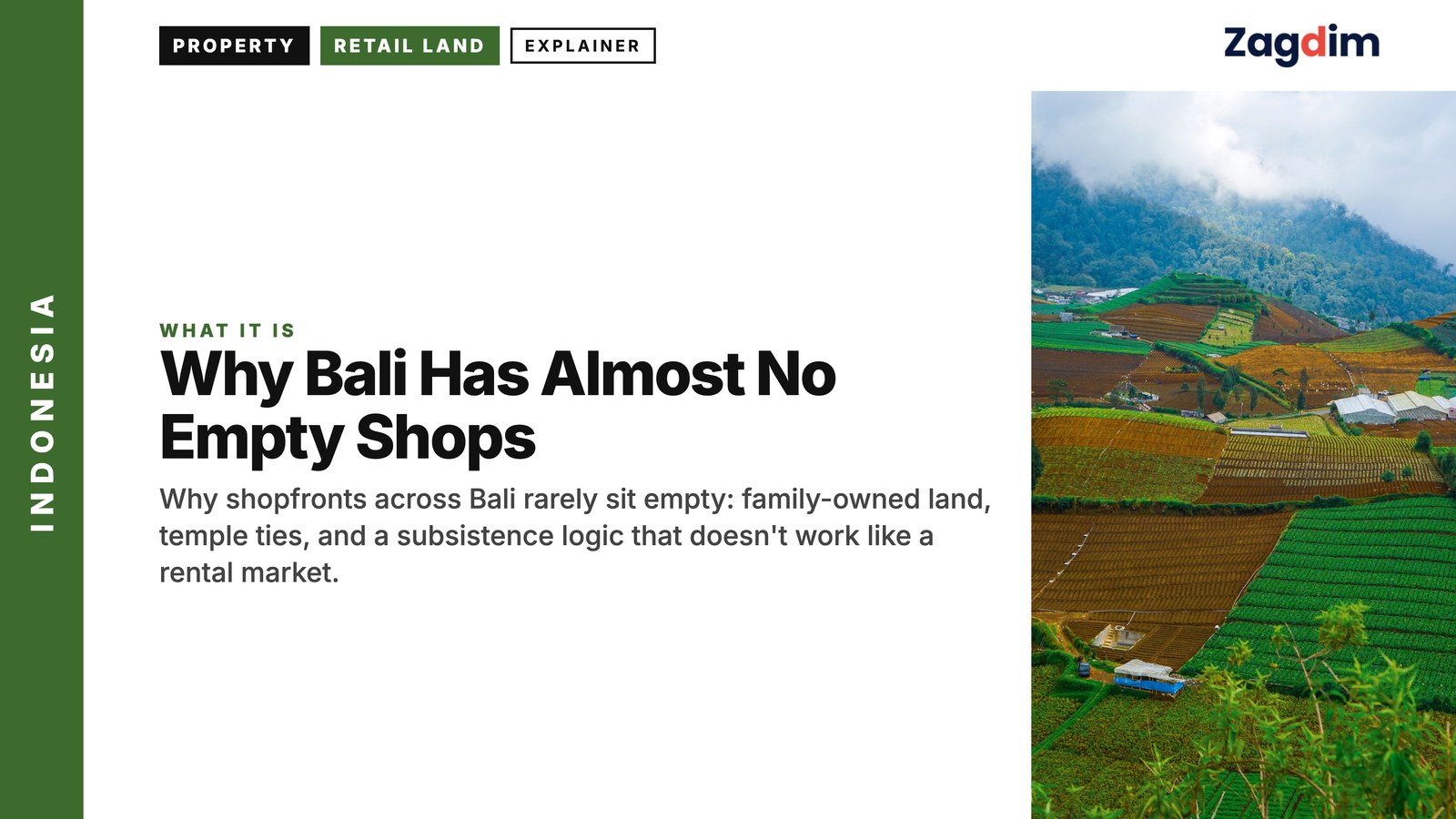
But historically, Bali has always been an island woven from a clan-and-village system, Hindu belief, and subsistence farming. Most land has been kept through village or family inheritance, which means it can’t easily be bought or sold. Visit almost any family home in Bali, and you’re likely to see the house, the family temple, the rice paddy, even a small handicraft stall — all on the same plot of land. That isn’t the result of deliberate planning; it’s simply how life has grown there naturally.
What’s more interesting is that this pattern was never fully broken apart by colonization or government policy. Even Dutch colonial rule never fully dismantled Bali’s shared land management and religious social stratification, and the Indonesian government that came later went on to recognize the subak — the traditional irrigation and farming cooperative system — which still operates today. Writing about nineteenth-century Bali, the cultural anthropologist Clifford Geertz observed that Bali’s political and social order was never simply an administrative or economic arrangement; it functioned instead as a system built and performed through religious ceremony, in which family, religion, and farmland together formed the core of local identity.
Even today, this tradition is why many households keep a small rice paddy — sometimes rented out or farmed by other villagers, with the owners occasionally taking part or returning at festival time to help. That isn’t just farm work; it’s a deeper connection to ancestors, village, and ritual.
Watching all this reminded me, on a flight, of a line from the television series *Yellowstone*. The character John Dutton makes the point that real leverage means holding the one thing that anyone with unlimited money would still want to buy.
As someone who writes property analysis with capitalist instincts running through my blood, I look at a prime tourist location and can’t help running through foot-traffic data, spending power, and future returns in my head. But then I see a family temple every hundred meters or so, and ancestral land held through tradition, passed down through generations, in nearly every household.
Capital and tradition strike their own particular balance here.
Have a question about this guide? Leave a comment below, or ask Zagdim directly.
Your first stop for international property and global living.
Research and insights. Know what’s changing. Understand what matters.