Zagdim Overseas
Subscribe
  • News
    • Thailand
    • Japan
    • UK
    • Germany
    • Global Reports
  • Country Guides
    • Thailand
    • Japan
    • Malaysia
    • Vietnam
    • Philippines
    • Indonesia
  • Property Research
    • Zagdim Insights
  • Ask Zagdim
  • About
    • Zagdim Research
    • Expert Network
    • Contact Us — LINE / WhatsApp
  • 中文 EN
No Result
View All Result
Zagdim
No Result
View All Result

Why Bali Has Almost No Empty Shops

Home Indonesia
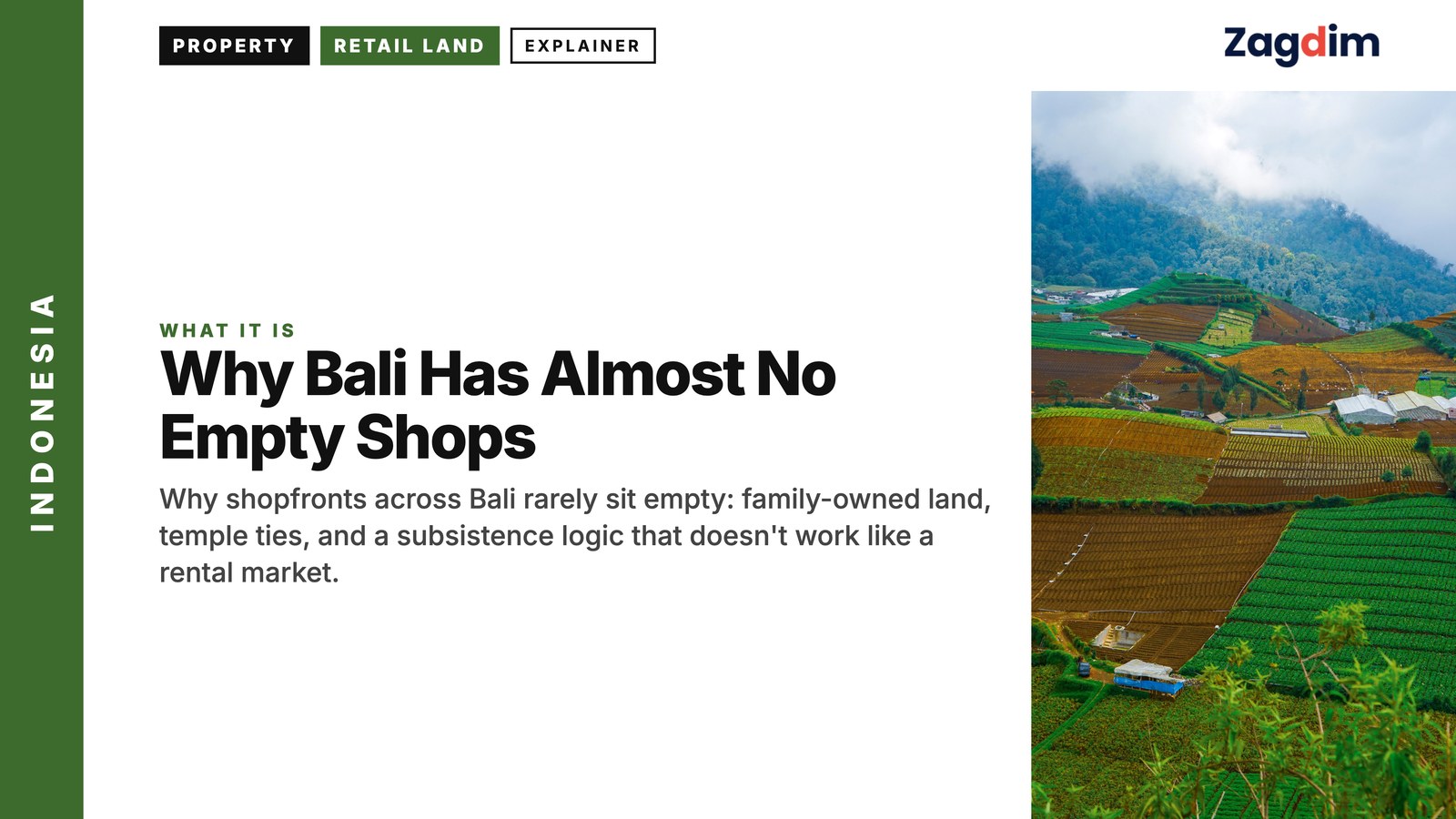
Rural — Aerial view of patchwork farmland terraces, illustrating Why Bali Has Almost No Empty Shops

Image: Zagdim

September 25, 2026
in Indonesia
Reading Time: 3 mins read
Tags: Living

Staying in Bali recently, one small thing has made me increasingly curious: why do shops here stay open even outside peak tourist season, even when the streets are quiet and business isn’t especially good? Roadside grocery stores, motorbike repair stands, coconut-water stalls, even the massage place that looks like it hasn’t had a customer in three days — almost none of them close down.

It reminded me of Chiang Mai, where I used to live. After the pandemic, the Nimman area looked like a scene of capital in full retreat — half the street shut down.

I started asking myself: what exactly is the difference?

At first, I thought it was cheap rent. But digging deeper, I learned that in Bali, a lot of these shops aren’t rented at all — they’re built right at the family’s own front door.

Many families hold ancestral land passed down through generations. Add a lean-to roof, set up a table, and you can open a warung (a small eatery) or a homestay. So even when income is poor, as long as the electricity bill and the rice money come out even, and there’s something to do and a sign worth hanging with some pride, the shop stays open. That living logic is completely different from Chiang Mai’s model of capital doing business and capital leaving the moment there’s no profit.

But historically, Bali has always been an island woven from a clan-and-village system, Hindu belief, and subsistence farming. Most land has been kept through village or family inheritance, which means it can’t easily be bought or sold. Visit almost any family home in Bali, and you’re likely to see the house, the family temple, the rice paddy, even a small handicraft stall — all on the same plot of land. That isn’t the result of deliberate planning; it’s simply how life has grown there naturally.

What’s more interesting is that this pattern was never fully broken apart by colonization or government policy. Even Dutch colonial rule never fully dismantled Bali’s shared land management and religious social stratification, and the Indonesian government that came later went on to recognize the subak — the traditional irrigation and farming cooperative system — which still operates today. Writing about nineteenth-century Bali, the cultural anthropologist Clifford Geertz observed that Bali’s political and social order was never simply an administrative or economic arrangement; it functioned instead as a system built and performed through religious ceremony, in which family, religion, and farmland together formed the core of local identity.

Even today, this tradition is why many households keep a small rice paddy — sometimes rented out or farmed by other villagers, with the owners occasionally taking part or returning at festival time to help. That isn’t just farm work; it’s a deeper connection to ancestors, village, and ritual.

Watching all this reminded me, on a flight, of a line from the television series *Yellowstone*. The character John Dutton makes the point that real leverage means holding the one thing that anyone with unlimited money would still want to buy.

As someone who writes property analysis with capitalist instincts running through my blood, I look at a prime tourist location and can’t help running through foot-traffic data, spending power, and future returns in my head. But then I see a family temple every hundred meters or so, and ancestral land held through tradition, passed down through generations, in nearly every household.

Capital and tradition strike their own particular balance here.

Related in this series:

  • Bali's 18 Restricted Business Categories for Foreign Investors

Have a question about this guide? Leave a comment below, or ask Zagdim directly.

Life abroad? Ask Zagdim.

Your first stop for international property and global living.

Research and insights. Know what’s changing. Understand what matters.

Zagdim AI
All content is researched, written, or authorized for publication by the @Zagdim Overseas team. Sharing and reposting are welcome, but please make sure to credit the source and include the original article link from this website. Any plagiarism or unauthorized use may result in legal action. For article submissions, please contact us via Facebook. Thank you for your support!

For article submissions, press release publication, or interview notices, please contact [email protected]. 

Zagdim Ask

Have a specific question about overseas living, property, visa, or practical arrangements?

Fill in your situation and key concerns through Zagdim Ask. Our team will review your message and get back to you by email where appropriate.

Submit your enquiry →

Similar Topics

UK Landlords Told to Rethink Property Ownership as October Budget Tax Rise Could Wipe Out Profit for Some
News

UK Landlords Told to Rethink Property Ownership as October Budget Tax Rise Could Wipe Out Profit for Some

November 10, 2026
Greece's 15% Property Transfer Tax for Non-EU Tax Residents Is Now a Government Bill in Parliament
News

Greece’s 15% Property Transfer Tax for Non-EU Tax Residents Is Now a Government Bill in Parliament

November 10, 2026
Taiwan's Financial-Proof Thresholds for Naturalisation: NT$5 Million in Assets or Twice the Minimum Wage
News

Taiwan’s Financial-Proof Thresholds for Naturalisation: NT$5 Million in Assets or Twice the Minimum Wage

November 10, 2026
Next Post
Aerial — Aerial view of green island bay with boats, illustrating Bali's 18 Restricted Business Categories for Foreign Investors

Bali's 18 Restricted Business Categories for Foreign Investors

Harbour — Sydney Harbour waterfront houses with moored yachts, illustrating Australia's Annual Vacancy Fee for Foreign Owners

Australia's Annual Vacancy Fee for Foreign Owners

Landmark — Sydney Opera House with CBD skyline behind, illustrating The New-Build Purchase Process for Foreign Buyers in Australia

The New-Build Purchase Process for Foreign Buyers in Australia

Facebook Twitter Youtube

About Us

Zagdim is a global knowledge platform focused on international property, global living, relocation, lifestyle, and location-based decision-making.

We provide insights on overseas real estate, market trends, regional analysis, economic developments, and practical relocation information. Through continuous market observation and on-the-ground research, Zagdim helps readers better understand a place before deciding where to live, invest, buy property, or establish a base abroad.

We currently follow markets including the UK, Japan, Thailand, Malaysia, Germany, Australia, the UAE, Greece, Portugal, and Spain, while continuing to track emerging lifestyle, relocation, and property trends worldwide.

Category

  • Australia
  • Buying & Immigration Guide
  • Cambodia
  • Canada
  • Costa Rica
  • Dubai
  • Encyclopedia
  • Europe
  • Expat Lifestyle Guide
  • Germany
  • Global Reports Analysis
  • Hong Kong
  • Human-Picked
  • Indonesia
  • International Property Buying Guide
  • Japan
  • Japan Market News
  • Kenya
  • Living Abroad
  • Malaysia
  • Mallorca
  • Market Trends Overview
  • News
  • Other Market News
  • Overseas Leasing & Long-Term Stay
  • Partner Content
  • Philippines
  • Policy Interpretation
  • Portugal
  • Property
  • Property Law & Tax
  • Real Estate & Economic News
  • Real Estate Law & Taxation
  • Relocation, Immigration & Visa
  • Singapore
  • South Korea
  • Spain
  • Switzerland
  • Thailand
  • Thailand Market News
  • UK Market News
  • United Kingdom
  • United States
  • Vietnam
  • Vietnam Market News
  • Visa & Immigration
  • Zagdim Insights
  • Zagdim Property Insights

Email:[email protected]


Add Friends


WhatsApp
Contact Us


Wechat:Zagdim

Work with Zagdim

For brand and content partnership enquiries, email [email protected].

©2026 Zagdim Overseas All Rights Reserved · Privacy Policy

No Result
View All Result
  • News
    • Thailand
    • Japan
    • UK
    • Germany
    • Global Reports
  • Country Guides
    • Thailand
    • Japan
    • Malaysia
    • Vietnam
    • Philippines
    • Indonesia
  • Property Research
    • Zagdim Insights
  • Ask Zagdim
  • About
    • Zagdim Research
    • Expert Network
    • Contact Us — LINE / WhatsApp
  • 中文 EN

©2026 Zagdim Overseas All Rights Reserved · Privacy Policy