































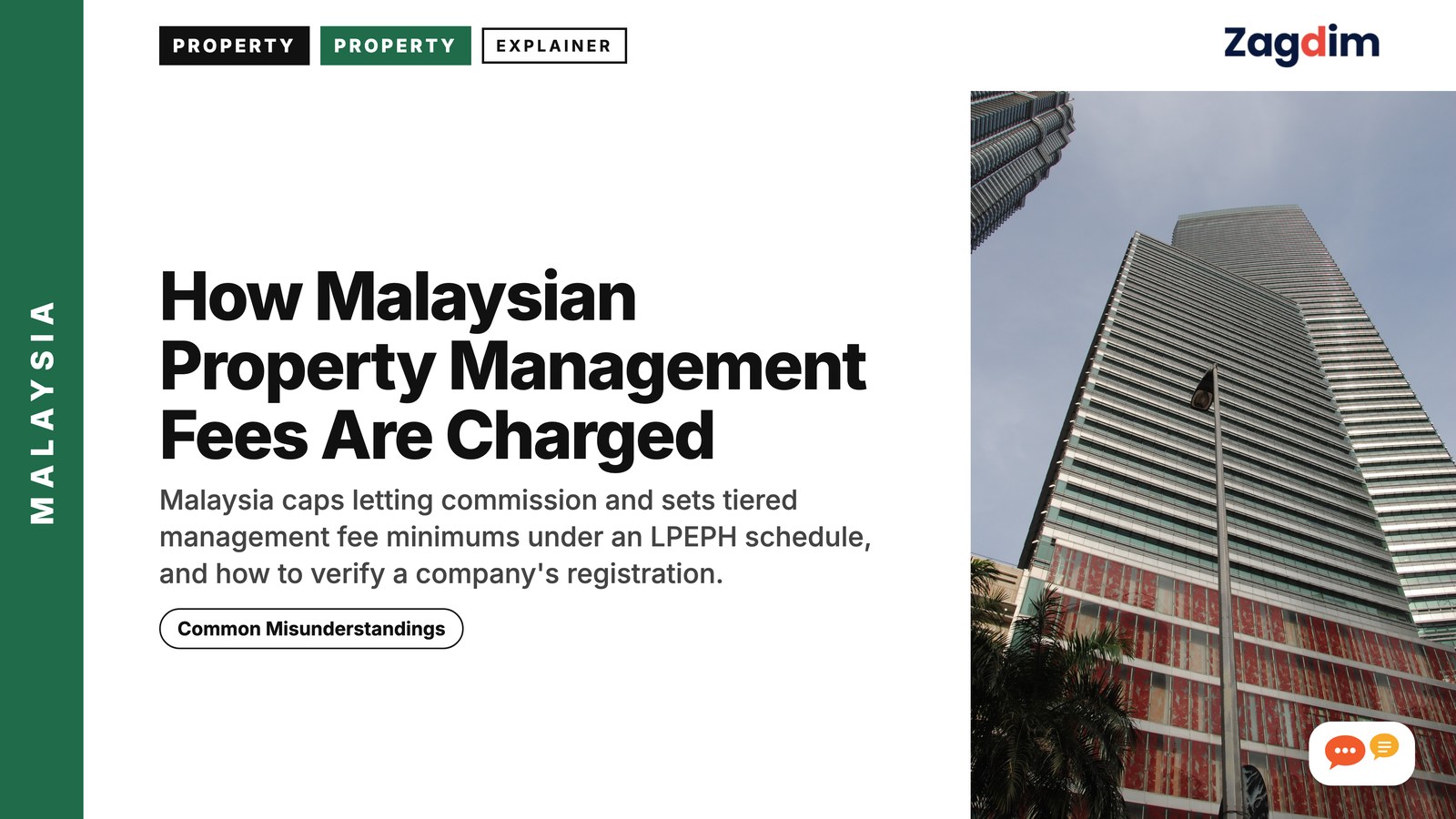
Property management fees in Malaysia are not simply a matter of free negotiation. A regulated fee schedule sets a maximum for letting commission, tiered minimums for ongoing management, and specific professional registrations that owners should check before signing anything. Comparing quotes by percentage alone will not necessarily show what an owner actually pays over a full year.
Ask What the Quoted Fee Actually Covers
Handing a property to someone else to manage can mean anything from simply finding a tenant through to ongoing rent collection, tenant contact and arranging repairs. The scope of service varies widely, and comparing only the percentage charged will not necessarily show what an owner pays in a year.
When requesting quotes, first state whether the property is for ordinary long-term letting, short-term rental operation, or another use. Then separate the one-off letting fee, the ongoing management fee, and any pay-per-use charges.
Three Fees That Are Easy to Confuse
| Fee | What It Typically Covers | What to Confirm |
|---|---|---|
| Letting commission | Marketing the unit, showing it to prospective tenants, and negotiating the lease | When payment falls due, and how lease term and renewal are charged |
| Owner-engaged management fee | Rent follow-up, tenant contact, arranging repairs, and reporting | What work is included, and whether a fee is still charged during a vacancy |
| Strata management fee and sinking fund | Management, maintenance, and fund contributions for common property | Usually not waived just because the owner also hires a separate management company |
Costs for repair materials, contractor labor, cleaning, lock changes, or furniture replacement are not necessarily included in the management fee either. A quote should clearly separate the service fee from amounts paid out on the owner’s behalf.
Not All of These Charges Are Unregulated or Freely Negotiable
Malaysia maintains a fee schedule covering regulated real estate agency and property management services. Which category applies depends on the nature of the service and the registration of the party providing it, not simply on whether a company labels its package “management” or “custodianship.”
For example, letting services covered by the relevant fee schedule are capped at a maximum of 1.25 months’ total rent for leases of three years or less, with a minimum fee and a pro-rated calculation for leases shorter than one year. Serviced offices, serviced apartments, and similar premises fall under separate exemptions, so this figure should not be applied to every type of rental product.
Property management services are also subject to tiered calculations based on annual total rent, with specified minimum fees. So when a quote comes back as a flat monthly amount, a percentage of rent, or a bundled package, owners should ask the provider to state the service category, the basis for the charge, and any additional items, rather than simply asking for a further discount.
Account for Three Scenarios: Normal Occupancy, Vacancy, and Tenant Turnover
A quote that is easy to compare should be able to answer the following:
- During normal occupancy, is the management fee calculated on rent due or rent actually received? When is it deducted, and when is the balance remitted to the owner?
- If a tenant falls behind on rent, or the unit sits vacant, is a fixed fee still charged? Is rent recovery or legal action billed separately?
- At the end of a lease, what are the separate charges for re-letting, finding a new tenant, handover, and cleaning?
- Are repair quotes subject to an additional arrangement fee? Are taxes and amounts paid on the owner’s behalf already included?
Getting quotes from different companies for the same unit, the same lease, and the same scope of service makes it possible to compare the real annual cost. A quote that covers only letting should not be placed side by side with one that covers ongoing management.
Repair Authorization and Payment Handling Should Be in Writing Before Signing
A management company can help find contractors, but the agreement should specify in advance which repairs require the owner’s approval, how far an emergency repair can proceed without prior sign-off, and what receipts must be submitted afterward.
Rent, deposits, and any repair reserve should also be recorded separately, stating who collects, holds, and returns each amount. Owners should be able to reconcile, each month, the rent due, the amount actually received, the fees deducted, and the balance remitted, rather than simply receiving a net figure.
The contract should also set out the notice period for ending the engagement, and how keys, the lease, tenant contact details, funds, and any unfinished repairs are handed over. These arrangements directly affect how smoothly an owner can switch to a different company later.
Verify Registration by Checking the Actual Scope of the Company and the Individual
Owners can use the regulator’s public search system to check the registration of a company and its relevant professionals, and confirm that the contracting party matches the party receiving payment.
A real estate agent, a REN (registered negotiator), and a registered property manager have different identities and different scopes of authority. A business card, a REN number, or the fact that someone previously helped with a property purchase is not by itself proof that a person can independently take on the full scope of management services.
Common Misunderstandings
“Since they collected the letting commission, they should keep managing my tenant.”
Letting and ongoing management are separate pieces of work. Whether follow-on service is included depends on what was actually engaged.
“A lower management fee always means a better rental return.”
Additional charges, vacancy arrangements, and the actual scope of service also need to be factored in. A low base fee plus multiple pay-per-use charges is not necessarily cheaper over a full year.
“Once the management fee is paid, repair labor and materials should be included.”
Arranging a repair and paying for the repair are two different things, and a quote should confirm them separately.
How to Decide What to Do Next
Start by listing the work an owner actually wants to outsource, then request a written scope of service and an itemized fee breakdown. When comparing quotes, work out the cost of a normal year of occupancy, one tenant turnover, and a period of vacancy, calculated separately.
Before signing, verify the provider’s registration, how payments are collected and handled, repair authorization, and the termination and handover terms. Any fee that has not been clearly explained should be added to the written agreement before signing.
FAQ
Is Malaysia’s management fee entirely set by the free market?
Not entirely. Regulated real estate agency and property management services are covered by a fee schedule, so the service category and its applicable scope should be confirmed first.
Is a management fee still charged while a unit is vacant?
It depends on the applicable fee schedule and the contract. Some work continues during a vacancy, so the fee and the scope of service should be confirmed in advance, rather than estimated from a quote for a tenanted unit.
Can rent simply be used as the basis for settling accounts with a management company?
Owners should ask for itemized accounts and supporting documents that separate rent, deposit, management fees, and amounts paid on the owner’s behalf, and reconcile these against the actual amount remitted.
Disclaimer
This article provides general information for comparing engagement terms and fees. It does not constitute legal advice or a quote for a specific service. Actual charges must comply with applicable regulations and should be confirmed against the scope of service and the formal contract. Information verified as of October 6, 2026.
Have a question about this guide? Leave a comment below, or ask Zagdim directly.
Your first stop for international property and global living.
Research and insights. Know what’s changing. Understand what matters.
Sources
- LPEPH — Fees: Seventh Schedule (Rule 48), fees for property management and estate agency services. https://lpeph.gov.my/fees
- LPEPH — Public search for registered firms, professionals, and real estate negotiators. https://bis.lpeph.gov.my/search
- KPKT — Strata Management Act and regulations: management of common property and related fees in strata developments. https://ehome.kpkt.gov.my/index.php/pages/view/734?mid=478