The Thai Social Security Old-Age Benefit Needs 180 Months for a Monthly Pension, and a Bill Approved on 3 November 2026 Would Add a Lump-Sum Option
According to the Social Security Office, the Thai social security old-age benefit is a monthly pension after 180 months of contributions at age 55, or a lump sum below 180 months; a Cabinet bill approved on 3 November 2026 would add a lump-sum choice but is not yet law.
Thailand’s Government Public Relations Department announced on 3 November 2026 that the Cabinet had approved a Labour Ministry bill amending the Social Security Act. It raises the age limit for Section 33 members from 60 to 65 and adds three new old-age options. On 8 November 2026, the Thai newspaper Thairath summed these up as the “3 ขอ”: ขอเลือก (choose a lump sum or a pension), ขอคืน (draw part early in a crisis) and ขอกู้ (use it as loan collateral), and noted that the bill is still in the legislative process and members cannot use the new options yet.
This guide uses the reform news as a starting point for a more basic question: if you work in Thailand and pay into social security, how is it paid today, can you take it with you when you leave, and what could the reform add?
Key Points
- Who should pay attention: foreign employees insured under Section 33; people who have left their job and are weighing voluntary cover under Section 39; and people who have worked in Thailand for many years and plan to retire around 55.
- Current rules: with 180 months of contributions you get a monthly pension of 20% of your average wage over the last 60 months, plus 1.5% for every extra 12 months; with fewer than 180 months you get a lump sum.
- Leaving Thailand: under Section 77 bis of the Social Security Act, a member without Thai nationality whose insured status has ended and who does not wish to remain in Thailand can claim the old-age lump sum under ministerial rules, whether or not they have 180 months, without waiting until 55.
- The “3 ขอ” reform: a lump-sum choice, early partial withdrawal in a crisis, and loan collateral. The bill still needs parliament and implementing rules, so today the current rules apply.
Thai Social Security Old-Age Benefit Today: Pension or Lump Sum Depends on Months Paid
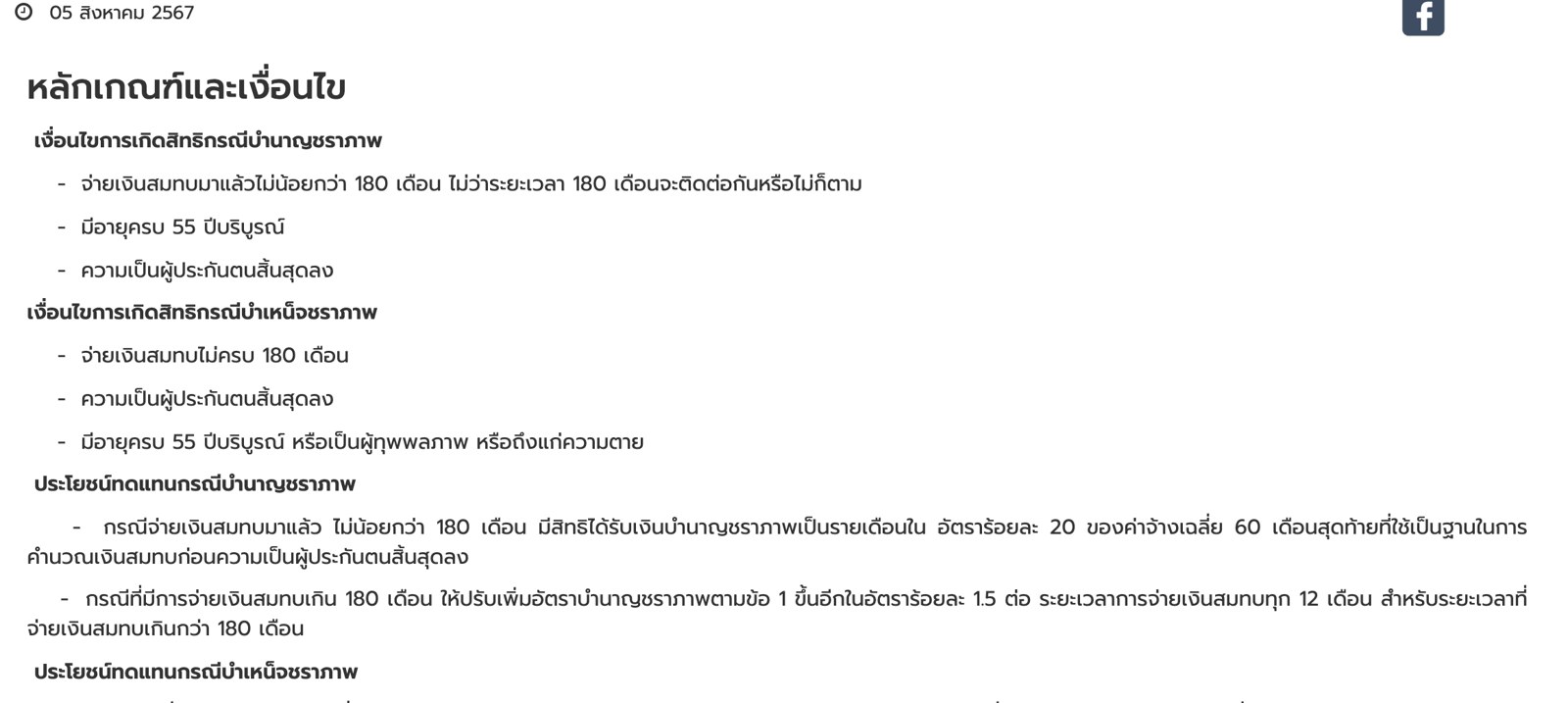
The old-age benefit comes in two forms: a monthly pension (บำนาญชราภาพ) and a one-off lump sum (บำเหน็จชราภาพ). Which one you get depends on how many months you have paid. All of the conditions below come from the Social Security Office page on old-age benefit criteria and conditions:
| Situation | When you can claim | What you get |
|---|---|---|
| 180 months or more (need not be consecutive) | Age 55 and insured status ended | Monthly pension: 20% of average wage over the last 60 months, plus 1.5% for every extra 12 months beyond 180 |
| Fewer than 180 months, at least 12 | Insured status ended, and age 55, invalidity or death | Lump sum: the old-age share paid by you and your employer, plus returns announced by the SSO |
| Fewer than 12 months | As above | Lump sum: the old-age share you paid |
How the Monthly Pension Is Calculated
The pension uses your average wage over the last 60 months: the wages used to calculate contributions in the 60 months before your insured status ended, added up and divided by 60. The SSO’s own example: an average wage of ฿13,000 gives 13,000 × 20% = ฿2,600 a month, paid for life. A member with 193 months of contributions gets 21.5%.
The wage used for contributions is capped, at ฿17,500 a month from 2026, so people earning more than the cap have their pension calculated on the cap.
A Lump Sum Returns Only the Old-Age Share
The lump sum returns the old-age share of your contributions, not everything you paid. The parts that funded medical, unemployment and other cover are not refunded. Your employer’s old-age share and the returns are included only once you have paid for 12 months or more.
Can Foreigners Claim the Thai Social Security Old-Age Benefit When Leaving Thailand?
Yes, if the conditions are met. Section 77 bis, paragraph three, added by the 2015 amendment to the Social Security Act, says that when an insured person who does not have Thai nationality has ceased to be an insured person, whether or not they have paid 180 months of contributions, and wishes not to reside in Thailand, they are entitled to the old-age lump sum under the criteria, procedures and conditions set by ministerial regulation.
In practice, this means:
- You do not have to wait until 55.
- A foreign member with 180 months or more who leaves Thailand under this rule receives a lump sum, not a monthly pension.
- Your insured status must have ended (for example, you have left your job and are not continuing under Section 39), and you must no longer be staying in Thailand.
The SSO’s old-age benefit page does not set out a separate procedure for foreigners. The general claim process it lists is:
| Step | What it involves |
|---|---|
| Form | Old-age benefit claim form สปส. 2-01, signed by you |
| Attachment | Copy of the first page of the bank book for the receiving account |
| Where to file | An area or provincial Social Security Office (not the head office), by post, or by email under the SSO’s 2023 electronic channels announcement |
| Payment | Transfer to your bank account or PromptPay linked to your ID number, cash or cheque collected in person or by a proxy, or a postal money order |
The source for this table is the SSO’s old-age benefit page. All the receiving banks it lists are Thai banks, so if you are about to leave Thailand, call the SSO hotline on 1506 before you go to confirm what documents a foreign member needs, whether you can file after leaving, and how to receive the money. The SSO’s general deadline for claiming benefits is within two years of becoming entitled; ask 1506 when that period starts for a foreign member as well.
Section 33 and Section 39: How Voluntary Cover Affects Your Old-Age Benefit
Foreign employees in Thailand are insured under Section 33, just like Thai employees. After leaving a job, you can switch to voluntary cover under Section 39 to keep medical, old-age and other benefits going. The conditions below are from the SSO’s Section 39 page:
| Item | Section 33 (employed) | Section 39 (voluntary) |
|---|---|---|
| Who can join | Employees | Former Section 33 members with at least 12 months of contributions, applying within 6 months of leaving their job |
| Monthly contribution | Employee and employer each pay a share of wages, with wages capped at ฿17,500 | ฿432, as published by the SSO (calculated on ฿4,800) |
| Cover | 7 benefits, including unemployment | 6 benefits, excluding unemployment |
| Losing cover | Leaving the job | Missing 3 months in a row, or paying fewer than 9 months in 12 |
For the old-age benefit, two points matter:
- Voluntary cover keeps you insured. A foreign member who wants the Section 77 bis lump sum when leaving Thailand needs their insured status to have ended; while you are paying under Section 39, you are still insured.
- It can lower your last-60-month average. The pension is based on the average wage used for contributions over the last 60 months, and Section 39 is calculated on ฿4,800. Paying under Section 39 in your final years can bring your average below your working-years wage (Zagdim’s reading of the SSO formula; your own figure is whatever the SSO calculates).
The 2026 “3 ขอ” Bill: What Could Change for Old-Age Benefits
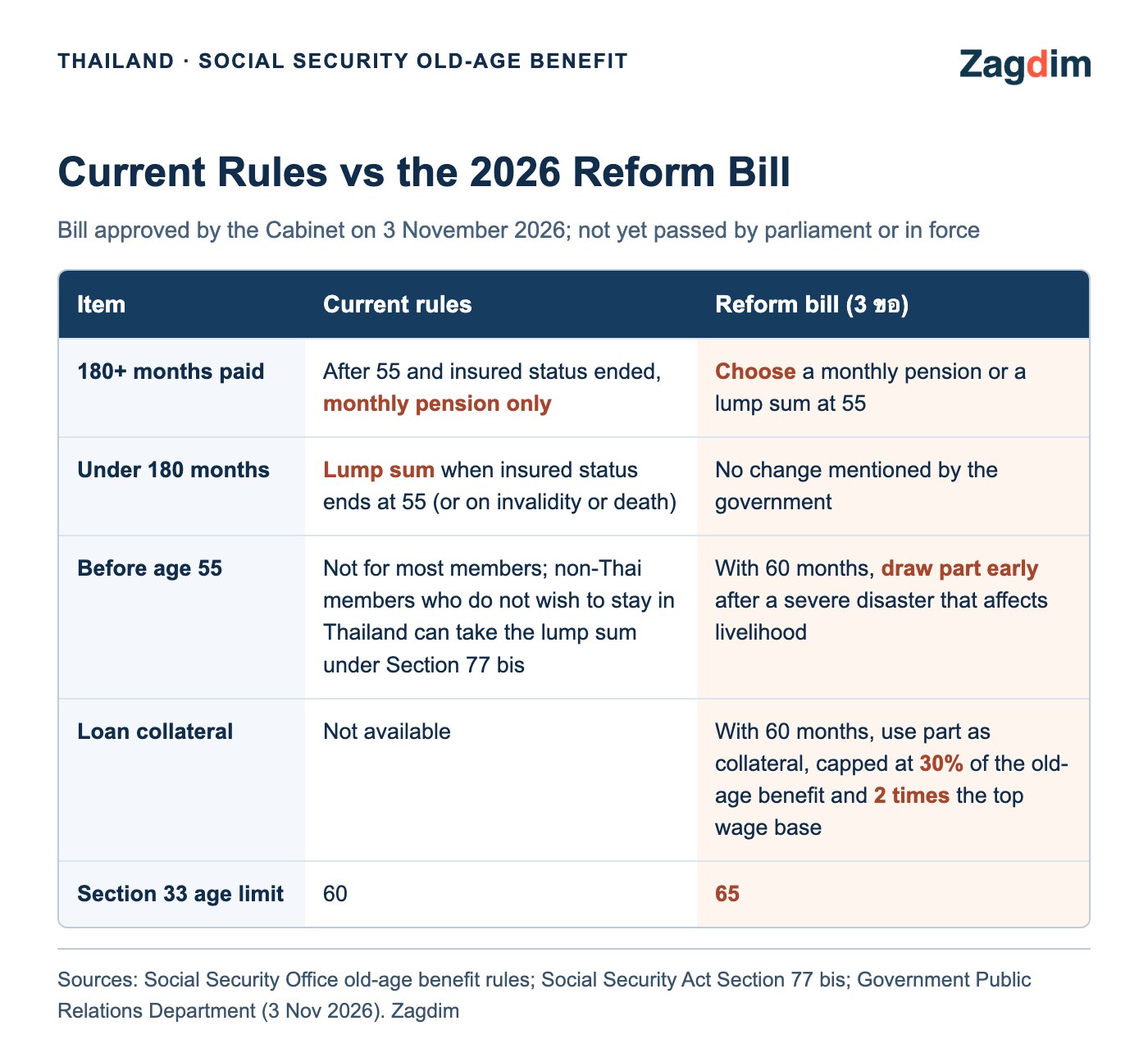
The following is based on the Government Public Relations Department’s announcement of 3 November 2026. It describes a bill that has not passed parliament and is not in force:
| Item | Current rules | Reform bill |
|---|---|---|
| ขอเลือก: 180 months or more | Monthly pension only | At 55, choose a monthly pension or a lump sum |
| ขอคืน: drawing before 55 | Not for most members (non-Thai members who do not wish to stay in Thailand use Section 77 bis) | With at least 60 months, draw part early after a severe disaster that affects your livelihood |
| ขอกู้: loan collateral | Not available | With at least 60 months, use part of the old-age benefit as collateral with financial institutions that have an agreement with the SSO |
| Cap on withdrawal and collateral | — | 30% of the old-age benefit, and no more than 2 times the top wage base |
| Section 33 age limit | 60 | 65 |
| Cover after retirement | — | People who receive the old-age pension and have left work can rejoin; the state pays 1 share and the member 2, covering sickness, invalidity and death |
The bill also raises income replacement for non-work-related invalidity from 50% of wages to up to 70%. The government’s announcement does not say whether the Section 77 bis rule for non-Thai members would change.
On procedure, the House of Representatives voted 436 to 0 on 18 November 2026 to accept the Cabinet’s bill in principle at first reading and set up a 25-member special committee to review it (Thai PBS, 18 November 2026). The Cabinet also noted a plan for 18 pieces of secondary legislation, to be completed within 60 days after the Act takes effect. So even if the bill passes, when people can actually use the “3 ขอ” depends on when those rules are issued.
Common Misconceptions About Old-Age Benefits in Thailand
Misconception 1: “Foreigners lose their social security contributions when they leave Thailand”
Why it is incomplete: Section 77 bis lets a member without Thai nationality claim the old-age lump sum once their insured status has ended and they do not wish to stay in Thailand, without 180 months and without waiting until 55.
Practical note: only the old-age share is returned, not every baht paid; confirm documents and payment with 1506 before you leave.
Misconception 2: “The reform has passed, so I can take a lump sum now”
Why it is incomplete: what was approved on 3 November 2026 is a Cabinet bill. It still needs parliament, and after the Act takes effect, implementing rules must follow.
Practical note: until the law is published and in force, the current rules apply; check any claim that the options are “now open” against SSO announcements.
Misconception 3: “Switching to Section 39 after leaving a job is always good for my old-age benefit”
Why it is incomplete: voluntary cover keeps your months adding up, but Section 39 is calculated on ฿4,800, which can lower your last-60-month average; and a foreign member who wants the lump sum on leaving Thailand needs their insured status to have ended.
Practical note: work out how far you are from 180 months and where you plan to retire before deciding.
Misconception 4: “Loan collateral means borrowing my whole old-age fund”
Why it is incomplete: the bill refers to using “part” of the old-age benefit, capped at 30% and at 2 times the top wage base, and only with financial institutions that have an agreement with the SSO.
Practical note: details depend on the final law and rules; no bank can offer this while it is still a bill.
Scenarios: Old-Age Benefits for Three Kinds of Foreign Workers
Scenario 1: An engineer leaving Bangkok after six years
Background: paid 72 months under Section 33 and is moving home when the contract ends, with no plan to live in Thailand again.
What applies: fewer than 180 months, but under Section 77 bis, once insured status has ended and they are no longer staying in Thailand, they can claim the old-age lump sum: the old-age share paid by them and their employer, plus returns.
Watch out for: all receiving banks listed by the SSO are Thai, so do not close the Thai account too early; call 1506 before leaving to confirm documents and whether the claim can be filed from abroad.
Scenario 2: A 52-year-old manager with 16 years in Thailand
Background: more than 180 months paid, and plans to retire in Thailand after 55.
What applies: under current rules, a monthly pension once they are 55 and insured status has ended, at 20% plus the increase for each extra year beyond 180 months. If the bill is passed and in force, they could choose a lump sum at 55 instead.
Watch out for: there is no way to choose in advance while it is still a bill; switching to Section 39 in the final years could lower the average wage.
Scenario 3: Staying on in Thailand after leaving a job
Background: left a job after three years and is staying in Thailand while looking for new work.
What applies: within 6 months of leaving, they can apply under Section 39, paying ฿432 a month to keep 6 benefits including medical and old-age.
Watch out for: Section 39 does not cover unemployment; missing 3 months in a row ends cover; and Section 39 does not give anyone the right to stay in Thailand, which depends on their visa.
Thai Social Security Old-Age Benefit: Frequently Asked Questions
I paid into Thai social security for less than 15 years. How much do I get back when I leave?
Under Section 77 bis, a member without Thai nationality whose insured status has ended and who does not wish to stay in Thailand can claim the old-age lump sum. The SSO calculates it as follows: with fewer than 12 months, the old-age share you paid; with 12 months or more, the old-age share paid by you and your employer, plus returns announced by the SSO. Medical, unemployment and other shares are not refunded.
Can I claim the Thai social security old-age benefit after leaving Thailand?
The SSO page lists filing at an SSO office, by post, or by email under its 2023 electronic channels announcement, but it does not describe a separate procedure for foreigners filing from abroad, and the receiving banks it lists are all Thai. The safest approach is to call 1506 before leaving and, if needed, file before you go.
If the 2026 reform passes, can people already receiving a pension switch to a lump sum?
The government’s announcement only says that members with 180 months of contributions could choose a pension or a lump sum at 55. It does not mention people who are already receiving a pension. Who it applies to will depend on the final law and rules.
How much is the Thai social security pension each month?
It is 20% of the average wage used for contributions over the last 60 months, plus 1.5% for every extra 12 months beyond 180. The SSO’s example is an average wage of ฿13,000, giving ฿2,600 a month. From 2026 the wage used for contributions is capped at ฿17,500.
When will the Thai social security old-age benefit reform take effect?
As of 18 November 2026, the bill has been approved by the Cabinet and has passed first reading in the House of Representatives. A 25-member special committee is now reviewing it. No effective date has been announced, and after the Act takes effect there are 18 pieces of secondary legislation planned within 60 days.
How much could I borrow against my old-age benefit?
The bill caps it at 30% of the old-age benefit and no more than 2 times the top wage base, with financial institutions that have an agreement with the SSO, for members with at least 60 months of contributions. This is a bill; no financial institution can offer it yet.
Working in Thailand and Planning to Leave or Retire? Ask Zagdim
If you want to check your contribution months, what to prepare before leaving, or how the reform is progressing, Ask Zagdim.
Life abroad? Ask Zagdim.
Your first stop for international property and global living.
Research and insights. Know what’s changing. Understand what matters.
Newsletter for overseas updatesSubscribe →
Important Disclaimer
This article is general information and is not legal, tax or financial advice. It is based mainly on official material from the Social Security Office, the Government Public Relations Department and the Social Security Act, dated 2015 to 2026; the bill may change during parliamentary review. Your own contribution record and benefit amount are whatever the Social Security Office calculates; consult a qualified professional where needed.
The rules described here are current as of 18 November 2026 (social security rules checked on 9 November 2026); check the latest announcements from the Social Security Office and the Government Public Relations Department.
References
Government Public Relations Department – ครม. เห็นชอบร่าง พ.ร.บ. ประกันสังคม ยกเครื่องสิทธิประโยชน์ครั้งใหญ่ ขยายอายุผู้ประกันตนถึง 65 ปี (3 November 2026) / Social Security Office – หลักเกณฑ์และเงื่อนไข กรณีชราภาพ (old-age benefit criteria and conditions) / Social Security Office – ผู้ประกันตนโดยสมัครใจ (ม.39) (voluntary insured persons, Section 39) / ASEAN – Social Security Act (No. 4) B.E. 2558 (2015) (unofficial English translation) / Thairath – รัฐบาล เดินหน้า “3 ขอ” ปลดล็อกเงินชราภาพประกันสังคม (8 November 2026) / Hfocus – ครม.เห็นชอบร่าง พ.ร.บ.ประกันสังคม (3 November 2026)